I’ve been preoccupied with all sorts of archival work lately, and I thought I’d pass along a few preservation tips for those of you that might have some “stuff” that you’d like to protect and save for the future.
Know your archival plastics!
Do you have photographs, artwork, manuscripts, letters, coins or currency that you’d like to preserve for years to come? Perhaps you’d like to enclose those items in a protective plastic enclosure, so that they may be viewed and handled with minimal damage? That’s a fine idea, but you should know that when it comes to archival storage, there are good plastics, and (very) bad plastics. With that in mind, I thought I’d share this helpful infographic, hoping that some of you may find it useful.

As always, feel free to click the image for a clearer, downloadable and/or printable version of the image.
No PVC. Ever. Please.
I won’t paraphrase the poster, except to note that enclosures made of the “good polys”—polyester, polypropylene and polyethylene—are the ones to use. Each has its advantages, but all are good for long term, stable, storage and preservation of documents, photos and other items.
But! please note the “Disqualified” information area at the bottom of the poster that describes the evils of polyvinyl chloride (PVC) as a storage medium. “Protective” sleeves, photo album pages, coin flips, and such made of PVC (vinyl) are actively bad for the storage of your archival items. PVC is unstable over time, and wants to return to its origins as a petroleum product. As it deteriorates, it off-gasses fumes that will age and discolor the items you are trying to preserve. So be kind to your stuff: No PVC, ever.
Other Bad “Archival” Things
I can go on at length (and might, in the future) about other archival “Dos and Don’ts,” but for now, here are just a few other things to keep in mind:
• Adhesive tape—whether clear or not— is usually very bad. Over time it becomes brittle and may detach from the object it is mending or holding in an album. And in the process, the adhesive on the tape discolors and is often absorbed into the material it is supposed to be mending or holding in place (especially paper of all kinds). There are some “archival” or “photo safe” adhesive tapes on the market. Some of these are quality products that perform as advertised, other are cheap, non-archival imitations. So as a general rule, you’re better off avoiding adhesive tape altogether.
• “Magic” or “magnetic” photo pages. For a number of decades a popular type of photo album featured “magic” or “magnetic” photo pages. No actual magnets were involved; these stiff cardboard album pages were covered with thin parallel lines of semi-permanent adhesive, allowing you to freely position and re-position documents and photos of various sizes and shapes on a single album page before replacing the clear (probably PVC) cover sheet over the whole assemblage. Sounds good, eh? Unfortunately, the adhesive on these magic/magnetic pages discolors over time and the discoloration can seep into the photos or documents on the page. And the adhesive often hardens with age, and instead having an album of semi-permanent, adjustable photo/document arrangements, you may find your items very strongly glued to the page.
• Laminating in plastic—permanently heat-sealing an archival document, photograph, textile or similar item in a plastic sleeve—may seem like a good idea, but it’s not. Very often, the plastic sleeve is made of a non-archival, off-gassing plastic (like PVC!). Other times it’s possible that the glue on the encapsulating envelope, or the heat-sealing process itself, will permanently discolor the encapsulated item over time. And most importantly, documents that are permanently laminated like this are essentially glued inside a “protective” layer and cannot be removed for close study at a later time without damaging or destroying the original photo or document. So please avoid laminating any of your important archival items.
A note on very old photos…
By the way, if you have a very old photo, such as a Daguerreotype, sealed behind glass in its molded case, or a tintype in (or out) of its fragile paper envelope, do not try and clean it. This can permanently damage or destroy the image.
First Aid for bad plastic storage
• If you have archival items enclosed in PVC (or other vinyl or smelly/deteriorating plastic) sleeves or pages, it’s a good idea to move those items to modern, archival-quality, sleeves or pages at your earliest convenience.
• Likewise, if you have “magic” photo pages you should migrate those photos to new, photo-safe storage products or albums. But be careful. That magic adhesive can get very strong over time and your photos may not want to peel off the album page. If that is the case, you might try to separate photo from page by sliding or “sawing” a taut length of thin, unwaxed, unflavored dental floss between the back of the photo and the album page’s adhesive. Proceed with caution, and stop if the photo begins to tear.
• If your photos are firmly stuck to the page, or have adhesive tape discoloration, or you want to free an item from its laminated covering, you are leaving the realm of do-it-yourself and may want to hire a trained conservation professional. In that case, you can ask for recommendations for qualified professionals from your local archive, museum, or major auction house, or use a reputable online search service, such as the American Institute for Conservation (AIC) “Find a Professional” website at this link.
For more info
Archival conservation and storage is a big field with many sub-specialties. If you have rare, valuable, or particularly fragile or damaged items, you will be best served by getting expert professional advice. But if you have some (or a lot of) historic or special-to-you “stuff,” and you’d like to take good care of it, then let me recommend this excellent and comprehensive layperson’s guide to conserving your “archives,” Saving Stuff, by Don Williams and Louisa Jaggar.
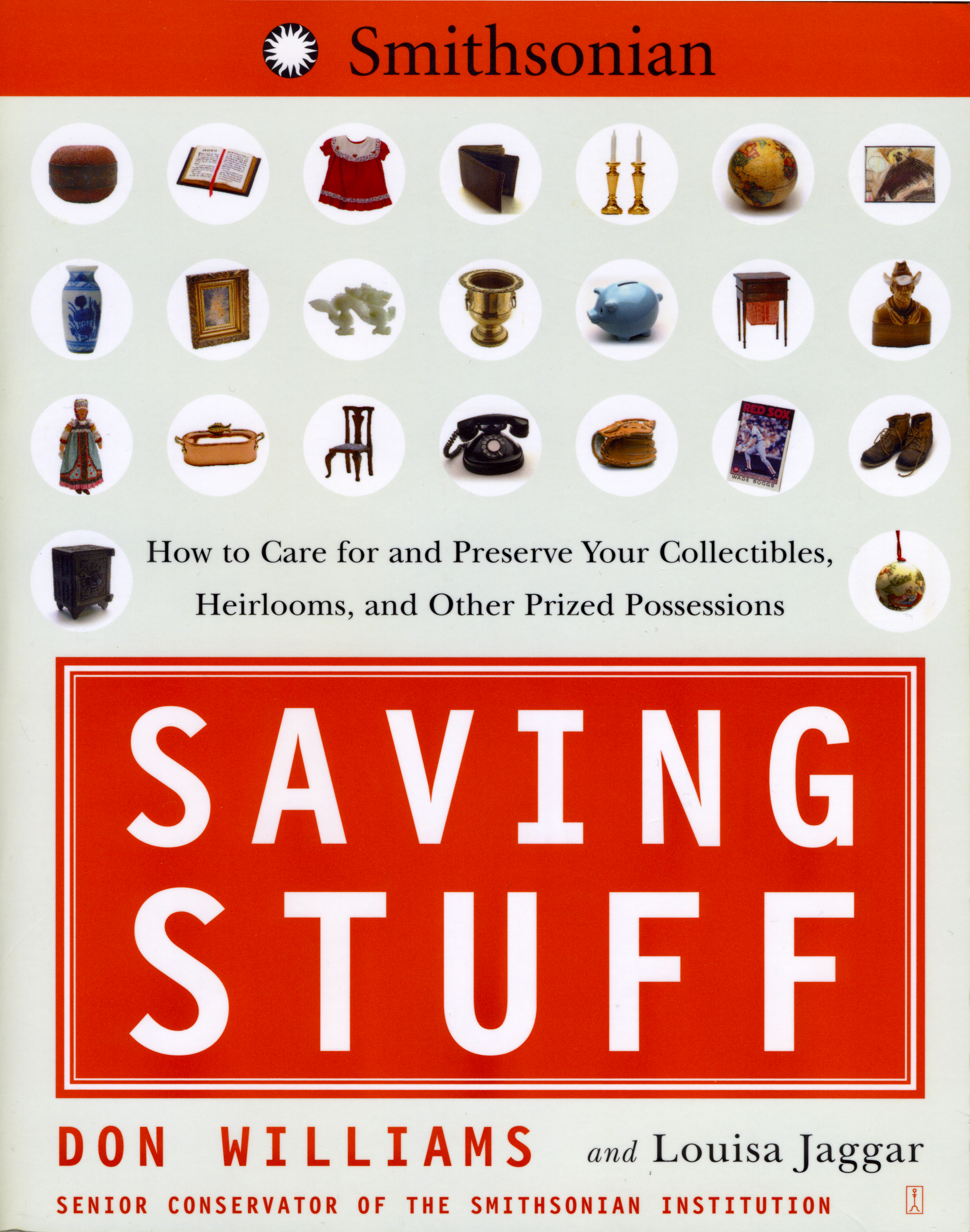

Saving Stuff is aimed at the general public, “both the serious collector and the sometime sentimentalist.” It was first published in 2005, but its advice and recommendations are still solid. It remains available online (and in stores?), new for $15-$24, or used for about $5. Click the photo images, above, for more information about the authors and the book’s contents.
The fine print
Disclaimer: Today’s colorful poster is from Gaylord Archival, one of several leading American suppliers of archival products. The Jonathan Clark House and I sometimes purchase supplies from Gaylord, but neither of us endorses or has any other business relationship with them.
Have fun saving your stuff. I’ll be back soon with more Clark House History.
 Clark House Historian
Reed, I enjoyed reading the “Know Your Archival Plastics” – a lot of good information.
Side note – my first project when I retired, was to convert all my paper photos to digital photos. I also converted all my old paper tax documents to digital tax documents. Digital is the way to archive items – when ever possible. Ed Foster.
LikeLike
Thanks, Ed!
Digitizing photos and documents is the way to go. Just be sure your digital archive is backed up to more than one device with, perhaps, one backup copy in the cloud.
I’m jealous that you’ve got your photos scanned. That’s on my (long-term) personal to-do list…
—Reed
LikeLike