It’s been several weeks of seemingly endless organizing at my house. A useful and productive time, perhaps, spent sorting, reading, and filing paperwork, updating the household accounts, and getting ready to host our family’s Thanksgiving celebration. But not much time or energy for writing Clark House Historian posts. So in lieu of a new post, I thought you might enjoy an expanded reprise of this piece, first published here in March, 2022.
The need to sort, repair and organize is not limited to our era. I suspect the Clarks, Turcks, Bonniwells—and their neighbors—spent a good bit of time trying to catch up with their 19th-century chores, like this fellow, at work in his barn…

Guy, Seymour Joseph (1824–1910), Utilizing a Spare Moment, oil on canvas, c. 1860-1870. Yale University Art Gallery, public domain (CC0 1.0). Click to open larger image in new window.
Today’s image is an original oil painting from about 1860-1870, by the American artist Seymour Joseph Guy (1824-1910). It comes to us courtesy of the Yale University Art Gallery. The Yale curators had this to say about the work:
Painted in warm earth tones, this rustic scene shows a farmer mending a leather bridle, using his knees to secure a simple wooden vice. Nearby an unused cider press, barrels, and other harvesting tools are stored in the barn for the winter, the season when farmers had “a spare moment.” Idealized rural scenes like this one were popular in nineteenth-century America, offering viewers a sense of traditional values in the face of rapid industrialization and political change.
The subject of the painting is not identified, probably a New York or New England farmer of the 1860s. But the image of this farmer—with his barn, his tools, and his tasks—also illustrates some of the equipment and seasonal chores that Wisconsin farmers like the Clarks, Turcks, and Bonniwells had to tend to in their own barns in the 1830s, ’40s and ’50s.
The Clark Barn
The two-story, Greek Revival-style Jonathan Clark House had a matching stone barn, located on the east side of Cedarburg Road, just a few yards north of the current Clark House driveway. It was documented in 1988-1989, with photos and textual reports, as part of the Historic American Buildings Survey (HABS). I’ve published a photo or two of the barn previously, including this one from our June 7, 2020, post The Clark Family in 1850 – part 4.
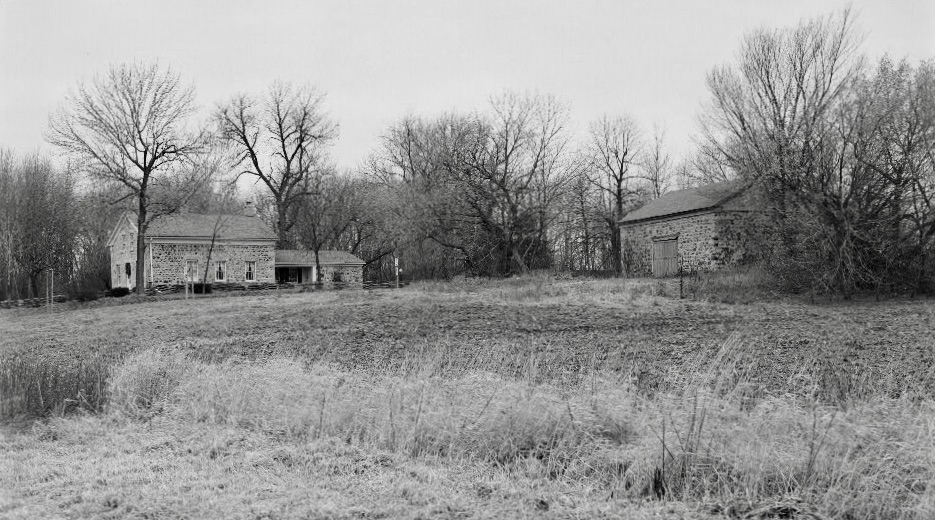
The view is from the shoulder of Bonniwell Road, looking west toward the Clark house (left) and northwest to the Clark barn (right). Cedarburg road runs from left to right between the buildings, just below our view. Sadly, the barn was demolished shortly after the Historic American Buildings Survey to accommodate the widening of Cedarburg Road.
If you’d like to know more about the Jonathan Clark barn, its history and construction, you can find the complete Clark barn HABS report, including photographs, online at the Library of Congress.
Looking ahead
I’m looking forward to some family time this week, and then I’ll be back with more Clark House history.
Until then, be well and thanks for reading.
 Clark House Historian