The Search for JMC’s roots continues!1 For the last few months, I’ve spent hour after hour reading through hundreds of digitized pages of the various manuscript land petitions and related documents that form the Land Petitions of Lower Canada, 1764-1841 database at Library and Archives of Canada (LAC).2
The good news is that I have found a lot of information about various early Clark (or Clarke) surname immigrants that petitioned for land—and actually settled on it—in Lower Canada during the relevant years of circa 1791-1840. Many of the documents that I’ve found contain information about these Clark immigrants, their families, and from whence they come. This is important, as we need to sort the Patriot, Vermont-related Clark families from other Clark immigrants from New York and New England (including American Loyalists), and the various Anglo-Canadian Clark families that sought land in the Eastern Townships at the same time. So, you know what that means…
We need another map!

Now that we have all this data, we need a way to organize and present it. And since so many of our rejected candidates earn their “Nope, not our Clark family” status because they settled far away from Stanstead, I thought it was time to make a big map of where these various Clark petitioners for Lower Canada land actually ended up. Then, in theory, we can eliminate the Clark families that settled “too far” from Stanstead (and adjacent Derby, Vermont), and focus on the Clarks that settled in or near Stanstead itself.
It’s going to take a while to assemble and present all the data. So we need a big, easy to read map created around the time of Jonathan Clark’s childhood and/or youth, from about 1812 until his arrival in New York state in 1831. (The latter date is flexible, as long as we find a map that predates the reorganization of the townships into larger counties in 1847.) We’ve presented some great Lower Canada maps here at CHH but, as is typical of that era, if they are accurate and detailed, they also tend to be visually “busy” and hard to read. But, dear readers, I finally found just the thing…
Composite: Map of the Eastern townships of lower Canada, 1842
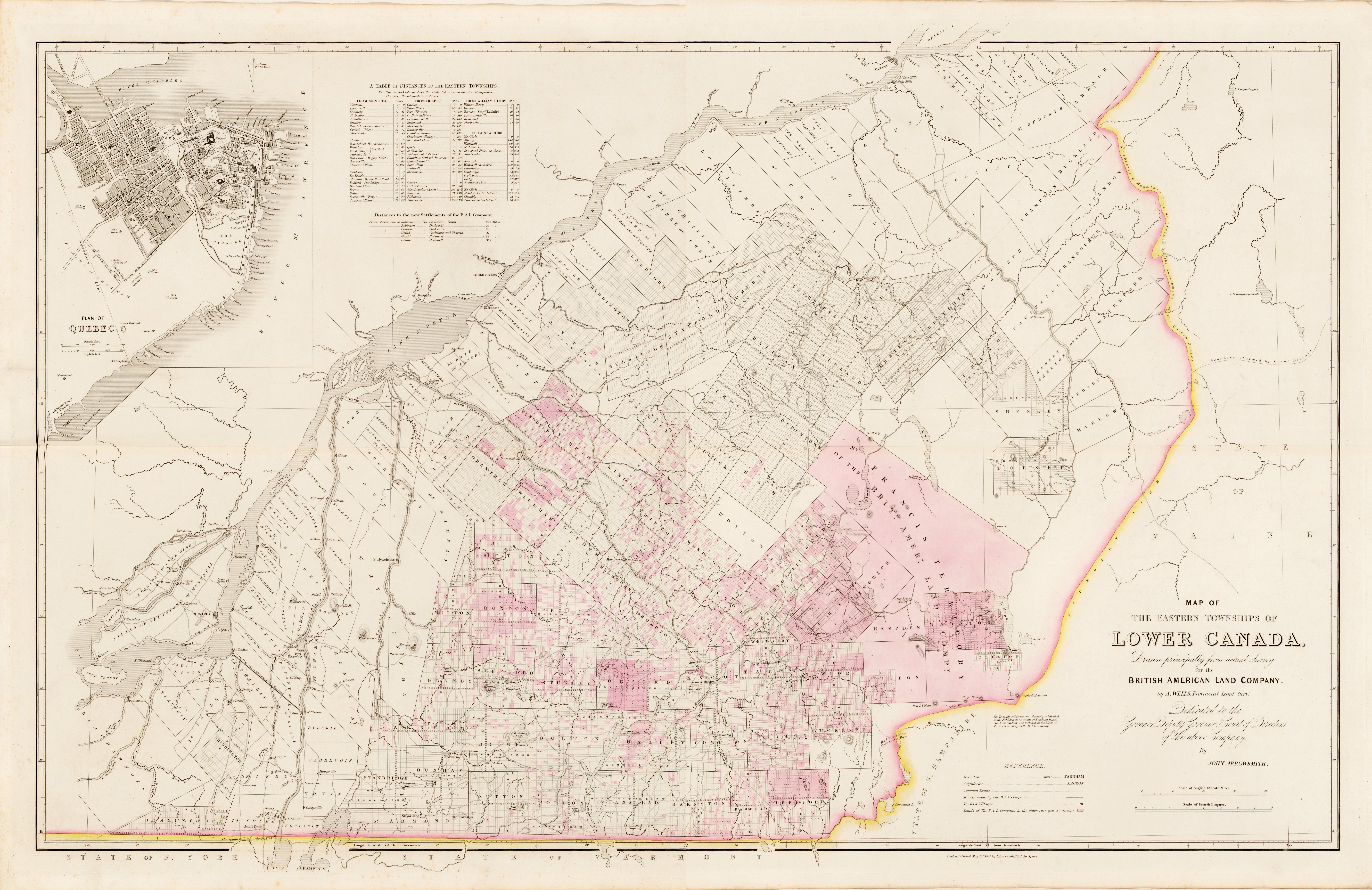
Arrowsmith, John (1790-1873), compiler and publisher. Composite: Map of the Eastern townships of lower Canada …, London, 1842. David Rumsey Map Collection.
Our map is a digital composite combining two separate maps that were created and published by the famed London map maker John Arrowsmith. Its full title is:
(Composite map of) Map of the Eastern townships of lower Canada, drawn principally from actual survey for the British American Land Company, by A. Wells. Provincial Land Survr. Dedicated to the Govenor, deputy Governor & Court of Directors of the above company. By John Arrowsmith. London, Published May 22d. 1842, by J.Arrowsmith, 10 Soho Square.
The two maps that make up this map of the Eastern townships were created in 1842 and published by John Arrowsmith as parts of The London Atlas of Universal Geography, 1858. More recently, the two separate maps were scanned and digitally stitched together by the staff at the amazing David Rumsey Map Collection. For the complete details of this map, and a look at the other maps in the 1858 atlas, follow this link to today’s map at the Rumsey collection.
What’s a British American Land Company?
The short answer is that the British American Land Company (BALC), chartered in 1834, was another, at best partly successful, attempt to market and sell the unoccupied lands of the Eastern Townships to prospective immigrants, particularly those from Anglophone Canada and the United Kingdom. For a taste of the issues involved, here’s part of the British American Land Company entry from the Canadian Encyclopedia:
Before 1844 its activities satisfied no one: the few settlers who came to the relatively inaccessible holdings complained of high land costs and harsh company policy; local politicians resented the fact that control over the purchase of money went to the executive branch of the government; and British shareholders demanded dividends.
If you want to know more, you can start by clicking the link to the Canadian Encyclopedia article, and also see the more detailed British American Land Company entry at Wikipedia.
What’s with all the pink shading?
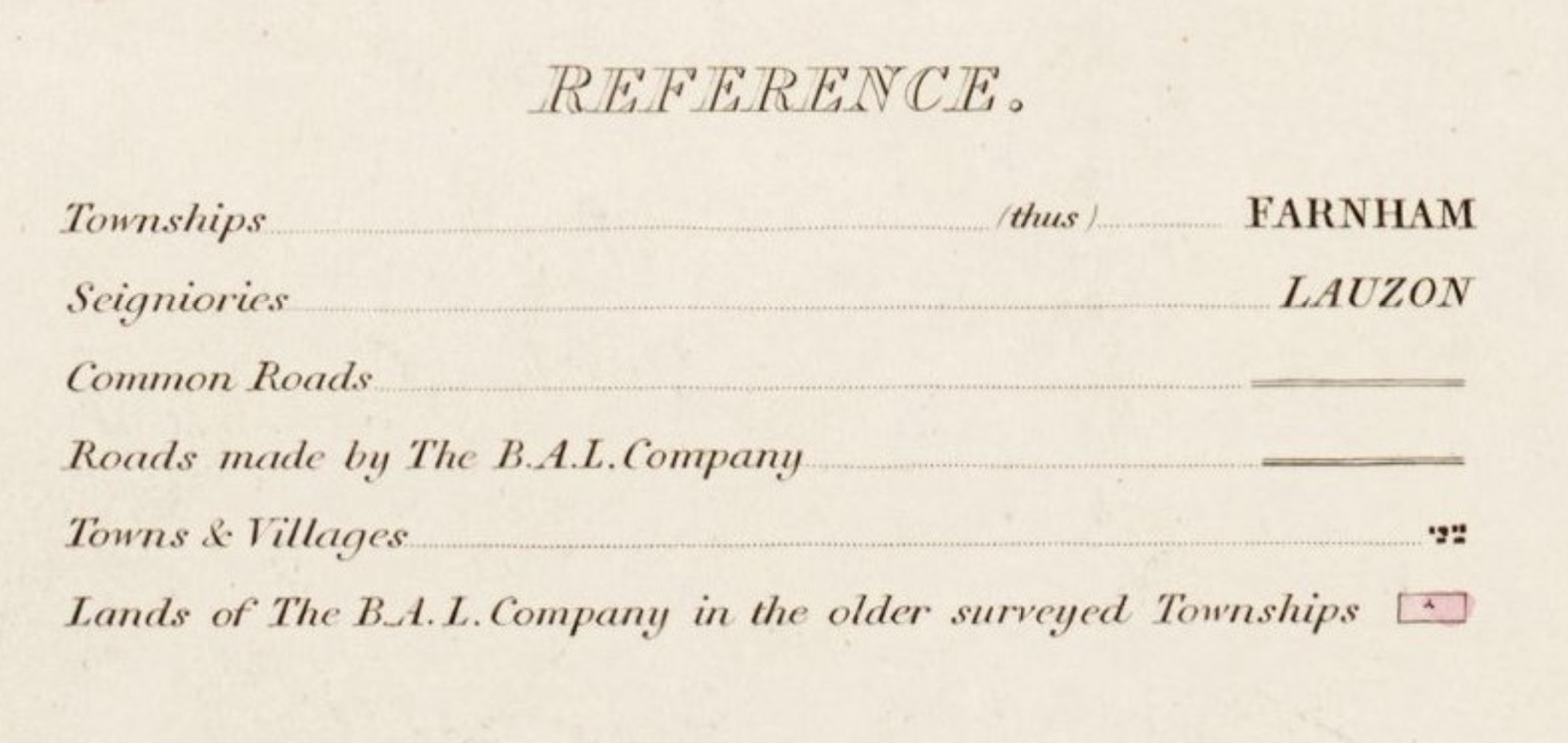
Nope, it’s not the location for “Barbie’s Canadian Wilderness Pioneer Adventure” (although that idea has real potential, if you ask me). Instead, a quick glance at the map’s “Reference,” or key, shows that the pink shading represents the lands in the surveyed townships that the BALC controlled and had not yet sold.
As you can see from the map, by 1842, Stanstead—with only a handful of pink-shaded, unsold lots—was one of the most thoroughly settled of all the surveyed townships east of Lake Memphremagog.
Coming up
As always, I encourage you to click the map and open a larger, higher-resolution version of it in a new window. I plan to refer to this map for a while, so you many want to zoom in, scroll around and—as did so many early post-1791 immigrants named “Clark”—make yourself at home in the Eastern Townships of Lower Canada.
I’ll be back soon with info to add to our big map. See you then.
______________________________
NOTES:
- If you need to catch up on the Search for JMC’s Roots (what it involves and why we need to do it), click this link and take a look at some of the relevant CHH blog posts. And then, while reading any of those posts, I recommend clicking through to the other linked CHH posts and outside sources. You’ll also want to check out our category of “Nope, not our…” posts for additional “(Not our) Clarks in Canada” information.
And by the way, since 2016 we’ve posted a lot about our search for JMC’s roots, but I’ll be the first to admit that the posts could be better organized and indexed. That is on my CHH “to do” list but, at the moment, is not my top priority. Thanks for bearing with me in the meanwhile. - By the way, I’m happy to report that searching for—and viewing—the Library and Archives of Canada (LAC) database of Land Petitions of Lower Canada, 1764-1841 has become a good deal easier. I now much prefer to use the LAC’s new and improved general-purpose Collections Search page to search for and access this information. My process involves going to that Collections Search link, and then searching for a surname or a surname-comma-space-first name and click “search.” Once I get the results (and this is quite quickly with the new interface), I usually apply various limiting factors (date range, documents with online content, land records, etc.) and that usually results in a very manageable lists of hits, some of which are just what I am looking for.
If you have the storage space on your computer, I recommend that you download a PDF of the document you want to read, and then read it on your computer or other device. Scrolling and zooming in and out on the PDF are much faster and less quirky this way.
 Clark House Historian
Pingback: Monday: Map Day! – the first (?) map of Stanstead, 1772 | Clark House Historian