How y’all doing? I can’t believe it’s been almost a month since my last post. Sorry about that! It’s that time of year, and I’ve been busier at my day job. But I’ve also been occupied with more pleasant, seasonal, activities…

Christmas—Gathering Evergreens, 1858
This picturesque scene is titled “Christmas—Gathering Evergreens,” published as a wood engraving from an original drawing by the young Winslow Homer (1836–1910). It first appeared in Harper’s Weekly magazine on December 25, 1858. Our copy is from the Yale University Art Gallery.
Of course, since it’s 2023 and I live in one of the more developed parts of southeast Wisconsin, I can’t just go outside and chop down a nearby tree and cut some extra greens for my holiday decorations. The neighbors might not appreciate that. But in 1858, when this print was published, the Clark family and their neighbors still had a lot of local greenery to choose from in the still-substantial surrounding woodlands of Ozaukee county.
Christmas at the Jonathan Clark House, 2023
Unfortunately, I couldn’t get to this year’s holiday gathering of the Friends of the Jonathan Clark House. It’s one of my favorite events, and it’s always nice to connect with my Mequon friends and enjoy the Clark House in its modest, period-appropriate Christmas attire. I hope to attend next year.
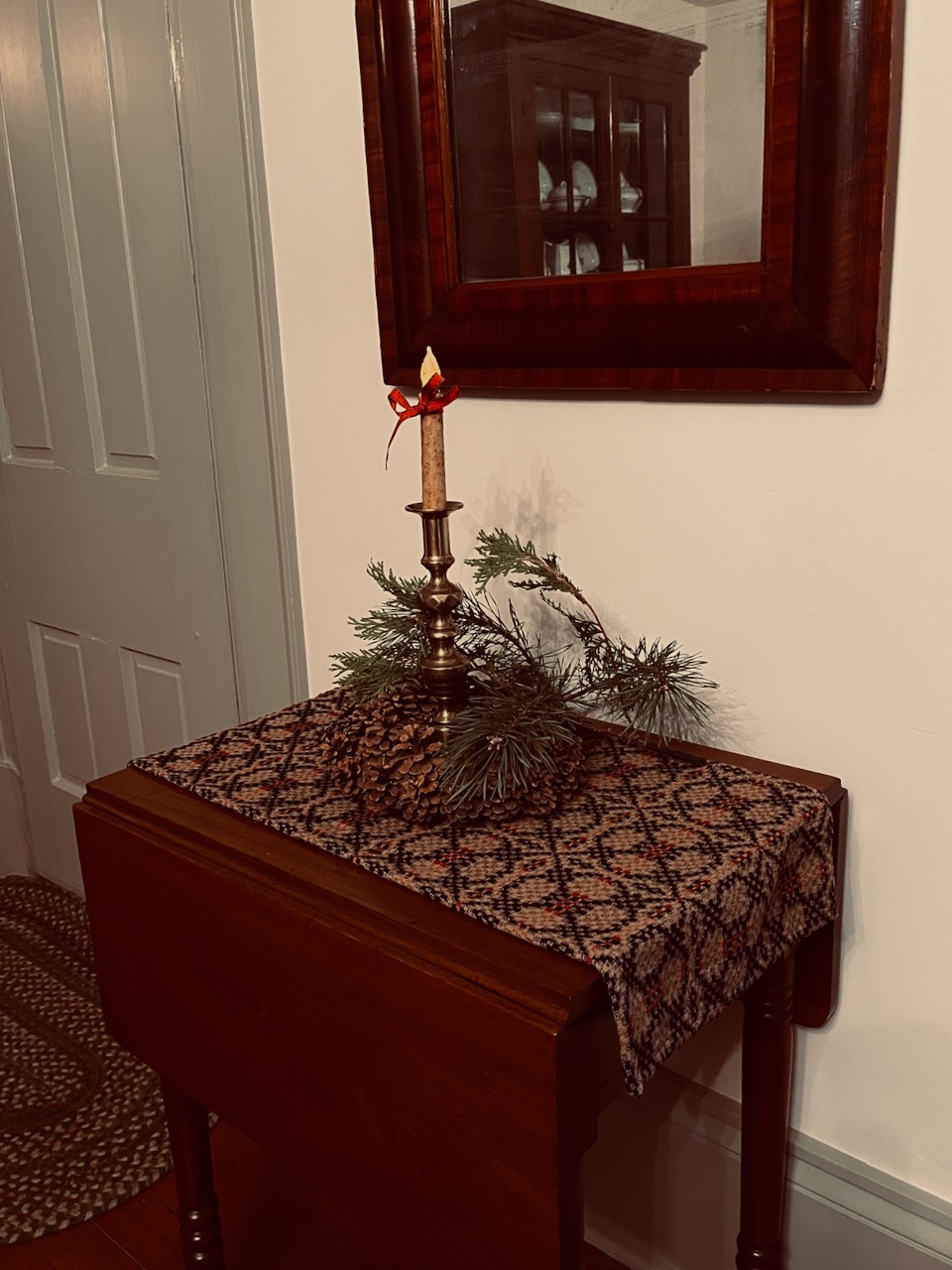
Jonathan Clark House front parlor with holiday candle and evergreens, December, 2022. Photo credit: Reed Perkins
Christmas at the Jonathan Clark House, 1858
Winslow Homer’s Gathering Evergreens was published on December 25, 1858. That date also marked Mary (Turck) Clark’s eighteenth Christmas on her farm in Mequon, and her tenth (or eleventh) Christmas celebrated in the big stone house that we know as the Jonathan Clark House Museum.
In all likelihood, the Clark family’s 1858 Christmas may have been an emotionally complicated time. Mary’s husband, Jonathan M. Clark, had died only 15 months earlier. Her eldest daughter, eighteen-year-old Caroline, spent most of the year in school in Milwaukee, possibly living in Milwaukee’s seventh ward with Mary’s father Peter Turck, his young second wife Christina (Koehler or Kaehler) Turck, and their nine-year-old daughter Lucinda.
Meanwhile, Mary Clark and her seven other children, aged 15 years to 19 months, were still living and farming on the family’s Mequon land. Nineteen-year-old Benjamin Turck, Peter Turck’s youngest son (and Mary Clark’s youngest brother), appears to have spent some of his time living with his father in Milwaukee, and some of his time helping on the Clark farm in Mequon.
At the same time, Mary’s life and work were made more difficult by a host of political and economic troubles, most importantly the ongoing economic crisis known as the Panic of 1857. As I wrote previously:
[…] in addition to all her other troubles, Mary Clark survived one of the nation’s worst financial disasters. It began in mid-summer, 1857, with declining amounts of gold coming from the California gold mines causing distress for banks in the East, financial markets being shaken by the implications of the Dred Scott decision, followed by the collapse of a bubble in railroad stocks, the failure of a major flour and grain company in New York and of a major bank in Ohio. Commercial credit dried up and land and grain prices plummeted, leading to loss of income and land and farm foreclosures. Recovery from the 1857 panic did not begin until 1859, and the nation’s finances would not fully recover until after the Civil War.
Christmas then and now…
No doubt, we live in troubled times. Tragic and disturbing local, national, and international events dominate the news, and it would be easy to assume that the fast-paced difficulties of our modern lives cause stresses that were unknown in earlier days. But that is simply not the case.
Times were hard for many Americans in December, 1858. Times were especially hard for Mary Clark at Christmas, 1858. She was 37 years old, widowed, the mother of seven daughters and one son—all still in school or at home—and owner and operator of a 160-acre farm during one of the nation’s worst financial disasters. Mary could have buckled under the stress. Instead, she kept her family together, led the Clark farm to continued prosperity, and saw that her children were educated well beyond the primary-grade level typical for many children of the period. One hopes that Christmas, 1858, brought her and her family some respite from the stresses of the previous few years.
Coming up…
As for me, I’m still hot on the history and genealogy research trail, searching for Jonathan Clark’s roots in Lower Canada and northern Vermont, and I’ll have lots to say about that after the Holidays. After that, we need to bring Alfred Bonniwell and the rest of our Mequon miners back from the California gold fields, and I’m long overdue to bring you updates on the Bonniwell Bible and related papers. In the meanwhile, I’m going to (continue to) take a bit of a writing break and republish a few CHH holiday favorites; if I have time I may add a new holiday post to the mix.
So wherever you are, whatever your circumstances, I wish you Happy Holidays, a Merry Christmas, and a peaceful and prosperous New Year, 2024.
 Clark House Historian