If this were an academic thesis (don’t worry: it’s not, it’s still a blog), one of the first things we’d do at the start of a project like this is create a “literature review” and accompanying annotated bibliography. Now that we’re restarting our search for JMC’s roots in the border area of northern Vermont and the Eastern Townships of southern Québec, circa 1790-1840, I thought it would be smart to do something similar, but less formal. Over the next several posts we’re going to sort and prioritize the various sources that look useful, and find a way to organize those sources—with their proper bibliographical citations—in a way that will serve us over time.

The Clark House Historian, growing old as he searches for Jonathan M. Clark’s roots…1
Today’s post is Part 1 (of many) of our hybrid literature review and annotated bibliography that—we hope—will finally lead us to JMC’s as-yet-unknown parents, ancestors, possible siblings, and kin.2 We begin with some Lower Canada—Eastern Townships books that I have found more (or less) useful.
Why these books?
We need to narrow our search to sources that focus on the time and location(s) of Jonathan M. Clark’s early life. We believe Jonathan M. Clark was born in either Stanstead, Lower Canada (now part of the Estrie or Eastern Townships of the province of Québec, Canada) or the adjoining area of Derby, Orleans County, Vermont, United States in either 1812 or, possibly, 1811.
Because the Derby and Stanstead areas were so remote, they were slow to be surveyed, mapped, and settled. There just weren’t many white settlers in these areas until a decade or more after the end of the American Revolution. The official surveys and sales of Crown lands in the Eastern Townships, including Stanstead, did not begin until the 1790s; adjoining northern Vermont remained sparsely settled until about the same time. And we know that JMC left the area in 1831, migrated to New York state, and, by 1833, had enlisted in the U.S. Army and was stationed at Ft. Howard (Green Bay), Wisconsin Territory.
In my experience, there just aren’t many books that cover our topic in much detail, but there are a few. Today we begin our list with six books that provide information about the early years of settlement in Stanstead—and the neighboring Eastern Townships of Lower Canada—that I have found more or less useful. For simplicity’s sake, I cite each book with reference to the original, published-on-paper version, as I think that will make finding the same book (in any format) easier for most readers. However, many of these volumes are now quite rare, so in almost all cases I have accessed these books online, and you can too. I will follow each citation to the book with a link to the appropriate online source, and a few brief comments on the content, strengths, and weaknesses of each in relation to our search.
Lower Canada & Eastern Township books: (mostly) geography and history of settlement
To get a better sense of the early days of the Stanstead area, I have found the following works to be helpful. Later writings about the Eastern Townships tend to cover the early decades of Anglo-American settlement quickly and with less detail about the earliest settlers and their families. These earlier books, written during or within a generation of the first Anglo-American settlement, are more informative about those days and, in some cases, about the individual settlers involved. So, in chronological order of publication, here we go, beginning with three by Lower Canada’s surveyor general, Joseph Bouchette, Esq. and his son, Joseph Bouchette, Jr., and a fourth by one of the Eastern Townships’ first historians, Mrs. C. M. Day.


Bouchette. 1815. A Topographical Description of the Province of Lower Canada.6
Bouchette Joseph. Topographical Description of the Province of Lower Canada with Remarks Upon Upper Canada and on the Relative Connexion of Both Provinces with the United States of America, London, Faden, 1815.
Online at Google Books, accessed September 5, 2023.
An essential and early book, by the surveyor general of Lower Canada, published to accompany his magnificent and highly detailed 1815 map of the province. In addition to the concise descriptive text, it includes many tables, and at the end, an index, list of plates, and errata list. About 775 pages in all. Includes a description of Stanstead (p 263-265) with good information on geography, flora, inhabited areas, and early economic development. Most subsequent histories (including Bouchette’s 1831 British Dominions) seem to be based on this 1815 book.
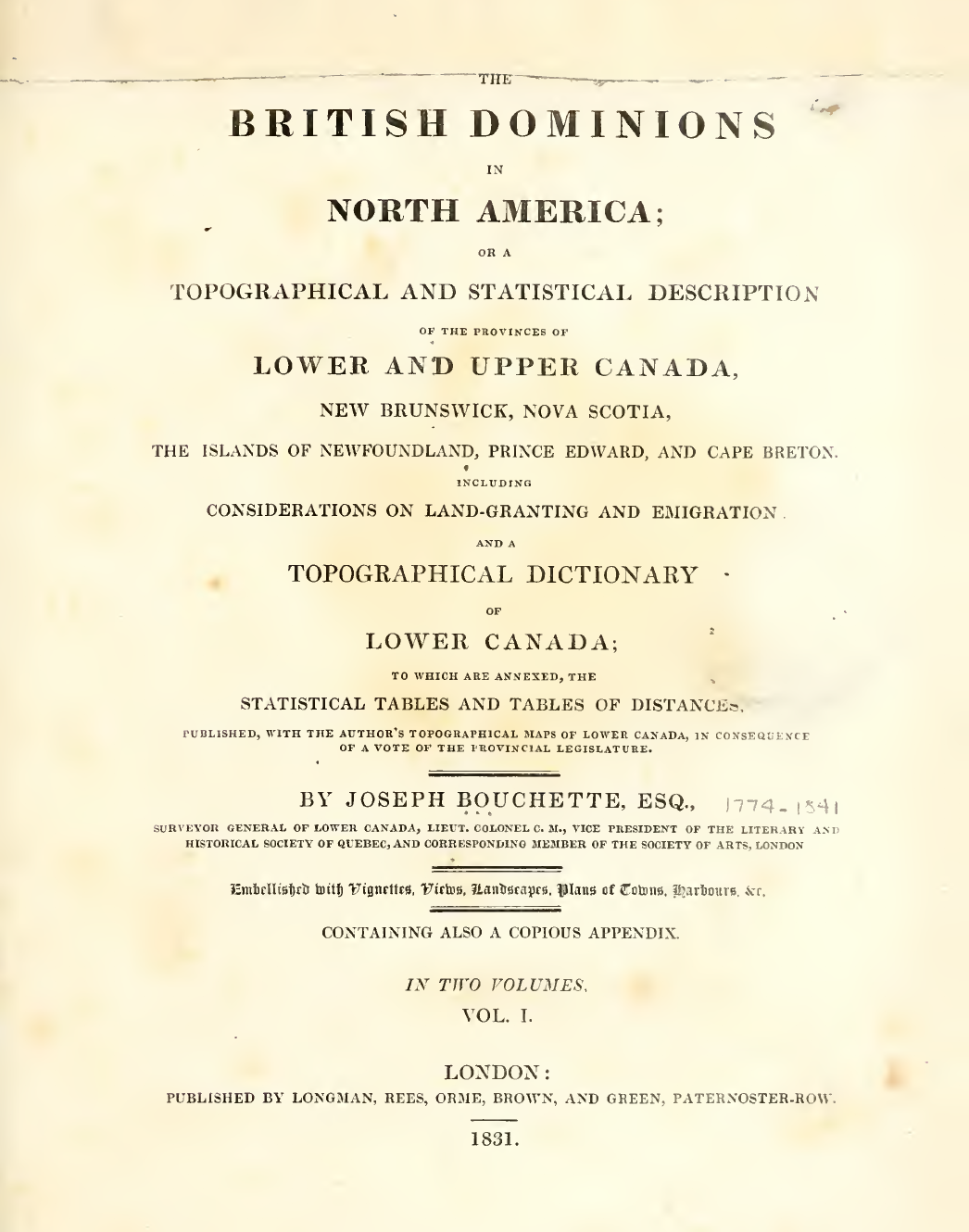
Bouchette. 1831. British Dominions of North America.
Bouchette Joseph. The British Dominions in North America; or a Topographical and Statistical Description of the Provinces of Lower and Upper Canada New Brunswick Nova Scotia the Islands of Newfoundland Prince Edward and Cape Breton. Including Considerations on Land-Granting and Emigration; and a Topographical Dictionary of Lower Canada; to Which Are Annexed the Statistical Tables and Tables of Distances. London, Longman, Rees, Orme, Brown and Green, 1831.
Online, two volumes digitized as one at Internet Archive, accessed September 5, 2023.
The companion volume to Joseph Bouchette, Jr.’s, beautiful 1831 Map of the Provinces of Lower & Upper Canada, 1831, which I have yet to write about. This massive book (almost 1300 pages), published only 16 years after its 1815 predecessor, documents the many rapid changes in political geography, settlement, and economic development of the British Empire in North America. There is updated information about Stanstead and the neighboring townships. The book includes the lovely 1827 drawing of Stanstead by Bouchette. For reference, 1831—the year this book was published, was also the year JMC emigrated to New York.
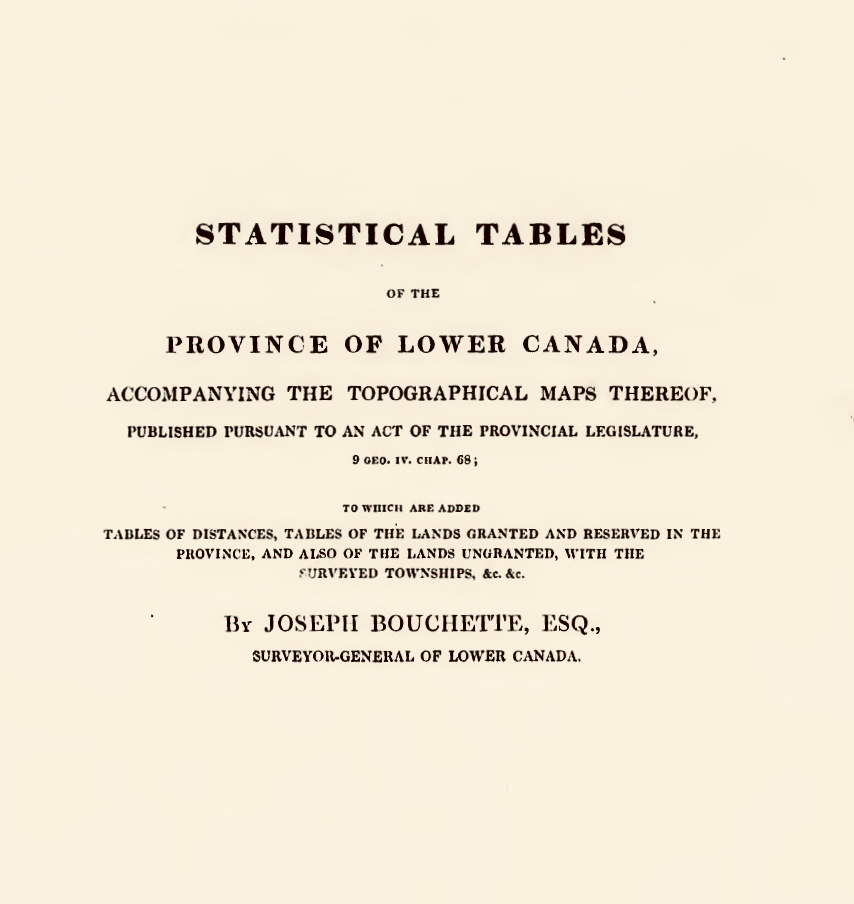
Bouchette, 1831. Statistical Tables of the Province of Lower Canada.
Bouchette Joseph. Statistical Tables of the Province of Lower Canada Accompanying the Topographical Maps Thereof : Published Pursuant to an Act of the Provincial Legislature 9 Geo. Iv Chap. 68 : To Which Are Added Tables of Distances Tables of the Lands Granted and Reserved in the Province and Also of the Lands Ungranted with the Surveyed Townships &c. &c. London, Thomas Davison, 1832.
Online at http://online.canadiana.ca/view/oocihm.52079, accessed 6 Sept. 2023.
A short book of about 30 pages. Contents as summarized in the title. Minimal use for the search for JMC, but some interesting statistics and tables for the specialist researcher.
Day. 1869. History of the Eastern Townships Province of Quebec.
Day, C. M. [Catherine Matilda]. History of the Eastern Townships Province of Quebec Dominion of Canada : Civil and Descriptive in Three Parts. Montreal, J. Lovell, 1869.
Online at Google Books, accessed September 5, 2023.
Three parts in one volume, about 475 pages. Part 1, History is, according to the author “more a condensed compilation that an original production.” Part 2, is a “series of miscellaneous chapters,” concerning the First Peoples, white settlement, the difficulties of the early settlers, some natural history, and more. Part 3, “gives short Historical Sketches of each Township.”
As far as I know, this is the first book to be called a history of the Eastern Townships (including the township and/or county of Stanstead). The book was written over half a century after JMC’s birth and the early days of settlement in the townships. The more detailed descriptions of political geography, agriculture, manufacturing, and transportation (including railroads) are usually contemporary (circa 1868), and not really relevant to JMC, his family or the earliest settler families. But the book contains some concise descriptions of the various settlements, villages, towns and counties established during the first years of white immigration, as well as compact lists of the earliest leaders and associates in each township.
Stanstead books: geography, history…and genealogy.
Hubbard & Lawrence. 1874. Forests and Clearings, the History of Stanstead.
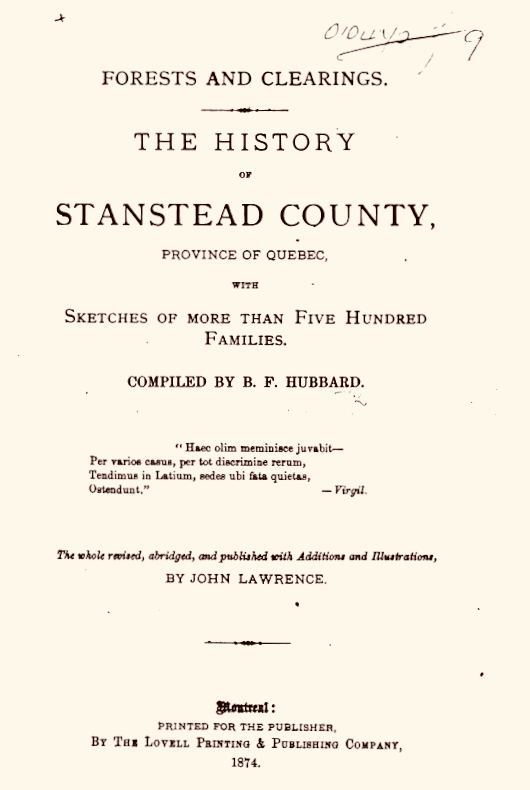
Hubbard B.F. [Benjamin Franklin] and John Lawrence. Forests and Clearings. The History of Stanstead County, Province of Quebec with Sketches of More Than Five Hundred Families … the Whole Revised Abridged and Published with Additions and Illustrations by John Lawrence. Montreal, Lovell, 1874.
Online at several sites; the best scanned copy is at Google Books, accessed September 5, 2023.
As far as I know, this remains the essential book for early Stanstead (township and county) history and genealogy. It has been reprinted several times but, to my knowledge, no one has written an updated or successor volume. The almost 370 pages of Forests and Clearings are divided into two equal parts: the first historical and the longer second part, genealogical. Both sections include information on a number of CLARK families, some of which may be related to JMC. Other families that may be related to JMC include the MERRILL/MORRILL and RIX families, and others. We will refer to this source often in our search for JMC in the Stanstead area.
Brown. 2001. Schooling in the Clearings: Stanstead 1800-1850, 2001.
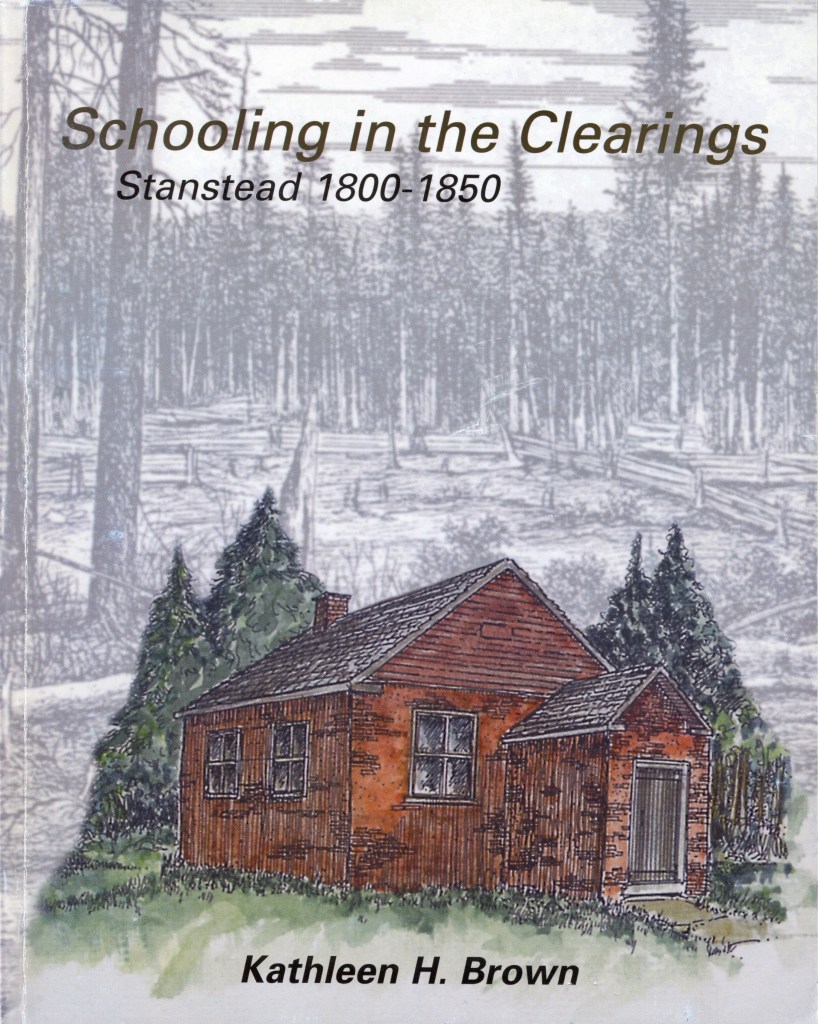
Brown, Kathleen H., Schooling in the Clearings: Stanstead 1800-1850, Stanstead Historical Society, Stanstead, Quebec, 2001. ISBN: 0-9689485-0-2
This book was published by, and may still be available from the Stanstead Historical Society. For full contact information, see their web page at the Society’s Colby-Curtis Museum website.
This is a very specialized history book, covering—in great detail—schools and schooling in Stanstead in the half century 1800-1850. While not a genealogy book, there is a great deal of genealogical information to be extracted from the hundreds of class rolls and other period documents uncovered, transcribed, and published here by the author. We discussed a possible appearance of JMC on one of these class rolls in Back to School, 1831: JMC in Stanstead? The opening sections of Ms. Brown’s book include an excellent, concise introduction to the early days of settlement and political geography, with several maps (some of which I have subsequently written about on this blog. More on those when we discuss maps in detail).
S.O.B.S.
Is that all, you say? Where, you ask, are the newer published histories and genealogies? Well, there are at least a dozen or so titles in WorldCat that may be relevant, but that I have not yet seen. I’ll discuss those at a future time.
But frankly, it appears that B.F. Hubbard and John Lawrence did such a comprehensive job documenting Stanstead’s history and early genealogy in Forests and Clearings that no one has had the motivation—or resources—to write a sequel. That said, there is one man, David Lepitre3, that has done years of yeoman’s work documenting and distributing information about settlement in Stanstead, Quebec and adjoining Orleans Co., Vermont. David has a theory about the difficulty of doing genealogy in this area. He calls it “S.O.B.S.”
For the genealogical researcher, this region has its own special problems. Finding your ancestors in Stanstead County, Quebec, and Orleans County, Vermont, is made difficult as a result of generations of folks living on or very near the international boundary.
You may find your roots in both Quebec and Vermont. You may be able to follow them for several generations and suddenly they vanish. If this has happened to you, you may be suffering from what we can euphemistically call a case of the S.O.B.S. or the Stanstead-Orleans Border Syndrome.
There are a number of reasons for the sudden disappearance of folks from the records on both sides of the border. I am not suggesting that all the following problems are unique to our region but the combination of them seems to be…
David Lepitre, “Genealogy on the Quebec/Vermont Border,” from “Log Cabin Chronicles,” originally accessed February 1, 2014.4
For the rest of David’s article, click the link above. David’s explanations of the causes of “Stanstead-Orleans Border Syndrome” are informative and amusing. One of the main issues for many Stanstead-Orleans residents seeking their roots is the inconsistent spelling of names over time, especially when French names become English names and then, sometimes, become French again, but with changes in spelling at each metamorphosis.
And there is a further problem for those of us tracking the earliest, mostly Anglophone, settlers in this area. It’s that there are too many people that share the same surname, and “Clark” (however you spell it), was the surname of dozens, if not hundreds of families in Stanstead, as well as neighboring Vermont and New Hampshire, in the half century or so following the end of the Revolutionary War.
Done for the day
That’s all for now.5 I’ll be back soon with a look at more key sources, and a new way to organize and access them here at Clark House Historian.
Meanwhile, if you have any recommendations for additional sources of early Stanstead (and Derby) history and —especially—genealogy, please let me know. Thanks!
______________________________
NOTES:
- No, as you probably guessed, that’s not really me. Yet. It’s a cropped version of engraver Samuel Hollyer’s William Cullen Bryant in his study at Cummington / S. Hollyer. , ca. 1876. The original image is at the Library of Congress. For more on Bryant—though he has nothing to do with Lower Canada or northern Vermont—here is a good place to start.
- Or, if this process does not lead us to JMC’s kin, it will properly document all the false-starts and dead-ends to date, which will be a great help if we eventually need to call in a professional/specialist genealogist.
- The 2005 article quoted above includes this short info on the author: “David Lepitre is a printer in Stanstead, Quebec, and an avid practitioner of genealogical research. He writes the Your Ancestry column for the Log Cabin Chronicles and the weekly Stanstead Journal ” I think David has retired in the last year or two, and his contact information has changed since 2014. Contact me if you’d like his more recent contact info.
- I checked again today, September 5, 2023, and the link to David Lepitre’s “S.O.B.S.” article, http://www.tomifobia.com/genealogy/lepitre.html, is still working.
- UPDATED, September 6, 2023, to correct a few minor typos and clarify a sentence or two.
- UPDATED, September 24, 2023. I’m finding it increasingly useful to be mindful of the dates of our various written sources; it helps establish a chain of provenance and authority. With that in mind, I’m making a slight change to our bibliographic cataloging style. Before the full bibliographic entry in author-title-etc.-date (more-or-less MLA) style, I’m changing the brief title, in bold, to a kind-of Chicago style (author, date, etc.) style for these books and for future records.
 Clark House Historian
Amazing and thorough summary of resources, Reed.
LikeLike
Thanks, Liz!
And the nice thing about so many of these rare sources being digitized and put online is (A) they are free and easy to locate and download and (B) the text is searchable with a simple “Find” search. It’s a great way to hunt for surnames, place names, and such in big, long books.
(Of course, the Search/Find function depends on how well the original text was scanned and processed with OCR, which is never 100% accurate, even in optimal circumstances.)
LikeLike
No, I did not think that was a sketch of you at your desk. Looks more like our JCH preservation manager.
LikeLike
LOL.
LikeLike
Pingback: Searching for JMC’s roots in Eastern Township sources: books (part 2) | Clark House Historian
Pingback: Searching for JMC’s roots: land grants – the official process, 1792 | Clark House Historian