Today was supposed to be a lavishly illustrated “Monday: Map Day!” post, to accompany our recent posts on the Bonniwell family’s roots in Chatham, Kent, England. But, of course, I ran into some interesting—although pretty much off-topic and confusing—Bonniwell documents. These records added a previously unknown1 second marriage to the story of early Mequon pioneer, Jonathan Clark House neighbor, and Washington/Ozaukee county mover-and-shaker William T. Bonniwell.
It’s a complicated story. A second marriage for him, a second marriage for her, and there is a seven-year-old child named Nellie (of somewhat obscure parentage) living with them. So, of course, I dropped what I was doing and dug in to try and solve these new mysteries. I’m now close to understanding what happened with W. T. Bonniwell’s short-lived second marriage, but I have a problem.
Cn u rd ths?
Can you read this?

As always, click the images to open higher-resolution versions of each.
I read a lot of handwritten documents, mostly from about 1600 to the present day. I’m pretty good at deciphering most English and German writing styles from those years, but every now and then I’m stumped.
This is an 1870 document in the hand of young Nellie’s trustee, one Jedd P. C. Cottrill (sp?), acknowledging the receipt of her share of the estate of her deceased foster father, Nelson Webster. Nellie’s name is inside the red rectangle: Nellie J. [hmm?]. What do you think Nellie’s surname is supposed to be? Is the first letter an F or a T or something else? And after that? Is it ?urck, ?urch, ?inck, ?inch? I’m leaning toward Finch or, maybe, Finck. But I’m not sure. Perhaps if we compared other examples of Nellie’s surname from the same probate file…
More clues
Nellie’s surname, and the name of her birth father, appear in Nelson Webster’s will, as copied in the fluid and mostly-readable hand of a clerk (or the judge himself?) at the Milwaukee County probate court. Take a look at this excerpt. Can you figure out Nellie’s and her birth father’s surname? Once again, Nellie’s name is in the red box; birth father J. C.’s name is underlined.
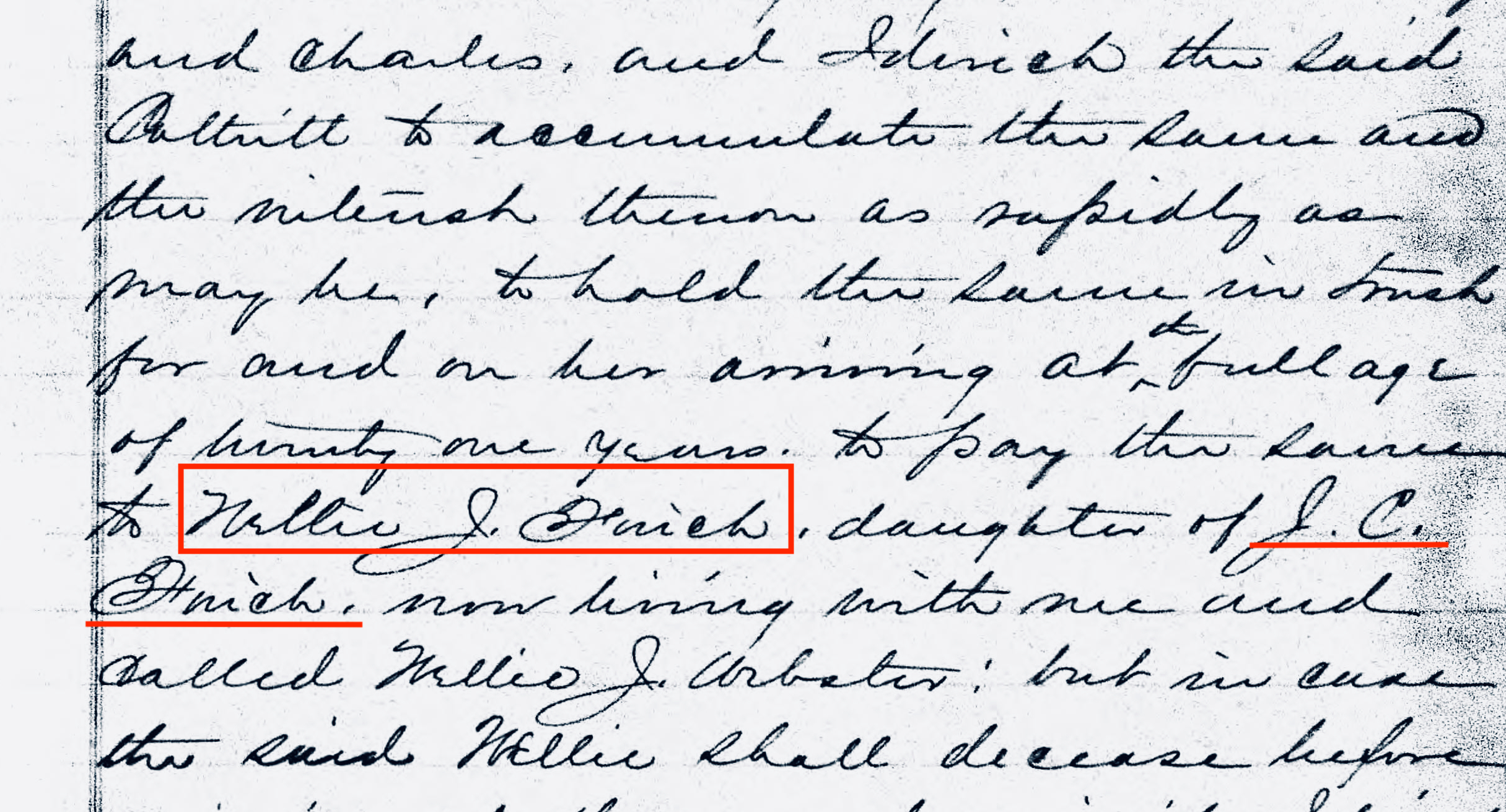
His first and middle initials are J. C., but I’m still unsure of that last name. ?urck, ?urch, ?inck or ?inch all still seem possible. But is that first letter an F, a T, or…a Q? For what it’s worth, I think it’s an F with an extra little stroke decorating the crossbar of the F, but I’m not 100% sure.
Help the Historian!
That’s all I’ve got. Nellie’s name does not appear elsewhere in Nelson Webster’s substantial probate file.
What do you think about Nellie’s last name? Put on your thinking caps, take out your official Clark House Historian Secret Decoder Badge, and let me know how you think Nellie spelled her last name. It’s the last missing piece of an interesting genealogy and history puzzle.
Join the conversation and send your comments and best guesses to me via the Leave a Reply area, below, or use the blog’s CONTACT function to send me a private message.
More fun with handwriting…
If you like these handwriting challenges, you might enjoy some of our other posts, including our Turck, Turk…Durk? challenge, our Bonniwell Bible introduction to Secretary Hand in our multi-part Help the Historian! – a manuscript “History Mystery” and Help the Historian! – MS “History Mystery” solved! And for those of you with German ancestors, we took a look at 19th-century German penmanship in Lesen Sie Kurrent?
Time to sharpen your quills, mix up some ink, and start writing. Cheers!
__________________________
NOTES:
- Naturally, I checked in with Bonniwell family chronicler George B. Bonniwell to see if he knew anything about this. George was gracious and speedy in his reply (as usual), and this second marriage for W. T. Bonniwell was news to him, also.
Thanks, George!
 Clark House Historian
I have no idea…good luck with this mystery.
And, I do not have a decoder ring!
Nina
LikeLike
I think Nellie’s last name is Quick or possibly Quich. In looking at the placement of dots over the letter, I in the rest of the paragraph, it makes me feel that the letter immediately before the last two is an I. Working backwards from the letter I first lowercase letter does look like a U. This means that the first letter of the last name would almost have to be a Q. And the elaborate squiggle at the beginning of the last name could definitely be a capital Q.
LikeLike
Hmm…an interesting theory (though dot-placement in 19th-century manuscripts is often pretty random). Quick is not impossible; Quich would be unique, to say the least.
Readers: any other votes for “Quick” (or “Quich”)?
LikeLike
Pingback: Bad Handwriting: not just a problem from the past | Clark House Historian