I’m still collating information about how and when the members of the Bonniwell gold rush expedition(s) returned to Wisconsin. I hope to have the full list posted here, shortly. In the meanwhile, I thought you might be interested in learning more about Clark family neighbor Thomas Day. He was a member of the Bonniwell 1849 by-land-and-sea expedition to the California gold fields and was a friend and colleague to Clark House neighbor and Methodist evangelist William W. Woodworth. Thomas Day’s life story sheds light on the early Washington/Ozaukee county settler experience, and illuminates various aspects of immigration, religion, and family life in pioneer days.
As we begin, be sure to note that our subject, Thomas Day, immigrated to Wisconsin from England in 1846, and is not directly related to the Tennessee-born, 1836 Mequon pioneer Isham Day.
Rev. Thomas Day, 1809 – 1901
Let’s start at the end, with the longer of two versions of Thomas Day’s obituary, as published on page 3 of the Indianapolis News, Sunday, April 21, 1901:

Barnstaple and Bristol
Thomas Day’s obituary states he was born in “Stoke Mills,” England. It turns out that there are a lot of places in England called “Stoke” and even more with the word “Mills” in the name. Based on other evidence (below), I think Thomas Day was born on Jan 6, 1809, probably at the Stoke Mill, Stoke Rivers, Devon, England, about six miles east of the city of Barnstaple, Devon.
Thomas Day married Mary Ann Gould in England, probably around or before the UK census of 1841. The first of their two sons, Frederick T. Day, was baptized in one of the non-conformist Weslyan-Methodist Chapels in the Kingswood Circuit, Gloucester County—near Bristol—on May 8, 1842. His brother, Thomas Charles Day, “was born in Bristol, England, Feb. 28, 1844” and baptized at the Wesleyan Chapel, Portland Street, Kingsdown, Bristol, on April 14 1844.
Methodism and early preaching
Like most Britons of his era, Thomas Day was born into a Church of England (Anglican) family. I have not been able to find records for Thomas Day to confirm whether he was baptized or married in the Church of England. His obituary suggests that while still in England, Thomas Day left the established church, joined the Methodist communion, and began to preach: “For a number of years after joining the Methodist Church, he devoted himself to preaching.” His membership in the Methodist Church in England is supported by the baptismal records for his two sons. Both were baptized in Methodist chapels (see above).
To Wisconsin, 1846
Day’s obituary states that he immigrated to the United States in 1847. It appears that he actually arrived a year earlier, on the British brig Cosmo, sailing from Bristol, England, arriving at the Port of New York on May 15, 1846:
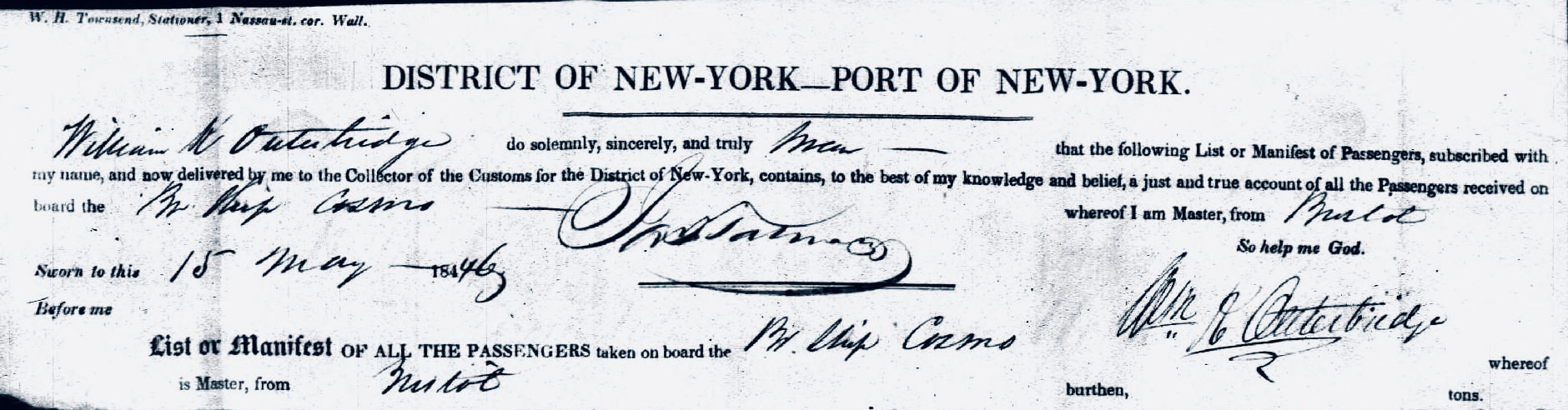
Thomas Day did not emigrate alone. He was part of a group of 16 emigrants leaving Barnstaple, Devon, and heading to Wisconsin (see vertical blue arrow):
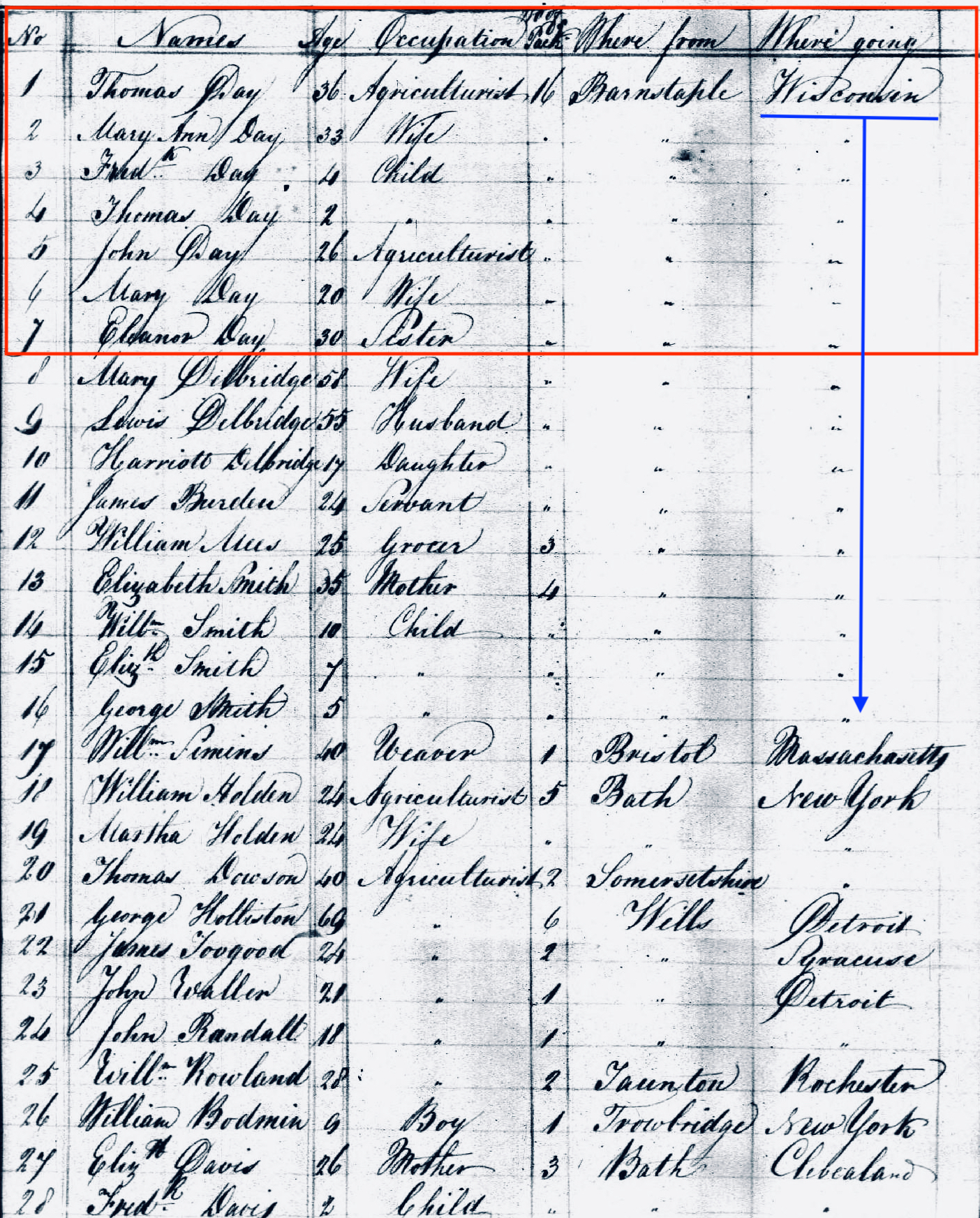
Ancestry.com, New York, U.S., Arriving Passenger and Crew Lists (including Castle Garden and Ellis Island), 1820-1957 [database on-line]. Year: 1846; Arrival: New York, New York, USA; Microfilm Serial: M237, 1820-1897; Line: 1; List Number: 321.
The first seven of these 16 emigrants (in the red rectangle) are all members of the Day family. The first four are Thomas Day, his wife Mary Ann (Gould), and their young children Frederick Thomas and Thomas Charles. They are accompanied by Thomas’s brother John Day and John’s wife Mary (Redding). The last member of the family on this manifest is Thomas and John’s sister Eleanor (aka Hellen) Day.2
The other Wisconsin-bound Barnstaple emigrants are Lewis and Mary Delbridge (or Dilbridge, but Delbridge seems to be correct per earlier, Devon, UK, records) and their daughter Harriot (aka Harriet), a “servant” named James Burden (working for the Delbridges, perhaps?), a grocer named William Mees (sp? or Mus?), and a woman named Elizabeth Smith, traveling with her three young children, William, Elizabeth and George.
Did they all go to Wisconsin?
Did all sixteen of these May 15, 1846, immigrants reach Wisconsin? If they made haste, they might have left New York and arrived in Wisconsin in time to be enumerated on the 1846 territorial census. I took another pass through the 1846 census, and it looks like our Barnstaple immigrants—if they did go directly to Wisconsin—did not arrive in time to be counted. The 1846 territorial census had an official enumeration date of June 1, 1846, and it appears that the Washington county enumerators did their work efficiently; the Washington county schedules were complete and received by the secretary of the territory on July 18, 18461.
The Barnstaple immigrants that did settle in Wisconsin certainly should have been counted on the next and final territorial census of 1847. Unfortunately, the 1847 census schedule pages for old Washington county no longer exist. For details, see Census Records for the In-Between Years: 1847. Other sources will need to be consulted to see what happened to the other Barnstaple-to-Wisconsin immigrants.
Prospector
A little more than three years after arriving in Wisconsin, Thomas Day left for the gold fields. On September 7, 1849, he sailed from New Orleans to California—via Panama—with Alfred T. Bonniwell and several other local men. According to Day’s 1901 obituary, “He remained in California for three years, and then returned to his farm. This suggests a return year for Day of 1852 or, perhaps, early-1853. So far, I have not been able to find him on any homeward bound passenger manifests for those years.
The Day family in Grafton, 1850
The Thomas Day family, with sister “Hellen,” was enumerated in Grafton as part of the 1850 census; see our post 1850 census: more neighbors “in Wisconsin”– while prospecting in California for a full discussion of the contradictions involved. For reference, here’s the Day family as officially enumerated—in southern Grafton—on Oct. 21, 1850, beginning with T. Day, a 44 year old farmer, born in England, with real estate worth $1,500. This is the same Thomas Day that was, at that very moment, in California, looking for gold with his Wisconsin companions.

The Day family’s 1850 census continues on the next sheet. Wife Mary Ann is absent. Sons Frederick and Thomas are present, as is sister Eleanor “Hellen” Day. One gets the impression that Eleanor/Hellen Day is raising the children—and running the farm—in Mary Ann’s (and Thomas’s) absence. Where were wife Mary Ann, and brother John Day and John’s wife Mary? Deceased? Elsewhere? I don’t know.3

From farmer to preacher
Clark House neighbor—and fervent Methodist preacher—James W. Woodworth mentions “Brother” Thomas Day several times in his published diary. This passage, from June 12, 1853, is particularly informative:
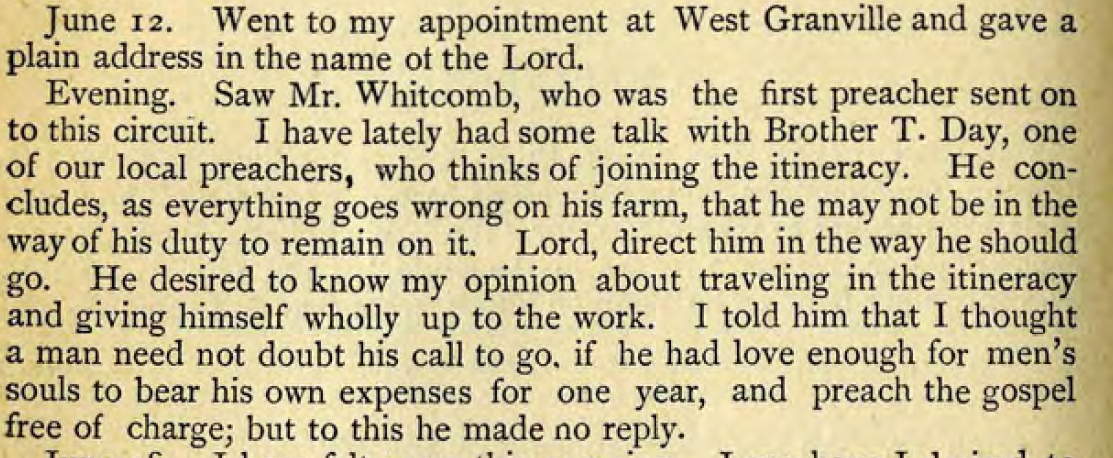
Woodworth, James W., My path, and the way the Lord led me, p. 48
Thomas Day was still living in Grafton, Ozaukee county—presumably still farming—according to the Wisconsin state census for 1855. The Thomas Day household was comprised of 4 white males and 2 white females, all of foreign birth. Three of the males were presumably Thomas and his two sons. Sister Eleanor/Hellen Day was probably one of the two females. Who were the other two? Perhaps brother John Day and John’s wife Mary? We don’t know.

Second marriage, ministry, and Minnesota
According to his obituary, Thomas Day “became a regularly ordained minister of the Methodist Episcopal Church” in 1856. And in 1857 he was “admitted to the Minnesota Conference” [of the Methodist Church] and assigned to a post in Red Wing, Minnesota. This was the first of several successful church building assignments that Day would undertake in Minnesota.4
Thomas Day’s first wife, Mary Ann Gould, died sometime after the family’s arrival in New York in mid-1846. She is missing from the family’s 1850 federal census, which suggests a death date prior to June 1, 1850. But there is also the possibility that she was still alive at that time and simply missed by the 1850 census enumerator. If that was the case, it is possible that she was the second woman enumerated in the Thomas Day household on the 1855 state census.
In any case, Thomas Day became a widower sometime between mid-1846 and mid-1858. Then, on June 17, 1858, he married a second time. His new bride was Julia Moore. She was born in New York state about 1822, and was almost 36 years old at the time of their marriage.
By the time the federal census was enumerated in June, 1860, Thomas and Julia Day were living in Faribault, Minnesota with Thomas Day’s two sons by his first wife, and with a new child of their own, daughter Emma, age 2.

Day, Thomas and family, Federal Population Census, 1860, for Faubault [sic, Faribault], Rice Co., Minnesota, lines 34-38. Original image is poor; click to open larger, somewhat easier to read image.
This 1860 census schedule is faded and hard to read. Lines 34-38 record the Thomas Day family, beginning with Thomas Day, age 51, born in England, a “Minister in the Meth[odist] E[piscopal Church],” owner of real estate worth $1000 and personal property valued at $300. Also in the household are ” JM” [wife Julia Moore Day], age 38, born in New York, and their children F. T., age 18, born in England, Thos. C., age 16, born in England, and Emma, age 2, born in Minnesota.6
Both boys are marked as having attended school in the past year, meaning any time between June 1, 1859 and June 1, 1860. The younger son, Thomas C. Day, is listed as having an occupation of “Teacher / Dist.,” suggesting that he is teaching in the local district school, probably following the completion of a two-year teacher-preparation course in his local school. (And see Thomas C. Day’s obituary, following note 7, below, for an explanation of how he taught during the summer months to pay his way through college.)
Onwards
Thomas Day labored with the Bonniwell party in the California gold fields for about three years. He returned to Ozaukee county, and tried farming for a few years more. By the late-1850s he was established in Minnesota as an ordained Methodist Minister. His 1901 obituary lists seven of the many churches that he built or founded in Minnesota. He was, it seems, very capable and well-liked and respected by all. In 1863, his flock in Mankato, Minnesota, had these words of approval printed in the local papers:
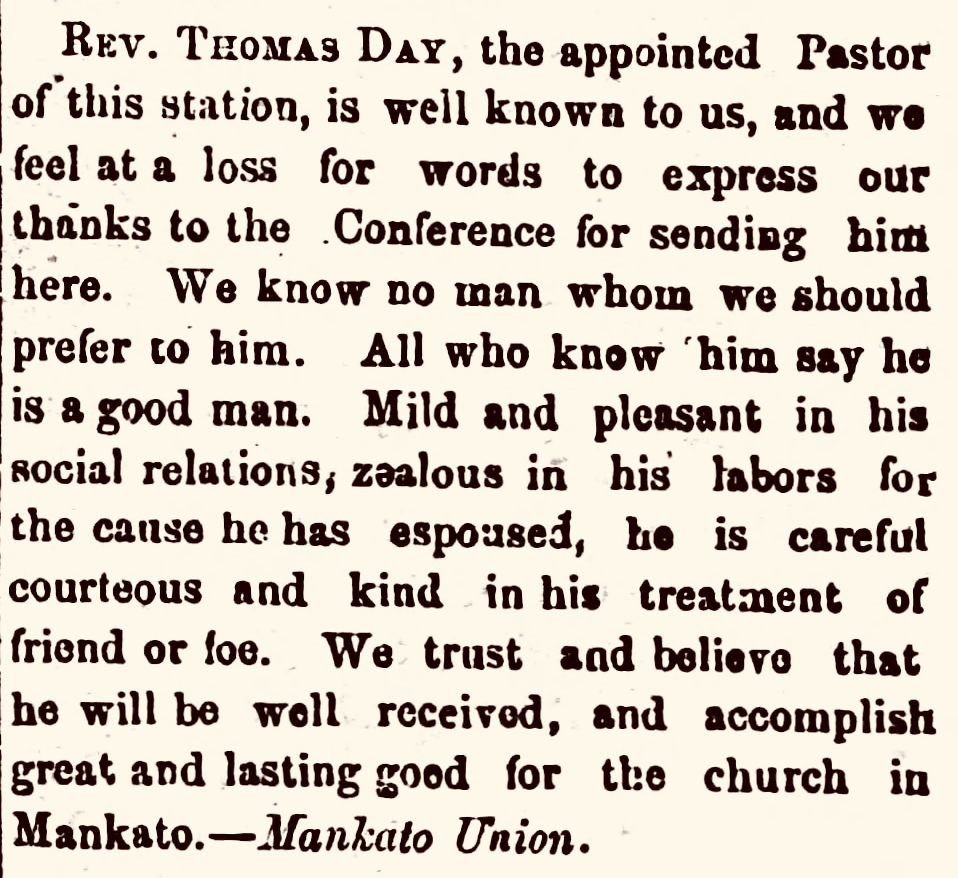
Day, Thomas, letter of approval, originally in Mankato Union, reprinted in Mankato, Minnesota, Goodhue Volunteer, Wednesday November 4, 1863, page 1
After twenty years in the ministry, around 1876 or ’77, Thomas Day retired and moved to Milwaukee, where he remained for about 16 or 17 years. Did he reconnect with his friends from the decade he spent in old Washington/Ozaukee county? If so, he left no evidence that I’m aware of.
In 1893 Thomas Day and Julia Day moved one last time, to Indianapolis, Indiana. Thomas Day died there in 1901. His second wife, Julia (Moore) Day followed him in death in 1905. Both are buried in Crown Hill Cemetery, Indianapolis.7
Two sons survived them, Frederick T. Day of Milwaukee and Thomas Charles Day of Indianapolis.8 Daughter Emma Day died sometime before the mid-1900 enumeration of the federal census. I have not been able to trace the life of sister Eleanor/Hellen Day after the 1850 federal census.
_________________________________
NOTES:
- 1846 Wisconsin territorial census image 983 of 1103, FamilySearch film #008117163.
- Thomas Day’s relationships with younger siblings John and Elenor/Hellen, and their father’s name (Thomas), have been established by finding and comparing various documents, including the 1841 UK census for Stoke Rivers, Devon showing that Thomas Day (father), wife Mary (aka Ellen?) and children John and Elenor were living together at Stoke Mill, where Thomas Day (father) was the Miller. Eldest son Thomas Day (the future Wisconsin immigrant) is not enumerated at the mill, which suggests that he is living elsewhere and may already be married to Mary Ann Gould.
There are assorted early 19th-century Church of England marriage and baptismal records for the Stoke Rivers area that connect Thomas Day to his siblings and their parents. It appears that brother John Day was married to Mary Redding on March 24, 1846, at the Church of England parish of Swimbridge, Devon, England, less than two months before their departure for the United States.
UK records for Wisconsin immigrant Thomas Day are sparse. My surmise is that he left the established Church of England and embraced Methodism some time before the 1841 UK national census and his (subsequent?) marriage to Mary Ann Gould, at a date and location unknown. - Thomas Day’s brother John Day may be the “Brother J. Day” that is mentioned from time to time in Rev. Woodworth’s diary, for example on pages 78, 112,154, 156, 187.
More research is needed into the life of Thomas Day’s brother John. I can’t find John or his wife anywhere on the 1850 U.S. federal census (unless he is the John Day, age 20, born in New York [sic], unemployed and living at a tavern/hotel in Milwaukee). Perhaps he was living the life of an itinerant Methodist preacher as suggested by some of the entries in Rev. Woodworth’s diary.
John and Mary Day and their five daughters were living in Cedarburg, Ozaukee Co., when the 1860 federal census was taken. John’s profession—following in his father’s footsteps—is listed as “Master Miller.” John Day has not been as financially successful as his brother Thomas (the gold prospector). In 1860, John Day owned only $300 worth of real estate, and had a personal estate of just $50.
John Day and family were in Iowa before the 1870 census was enumerated at West Point, Lee Co., in early August, 1870. There is a detailed—if not entirely accurate—family tree for him (“Rev. John Elwood Day”) at Ancestry.com (paid site) and his (free) FindAGrave memorial, with links to his spouses’ and children’s memorials, is here. - Thomas Day’s chronology gets a bit confused around 1856-1858. His obituary states that he was in Minnesota by 1857. But on May 10, 1857, “Brother [Thomas? or John?] Day” spoke at the burial of one of his (unnamed) Wisconsin neighbors. Rev. Woodworth found his words cheering and comforting and recorded the event in his diary of that date. It reminded Rev. Woodworth of Brother Day’s similarly cheering and comforting words spoken at the February, 1857, burial of Woodworth’s first wife, Mary Cerena Loomer.5

Woodworth, James W., My path, and the way the Lord led me, p. 103
- James W. Woodworth and Mary Cerena Loomer were married on March 1, 1838, in Washington (later Ozaukee) county. Jonathan Clark’s future father-in-law, Peter Turck, “an anabaptist preacher,” performed the ceremony. See Woodworth, James W., My path, and the way the Lord led me, p. 315.
Other records of this marriage include: “Wisconsin, Marriages, 1836-1930,” index, FamilySearch (https://familysearch.org/pal:/MM9.1.1/XRNY-T5W : accessed 12 Nov 2013), James W. Woodworth and Mary C. Loomer, 01 Mar 1838. - And yes, if you look at the calendar and do the math, Thomas and Julia (Moore) Day’s wedding date, the date Thomas Day took up his ministry in Minnesota, and the date of daughter Emma’s birth in Minnesota, circa 1858, all suggest that Emma’s conception may have preceded her parent’s marriage by many months. This was not uncommon in the Clarks’ era. (As my wife’s Grandpa Elmer used to say: “The first child can come at any time; all the rest take about nine months.”)
- Thomas Day’s FindAGrave memorial is here. Julia (Moore) Day’s FindAGrave memorial is here.
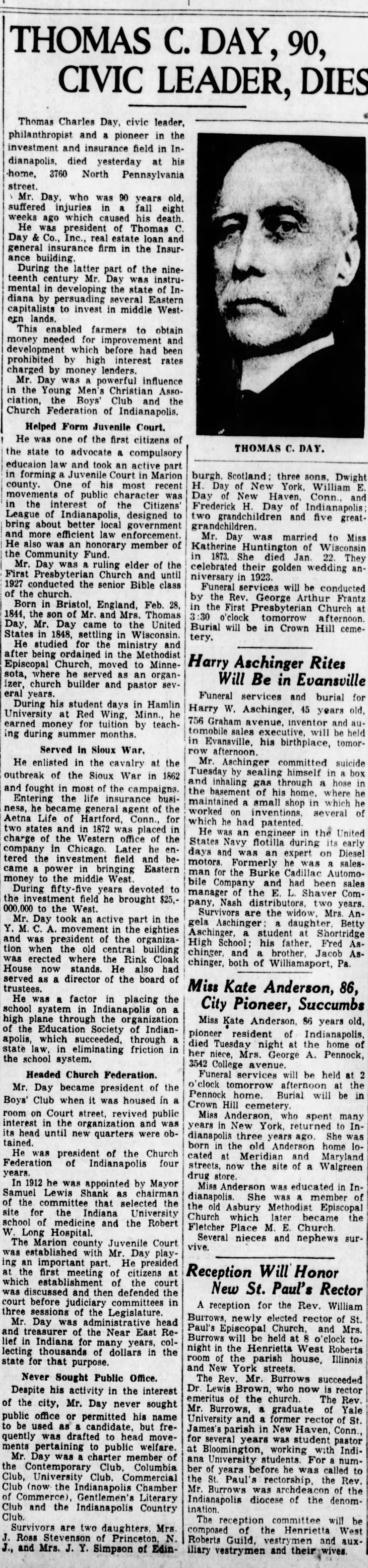
- Thomas and Mary Ann (Gould) Day’s son Thomas C. (aka Charles T.) Day led a long and notable life, most of which falls outside the scope of our work here at Clark House Historian. But in the interest of completeness, here is T. C. Day’s obituary, from the Indianapolis Star, February 14, 1935, page 3:
UPDATED: June 19 and 20, 2023 to correct some minor typos and infelicities. Last update June 21, 6:20 p.m. to correct spelling of Delbridge surname.
 Clark House Historian