Guess what I’ve been doing?

This is the second part of a multi-part look at local (Mequon and Washington/Ozaukee County) history sources. If you missed Part 2, I recommend you click this link and read that first.

In today’s post, I’d like to guide you to and through another one of the local histories that I’ve bumped into over the last decade or so. As in Part 1, I’ll include a link to a PDF copy of the source, make comments on the range and quality of the information in the book, and sum it up with an overall grade for accuracy, style, and usefulness.
“All sources lie.” — Lawrence of Arabia (supposedly)
That provocative quote begins the forward of Elizabeth Shown Mills’s monumental Evidence Explained (third edition, revised, 2017), the “Bible” of genealogical research, source evaluation, and modern citation practices. It makes an arresting opening for her almost 900-page book, devoted to historical and genealogical sources and how to cite them.1 But what does the author mean by beginning her book with Lawrence’s (supposed) quote? Here is part of her explanation:
Continue readingI’ve been preoccupied with all sorts of archival work lately, and I thought I’d pass along a few preservation tips for those of you that might have some “stuff” that you’d like to protect and save for the future.
Know your archival plastics!
Do you have photographs, artwork, manuscripts, letters, coins or currency that you’d like to preserve for years to come? Perhaps you’d like to enclose those items in a protective plastic enclosure, so that they may be viewed and handled with minimal damage? That’s a fine idea, but you should know that when it comes to archival storage, there are good plastics, and (very) bad plastics. With that in mind, I thought I’d share this helpful infographic, hoping that some of you may find it useful.

As always, feel free to click the image for a clearer, downloadable and/or printable version of the image.
Continue readingIf you are interested in the history of the Jonathan Clark House, there are a number of published local histories that you might consult. Many of them are available online, as free, searchable, PDF downloads from Internet Archive, GoogleBooks, the Library of Congress, and other digital repositories. This is pretty cool but, as you might expect, not all sources are equal. Some are more reliable than others. Some contain detailed information about early settlement, settlers, government and politicians, pioneer businesses and other local affairs, often drawing upon old primary sources, some of which have since disappeared. Other histories are more content to paraphrase (and sometimes mangle) earlier volumes. How do you know which to trust?
A guide for the perplexed
In today’s post, I’d like to guide you to and through several of the published histories that I’ve spent a lot of time with. I’ll provide links to PDF copies where available, make a few comments on the range and quality of the information in each book, and give each book an overall grade for accuracy, style, and usefulness.

We’ve had some snow in my corner of southeastern Wisconsin, several modest snowfalls over the past few days. I’ve had to shovel the walks and driveway at our house a few times this week, and there’s more snow—and shoveling—in the forecast. With that in mind, I thought you might enjoy the snow-related images and stories from a revised edition of this post, which originally appeared here in February, 2023.

Homer, Winslow, A Winter-Morning,—Shovelling Out, 1871. Wood engraving. Brooklyn Museum, Gift of Harvey Isbitts.
Winter chores
I empathize with the lads in this 1871 engraving by Winslow Homer. Unlike these fellows, with their (homemade?) wooden shovels, I have a lightweight, sturdy, ergonomic, plastic and metal snow shovel to work with. And although we do get snow in 21st-century Wisconsin, I haven’t had to deal with shoulder-high accumulations like the ones in Homer’s picture since I lived in western Massachusetts in the early 2010s. It looks like our 1871 snow shovelers are dealing with the kind of snowfall that Clark family neighbor Rev. James W. Woodworth described in these January, 1871, diary entries:
Continue readingHo! Ho! Ho! — a little nonsense for the end of the year
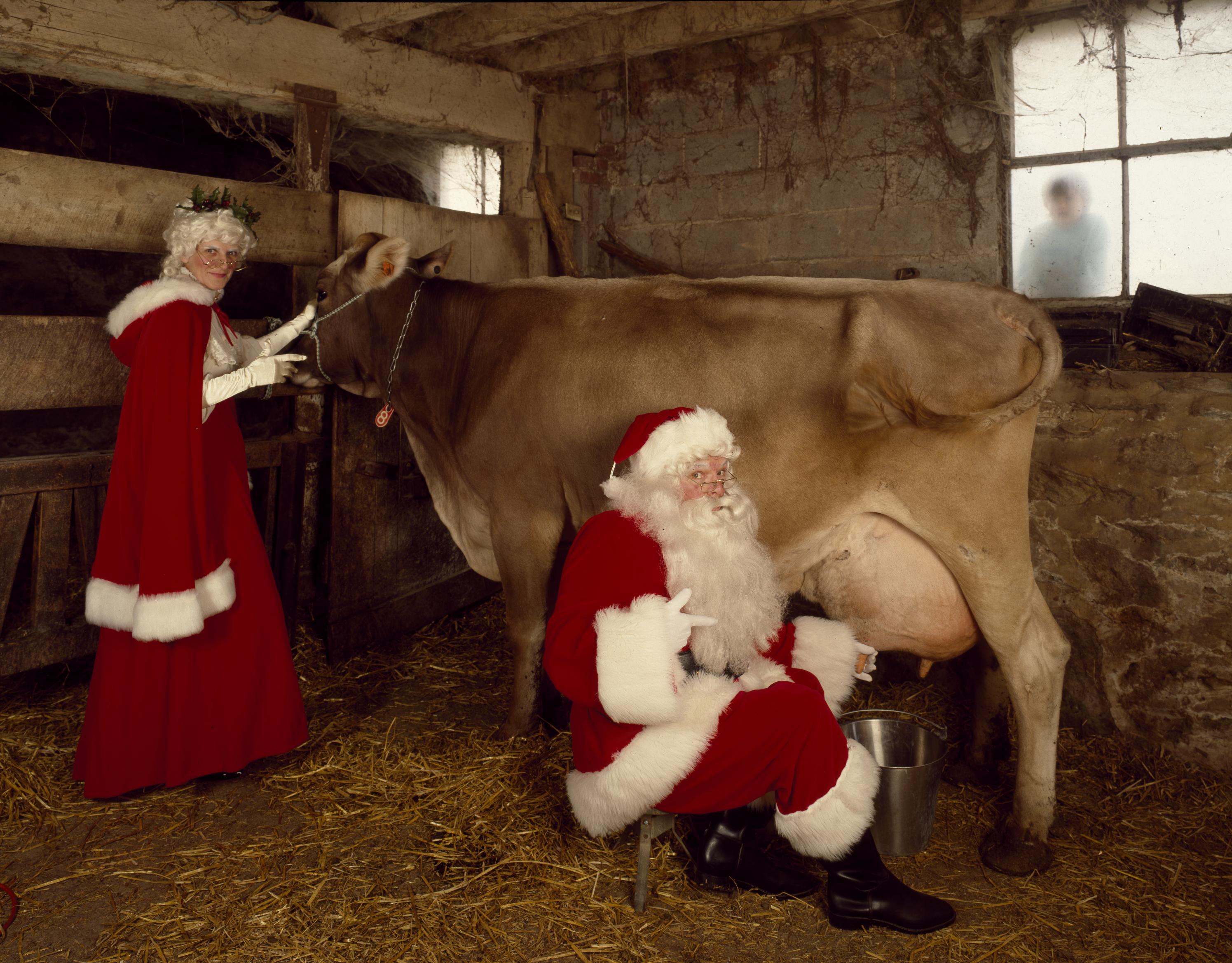
I found a photo. It needs a better caption. Something funny, and perhaps seasonal, too?

Highsmith, Carol M, photographer, “Santa and Mrs. Claus milk a cow. Why, we’re not exactly sure.” c. 1980-2010. Library of Congress
Send your entry (or entries, as many as you like!) to me via the blog’s “Leave a Reply | Write a Comment…” space. I’ll publish all the comments (let’s keep it clean and non-partisan) and I’ll pick a winner.1 Go to it, history lovers!
Needless to say, this photograph is—to the best of my knowledge—not related in any way to the Jonathan Clark House Museum, its board, staff, or volunteers. Except that it has a cow. And a barn. As did the Clark family back in the 1840s-1850s.
Continue reading
[Editor], daguerreotype with added color highlights c.1855 (slightly cropped, and color adjusted), Smithsonian American Art Museum, Gift of Charles Isaacs, (link), Creative Commons CC0 license. Click to open larger image in new window.
Hey! It’s almost been a month since my last post. Sorry about that. I haven’t gone this long between posts in several years, I think, and now I’ve got (the digital equivalent of) a towering pile of half-written posts to finish and topics to discuss. That said, I have been busy…
Continue reading
Homer, Winslow, A Winter-Morning,—Shovelling Out, 1871. Wood engraving. Brooklyn Museum, Gift of Harvey Isbitts.
We had a winter storm yesterday, so I had to shovel the walks and driveway at our house a few times during the snowfall, and once again this morning.
Continue reading