In a follow-up to our earlier News… post, I’m pleased to note that the Jonathan Clark House Museum website is once again up and running.
Continue reading
In a follow-up to our earlier News… post, I’m pleased to note that the Jonathan Clark House Museum website is once again up and running.
Continue readingHello again! Sorry for the long blog silence. I hope all is well with you. I’ve been busy offline, in part answering some interesting questions from CHH readers.
I’ve also been doing a lot of reading, as I try to get a clearer understanding of several ongoing Clark House Historian research topics. It’s going well, but I haven’t got much written up yet. More coming soon. Watch this space.
Under repair

By the way, if you’ve been to the official Jonathan Clark House website in the past few days, you may have seen this 404 error message, in place of our usual colorful and informative pages:
I contacted Clark House director Nina Look, and she assures me that they are aware of the problem, working on a solution, and expect the Jonathan Clark House museum website to be back up shortly. (It’s even possible that the problems may be fixed by the time this blog post goes live on Friday morning.)
Meanwhile…
Continue readingUPDATED (1:30 p.m.): What would the New Year be without a typo? The meeting is, indeed, on Wednesday, January 17th (not the other date that CHH subscribers received in their original email version of this post). So I’m pulling the erroneous post and sending this revised version to all CHH subscribers. My apologies for crowding your inbox.
Let’s see if the weather behaves this time!

Last week’s annual meeting of the Friends of the Jonathan Clark House had to be postponed due to foul weather. The meeting has been rescheduled to this Wednesday, January 17, 2024 at 6:00 PM (note later start time), at Spectrum Investment Advisors Cafe, 6329 West Mequon Road, Mequon, WI. 53092
Want to attend? Please RSVP to JCH Executive Director Patrick Steele at jchmuseum@gmail.com
See you Wednesday!
No new research today. I’m celebrating a big event with family, and taking a few days off from emails and major blog posts while I do.
“They just don’t name ’em like they used to…”
I’m loath to leave loyal blog readers without some Clark House History to while away the time until our next big CHH post, so I made another word search puzzle.
Your assignment today is to find the vintage Stanstead-area settler first names, all of which are documented from Clark-era sources in and around Stanstead, Lower Canada, circa 1790-1840, and many of which will feature in future posts as we search for JMC’s roots.

As in our previous post, just click the image to open and print your own copies of this version of the puzzle. Or, if you’d like to play online, just click this link: https://thewordsearch.com/puzzle/6173938/stanstead-first-names-c-1790-1840/
Continue readingI’m currently (happily) distracted as I get ready for a special family event, and blogging may be sparse for the next several days. But I’m still chipping away on our search for Jonathan M. Clark’s roots, looking for possibly-related Clark names in the early Land Petitions of Lower Canada, 1764-1841. Which is kind of like doing a Word Search puzzle, only with faded documents and sometimes-illegible 18th-century handwriting.
Beginner Level
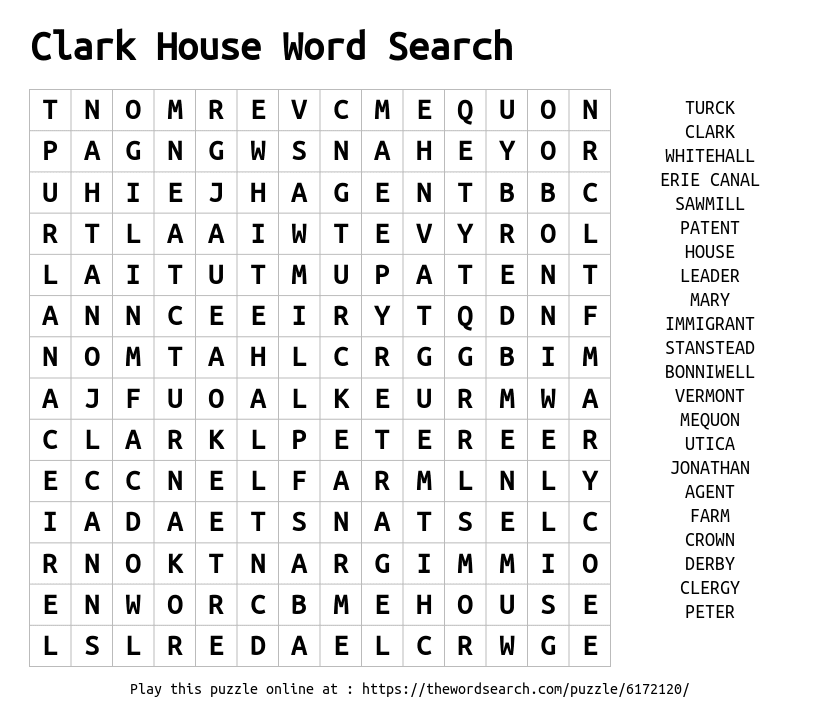
Would you like to join in the search and Help the Historian? Here’s a “Searching for JMC’s Roots”-themed word search puzzle I made, just to get you warmed up:

Click the image to open and print your own copies of this version of the puzzle. Or, if you’d like to play online, just click this link: https://thewordsearch.com/puzzle/6172120/clark-house-word-search/
Look for the Clark House related words in all directions: horizontally, vertically or diagonally, both forwards and backwards. You can solve the online puzzle as many times as you like, and each time you play again, the layout of the puzzle changes. (If you play online, ignore the big orange rectangular button at the bottom of the screen that says “Next→”. It’s just a link to a page of unrelated ads.)
Each time you play you can also change the level of difficulty. Once you’ve developed your word-finding skills with our online puzzle, it’s time to Level Up!
Expert Edition
Here’s one of my current “puzzles,” the original 1792 Leaders & Associates’ petition to the Crown for a grant of land that would eventually become the Township of Stanstead, Lower Canada. Continue reading (below) to view the front side of the petition page. How many “Clark” signatures can you find? And can you transcribe all their first names accurately?
Continue reading
… and I’ve got a lot of reading, sorting, thinking, and writing to do before my next posts are ready.
So no new Clark House history today. Have a great weekend. I’ll be back on Monday. (I hope!)
Continue readingA late-summer look at Clark House Historian news and upcoming posts…
First, a few stats…

I missed publishing my annual review of CHH stats on the blog’s seventh (!) anniversary last March. But here are a few numbers for those of you keeping score at home, beginning with this year’s (incomplete) numbers, as of August 20, 2023:
• Number of visitors, 2023: 2,262
• Number of views, 2023: 4,660
• Number of posts, 2023: 38
• Number of words, 2023: 50.5K
For comparison, here are the numbers for all of last year:
• Number of visitors, 2022: 2,424
• Number of views, 2022: 5,523
• Number of posts, 2022: 62
• Number of words, 2022: 68.2K
The blog’s all-time outreach on behalf of the Jonathan Clark House Museum (as of Aug.20, 2023), includes:
• Number of visitors, all time: 8,985
• Number of views, all time: 26,819
• Number of posts, all time: 361
• Number of words, all time: circa 382K
• Subscribers: 49
Full disclosure: In addition to sharing Clark House history with you all, I use the blog as a searchable archive of the facts, analyses, and images that I find or create during my work as Clark House Historian. I often search for and refer to previous blog posts as I prepare new posts and other work. So take the “visitor” and “views” stats with a grain of salt, and assume that at least a certain number of visits to the various blog posts are mine.
A bit of a ‘”Bonniwell break”…
I was at the Friends of the Clark House annual meeting back in January, 2022, and I overheard Clark House director Nina J. Look mention a little research project focused on the youngest—and least documented—member of the Mequon’s pioneer Bonniwell family: Clark House neighbor and brother-in-law, Alfred T. Bonniwell. I volunteered to help with a “short series” of related blog posts. After all, when I began this project, I had fewer than a dozen records documenting Alfred’s life. How long could a quick survey of those take? A month or so, at most?
Continue readingJCHM Newsletter is here!
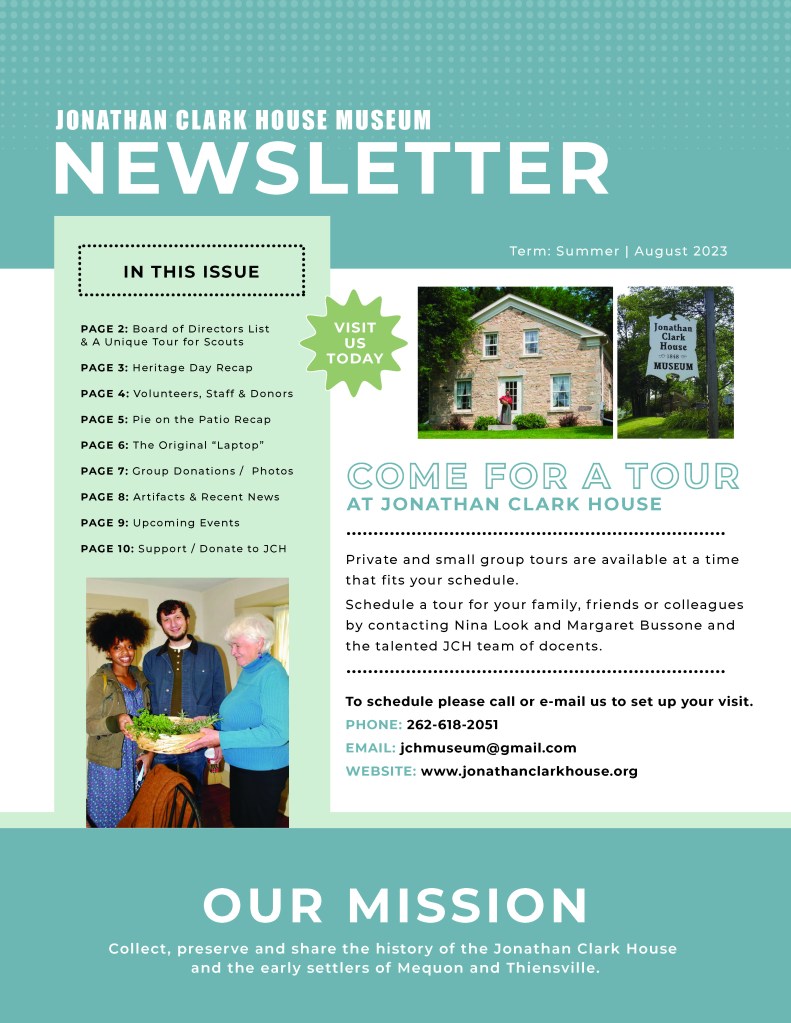
Here’s the Summer | August, 2023 edition of the Jonathan Clark House Museum newsletter. It’s filled with Clark House news, notices of upcoming events, and recaps and photos of a variety of summer happenings. Click the image below to view and/or download your own PDF copy of the complete newsletter.

Thanks to all involved in producing a summer full of Jonathan Clark House activities, especially museum director Nina J. Look and our wonderful crew of docents, volunteers and board members. And a tip of the hat to Nina (and our savvy graphic designer, Shayla Krantz) for this latest edition of the newsletter.
But wait—there’s more!
Continue readingI hope you enjoyed Monday’s post Help the Historian — what’s Nellie’s last name? and that you’re now working on your best guess for Nellie’s almost-illegible surname.
A historical handwriting puzzle like this is fun when the stakes are low and you don’t have any pressure to get the job done quickly. But did you know that there are several hundred federal employees in Salt Lake City who decipher thousands and thousands of bad or damaged printed and handwritten addresses every day? Let’s let YouTube’s excellent experience-it-yourself man, Tom Scott, show us how it’s done:
How the U.S. Postal Service reads terrible handwriting
It’s an amazing system, when you think of it. To begin with, the speed and accuracy of optical character recognition (OCR) technology has improved dramatically over the years. But when the writing is really bad, or smudged? Then the mail is viewed by the men and women of the USPS Remote Encoding Center in Salt Lake City process, and they read and key in 1.2 billion (that’s billion with a B) images of mail every year. My hat’s off to the USPS employees that can do this fast-paced detective work so efficiently, day after day. Meanwhile, how about you and your deciphering skills?
Continue readingI’m still thinning out my backlog of Bonniwell-related documents that currently crowd my computer desktop. Today’s post includes some multimedia links, too. I hope you enjoy them.
A long, narrow, disagreeable, ill-built town…
Unlike the glowing prose of the description of Chatham we discussed earlier in Bonniwell background: Chatham, Kent 1832, not everyone was impressed by the Bonniwell’s home town, at least not in the late-1700s. For example, Edward Hasted (1732-1812), in his monumental History and Topographical Survey of the County of Kent (second edition, vol. 4, Canterbury, 1798, pp. 191-226) had this to say:
THE TOWN OF CHATHAM, the greatest part of which has been built since the reign of queen Elizabeth, adjoins to that of Rochester, which, with Stroud [sic, Strood], makes one long street of more than two miles in length, of which Chatham is one, being commonly called the Three Towns, through which the high road leads from London to Dover, as above mentioned.
It is situated close to the bank of the Medway for about half a mile, after which the river leaving the town flows north-north east. It is like most sea ports, a long, narrow, disagreeable, ill-built town, the houses in general occupied by those trades adapted to the commerce of the shipping and seafaring persons, the Victualling-office, and the two breweries, and one or two more houses, being the only tolerable built houses in it.
The 12 volumes of the second edition of Hasted’s complete magnum opus have been digitized and made available at British History Online. The quoted bits above are a brief excerpt from Hasted’s almost 9,000 words devoted to the parish history of Chatham. Click the link for online access, or download a PDF copy here.
I discovered Hasted’s sour appraisal of 1798 Chatham while watching an interesting YouTube video devoted to the history of two major disasters that befell the town—and our Bonniwell and Hills families—in the early 1800s:
Continue reading