On the northern frontier: (resuming) the search for JMC’s roots

The scene above is A settler’s hut on the frontier, by W. H.Bartlett and R. Sands, published in London in 1841.1 Based on the known locations of some of Bartlett’s other, similar images, published at about the same time, it is almost certain that the scene depicted was drawn from life in Lower Canada (modern day Québec), and possibly in or near Stanstead, or one of the neighboring Eastern Townships of Lower Canada.

The landscape, dwelling, and people in this scene would have been very familiar to young Jonathan M. Clark. They are the physical and human landscape of his first three decades of life—from about 1812 to 1831—in the vast and sparsely settled north woods of Stanstead, Lower Canada, and nearby Derby, northern Vermont.

I have been searching Vermont and Lower Canada for Jonathan M. Clark’s parents, possible siblings, or other kin for over seven years, and have not yet been able to identify any. As it’s been a while since the blog focused on JMC’s roots, I thought it was time to organize our previous research, publish new sources and findings, and see if we can get closer to locating the family of the builder and first occupant of Mequon’s 1848 Jonathan Clark House.

Continue reading
The original “laptop”

This is an expanded—and lavishly illustrated—version of a piece that first appeared in the Summer | August 2023 edition of the Jonathan Clark House Newsletter. I hope you enjoy the extra information, images, and the vintage writing tips.
UPDATED: August 27, 2023, to clarify provenance of Robert Beveridge’s writing desk.

One of the ways we collect, preserve and share the history of the Jonathan Clark House and the early settlers of Mequon and Thiensville is by acquiring and interpreting furniture, tools, clothing, and various accessories that would have been familiar to the Clarks and their neighbors. One particularly fine item in our collection is this box, a treasured heirloom generously donated to the Clark House collection by JCH Friend Frederick Bock.

Photo courtesy of Tom Gifford (2023)

When closed it measures about 16 x 6 x 10 inches. It is made of wood, stained a rich golden brown. On the top is a brass plaque inscribed Rt.[Robert] Beveridge / 1854. And there’s a lock on the front. Why is that?

Continue reading

Bonniwell background: clues from the Great Fire reports

Today I’d like to share two rare and unusual official documents, and note how there are early 19th-century Bonniwell family genealogical clues hidden in each.

The Bonniwells and related families in Kent, 1667-1832

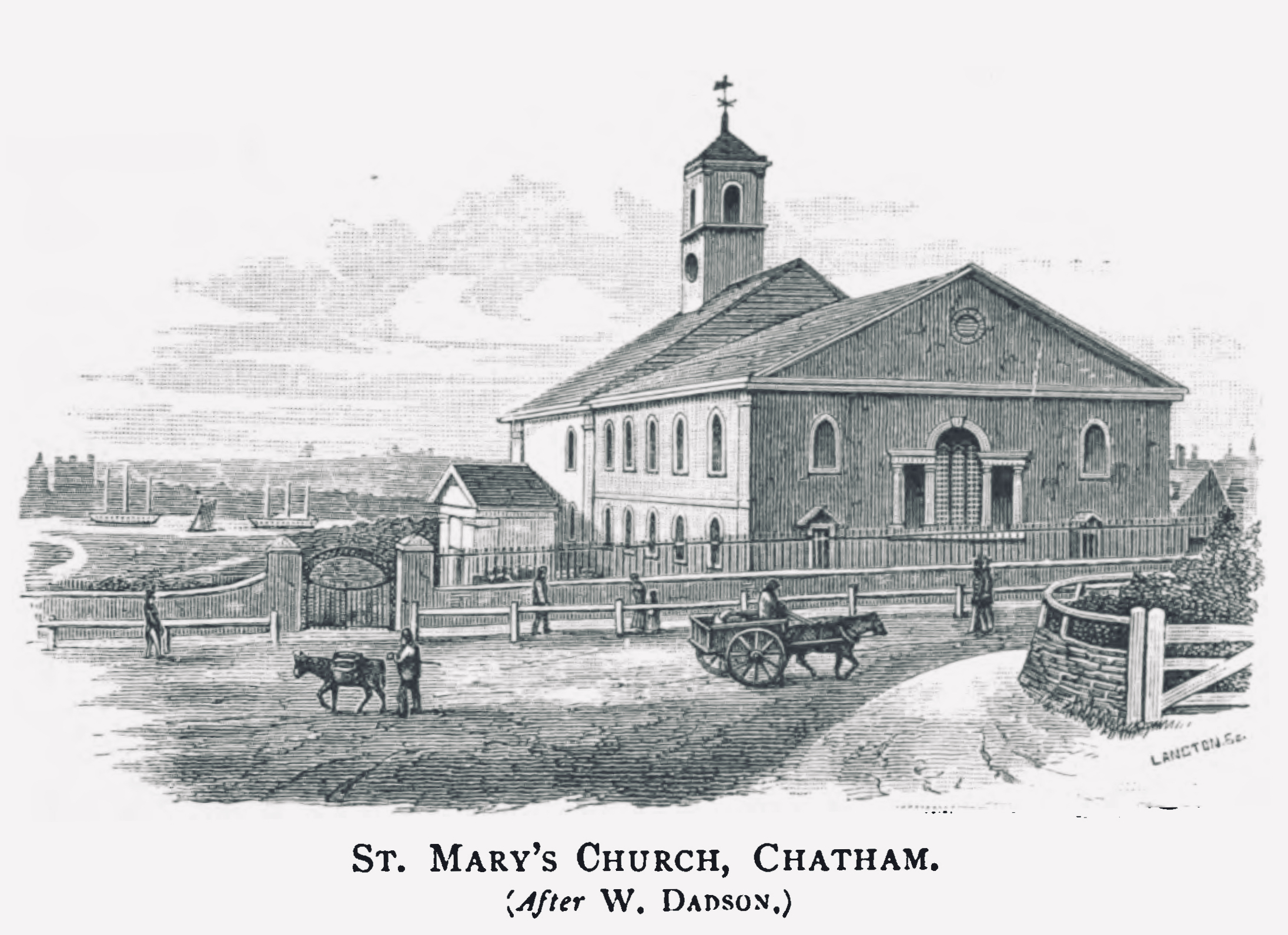
The image below is of St. Mary’s Church, Chatham, much as it looked at the time of Alfred T. Bonniwell’s christening there in 1826. It’s likely that the Bonniwells regularly attended services here during their years in Chatham. St. Mary’s has had a long and eventful history as a parish church, and has been reconstructed several times.1

Engraving based on original art by W. Dadson, in Robert Langton’s The Childhood and Youth of Charles Dickens, Manchester, 1883, page 72. GoogleBooks, accessed 1 Aug. 2023.

A surprising number of our early Mequon immigrants had ancestors in southeast England’s venerable Kent county. Early Mequon settlers (and their spouses) from the Ashby, Bonniwell, Dunning, Eastree, Hills, Long, Moss, Munn, Smith and Whitehead families all had roots in Kent, many of them in or around the town of Chatham. For an introductory overview of this, see Monday: Map Day! – the Bonniwells in Kent, featuring a very cool map of the county from 1665, with added annotations that indicate many of the of the family’s various Kent residences, christenings, marriages, and burials over the subsequent decades.2

Family history before the census of 1841

The first modern, “all name,” census of England was enumerated in 1840 and published in 1841 and, as with every succeeding decennial census, the 1841 Census of England and Wales is full of useful information for historians and genealogists. But the Bonniwells left England for North America in 1832, almost a decade before the 1841 census was enumerated. How do we reconstruct and understand family relationships and local history, especially on the female branches of the family tree, before 1841? Today we’ll look at two obscure bureaucratic reports that may offer some useful clues.

Continue reading

Monday: Map Day! – the Bonniwells in Kent

OK, this “Monday: Map Day!” is a few days late (and has been updated since posting, see notes 7 & 8). But I needed a bit more time to edit this beautiful and historic map of the County of Kent for you. Kent was home to Mequon’s pioneering Bonniwell family and their kin for almost 150 years, and taking a close look at its geography may prove helpful for understanding the family and its history, including some of the earlier inscriptions in the Bonniwell family Bible.

Cantivm Vernacule Kent, 1665

Let’s begin with a view of the complete, original map. It was made in 1665, just before James Bonniwell (1636-1709) moved his family from Sutton-Courtney, Berkshire, in south-central England, to Kent, in the southeast.1 As always, I encourage you to click the images to view higher-resolution versions of each map in a new window. Take some time to zoom in and out and scroll around. There’s a lot to see, so I’m going to keep the commentary to a minimum.2

This 1665 map, titled Cantivm Vernacule Kent [Cantium, in the vernacular, Kent], is part of a much larger work, Joan Blaeu’s magnificent Atlas Maior Sive Cosmographia Blaviana, published in Amsterdam between 1662-1672. This is another amazing map made available online by the David Rumsey Map Collection, whose staff provided this commentary:

Continue reading

Bonniwell background: more Chatham links & docs

I’m still thinning out my backlog of Bonniwell-related documents that currently crowd my computer desktop. Today’s post includes some multimedia links, too. I hope you enjoy them.

A long, narrow, disagreeable, ill-built town…

Unlike the glowing prose of the description of Chatham we discussed earlier in Bonniwell background: Chatham, Kent 1832, not everyone was impressed by the Bonniwell’s home town, at least not in the late-1700s. For example, Edward Hasted (1732-1812), in his monumental History and Topographical Survey of the County of Kent (second edition, vol. 4, Canterbury, 1798, pp. 191-226) had this to say:

THE TOWN OF CHATHAM, the greatest part of which has been built since the reign of queen Elizabeth, adjoins to that of Rochester, which, with Stroud [sic, Strood], makes one long street of more than two miles in length, of which Chatham is one, being commonly called the Three Towns, through which the high road leads from London to Dover, as above mentioned.

It is situated close to the bank of the Medway for about half a mile, after which the river leaving the town flows north-north east. It is like most sea ports, a long, narrow, disagreeable, ill-built town, the houses in general occupied by those trades adapted to the commerce of the shipping and seafaring persons, the Victualling-office, and the two breweries, and one or two more houses, being the only tolerable built houses in it.

The 12 volumes of the second edition of Hasted’s complete magnum opus have been digitized and made available at British History Online. The quoted bits above are a brief excerpt from Hasted’s almost 9,000 words devoted to the parish history of Chatham. Click the link for online access, or download a PDF copy here.

I discovered Hasted’s sour appraisal of 1798 Chatham while watching an interesting YouTube video devoted to the history of two major disasters that befell the town—and our Bonniwell and Hills families—in the early 1800s:

Continue reading

Random bits of Gold Rush history

UPDATED, May 28, 2023 with additional information about Panama (City) and Postal Museum hours.

I’m still organizing a final roundup of what we know about the Bonniwell gold rush expeditions and when everyone returned to Wisconsin. Until that’s ready, here are three random bits of history that might interest you. All are closely tied to the homecoming experiences of the Clark House neighbors that went prospecting in California between 1849 and the mid-1850s. And if you missed our series of Farewell to California! The Bonniwell party returns, you can catch up with these links to Part 1, Part 2, Part 3 and Part 4.

Piracy

In a follow-up question to part 4 of this series, reader Laura Rexroth asked: “Reading about the robberies on land, traveling from San Francisco to New York, I’m wondering if there was any piracy at sea with all these ships carrying so much gold dust?”

That’s a good question. As I mentioned in my original reply, the U.S. Mail Steamers that served the Pacific and Atlantic sides of the California mail route were considered the latest and greatest in ocean transportation and I suspect they could probably out run most other ships of the day. That said, I did find this interesting news item, “Arming of the Chagres steamers” on page 2 of the September 10, 1851, Milwaukee Weekly Wisconsin:

Continue reading

Finis, 2022

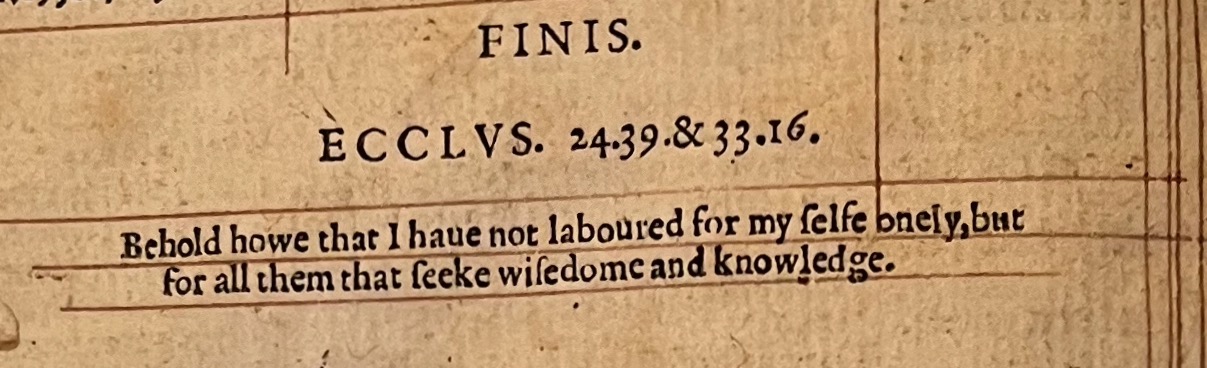
[The Bible,] Geneva version, published by Christopher Barker, London, circa 1580-1588. Collection of the Jonathan Clark House, photo credit: Reed Perkins, 2022.

What a year!

Finis. The End. Today is December 31, the last day of a long and eventful 2022. I’m not up to the task of summarizing all the highs and lows of the past year. I’ll leave that to others.

But I thought recalling one special summer day at the Clark House might make a nice valediction at the close of the old year and the beginning of the new. And for me, without question, the best day for the Clark House this year was July 23, 2022, the day we celebrated the generous donation of the historic Bonniwell family Bible and papers.

Continue reading