Guess what I’ve been doing?
In a recent CHH post I wrote about my Saturday, August 16 visit to, and presentation at, the WSDAR’s excellent Fort Winnebago Surgeons Quarters historic site. That was worth a road trip in itself. But since I was heading up to Portage, I decided to make a history weekend out of the occasion. So on Friday the 15th, I spent a fine few hours touring the nearby Historic Indian Agency House and museum, just a short distance from the Surgeon’s Quarters across the old channel of the Fox River.

Historic Indian Agency House, 2025. Photo credit: Reed Perkins
The Historic Indian Agency House
The Historic Indian Agency House (HIAH) is one of Wisconsin’s oldest museums and a “must see”, for those of you interested in the early days of the Wisconsin Territory and the history of the state’s original Native American inhabitants and their forced removal during white settlement in the 1820s, ’30s and beyond. Like the nearby Fort Winnebago and its remaining Surgeon’s Quarters, the story of the HIAH overlaps and intersects with the story of Jonathan M. Clark and his 1833-1836 military service at Fort Winnebago’s headquarters post, Fort Howard, in Green Bay.
Continue readingIt’s been a while, I know! One thing led to another and this summer ended up being a very quiet summer here on the CHH blog, with just a post or two over the past few months. My apologies to you all. However, I have been very busy “behind the scenes,” reading, researching and writing all summer long, and I have lots of new historical information and stories to share with you.
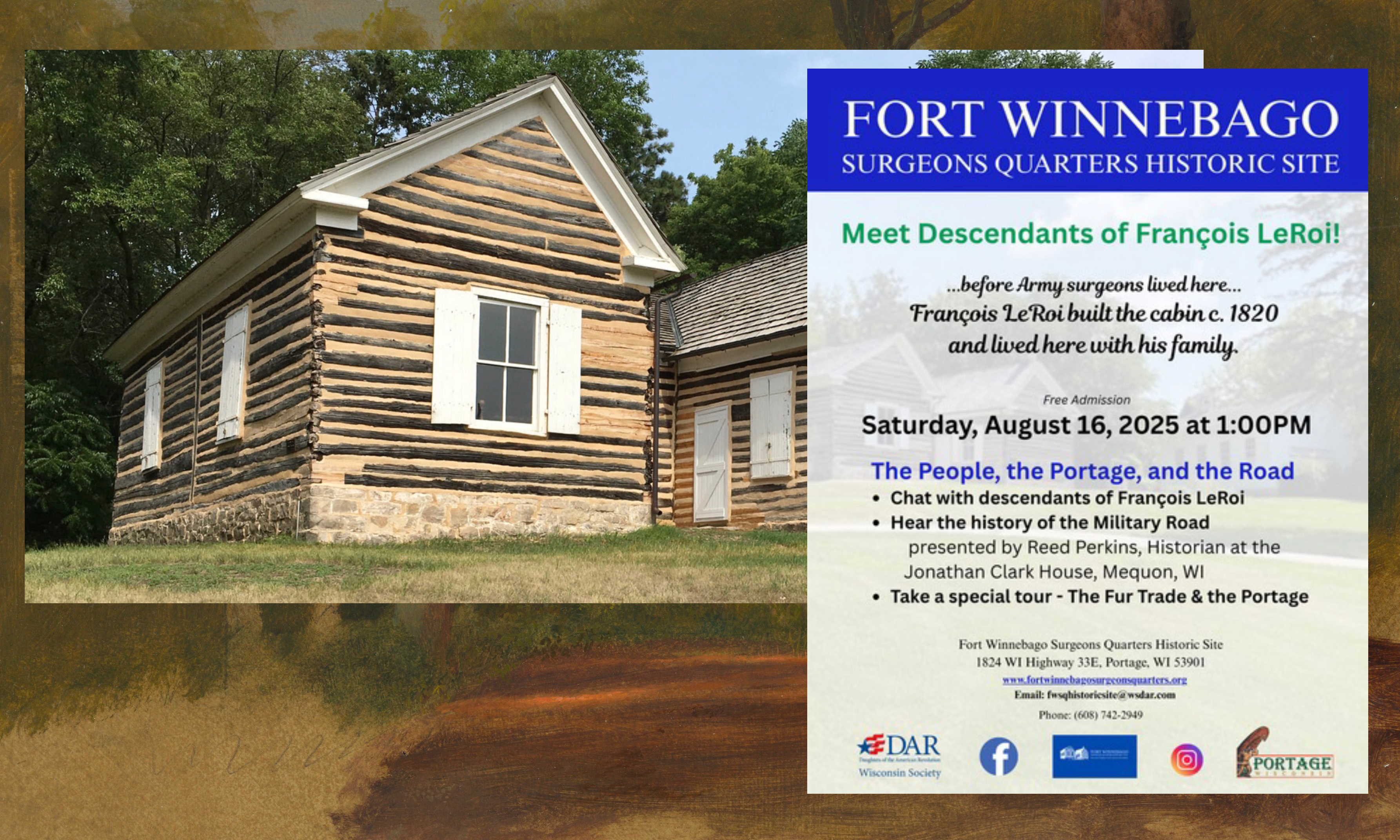
Fort Winnebago Surgeons Quarters—and more
One of the projects that has kept me busy this summer was researching and preparing a presentation that I gave last Saturday, at the historic Fort Winnebago Surgeons Quarters museum as part of their The People, the Portage and the Road event. Originally, my talk was going to be a lightly-revised update of my September, 2024 talk at the Wisconsin Society of the Daughters of the American Revolution’s Fall Workshop in Oshkosh.

That talk, “Building the Military Road,” contained about 45 minutes of detailed information about Wisconsin’s first federal road, and the men that built it—including our own Sgt. Jonathan M. Clark—tightly squeezed into about a half-hour time slot. The presentation was well-received, and I was invited to repeat that talk at this August, 2025, event at the WSDAR’s Fort Winnebago Surgeons Quarters museum in Portage.
However! The August 16th event was also going to be a reunion of the descendants of François LeRoi (aka Francis LeRoy or Roy)—the man that first built and occupied the historic surgeon’s quarters (1816-1829), and it was suggested that I include some Francis LeRoy related information in my talk, a very reasonable request. Since I already knew quite a bit about the Military Road, the Portage, and the life and times at Forts Howard and Winnebago in the 1830s, I thought I would just need to make a few minor cuts to my original talk, find a few, possibly obscure or unknown, LeRoi documents, add them to the presentation and, well, that would be just the thing! Well…
Continue readingJust a reminder…
249 years ago today, representatives of all thirteen of Britain’s American colonies, gathered “in congress” in Philadelphia, and publicly declared our independence from “George the Third, by the Grace of God, King of Great Britain, France, and Ireland, Defender of the Faith, and so forth,” and his distant and unresponsive legislature. The Americans proposed to separate—forever—from their Divinely appointed King, and form a new and independent nation, the “united States of America.” This decision was bold, completely unprecedented in a world dominated by autocratic monarchs, and potentially fatal for anyone that supported this Declaration of Independence. From the King’s point of view, the authors, his subjects, were committing treason.

After a public reading of the Declaration of Independence at Bowling Green, on July 9, 1776, New Yorkers pulled down the statue of King George III.
The authors of the Declaration were clear-eyed about the stakes, yet unwavering in their desire to separate from the King. They closed their—our—Declaration of Independence with their unanimous avowal that, […] for the support of this Declaration, with a firm reliance on the protection of divine Providence, we mutually pledge to each other our Lives, our Fortunes and our sacred Honor.
The Declaration of Independence is our pivotal foundational document. People risked their lives and fortunes by creating and signing it. Thousands of Patriots died in the subsequent War of Independence in order to make the “united States of America” a reality. A large number of British-Americans, still loyal to their monarch, fled the 13 colonies and migrated to the King’s remaining possessions to the north, including Nova Scotia and the Province of Quebec.
Through it all, the ideals expressed in the Declaration inspired generation after generation of Americans, including Jonathan Clark and his ancestors, as attested in this excerpt from daughter Caroline (Clark) Woodward’s 1893 biographical sketch:
[…] Jonathan M. Clark, was a Vermonter of English descent, who, born in 1812, of Revolutionary parentage, inherited an intense American patriotism.
Jonathan Clark and his Mequon neighbors—including native-born “Americans,” as well as more recent immigrants from Ireland, the German lands, the United Kingdom, Nova Scotia, and elsewhere—knew the Declaration, read it aloud at patriotic events (in English and German!), and shared its anti-monarchical sentiments.
This July 4th, before you head to the beach or light the barbecue, why not refresh your memory and read the document that created our nation, and forever declared our freedom from the “absolute Despotism” of kings?
The unanimous Declaration of the thirteen united States of America,
When in the Course of human events, it becomes necessary for one people to dissolve the political bands which have connected them with another, and to assume among the powers of the earth, the separate and equal station to which the Laws of Nature and of Nature’s God entitle them, a decent respect to the opinions of mankind requires that they should declare the causes which impel them to the separation.
Continue readingAmong the real pleasures of writing a blog like this are the comments I receive from CHH readers. Recently, I heard from reader James Cornelius of nearby Grafton, Wisconsin,1 who had some thoughts about our January 24, 2025, post “Help the Historian: Mysterious (Bible?) Fragment.” 2
As the original post explained, I had been examining a number of loose Bonniwell papers, scraps, and other ephemera that were donated to the Clark House along with the Bonniwell family Bible itself, and I was particularly interested in one little fragment of printed text that had me baffled.
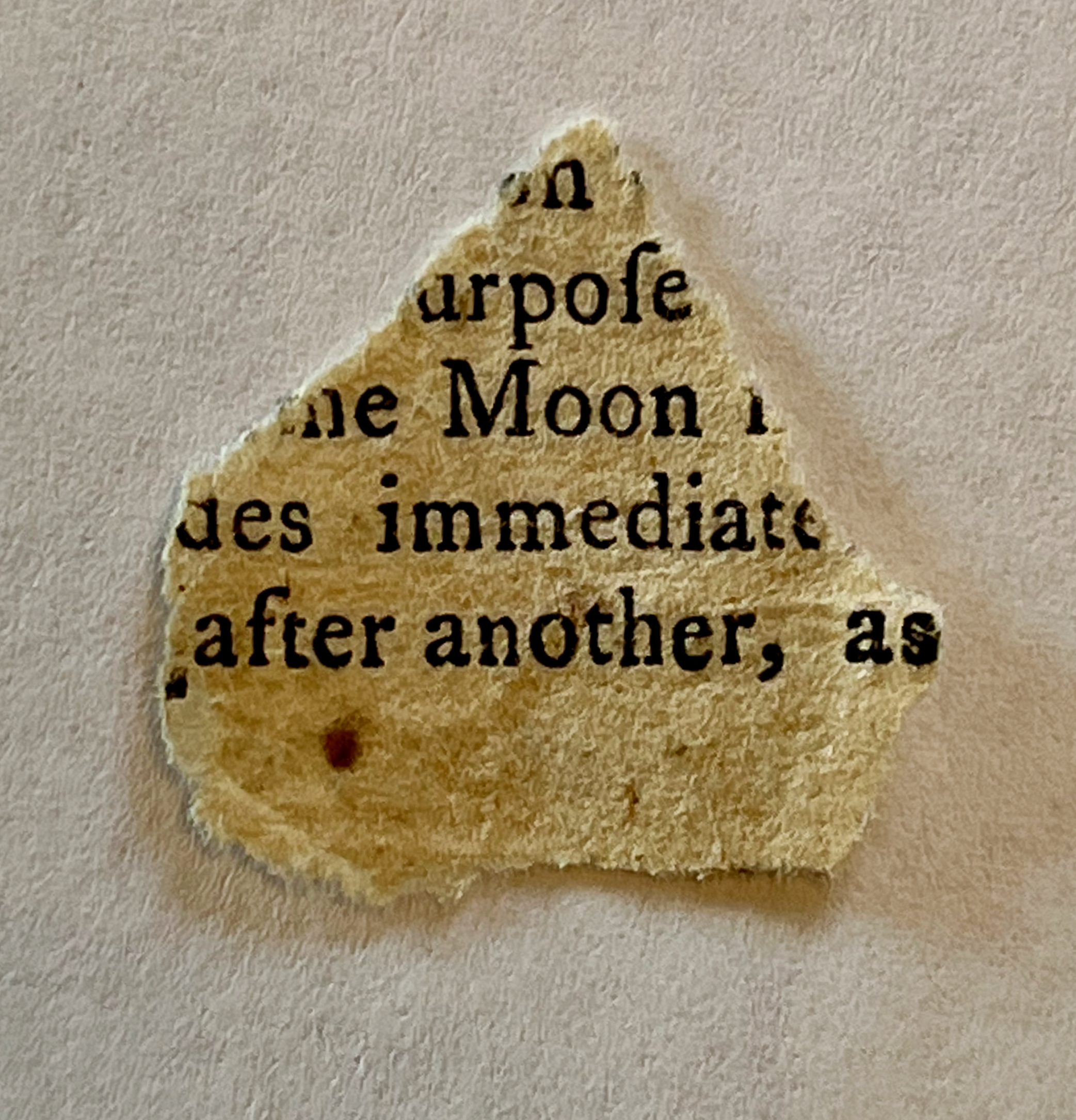
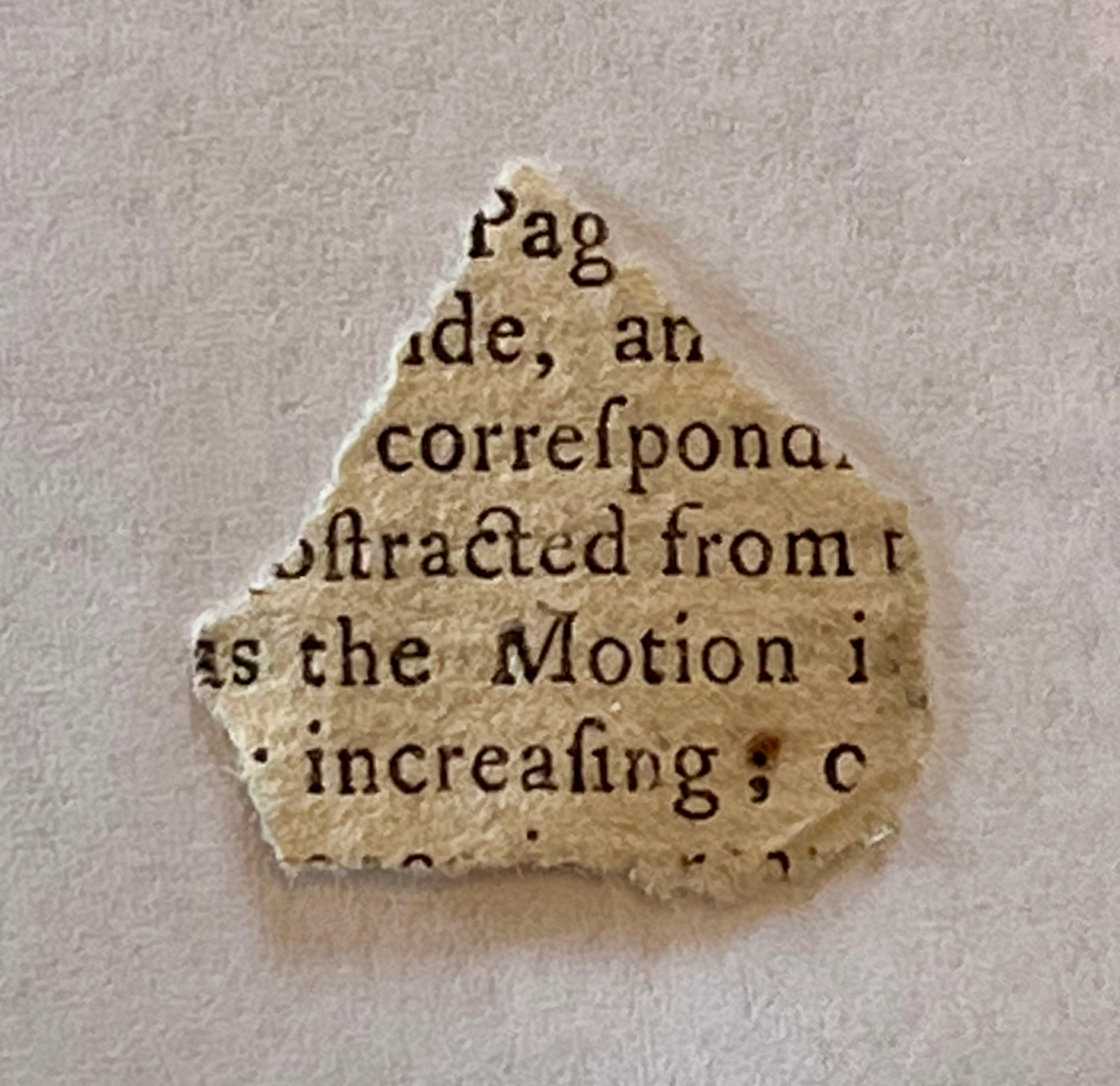
The mysterious fragment, sides A & B, photo credit: Reed Perkins, 2022.
In my original post, I examined the text and typography of the fragment and estimated that the it was published sometime between the late-sixteenth century (at the very earliest) and—at the very latest—the first decades of the nineteenth century. And the mentions of “Moon” and “motion” and such suggested a source that might be more scientific or philosophical, and not necessarily a sacred text, but I couldn’t think what that might be.
A new possible source: Almanacs!
In his comment, James observed: My hunch is that this triangular scrap /bookmark came from an almanac, likely as common in 1800-1820 U.K. as in U.S. a half-decade later. Many fairly good or detailed ‘scientific’ discussions appeared in the old almanacs or ‘farmer’s friends.’
I think James is on to something. Almanacs seem like a very plausible source. But how common were farmer’s almanacs in the UK, and how likely was it that the Bonniwells had access to these annual “farmer’s friends” in Chatham, Kent, England, in the years before their 1832 immigration to North America?
Continue readingI’m spending some of my time this winter on projects related to the cataloging, interpretation and display of our historic Bonniwell Family Bible. One of the items on my “to do” list involves the study of a number of Bonniwell papers and other ephemera that were donated along with the Bible itself. Some of the miscellaneous papers are self-explanatory and easily understood. But one little fragment of printed text has me baffled, and I need your help, history lovers!
The fragment, sides A & B
Photos credit: Reed Perkins
Continue readingJust a reminder…
248 years ago today, representatives of all thirteen of Britain’s American colonies, gathered “in congress” in Philadelphia, and publicly declared our independence from “George the Third, by the Grace of God, King of Great Britain, France, and Ireland, Defender of the Faith, and so forth,” and his distant and unresponsive legislature. The Americans proposed to separate—forever—from their Divinely appointed King, and form a new and independent nation, the “united States of America.” This decision was bold, completely unprecedented in a world dominated by autocratic monarchs, and potentially fatal for anyone that supported this Declaration of Independence. From the King’s point of view, the authors, his subjects, were committing treason.

After a public reading of the Declaration of Independence at Bowling Green, on July 9, 1776, New Yorkers pulled down the statue of King George III.
The authors of the Declaration were clear-eyed about the stakes, yet unwavering in their desire to separate from the King. They closed their—our—Declaration of Independence with their unanimous avowal that, […] for the support of this Declaration, with a firm reliance on the protection of divine Providence, we mutually pledge to each other our Lives, our Fortunes and our sacred Honor.
The Declaration of Independence is our pivotal foundational document. People risked their lives and fortunes by creating and signing it. Thousands of Patriots died in the subsequent War of Independence in order to make the “united States of America” a reality. A large number of British-Americans, still loyal to their monarch, fled the 13 colonies and migrated to the King’s remaining possessions to the north, including Nova Scotia and the Province of Quebec.
Through it all, the ideals expressed in the Declaration inspired generation after generation of Americans, including Jonathan Clark and his ancestors, as attested in this excerpt from daughter Caroline (Clark) Woodward’s 1893 biographical sketch:
[…] Jonathan M. Clark, was a Vermonter of English descent, who, born in 1812, of Revolutionary parentage, inherited an intense American patriotism.
Jonathan Clark and his Mequon neighbors—including native-born “Americans,” as well as more recent immigrants from Ireland, the German lands, the United Kingdom, Nova Scotia, and elsewhere—knew the Declaration, read it aloud at patriotic events (in English and German!), and shared its anti-monarchical sentiments.
This July 4th, before you head to the beach or light the barbecue, why not refresh your memory and read the document that created our nation, and forever declared our freedom from the “absolute Despotism” of kings?
The unanimous Declaration of the thirteen united States of America,
When in the Course of human events, it becomes necessary for one people to dissolve the political bands which have connected them with another, and to assume among the powers of the earth, the separate and equal station to which the Laws of Nature and of Nature’s God entitle them, a decent respect to the opinions of mankind requires that they should declare the causes which impel them to the separation.
Continue readingFor the record, here’s one more source to add to our list of “not Jonathan M. Clark’s kin” dead ends in the search for JMC’s roots in northern Vermont and Lower Canada, circa 1800-1840.

Clark, Almon W., 1541-1907. The Clark family genealogy in the United States, a genealogical record showing sources of the English ancestors. Stamford, N.Y., Press of the Mirror-recorder, 1907. Library of Congress
Continue readingUPDATED, Oct. 31, 2023. Rearranged a few paragraphs to highlight the information about a son and grandson of Isaac “Old Rifle” Clark, Satterlee Clark, senior and junior.

As we proceed in our search for Jonathan M. Clark’s kin in the area where southern Québec meets northern Vermont and New Hampshire, I thought it would be useful to begin a list of various Clark-surnamed people that show up in our search, but we know (with reasonable certainty) are not JMC’s parents or other relatives.
I’m not going into great detail for each subject, but I’ll try and give enough info to make clear whom we are talking about, and why they are on the “Nope, not our Clark family…” list. Here is today’s installment.
Sir Alured Clarke, (c. 1745-1832)
Lieutenant Governor of Lower Canada, he helped implement the Constitutional Act of 1791—and its provisions for making grants of the Crown’s “Waste Lands” in the province—and his name appears on many of the early Lower Canada land petitions, including those for Stanstead and Hatley. The Dictionary of Canadian Biography has a fine, lengthy entry (illustrated with an engraved portrait) which concludes that Clarke was “a professional soldier whose modest talents and courteous manner had enabled him to discharge the civil duties of a colonial administrator without either distinguishing or disgracing himself.”
Continue readingToday’s post is a special one: our first guest post on Clark House Historian! It’s an excellent, beautifully illustrated introduction to the very early history of the Township of Stanstead and the often contentions relationship between the two Leaders that made it happen, Col. Eleazar Fitch and Issac Ogden, Esq. I hope you enjoy the piece as much as I did. Many thanks to guest author Jeffrey Packard and Heritage Ogden – Patrimoine d’Ogden for permission to publish this on Clark House Historian. See my postscript, below, for more on the author and his organization. For readers new to this part of Québec, the Municipality of Ogden is, generally speaking, the southwest corner of the historic Township of Stanstead, one of two reputed birthplaces of Jonathan M. Clark. And, as always, be sure to click on each image to open larger, higher-resolution versions in gallery view or a new window.
Dr. Jeffrey Packard, president, Heritage Ogden – Patrimoine d’Ogden. Copyright © 2023 by Jeffrey Packard, Heritage Ogden – Patrimoine d’Ogden.
Toponomic Namesakes
There is Fitch Bay and the Municipality of Ogden, but few realize that their respective namesakes had a five year long and not always amicable relationship as the two men both separately and collectively attempted to secure a land grant of 40,000+ acres on the east side of Lac Memphrémagog. This article describes the lead-up to the formal granting of the Patent for the Township of Stanstead in 1800, and provides the story of these two Loyalists, who were pivotal in the early history of the area.
Colonel Eleazer Fitch
Eleazer Fitch was born August 29th in 1726 in Lebanon, Connecticut to relatively affluent parents. As a young man he attended Yale where he studied law. He was described as broad and handsome and at 6’ 4” and 300 lbs he was most certainly an imposing figure for those days. At age 19 he married Amy Brown and eventually their family grew to 12 children (8 daughters and 4 sons). He fought in the Seven Years War where he served as a major of the 4th Connecticut Regiment, and was involved in the capture of Fort Ticonderoga. He was a successful business man, and furthermore had business interests in association with the Governor of Connecticut. He was also heavily involved with land speculation in Pennsylvania.


At left, Windham, Connecticut circa 1826. At right Eleazer Fitch house on Zion Hill in Windham. Exterior of house modified in late Victorian times, original façade would have evident Georgian symmetry and simplicity. Built in 1763, the house burnt in 1923.
Continue reading Clark House Historian