Some of our recent and upcoming posts are focused on reading and evaluating source materials. The first of these posts, JCH Sources, part 1, was illustrated with this drawing…
Whistler, James McNeill, artist, Reading by Lamplight, etching and drypoint, 1859. MetMuseum. Bequest of Julia H. Manges, in memory of her husband, Dr. Morris Manges, 1960
This is James McNeill Whistler’s 1859 Reading by lamplight, an evocative drawing of a young woman, reading by the light of an oil lamp, a cup of tea at her side. The lamp is supported on a tall, slender metal stand. It’s light is raised even further by placing the lamp stand on a large, overturned bowl.
If I didn’t know better, I’d think this was Caroline Clark, or one of her other well-read sisters. Caroline would have been about 19 years old in 1859, when Whistler made this drawing. She was in the middle of her pioneering two-year high school course in Milwaukee, a talented, energetic young woman on the way to living a remarkable life of service. Here she is circa 1889-1900, around age 50, in the prime of life:
We’ve had some snow in my corner of southeastern Wisconsin, several modest snowfalls over the past few days. I’ve had to shovel the walks and driveway at our house a few times this week, and there’s more snow—and shoveling—in the forecast. With that in mind, I thought you might enjoy the snow-related images and stories from a revised edition of this post, which originally appeared here in February, 2023.
Homer, Winslow, A Winter-Morning,—Shovelling Out, 1871. Wood engraving. Brooklyn Museum, Gift of Harvey Isbitts.
Winter chores
I empathize with the lads in this 1871 engraving by Winslow Homer. Unlike these fellows, with their (homemade?) wooden shovels, I have a lightweight, sturdy, ergonomic, plastic and metal snow shovel to work with. And although we do get snow in 21st-century Wisconsin, I haven’t had to deal with shoulder-high accumulations like the ones in Homer’s picture since I lived in western Massachusetts in the early 2010s. It looks like our 1871 snow shovelers are dealing with the kind of snowfall that Clark family neighbor Rev. James W. Woodworth described in these January, 1871, diary entries:
Revised 17 February 2025 to include some additional material about my Beckmann-related talk at the Cedarburg History Museum in Spring, 2023.
Cedarburg News, October 14, 1885, page 1
I’ve been spending time with historic local newspapers online, searching for those tasty tidbits of local news that never quite make it into the history books, but are often found in the 19th-century local press. Today I was browsing through 1880s to early-1900s issues of the Cedarburg News, Fred. W. Horn, publisher, and found some interesting random bits o’ history that are connected to the Clark House and to some work I’ve done for the Cedarburg History Museum.
Fred. Beckmann and kin
You may remenber a post I wrote back in July, 2020, about newly-married German immigrant Fred. Beckmann, who farmed and lived on the Jonathan Clark property from 1868 until 1873, at which time he and his growing family moved to Cedarburg, where he then owned and ran the Wisconsin House hotel for the better part of the next four decades. I followed that up with an April, 2023 presentation at the Cedarburg History Museum, where I spoke about the life and the extended circle of family, business associates and friends of Fred. Beckmann. His story connects the hardscrabble early days of our area’s Yankee, Irish and German pioneers (Jonathan and Mary Clark’s generation) with the following generation of established and settled German-American farmers, business owners and civic leaders, such as himself. And Fred also connected and illuminated the story of the Jonathan Clark House with those of nearby Hamilton—and its Concordia Mill—and the development of downtown Cedarburg in the 19th-century.
That 2023 presentation was followed by a March, 2024, illustrated talk I gave at the Cedarburg History Museum as part of their big 2024 Civil War exhibition and lecture series. My subject was “From the ‘Burg to the Battlefield…and Back: Cedarburg’s Beckmann Family and the Civil War.” In my talk, I tried to take a more personal and local look at the war by examining the military service of few of Fred. Beckmann’s Cedarburg relatives, including his brother Charles Beckmann, future brother-in-law, Charles Gottschalk, and future father-in-law Henry Hachfeld/Hackfeldt.
Well, I wasn’t really looking for more info on Fred. Beckmann today, but I stumbled across some interesting things, and thought I’d share them with you here…
Christmas is here, and I thought you might enjoy a repeat of this seasonal Turck family anecdote, “a true story,” as related in the pages of Correct English magazine, written, edited and published by Mequon pioneer Peter Turck’s granddaughter—and Mary (Turck) Clark’s niece—Josephine Turck Baker, and later collected with other similar tales and published as a book, Correct English in the Home, Chicago, 1909.
In the foreword to her book, the author explains:
When I was a little girl, like most children, I was very fond of listening to stories; but unlike most children, I did not care for fairy tales, my first question invariably being, ” IS IT A TRUE STORY?” I don’t want a “once upon a time” story. This is a true story. The children, their names, the incidents narrated, are all true. Beatrice, Roschen, and the “Boitie,” are my children […] For those who like really true stories of really true people with really true names, this little book is written. That it may instruct and entertain all readers, both little and big, young and grown up, is the earnest wish of Yours for Correct English, Josephine Turck Baker
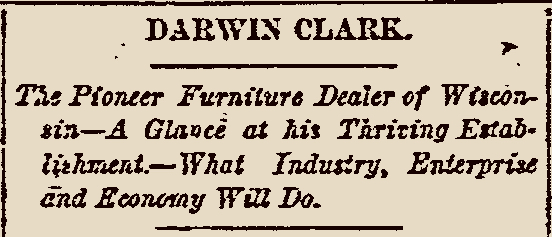
Today we have another addition to our list of various Clark-surnamed people that show up in our search for Jonathan M. Clark’s kin and that we establish (with reasonable certainty) are not JMC’s parents or other relatives. The gentleman in question is early (1837) Madison, Wisconsin Territory, settler Darwin Clark (1812-1899).
“Darwin Clark,” (Madison) Wisconsin State Journal 1884-12-26 p 8 (detail)
Christmas is here, and I thought you might enjoy a repeat of this seasonal Turck family anecdote, “a true story,” as related in the pages of Correct English magazine, written, edited and published by Peter Turck’s granddaughter—and Mary (Turck) Clark’s niece—Josephine Turck Baker, and later collected with other similar tales and published as a book, Correct English in the Home, Chicago, 1909.
In the foreword to her book, the author explains:
When I was a little girl, like most children, I was very fond of listening to stories; but unlike most children, I did not care for fairy tales, my first question invariably being, ” IS IT A TRUE STORY?” I don’t want a “once upon a time” story. This is a true story. The children, their names, the incidents narrated, are all true. Beatrice, Roschen, and the “Boitie,” are my children […] For those who like really true stories of really true people with really true names, this little book is written. That it may instruct and entertain all readers, both little and big, young and grown up, is the earnest wish of Yours for Correct English, Josephine Turck Baker
[Editor], daguerreotype with added color highlights c.1855 (slightly cropped, and color adjusted), Smithsonian American Art Museum, Gift of Charles Isaacs, (link), Creative Commons CC0 license. Click to open larger image in new window.
Hey! It’s almost been a month since my last post. Sorry about that. I haven’t gone this long between posts in several years, I think, and now I’ve got (the digital equivalent of) a towering pile of half-written posts to finish and topics to discuss. That said, I have been busy…
Christmas is here, and I thought you might enjoy this seasonal Turck family anecdote, “a true story,” as related in the pages of Correct English magazine, written, edited and published by Peter Turck’s granddaughter—and Mary (Turck) Clark’s niece—Josephine Turck Baker, and later collected with other similar tales and published as a book, Correct English in the Home, Chicago, 1909.
In the foreword to her book, the author explains:
When I was a little girl, like most children, I was very fond of listening to stories; but unlike most children, I did not care for fairy tales, my first question invariably being, ” IS IT A TRUE STORY?” I don’t want a “once upon a time” story. This is a true story. The children, their names, the incidents narrated, are all true. Beatrice, Roschen, and the “Boitie,” are my children […] For those who like really true stories of really true people with really true names, this little book is written. That it may instruct and entertain all readers, both little and big, young and grown up, is the earnest wish of Yours for Correct English, Josephine Turck Baker
It’s a New Year (yikes!—we’re already three weeks into the New Year!), and I thought I’d take a break from researching and note-taking for quick look back at our 2021 year of blogging at Clark House Historian. The blog is about to celebrate its seventh anniversary (on March 29), and 2021 was our most productive year so far, sharing more posts, documents, and historic maps and images with our readers than ever before.
The author, hard at work. For full photo credits, see below. Click to open larger image in new window.




 Clark House Historian