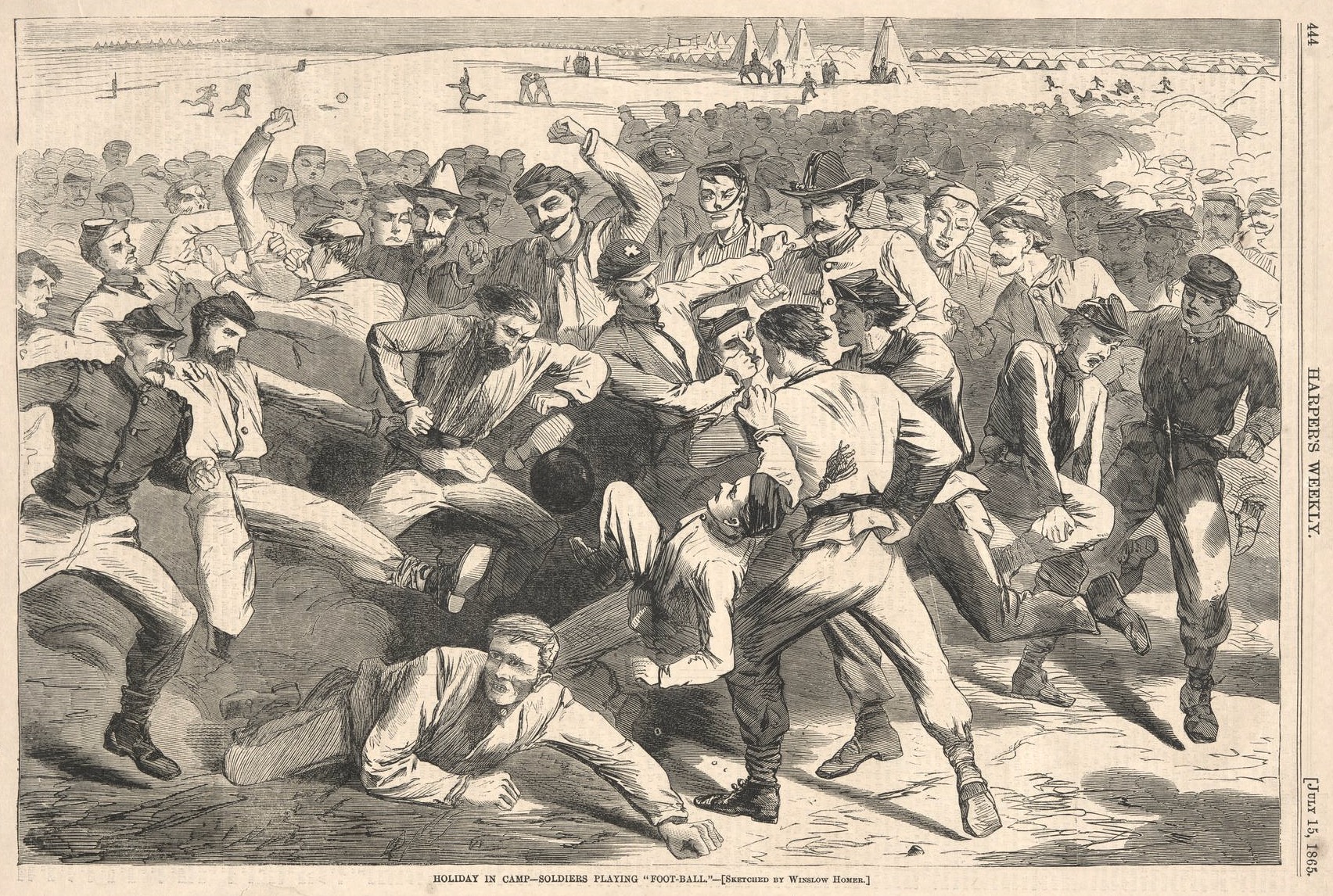
I hear there’s some sort of big sporting event today. Something called…”football.”
Homer, Winslow, Holiday in Camp – Soldiers Playing “Foot-Ball,” from Harper’s Weekly, July 15, 1865, Yale University Art Gallery, Gift of Allen Evarts Foster, B.A. 1906.
Inman, Henry. Rip Van Winkle Awakening from his Long Sleep, 1823. National Gallery of Art, gift of William and Abigail Gerdts. Public Domain.
A long “nap”
Unlike Rip van Winkle, I haven’t been asleep the whole time since our previous post. But we are well overdue for new blog material. I’ve got a big backlog of documents and images to share with you; all I need to do is get writing. But first…
Be sure to vote today!
It’s election day today, and your vote counts. If you haven’t already done so, get out of the house, over to your polling place, and vote. Voting is your right and responsibility as a citizen, and an indispensable element of our nation since the earliest days of the Republic.
Not surprisingly, voting and public service were an important part of life in the Clark House era. From 1840 onward, Jonathan M. Clark, Peter Turck, William T. Bonniwell and many other relatives and neighbors sought, and won, appointment or election to a wide variety of local, territorial and state offices. Voting—then limited to white males only—was a priority for Mequon’s early settlers, and they never failed to turn out in large numbers for each election. Their passion for civic engagement and electoral politics was, in turn, passed to the next generation.
UPDATE, Nov. 30, 2022: The discussion of the William Bonniwell signatures and dates, below, is not correct. I have lined-through the incorrect paragraph and added the correct info in two new paragraphs below the original misinformation.
It may not look like much on the outside. It’s old. Not very big. Whole pages are missing, others are damaged. The binding is worn.
Bonniwell Bible, front cover. Photo credit: Kendalyne Gentile, 2022
But this modest book was—for over 300 years—the family Bible for Mequon’s pioneer Bonniwell family, their ancestors and descendants. And last month, the Bible’s most recent owner, Bonniwell descendant Kendalyne Gentile, generously gave the Bible and other Bonniwell family documents to the Jonathan Clark House Museum where they will form an important part of our permanent collection.
Our annual Memorial Day post, first published in 2020. This revised edition, originaly published in 2022, was inadvertently updated for the further-revised 2023 edition, making a few minor edits and adding new information about Evander B. Bonniwell’s service. So the original 2022 post is “gone” and I’m going to leave this revised-revised version of that post here for reference, in case it is bookmarked elsewhere on the blog or in a readers’ notes.
Graves of Unknown Union Soldiers, Memphis National Cemetery, photo by Clayton B. Fraser, (Library of Congress), public domain. Memphis National Cemetery is the final resting place of Mequon’s Watson Peter Woodworth, and almost 14,000 of his Union Army comrades.
Today is the day our nation officially observes Memorial Day. For many Americans, Memorial Day represents “the first day of summer,” and is traditionally celebrated with trips to the lake, picnics, parades, and sales on cars, appliances, and other consumer goods.
But for many of us, Memorial Day remains rooted in its origins as Decoration Day. The first national observance was in 1868, when retired general John A. Logan, commander and chief of the Grand Army of the Republic—the Union veterans’ organization—issued his General Order Number 11, designating May 30 as a memorial day “for the purpose of strewing with flowers or otherwise decorating the graves of comrades who died in defense of their country during the late rebellion, and whose bodies now lie in almost every city, village, and hamlet churchyard in the land.”
On this Memorial Day, let’s take a moment to remember what this day truly represents.
Updated February 22, 2022 to fix a few minor typos, and to add a link to a brief history of American samplers, with an illustrated list of 73 of the 137 American samplers in the Textile Collection of the National Museum of American History.
In addition to raising and educating her children, a 19th-century farm wife like Mary Turck Clark had many other responsibilities, including planning and tending a farm garden, preserving its produce, preparing daily meals for the family and hired hands, and keeping the farm house clean and organized. And Mary, like many women of her era, probably made some or all of her own and her family’s clothes.
The sewing arts
Like most girls of her era, Mary Turck (born in New York, 1821) probably learned the craft of needlework from her mother and, perhaps, as part of her school education. When a young girl like Mary mastered some of the many practical and decorative sewing stitches, she might demonstrate her proficiency by making a sampler.
A sampler might feature simple examples of sewn letters, numbers and perhaps a popular saying or Bible verse. But many samplers were more complex and artistic. An accomplished embroiderer might produce an elaborate sampler featuring detailed images and texts, as in this 1829 sampler from Connecticut.
Thompson, Mariette (1817-1851), [Sampler with family register], 1829. Yale Art Gallery, public domain. Click to open larger image in new window.
It’s a New Year (yikes!—we’re already three weeks into the New Year!), and I thought I’d take a break from researching and note-taking for quick look back at our 2021 year of blogging at Clark House Historian. The blog is about to celebrate its seventh anniversary (on March 29), and 2021 was our most productive year so far, sharing more posts, documents, and historic maps and images with our readers than ever before.
The author, hard at work. For full photo credits, see below. Click to open larger image in new window.
We’re looking into the life of Jonathan M. and Mary (Turck) Clark’s first child, Caroline Clark. If you need to catch up, you might start with some pivotal dates and events in the lives of Caroline and her Clark family in:
The biographical materials we looked at in those posts were a good introduction to Caroline’s life (through 1893), but lacked some key information about her youth, and especially her transition from a scholastic “prodigy” in rural Mequon to—supposedly—a teacher in Milwaukee’s public schools. And in order to examine her time as a Milwaukee public school student and teacher, we had to take a deep dive into the life and work of her esteemed high school principal, Caroline Clark’s mentor, John G. McKindley.
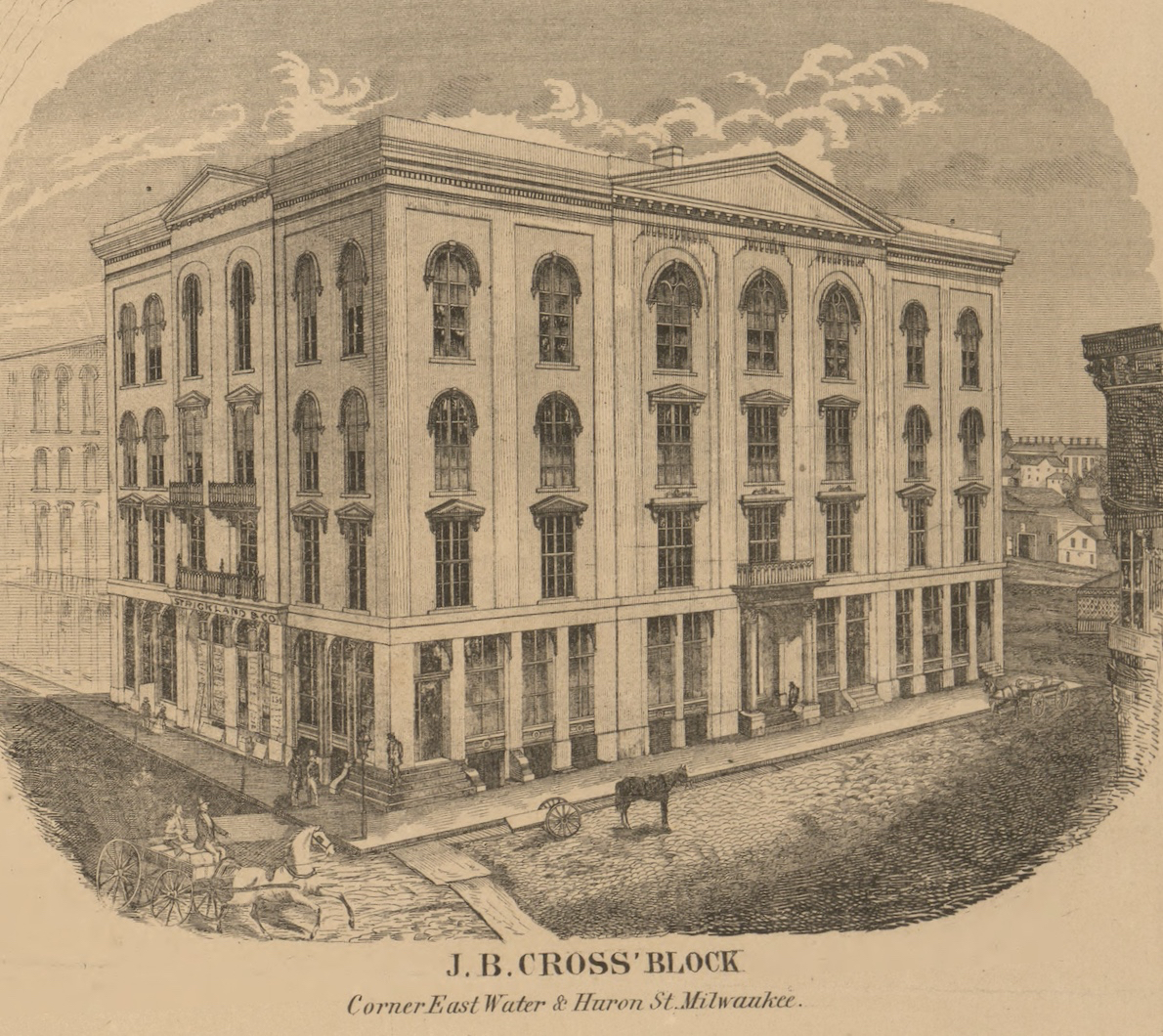
Walling, Henry Francis. Map of the county of Milwaukee, Wisconsin. New York: M.H. Tyler, 1858, Library of Congress, (inset showing Cross’ Block).
View of Cross’ Block circa 1858, home of the Milwaukee School Board until destroyed by fire on December 30, 1860.1, 2
In today’s post, we continue our examination of the life and work of Jonathan M. and Mary (Turck) Clark’s oldest child, Caroline Mary (Clark) Woodward (1840-1924). In our earlier post, Caroline M. (Clark) Woodward: a closer look at that 1893 biography, we came across this passage:
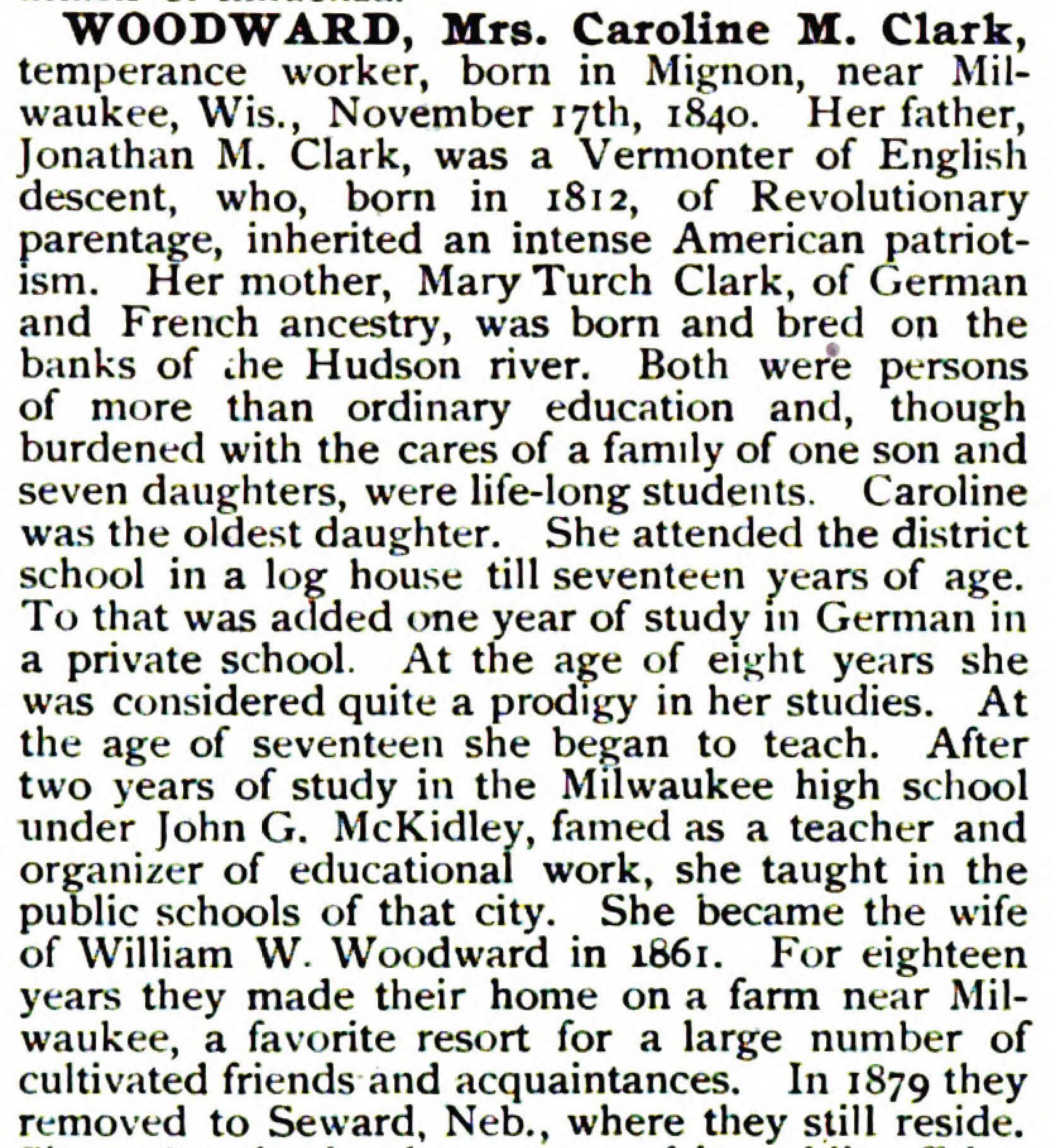
Caroline was the oldest daughter. She attended the district school in a log house till seventeen years of age. To that was added one year of study in German in a private school. At the age of eight years she was considered quite a prodigy in her studies. At the age of seventeen she began to teach. After two years of study in the Milwaukee high school under John G. McKidley [sic, McKindley], famed as a teacher and organizer of educational work, she taught in the public schools of that city.
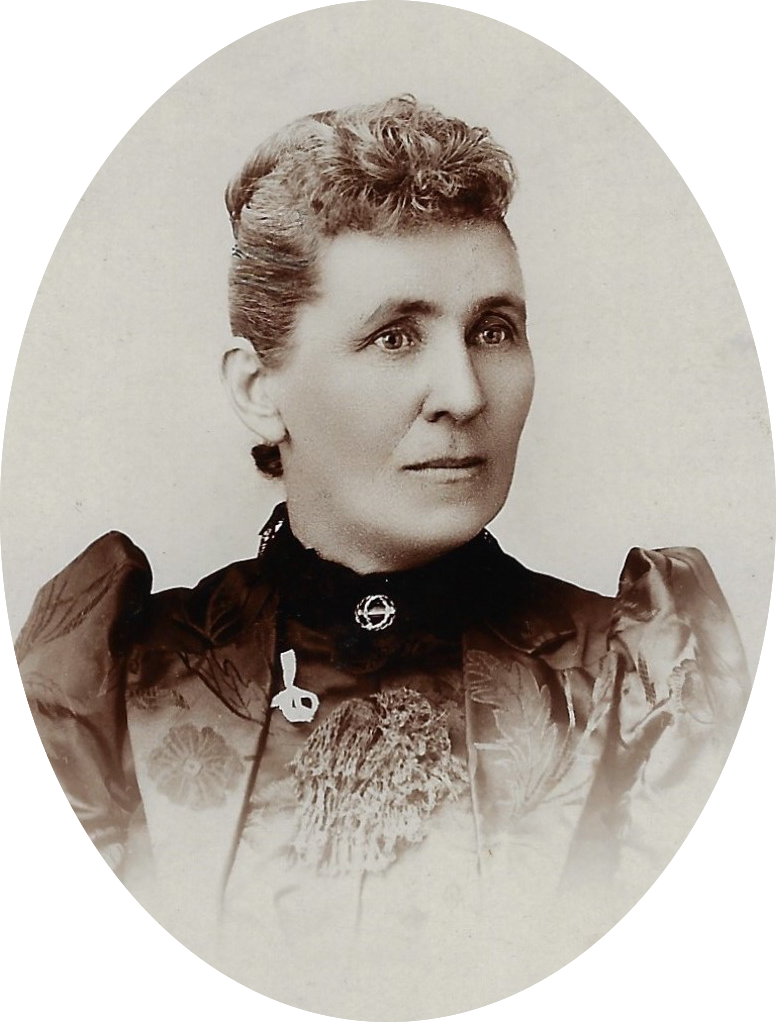
Photo of Caroline M. (Clark) Woodward courtesy of Frances Willard House Museum & WCTU Archives, Evanston, Illinois. Text: Willard, Frances E., and Mary A. Livermore, editors. A woman of the century ; fourteen hundred-seventy biographical sketches […], Buffalo, 1873, page 779.
Think back…
Imagine this: You are now more than 50-years-old. You have achieved statewide and national prominence as an organizer for the largest women’s social and political organization of the 19th-century. You and your spouse manage a family farm, continue to raise your several adopted and foster children, and you have a successful business of your own, selling insurance. And when you are asked to provide the details of your life for inclusion in a major biographical dictionary of leading American women, you make sure to include, by name…one of your high school teachers?
That’s exactly what Caroline (Clark) Woodward did in 1893, when she highlighted her two years of study with John G. McKindley at the Milwaukee public high school. And that prompts a few questions: who was J. G. McKindley? why is he cited in Caroline’s 1893 biography? when would he have worked with Caroline? was he really “famed as a teacher and organizer of educational work”? and how big a deal was “high school” in Wisconsin in the 1850s and ’60s, anyway?
Today, as we continue to explore the life of Jonathan M. and Mary (Turck) Clark’s eldest child, Caroline Mary Clark—later usually known as Mrs. C. M. Woodward—we’ll take a fact-by-fact look at the biographical sketch of Caroline that was published in 1893, re-printed unchanged in 1897, then abridged and reprinted in 1912. For a full discussion of these three publications, see last Monday’s Caroline M. (Clark) Woodward: first steps toward a biography.
Willard, Frances E., and Mary A. Livermore. 1893. A woman of the century ; fourteen hundred-seventy biographical sketches accompanied by portraits of leading American women in all walks of life ; ed. by Frances E. Willard and Mary A. Livermore, assisted by a corps of able contributors, title page and page 779.
Today’s post will be less of a fully-formed essay, and more of a running analysis, commentary, and proof-reading of this 1893 biographical sketch. We’ll take one portion at at time, starting at the beginning. The source text will be presented as a shaded quotation, followed by my commentary and corrections in simple black text on white background, with highlighted links to additional sources and explanations and, of course, a few footnotes, too. Here we go…
In our most recent blog post, Another family portrait! Caroline (Clark) Woodward, c. 1890s, we located and discussed the history of a previously unknown photo of Jonathan M. and Mary (Turck) Clark’s eldest child, Caroline Mary Clark, later usually known as Mrs. C. M. Woodward:
Townsend Elite Studio, [Portrait, Caroline M. (Clark) Woodward], inscribed “Mrs. C. M. Woodward, Supt. Work among Railroad Employes, N.W.C.T.U.”, photograph, circa 1889-1900. Photo courtesy Frances Willard House Museum & WCTU Archives, Evanston, Illinois. Click to open larger image in new window.
Caroline’s life was the most public—and perhaps best documented—of all the members of Jonathan M. Clark family, and is overdue for a closer examination. So today we begin a multi-part look at Caroline’s story, starting with three biographical sketches that were published during her lifetime.





 Clark House Historian