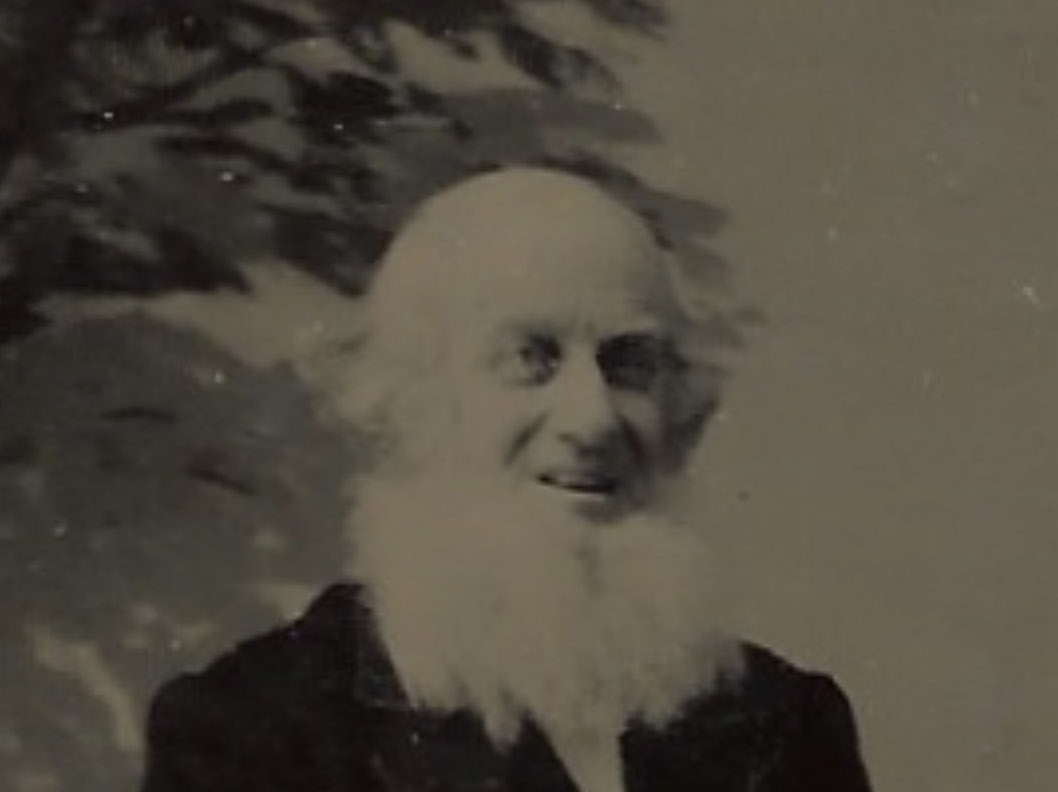
Why is Cyrus smiling? Tintypes!

Cyrus Clark (tintype, detail). Photo courtesy Steven Clark Van Slyke. Click to open image in new window.

Dating and interpreting old photographs, part 3 of 4

For our next to last look at photographs from the family of early Mequon settlers Cyrus and Sarah (Strickland) Clark we’ll start to take a closer look at three images made with another popular photographic process from the era, the tintype. We will examine the clothing, props, backgrounds and other aspects of the photographs, learn more about the tintype process, and try and determine when the photos were taken1. Once again, thanks to Clark and Strickland descendants Steven Clark Van Slyke and Lynnette Thompson for the photos and family history assistance.

If you’re new to the discussion, I recommend you read our previous post, Cyrus Clark’s Cabinet Card, and click the links there for additional background on the family and the other Clark portraits. To begin, let’s take a quick look at all three of our Cyrus Clark tintypes:

Continue reading

Cyrus Clark’s Cabinet Card

Dating and interpreting old photographs, part 2

Today we take another dive into photo research and dating, as part of our look into the lives of Cyrus Clark and Sarah Strickland Clark (here, here, here, here and here). Thanks again to Clark and Strickland descendants Steven Clark Van Slyke and Lynnette Thompson. Without further ado, here is part two of our initial Clark House Historian attempt at analyzing historic photos1.

Let’s start with the photo of Cyrus that we’ve used on our previous Cyrus and Sarah posts. Here’s the front:

Continue reading

Monday: Map Day! – Another Clark Family

This week we take a break from our usual focus on the extended Jonathan M. and Mary (Turck) Clark family and begin a week of posts about two remarkable, original Mequon settlers and Clark House neighbors: Sarah Allise Strickland (1823-1891) and her husband, Cyrus Clark (1815-1905).

Sarah A. Strickland was born and raised in Nova Scotia, the eldest child of Daniel and Matilda Strickland. Her family was one of the original white settler families in the area; they were enumerated in Milwaukee County on Wisconsin’s first territorial census in 1836.1

Cyrus Clark was born in western Massachusetts and was in Mequon by about 1839. He married Sarah Strickland in Grafton, Washington (later Ozaukee) County, on March 1, 1841. They lived almost forty years in Wisconsin. First in Mequon and Cedarburg, Washington/Ozaukee) County, and then divided their time between their farm in Moscow, Iowa County, and homes of one or more adult children in Oshkosh, Winnebago County. So how—and why—did they end up in South Dakota at the end of their days?

It’s an interesting story, and one that illustrates a characteristic type of pioneer experience: the continued drive to push westward, on to new frontiers and new challenges. It may seem cliché to us, but it was a real, lived experience for many of Cyrus and Sarah’s generation. This week’s posts will look at a number of key moments in their long lives, especially the decades they spent in Wisconsin. And we have some unique and new sources to share, too.

Beginning at the end…

Click to open larger image in new window.

Gravestones of Cyrus Clark and Sarah A. (Strickland) Clark, Graceland Cemetery, Madison, South Dakota.
Photo by Steve Van Slyke, used by permission.

We begin the story of Cyrus and Sarah Clark at the end, in Lake County, South Dakota, their final resting place. And not one, but two maps today, all of which take us far from Mequon and the Jonathan M. Clark house.

Continue reading

Fred Beckmann, Sr.

UPDATED February 9 & 11, 2025, to correct the year and date of Fred. Beckmann’s death and investigate the apparent errors on his gravestone (see updated images, text, and especially Note 4, below).

Farming the Clark place, 1868-1873

In our previous post we saw that sometime around 1861/62, Mary Clark and her children decided to move to Milwaukee. By the time the Milwaukee City Directory for 1862 was published, Mary—and, we presume, her children—were living together with Mary’s father Peter Turck, at 474 Jefferson in the city.

We also know that Mary and her daughters did not sell the Mequon farm—to Catherine Doyle—until April, 1872. So, for over a decade, someone besides the Clark family was living and working on the Clark property. Most likely, Mary made some kind of tenant-farmer arrangement where someone grew crops on the Clark land and paid rent to Mary from the proceeds. This could have been a very useful source of income for Widow Clark and her seven children during the 1860s. Unfortunately, we don’t have much documentation of who the tenants may have been and what sort of arrangement Mary may have made with them.

The Doyle Family

In the same post, I also erred in assuming that the John and Catherine Doyle family probably farmed the Clark land throughout the 1860s. Clark House museum director Nina Look recently called my attention to information about the Doyles and their neighbors in various maps and census schedules created around 1870 that shows that the Doyles were living and farming elsewhere in Mequon through most of the 1860-1870 decade. In future posts I will look at those maps and census schedules and try and make more sense of where the Doyles lived and what land they may have farmed prior to purchasing the Clark farm in April, 1872.

Nina also reminded me that I forgot one important person that we know did farm the Clark farm: Fred Beckmann

Continue reading

View from the window…

There’s a lot going on behind the scenes at Clark House Historian these days. I’ve got a half-dozen blog posts in various stages of completion, plus ongoing research and information-checking projects with Nina Look, Liz Hickman, and others. And, I’ve just heard from a third-great-granddaughter of two of the original Mequon settler families! How cool is that? More on those folks in an upcoming post—or two!

So let’s take a break, and enjoy a relaxing summer view from the Clark House. In this instance, a lovely July, 2015, view from the Clark’s front parlour, looking to the southwest toward present-day Bonniwell Road. According to the 1872 “Shoolmap” of Mequon, neighbors John Kurz and J. H. Townsend lived just across the street. A bit farther west down the road were—still—the farms of old friends and original Mequon settlers William Bonniwell and Jesse Hubbard.

Photo by Anna Perkins, used by permission. Click to open larger image in new window.

Monday: Map Day! – “Shoolmap” of Mequon, c. 1872

Today’s Monday: Map Day! introduces a rare and very interesting map, from a wonderful digital collection of maps. It’s the c. 1872 “SHOOLMAP of the TOWN of MEQUON,” from the University of Wisconsin–Milwaukee’s American Geographical Society Digital Map Collection, and it is packed with information and unique details:

Shoolmap of the Town of Mequon / School Map of the Town of Mequon, 1872?, University of Wisconsin-Milwaukee, American Geographical Society Digital Map Collection. Manuscript map. Mequon-Thiensville Historical Society, donor. Copyright notice here, presented in this post as a public domain item and/or under fair use provisions of U.S. copyright law.

To view a beautiful, large version of today’s map, click here, or on the map image (above). That will open a new window and take you to the University of Wisconsin–Milwaukee’s American Geographical Society Digital Map Collection, and the home page of this map. It will look something like this:

Continue reading

Correction: Laura M. Clark

“Constant vigilance!” — J. K. Rowling, Harry Potter and the Goblet of Fire

Mad Eye Moody’s advice to the Hogwarts students was essential for them and remains apt for anyone doing historical research. Whether working on a large history project or a modest family tree, constant vigilance is needed to avoid bad information. Fortunately, the historian or genealogist’s dementors are not deadly wraiths ready to suck the life force from us, but more mundane creatures such as typos, inaccessible or hard-to-read documents, and—most vexingly—mystery data.

For some reason, in my database I had recorded that Jonathan and Mary Clark’s sixth child, daughter Laura, had a middle name of “Mandlena.” This—unless I’ve overlooked some important but now lost evidence—was nonsense. It’s the sort of mistake that creeps into historical writing via random error; I don’t know how I managed to make this particular honker. So for the record, the Clark’s sixth child was Laura Marcelleau Clark.

Continue reading

Rev. Woodworth’s Autobiography

James W. Woodworth (1813-1893) and his brother Ephraim were among the earliest settlers in Mequon. They came from Nova Scotia, as did several other early Mequon settlers and families, including Isaac Bigelow, Daniel Strickland and Stephen Loomer. On March 1, 1838, J. W. Woodworth married fellow Nova Scotia emigrant and Mequon neighbor Mary Cerena Loomer. The marriage was believed to be the first Christian marriage in old Washington county and was performed by Mary Turck Clark’s father, Peter Turck, “an anabaptist preacher.”

J. W. Woodworth, like so many Protestant Christians of his era, was a man in search of a powerful and authentic connection to God. He found his answer in the 1830s and ’40s through Methodism. And, after many years of intense self-instruction, camp meetings, private prayer and preaching at local worship services, Woodworth was certified as a Methodist minister.

For much of his life Rev. Woodworth kept a diary of both the spiritual and mundane events of his life. He published the diary in Milwaukee in 1878 as My Path and the Way the Lord Led Me.  Continue reading

Where are we?

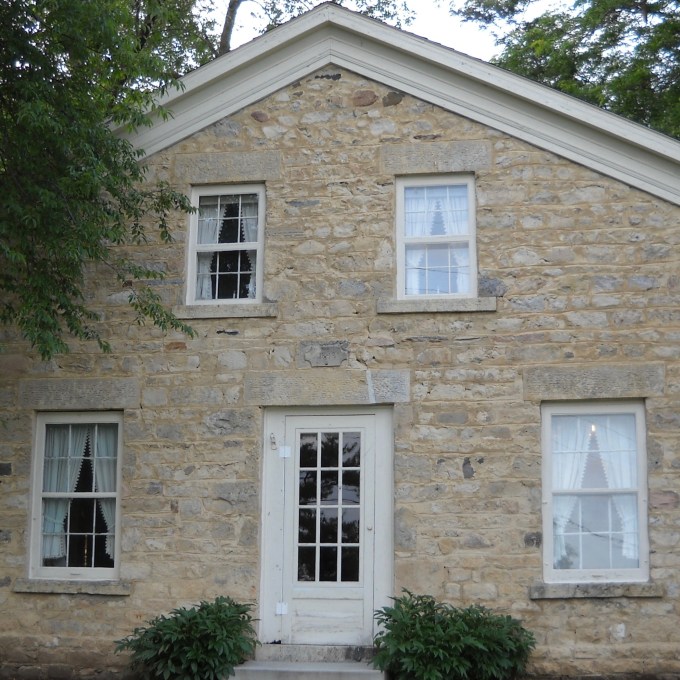
CLARK, Jonathan house square crop  July,  2015

Jonathan Clark House, Mequon, Wisconsin, July, 2015. Photograph by Reed Perkins

Where are we? Well, if you’re looking at this handsome stone house in real life, you’re standing by the front door of the Jonathan Clark House Museum, looking northward. On a modern map you can find it at 13615 N. Cedarburg Road—on the intersection with Bonniwell Road—Mequon, Wisconsin. If you’d like to visit the museum, click here for more info.

But “Where are we?” is never a simple question when it comes to historic places, because the answer often changes over time. Along with “Where are we?” we need to ask “When are we?” The answer to “Where are we?” is surprisingly varied—and useful for further research—throughout the lives of Jonathan and Mary Clark.

Continue reading