Christmas-Tide: a Turck family tale

A True Story! from an unexpected source

Christmas is coming, and to get in the holiday mood, how about a seasonal Turck family anecdote, “a true story,” as related in the pages of Correct English magazine, written, edited and published by Peter Turck’s granddaughter—and Mary (Turck) Clark’s niece—Josephine Turck Baker, and later collected with other similar tales and published as a book, Correct English in the Home, Chicago, 1909.

In the foreword to her book, the author explains:

When I was a little girl, like most children, I was very fond of listening to stories; but unlike most children, I did not care for fairy tales, my first question invariably being, ” IS IT A TRUE STORY?” I don’t want a “once upon a time” story.

This is a true story. The children, their names, the incidents narrated, are all true. Beatrice, Roschen, and the “Boitie,” are my children […]


For those who like really true stories of really true people with really true names, this little book is written. That it may instruct and entertain all readers, both little and big, young and grown up, is the earnest wish of


Yours for Correct English,
Josephine Turck Baker

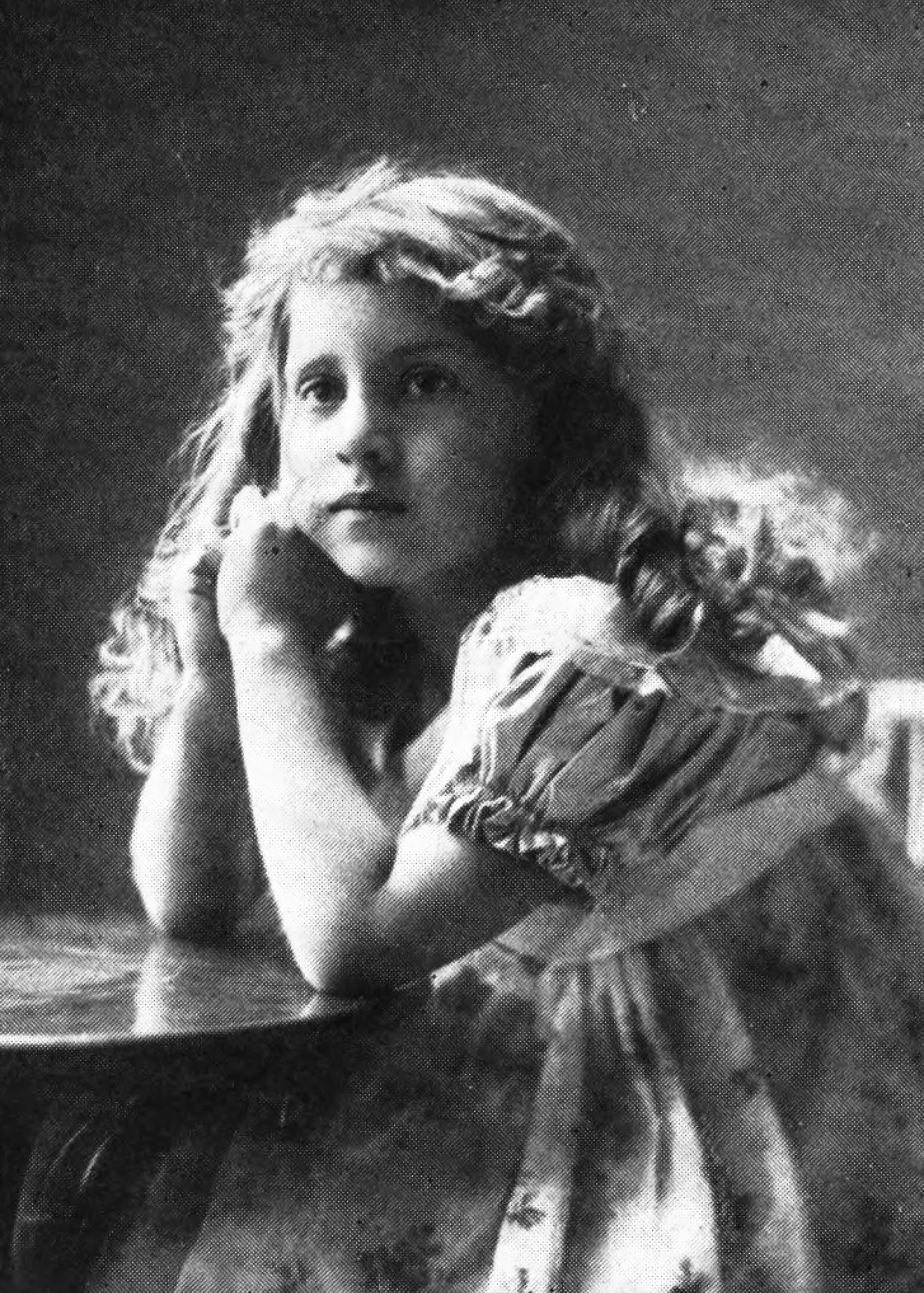
Our Protagonists

Photo credits and dates: see notes below. Click gallery for larger images
Continue reading

Stuff happens

Time flies. After over a year of regular, thrice-weekly blog entries, it’s been a month since I’ve posted anything new here. So let’s catch up a bit…

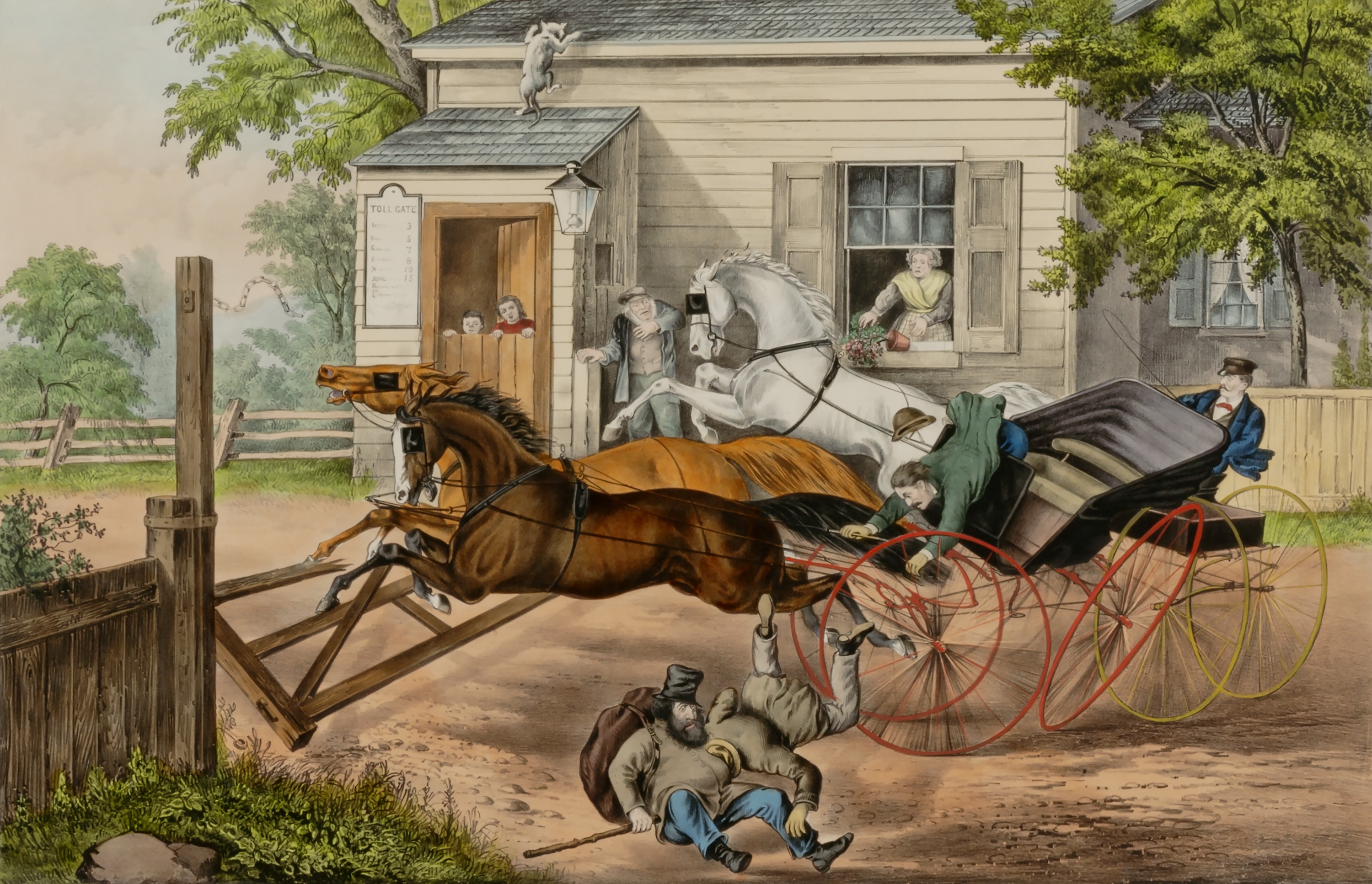
Bad driving: not just a modern invention

If you recall, our previous post began with “I’m still preoccupied with non-Clark House matters, and new posts continue to be delayed.” The reason for the delay? Two words: bad driving.

Unidentified artist, A Crack Team at a Smashing Gait, hand-colored lithograph, 1869, Smithsonian American Art Museum, transfer from the National Museum of American History, Division of Graphic Arts, Smithsonian Institution, Public domain, CC0 license. Click to open larger image in a new window.

Continue reading

Caroline gets married – but where?

May, 1861

In a recent post, Caroline Clark – public school teacher, we examined Caroline Clark’s brief tenure as a teacher in the grammar department of Milwaukee’s Ninth Ward School, and concluded:

Caroline Clark’s employment as a Grammar Department teacher began on September 1, 1860. According to the 1861 Report, she taught for eight months. That would mean she left her teaching position around the beginning of May, 1861. Why? One factor might have been her salary […] But the more likely reason for her departure from the Ninth Ward School was that on May 15, 1861, she married Milwaukee county farmer William Wallace Woodward. For much (all?) of the nineteenth century, it was customary for female school teachers to be single; once they married, they were expected to leave the profession and set up housekeeping with their new husband and, eventually, start a family of their own. I think it’s safe to assume that this is what happened to “Miss Caroline M. Clark” in May, 1861.

Finding Caroline’s marriage record

Long before I found Caroline’s 1893 biographical sketch, or her profile and interview in the Omaha Daily Bee (March 30, 1916, page 11), or read her several long obituaries, I was able to determine when—and whom—she married. How? By using the Wisconsin Historical Society’s invaluable—but not infallible—Pre-1907 Vital Records Database (Birth, Marriage, Death). Yes, the interface is a bit clunky, but if you search for “Clark, Caroline,” one of the results you’ll find is:

Seems plausible, right? But how do we know it’s “our” Caroline? And how do we match her with a spouse?

Continue reading

Caroline Clark – public school teacher

Leaving High School – August, 1860

As we discussed earlier, Caroline M. Clark (1840-1924), the oldest child of Mary (Turck) Clark and the late Jonathan M. Clark, studied for two years at Milwaukee’s first public high school, led by the noted educationist John G. McKindley. McKindley’s second academic “exhibition” of his Seventh Ward High School students took place at Albany Hall, Milwaukee, on August 9, 1861. It was McKindley’s final appearance as Principal of the Seventh Ward High School. I expect that 19-year-old Caroline M. Clark was there also, as the event marked the end of her years as a student in the Mequon and Milwaukee public schools.

After high school: teaching in Milwaukee?

Caroline’s 1893 biographical sketch included this statement:

After two years of study in the Milwaukee high school under John G. McKi[n]dley, famed as a teacher and organizer of educational work, she taught in the public schools of [Milwaukee].

Once she finished her high school studies, Caroline would have been qualified to teach Primary, Intermediate, or—perhaps—Grammar school classes in Milwaukee’s public schools. And she did.

Caroline got a job!

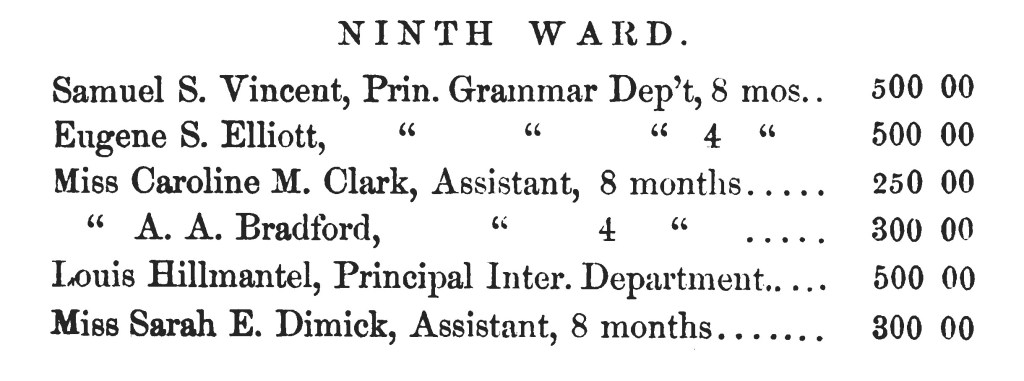
Annual Report of the Board of School Commissioners of the City of Milwaukee, to his honor the mayor and the common council of Milwaukee, for the year ending September 1, 1861, Milwaukee, 1861, p 15-16, via GoogleBooks.

“Miss Caroline M. Clark” was hired as an Assistant teacher in the Grammar Department of the city’s Ninth Ward school, for 8 of the 12 months of the academic year beginning September 1, 1860. For those eight months, she was paid a total of $250. (Why did she only work for eight months? More on that, below.)

Continue reading

Caroline M. Clark’s classroom & curricula, 1858-1860

Before laptops and iPads…

Currier & Ives. God Bless Our School. United States, ca. 1874. New York: Published by Currier & Ives, 125 Nassau St. Library of Congress. Click to open larger image in new window.

This colorful lithograph was published in 1874, but the books, maps, globe, slates for writing on, inkwell and dip pen, and other classroom supplies are very consistent with the materials that Caroline Clark would have encountered in her Seventh Ward High School classroom between 1858 and 1860. Her Clark siblings would have used similar materials during their time as students in the Milwaukee public schools during the 1860s and ’70s.

Continue reading

Caroline Clark – from student to teacher

We’re looking into the life of Jonathan M. and Mary (Turck) Clark’s first child, Caroline Clark. If you need to catch up, you might start with some pivotal dates and events in the lives of Caroline and her Clark family in:

Then check out these previous posts in our current Caroline (Clark) Woodward series:

The biographical materials we looked at in those posts were a good introduction to Caroline’s life (through 1893), but lacked some key information about her youth, and especially her transition from a scholastic “prodigy” in rural Mequon to—supposedly—a teacher in Milwaukee’s public schools. And in order to examine her time as a Milwaukee public school student and teacher, we had to take a deep dive into the life and work of her esteemed high school principal, Caroline Clark’s mentor, John G. McKindley.

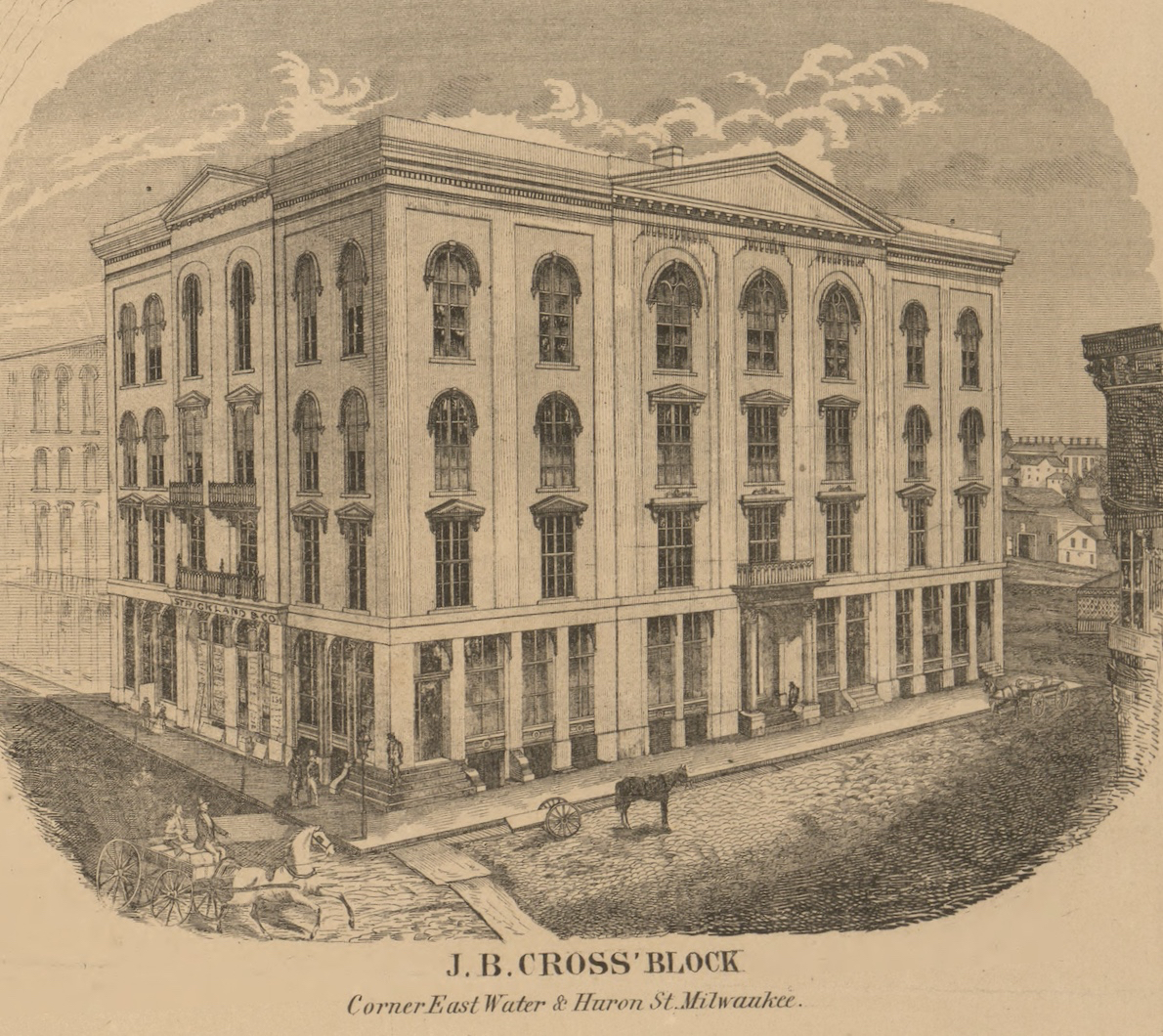
Walling, Henry Francis. Map of the county of Milwaukee, Wisconsin. New York: M.H. Tyler, 1858, Library of Congress, (inset showing Cross’ Block).

View of Cross’ Block circa 1858, home of the Milwaukee School Board until destroyed by fire on December 30, 1860.1, 2

Continue reading

Caroline Clark’s mentor, John G. McKindley

In today’s post, we continue our examination of the life and work of Jonathan M. and Mary (Turck) Clark’s oldest child, Caroline Mary (Clark) Woodward (1840-1924). In our earlier post, Caroline M. (Clark) Woodward: a closer look at that 1893 biography, we came across this passage:

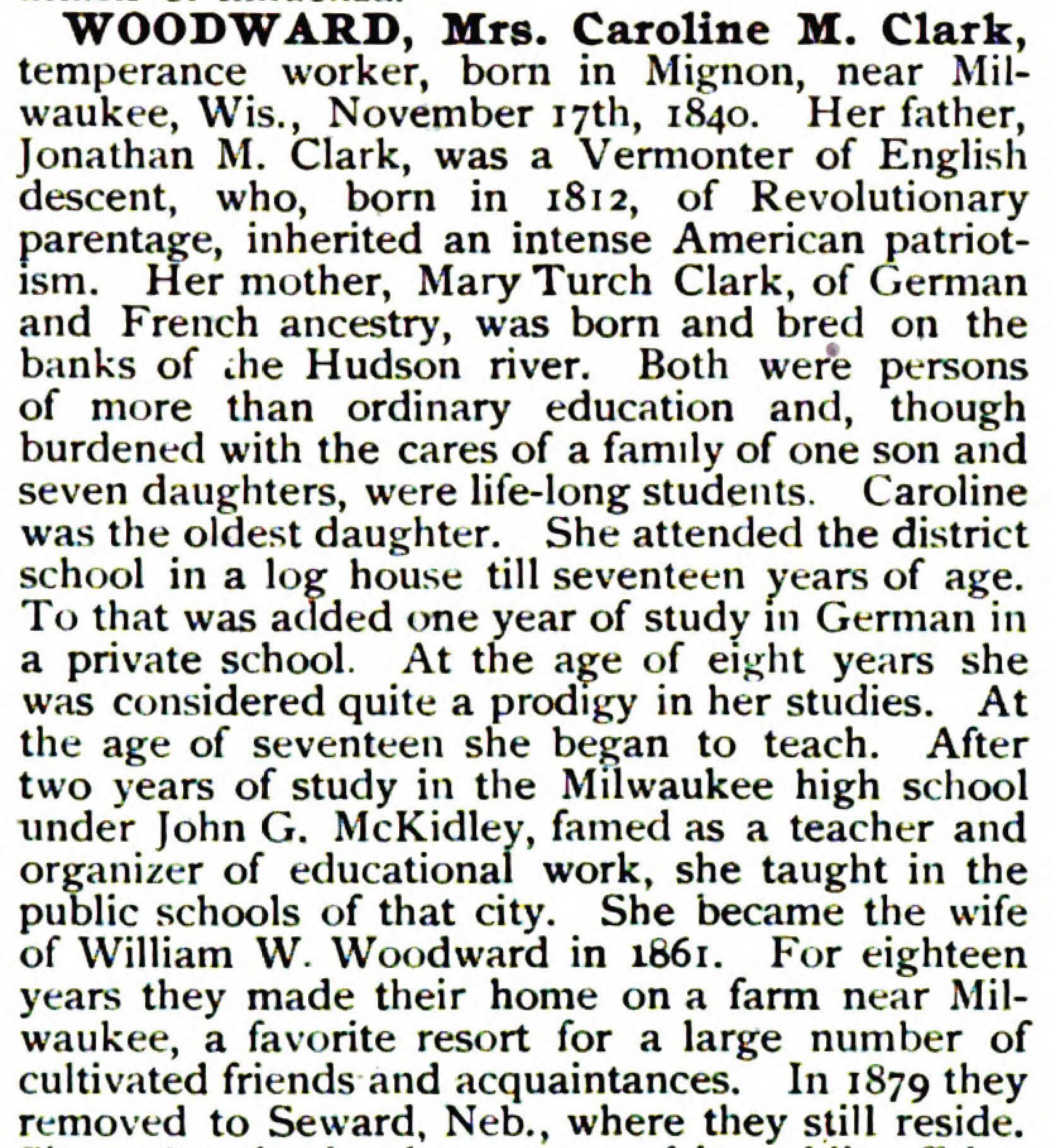
Caroline was the oldest daughter. She attended the district school in a log house till seventeen years of age. To that was added one year of study in German in a private school. At the age of eight years she was considered quite a prodigy in her studies. At the age of seventeen she began to teach. After two years of study in the Milwaukee high school under John G. McKidley [sic, McKindley], famed as a teacher and organizer of educational work, she taught in the public schools of that city.

Photo of Caroline M. (Clark) Woodward courtesy of Frances Willard House Museum & WCTU Archives, Evanston, Illinois. Text: Willard, Frances E., and Mary A. Livermore, editors. A woman of the century ; fourteen hundred-seventy biographical sketches […], Buffalo, 1873, page 779.

Think back…

Imagine this: You are now more than 50-years-old. You have achieved statewide and national prominence as an organizer for the largest women’s social and political organization of the 19th-century. You and your spouse manage a family farm, continue to raise your several adopted and foster children, and you have a successful business of your own, selling insurance. And when you are asked to provide the details of your life for inclusion in a major biographical dictionary of leading American women, you make sure to include, by name…one of your high school teachers?

That’s exactly what Caroline (Clark) Woodward did in 1893, when she highlighted her two years of study with John G. McKindley at the Milwaukee public high school. And that prompts a few questions: who was J. G. McKindley? why is he cited in Caroline’s 1893 biography? when would he have worked with Caroline? was he really “famed as a teacher and organizer of educational work”? and how big a deal was “high school” in Wisconsin in the 1850s and ’60s, anyway?

Continue reading

Still getting the lay of the land…

I’m still sifting through a huge (mostly digital) pile of Caroline M. Clark and William W. Woodward sources and trying to organize them into a series of coherent and interesting posts for you. Sort of like assembling a bunch of hastily-drawn field surveys and turning them into accurate topographical maps or railroad construction plans:

Unknown photographer, W.W. Wright, Chf. Eng. & … Mil. RRds. United States, circa 1861 and 1866. Library of Congress. Click to open larger image in new window.

At least my desk is indoors.

Continue reading

Caroline M. (Clark) Woodward: a closer look at that 1893 biography

Today, as we continue to explore the life of Jonathan M. and Mary (Turck) Clark’s eldest child, Caroline Mary Clark—later usually known as Mrs. C. M. Woodward—we’ll take a fact-by-fact look at the biographical sketch of Caroline that was published in 1893, re-printed unchanged in 1897, then abridged and reprinted in 1912. For a full discussion of these three publications, see last Monday’s Caroline M. (Clark) Woodward: first steps toward a biography.

Willard, Frances E., and Mary A. Livermore. 1893. A woman of the century ; fourteen hundred-seventy biographical sketches accompanied by portraits of leading American women in all walks of life ; ed. by Frances E. Willard and Mary A. Livermore, assisted by a corps of able contributors, title page and page 779.

Today’s post will be less of a fully-formed essay, and more of a running analysis, commentary, and proof-reading of this 1893 biographical sketch. We’ll take one portion at at time, starting at the beginning. The source text will be presented as a shaded quotation, followed by my commentary and corrections in simple black text on white background, with highlighted links to additional sources and explanations and, of course, a few footnotes, too. Here we go…

Continue reading

Caroline M. (Clark) Woodward: first steps toward a biography

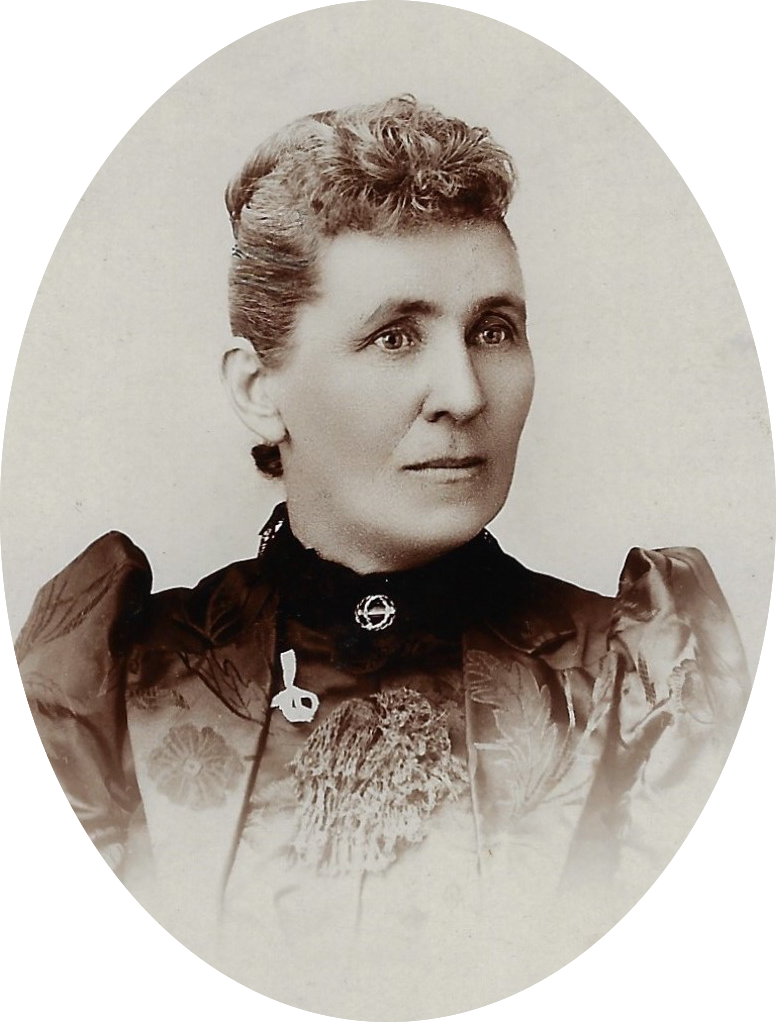
In our most recent blog post, Another family portrait! Caroline (Clark) Woodward, c. 1890s, we located and discussed the history of a previously unknown photo of Jonathan M. and Mary (Turck) Clark’s eldest child, Caroline Mary Clark, later usually known as Mrs. C. M. Woodward:

Townsend Elite Studio, [Portrait, Caroline M. (Clark) Woodward], inscribed “Mrs. C. M. Woodward, Supt. Work among Railroad Employes, N.W.C.T.U.”, photograph, circa 1889-1900. Photo courtesy Frances Willard House Museum & WCTU Archives, Evanston, Illinois. Click to open larger image in new window.

Caroline’s life was the most public—and perhaps best documented—of all the members of Jonathan M. Clark family, and is overdue for a closer examination. So today we begin a multi-part look at Caroline’s story, starting with three biographical sketches that were published during her lifetime.

Continue reading