I’m still working on several larger Clark House Historian projects, but I still have time to share a few Random Bits O’ History with you…
More Fun with Fraktur
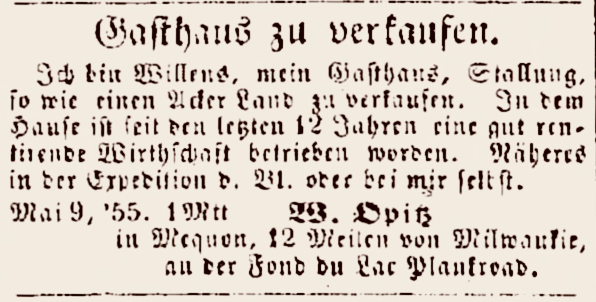
You may remember our recent post, William Opitz – real estate agent (1855), in which we noted the start of a new business venture—a “Land Agency”—by one of Mequon’s earliest and most influential German settlers, Wilhelm Ferdinand “William F.” Opitz (1813 or 1816 – 1882). Well, I found a companion advertisement from W. F. Opitz, published on page 2 of the Milwaukee Banner und Volksfreund on May 18, 1855:
In our previous post I made use of a paragraph from a recently rediscovered 1891 profile of Jonathan and Mary (Turck) Clark’s eldest child, Caroline M. Clark, later Mrs. C. M. Woodward. Caroline was the most publicly active, visible, and well-documented of all of the Clark siblings, and we have published a number of blog posts on her life and career, including this comprehensive piece: Caroline M. (Clark) Woodward: a closer look at that 1893 biography. I recommend reading that post and clicking all the links; they lead you to other, detailed CHH posts about specific moments and events in Caroline’s life.
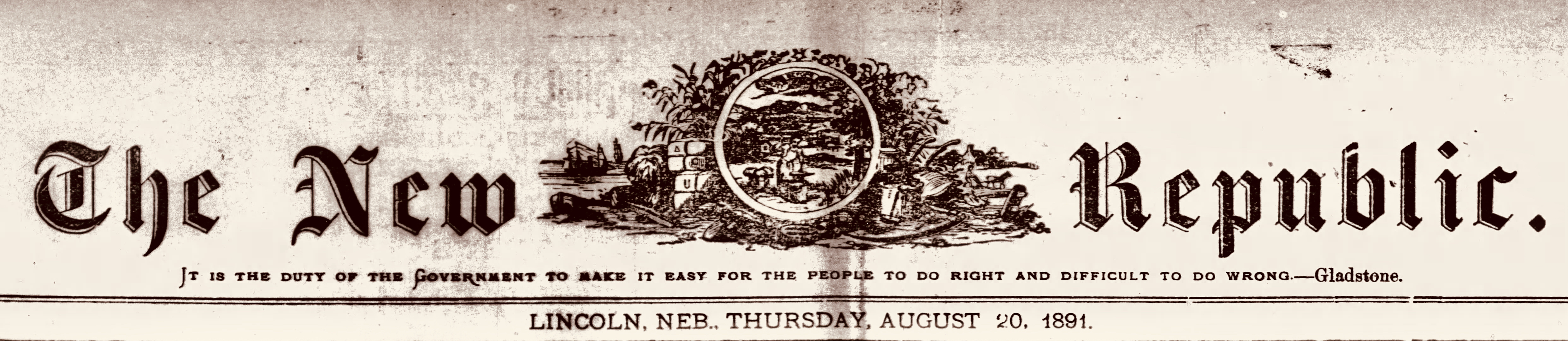
Today I’d like to share with you the complete 1891 profile that I quoted in our March 26, 2026, post. It originally appeared as one long column of text on page 1 of the Lincoln, Nebraska, “New Republic” newspaper, on August 20, 1891. Caroline (1840-1924) was fifty years old when this article appeared, and had another thirty years of active work in the temperance and women’s rights fields ahead of her.
Given the amount of accurate detail in the article, I suspect that the information came directly from Caroline herself. In fact, given how well-written and how accurate the whole profile is, I would not be surprised if Caroline wrote most, or all of it herself. For ease of reading, I have divided the article into several sections, created paragraph headers, and added a few notes on some of the facts mentioned in each section.
Home Sweet Home., ca. 1876. [New York: publisher not transcribed]. Library of Congress.
One of the first and most important tasks for any settlers arriving in the recently “opened-for-settlement” Wisconsin Territory was to create some sort of dwelling to shelter themselves as they carved out new farmsteads amid the dense hardwood forests. But what sort of quickly-built structures did our immigrants first construct and take shelter in?
Obviously, the big, stone, full-basement, two-story, Greek Revival style Jonathan Clark House, with its “1848” inscription carved over the front door, and its many double-hung sash windows, was not a hastily-made “first shelter” for newlyweds Jonathan and Mary (Turck) Clark. They must have had another, smaller, first home. What was that first home like? Until now we have assumed that the Clarks’ first home was probably a log cabin, and not some kind of “shanty,” but we didn’t really know. In today’s post, we share with you a recently discovered document that—I believe—solves this mystery once and for all…
I’m in the thick of researching and writing several series of illustrated posts for the blog, as well as for some upcoming public talks that I’m giving this spring and summer, and it’s kept me from posting lately. And as is often the case with these big projects, I find I have so much fresh material, and so many interesting, interconnecting, events and stories, that the problem becomes sorting and organizing all that information, and all those images, into coherent and not-overwhelmingly-long posts and presentations. (Heh. We’ll see about that…)
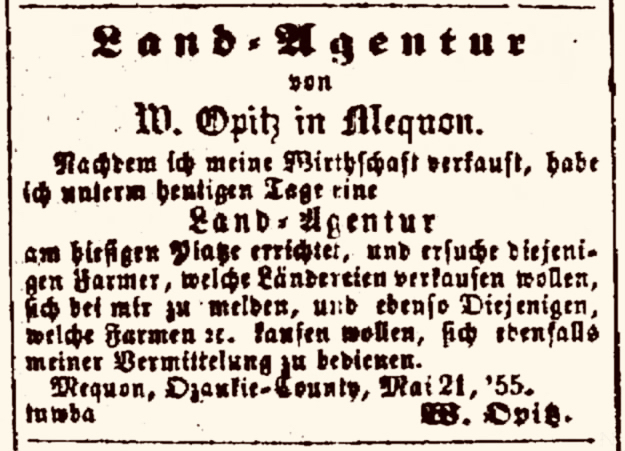
Anyway, while I continue my writing and editing behind the scenes, I thought you might enjoy this random bit of Mequon history I found while looking for some other, entirely different, information. It’s an advertisement originally dated May 21, 1855; this copy was published on page 3 of the Milwaukee Banner und Volksfreund [Banner and People’s Friend] on February 6, 1856. The ad announces a new business venture by one of Mequon’s earliest and most influential German settlers, Wilhelm Ferdinand “William F.” Opitz (1813 or 1816 – 1882):
How’s that? Your German language and Fraktur-reading skills are a bit too rusty to enjoy this historical advert? Well, just click and read on for all the details!
Our previous two posts (here and here) examined the 1888 recollections of a Mequon man that migrated from Germany to Mequon-Thiensville in 1848-1849, just after completing his schooling. His recollections were published in the form of two “letters” addressed to the Cedarburg News in May, 1888. Both letters were signed with just the initial “L.” Today I’d like to see what we know about our author — “L.” — and whether we can identify him.
But—before we start solving mysteries, there are errors to correct…
Updated dates!
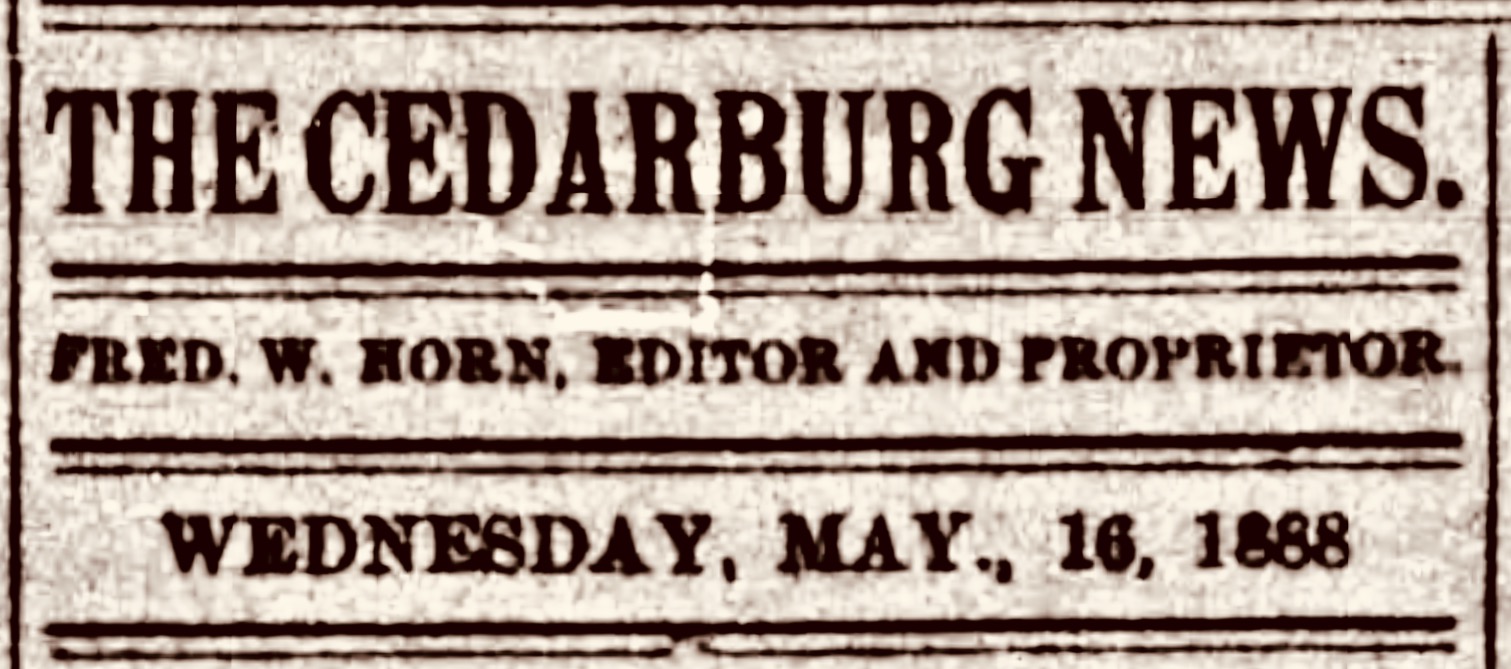
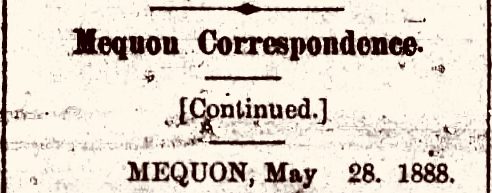
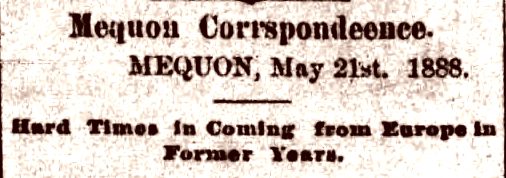
I goofed! I fell into a record-keeping, citation-making trap. As I started this new post, I decided to take yet another look at my sources. And much to my chagrin, I noted that the date at the head of each of our “Mequon Correspondence” letters does not agree with the date that each letter was actually printed in the Cedarburg News. That’s not so strange; I would expect that a letter would be written, dated, and sent to the paper’s editor before the newspaper’s date of publication. But in our case, the letters are dated almost a full week after the newspaper date of publication. What’s that all about?
Anyway, here’s the correct info: • the first letter of two, titled “Mequon Corrspondeence” [sic], was published on page 2 of the Cedarburg News on May 16, 1888, but the “letter” was dated, in its headline, “May 21, 1888.” • the second letter, titled “Mequon Correspondence. [Continued.]” appeared the following week, May 23, 1888, also on page 2, but the “letter” was dated, in its headline, “May 28, 1888.”
For the record, earlier today (28 Feb. 2026) I added this corrected date information to thosse two previous CHH posts. And now that we’ve settled that, let’s see what we can do to solve today’s History Mystery!
UPDATED, Feb. 28, 2026, to correct erroneous dates of publication of the two Cedarburg News “letters.“
Migration memories, 1848, continued
In our previous post we presented the first part of a personal memoir of travel from Germany to New York City and, eventually, Mequon-Thiensville, circa 1848. Those recollections were published as the first of two “letters” to the Cedarburg News in May, 1888. Both letters were pseudonymous, signed only with the initial “L.”
The first letter of the pair, titled “Mequon Corrspondeence” [sic], was published on page 2 of the Cedarburg News on May 16, 1888, but note that the letter itself was dated, in its headline, “May 21, 1888.” If you missed it, I recommend you begin with that earlier post and then come back here for the conclusion. Today we complete the author’s reminiscences with excerpts from his second letter, titled “Mequon Correspondence. [Continued.]” appeared the following week, May 23, 1888, also on page 2, but the letter was dated, in its headline, “May 28, 1888.”
An 1840s “prank” in NYC
The May 28th, 1888, letter begins with two anecdotes from our immigrant’s first day in New York City. The first incident involves a schoolboy “prank” in which a bottomless peach basked is used to trap the arms of an unsuspecting “fat old bachelor, the universal fool of our ship [illegible] to the greatest merriment of the bystanders.”
UPDATED, Feb. 28, 2026, to correct erroneous dates of publication of the two Cedarburg News “letters.”
Hard Times in Coming from Europe
You may have wondered why I haven’t written much about the German immigrant history and heritage of our corner of southeast Wisconsin. After all, since the late-1830s, and especially following the “Revolutionary Year” of 1848 in Europe, waves of Europeans—including hundreds of thousands of emigrants from the German Lands— left their homes in the Old World and set out to make a fresh start in America. Many of these German-speaking emigrants would find their way to Wisconsin, where they and their descendants would leave a lasting imprint on the culture and development of the new state.
The story of the Jonathan Clark House, however, centers around the lives of the Clarks and their immediate neighbors and in-laws, especially the Bonniwell and Turck families. All were prominent players in the earliest days of white migration to and settlement of Mequon, old Washington/Ozaukee county, and the city of Milwaukee. The Clarks, Turcks and Bonniwells came to Wisconsin Territory from New York, New England, English-speaking Canada and the United Kingdom in the later 1830s. Their Wisconsin story was not so well known or documented, so I have spent much of my time over the past decade or so researching their families, lives, and the events of their day.
Having said that, we need to remember that these “Yankee-Yorkers” and other English-speaking pioneers were not the only early immigrants to our area. Irish and German families were, indeed, already present and establishing farms and businesses in old Washington/Ozaukee county by the late-1830s, including at the large German Freistadt Colony and the early Irish neighborhood centered between the Jonathan Clark House and the crossroads hamlet of Hamilton. All of these overseas immigrants were the Clarks’ neighbors, and their stories are intertwined throughout the early history of Mequon.
And one thing those 19th-century Irish and German and British immigrants all had in common was time spent on a ship, making the uncertain and difficult voyage from Europe to America. In the next few posts we will look at some first-person recollections of a school boy who came with his mother and brother from the German Lands to Mequon-Thiensville around 1848, as recollected and published in 1888.
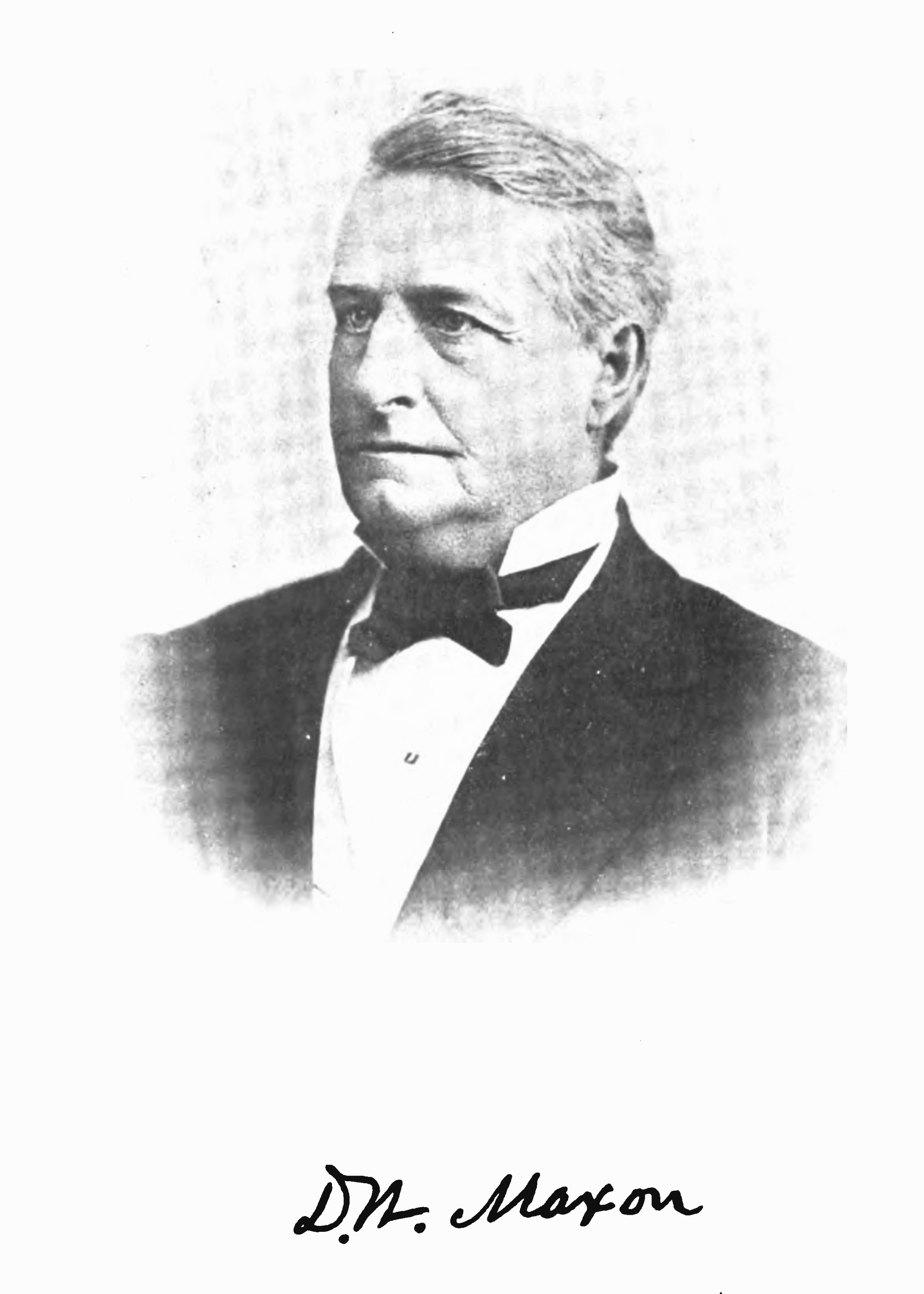
The lives of Mary Clark’s sister Elizabeth (Turck) Maxon, her husband Densmore W. Maxon, and the Maxon children are deeply intertwined with the history of Washington and Ozaukee counties, and with the lives of many of the early settlers, especially the Clark, Turck and Clow families.
From the early 1840s until at least the 1880s, members of the Maxon family—and especially D. W. Maxon— played important, recurring roles in Clark and Turck family affairs. That being the case, I thought we might benefit from a reasonably detailed overview of D. W. Maxon’s life, and I found a good one in A. M. Thomson’s A Political History of Wisconsin, second edition (C. N. Caspar Company, Milwaukee, 1902).
D. W. Maxon
The biography spans pages 431-433. D. W. Maxon’s portrait, with signature (above), is found facing page 236. I have proofread the transcribed text and added some paragraph breaks and headers for ease of reading. Otherwise the text, displayed here in grey-background “quotation” paragraphs, is complete as published in 1902.
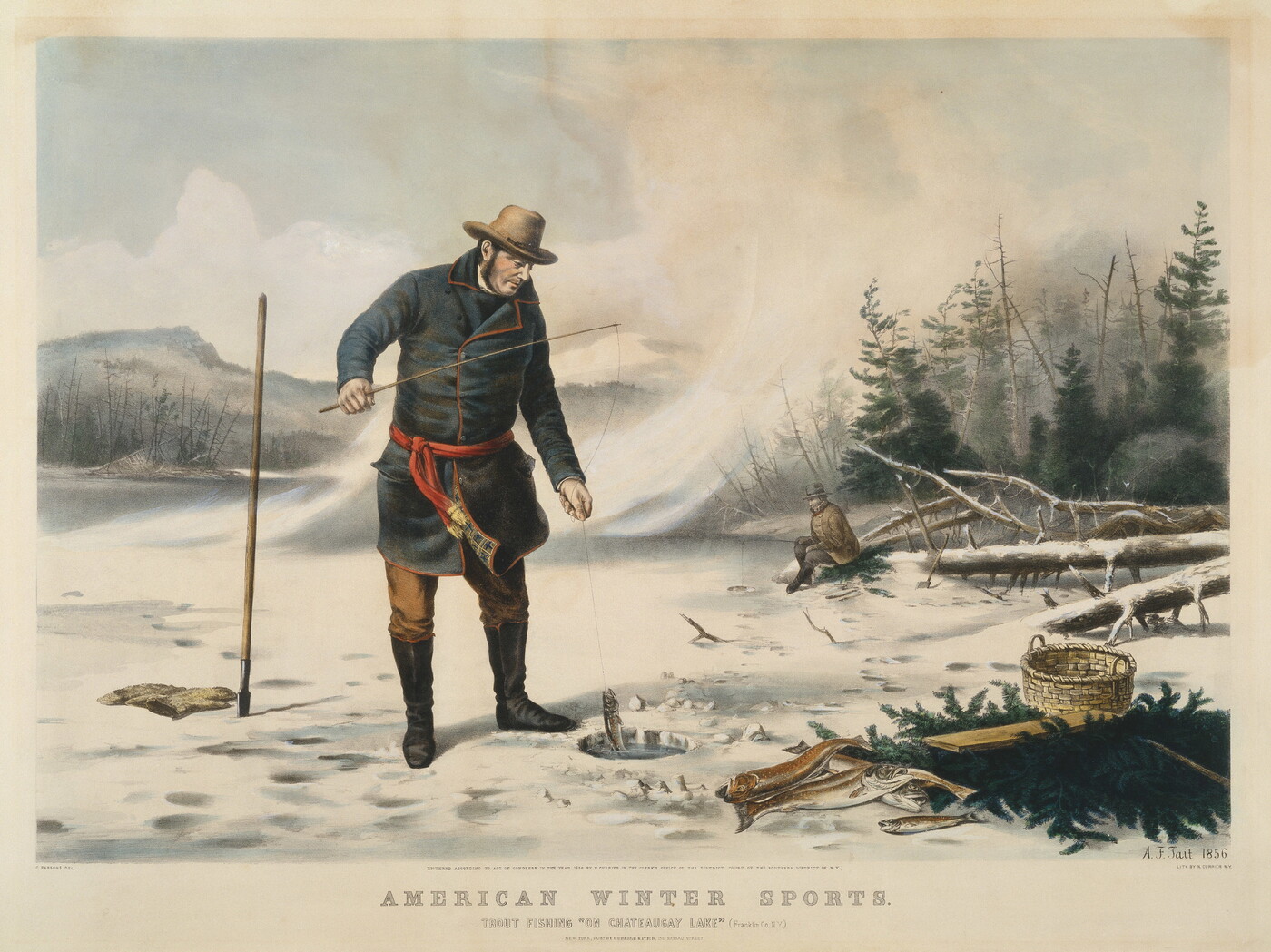
In an earlier post, “Intensely Cold Weather,” we examined the negative effects of several episodes of bitterly cold winter weather during the Clark family’s era and shortly afterwards. Today we look at some of the positive aspects of frigid winters in our part of the Old Northwest.
It’s no secret. Wisconsinites like to do stuff outdoors in the winter cold. Ice fishing. Skating. Cheering for the Packers.
But the Green Bay Packers professional football team wasn’t organized until 1919, a full eighty years after Jonathan M. Clark bought his first parcel of Mequon land in 1839. So what did our intrepid Wisconsin pioneers do back in the mid-1800s when those deep snows fell and cold north winds began to blow? Well, if you believe the newspapers of the era, there was no finer way to occupy a clear, frosty day—or moonlit evening—than to bundle up, go outside, and enjoy a…
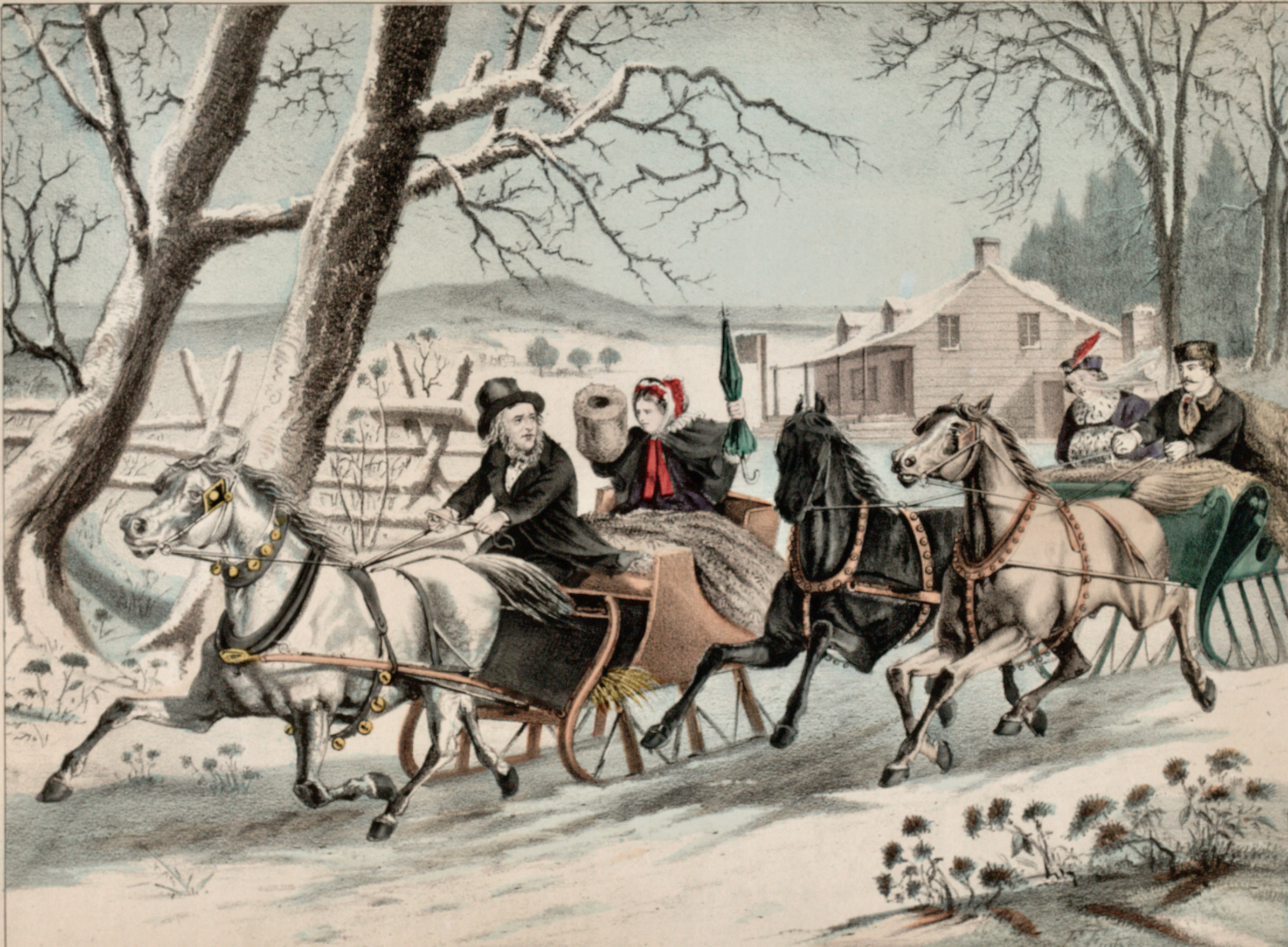
As I write this, southeastern Wisconsin is in the midst of our first substantial snowfall of Winter, 2025-2026. In Jonathan and Mary Clark’s lifetime, the day after a storm like this meant it was time to hitch up the sleigh and have some fun “dashing through the snow.” Here’s a lightly-revised and expanded repeat of a post that celebrates Clark-era “sleighing time” and “jingle bells.” (And be sure to click the highlighted links for more vintage wintertime images and info.)
Kimmel and Forster, publishers, “Winter Pleasure in the Country,” circa 1865. National Museum of American History, Peters Prints Collection, Smithsonian Institution.1 Note the modest straps of jingle bells on the one-horse sleigh and the much more ostentatious—and louder—straps of bells on the two-horse sleigh.
Last winter, our earlier CHH posts Snow!, Shoveling out -and other winter chores and Stuff Happens – on a sleigh ride, got me wondering again about winter travel in old Washington/Ozaukee county during the Clarks’ era of the mid-1830s through the 1860s or so. Assuming most of the more successful farmers—such as the Clarks, Bonniwells and Turcks—owned a one- or two-horse sleigh, how easy was it to navigate that sleigh on the early county roads? Could you sleigh ride all the way to Milwaukee? And if you could, how long might that take?
 Clark House Historian