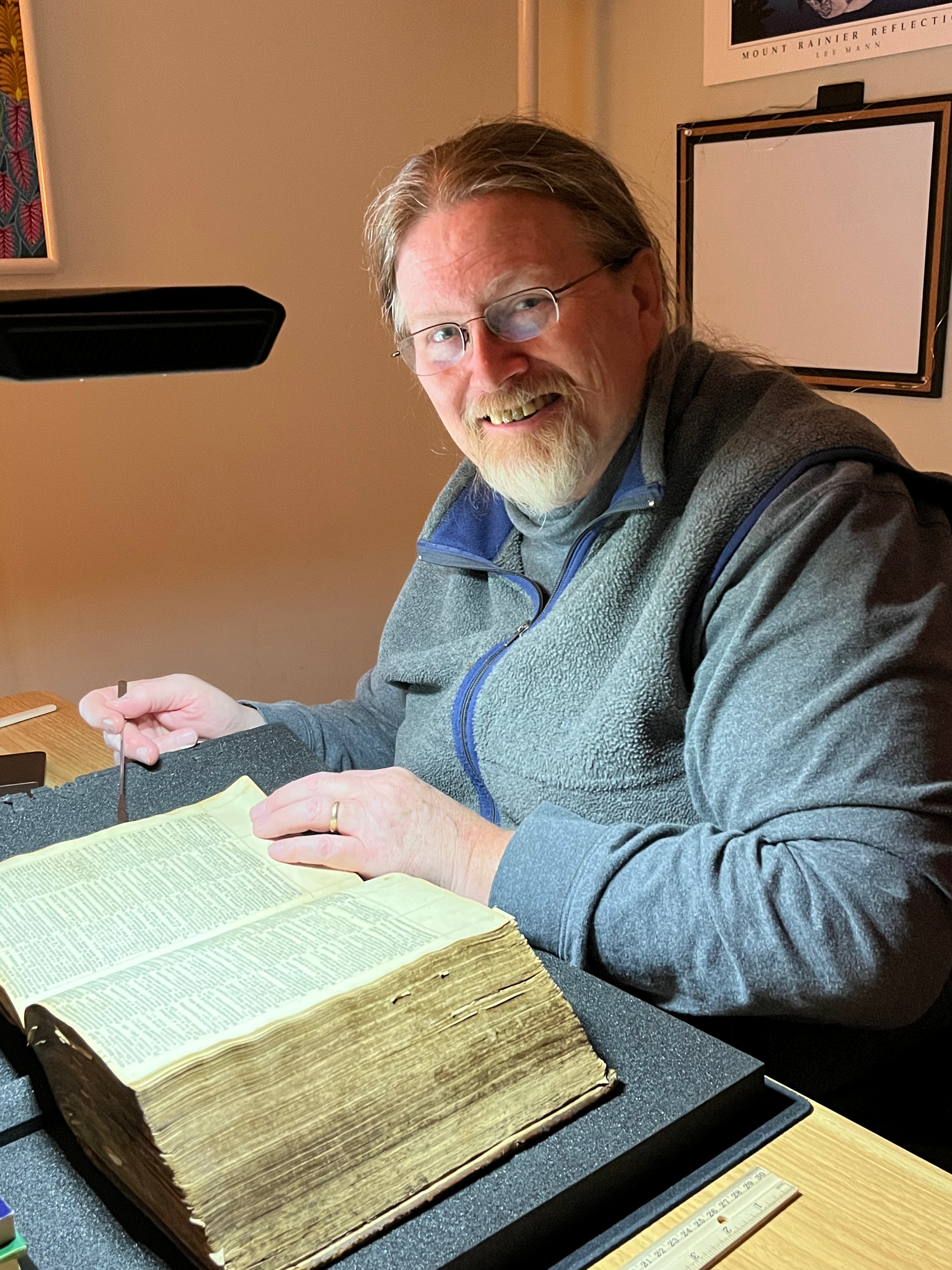
Guess what I’ve been doing?
Provenance
Provenance is an important concept for historians, collectors and museums. It refers to the chain of ownership of any collectible item, including manuscripts, artworks, official documents or, in our case, a family Bible. Establishing the provenance of an item—such as the Bonniwell Bible—from its creation to the present day is important for several reasons:
Who owned it first?
That’s still a bit of a mystery. On the one hand, we do have a solid—though perhaps not unbroken—history of Bonniwell family inscriptions in this Bible, beginning in 1697 and continuing through the early 1900s. First-person family recollections record the Bible’s direct descent from that time until the present day. And we know that this Bible was first in the possession of a related branch of the Bonniwell family and then owned by “our” Bonniwells no later than 1795:

Bonniwell Bible, detail, showing inscription by William Bonniwell, 1798, and ligature WBonniwell, 1795. photo credit: Kendalyne Gentile, 2022.
Continue readingUPDATE, Nov. 30, 2022: The discussion of the William Bonniwell signatures and dates, below, is not correct. I have lined-through the incorrect paragraph and added the correct info in two new paragraphs below the original misinformation.
It may not look like much on the outside. It’s old. Not very big. Whole pages are missing, others are damaged. The binding is worn.

Bonniwell Bible, front cover. Photo credit: Kendalyne Gentile, 2022
But this modest book was—for over 300 years—the family Bible for Mequon’s pioneer Bonniwell family, their ancestors and descendants. And last month, the Bible’s most recent owner, Bonniwell descendant Kendalyne Gentile, generously gave the Bible and other Bonniwell family documents to the Jonathan Clark House Museum where they will form an important part of our permanent collection.
Continue readingOn Monday, I mentioned how I’ve been reading a lot of interesting documents lately, including some very cool and very old Clark House related manuscripts, and I was puzzled by this bit of manuscript marginalia, found in an old religious book, a real History Mystery:

I noted that this handwriting may (or may not) be a variation on the English writing style known as Secretary hand. I was stumped, and asked you readers to Help the Historian! with this mysterious passage. And although I didn’t have any prizes to award—except eternal fame and glory throughout our vast Clark House Historian readership—I hoped someone would step forward and claim their virtual laurel wreath. Well, the week is over, and the winner is…
Continue readingMore Clark House news has arrived from our executive director, Dana Hansen. Starting this month—May, 2022—the Jonathan Clark House Museum, at the corner of Bonniwell and Cedarburg Roads in Mequon, Wisconsin, will be open for tours on the first Friday and second Saturday of each month, from 11:00 a.m. to 2:00 p.m.

If I read my calendar correctly, that means you can just drop in this Friday, May 6, or next Saturday, May 14, between 11 and 2, and enjoy a tour of the historic home of Mequon’s pioneer Clark family. Other open days will follow on first Fridays and second Saturdays throughout the summer. If you have a group of 6 or more, please call ahead. More info on Clark House tours can be found at this link. Questions? Give us a call at 262-618-2051 or send us an e-mail at jchmuseum@gmail.com.
History Mystery! update…
Did you see our CHH History Mystery! post on Monday? Have you been working on your transcription of our early English manuscript text? Are you stumped? Do you still want to win eternal fame and glory throughout the Clark House Historian readership? Here’s an update to that initial post, with two more clues to help you solve our handwriting puzzle:
Continue readingI’ve been reading a lot of interesting documents lately, including some very cool and very old Clark House related manuscripts. (More details on these exciting documents coming later this spring or early summer.) We’ve looked at many old manuscripts here at Clark House Historian, and I think I’m pretty good at deciphering most older English handwriting from about 1700 until the present and, with help, I can even figure out many German scripts from the late 18th- through the 19th-century.
But then there’s this, a real Clark House Historian History Mystery:
That’s the handwriting of a literate English-speaking man or woman of a certain era. I’ve seen handwriting like this before in old Cornwall parish records of my Perkins family. In my (limited) experience I’ve seen this style of writing on documents dating from the later-1600s through the early 1700s, perhaps as late as 1750 or so. But I’m not an expert on Early Modern English or English orthography, and it’s possible that this hand was in use as early as the 1500s. It may (or may not) be a variation on the English writing style known as Secretary hand.
For some reason, this writing style remains very difficult for me to read. I’ve spent enough time with examples of this hand—and the many spelling conventions of the era—that I’m not completely lost, but there is a lot here that I don’t understand. So I’m asking you readers to take a crack at it, and Help the Historian! with this mysterious passage.
Along the way, I recommend you click on each image to open it in a new, larger window. You’ll get the best, enlargeable, view of each mystery text and my annotations. Here are your clues:
Continue reading
 Clark House Historian