1864/65: A Directory Divertimento

Today’s post started out as a simple continuation of earlier posts (here, here, here) looking at Mary Clark, her children, her father Peter Turck and her brother James B. Turck, living and working in Milwaukee in the early 1860s. We discussed the years 1861-1863, using as an important source the Milwaukee city directories compiled in those years by A. Bailey and published by Starr & Son. Today we take a detour from our search for Clarks and Turcks in 1860s Milwaukee, to learn a few things about how city directories were made, and about the revised Milwaukee street numbering system of 1865.

1864: Missing directory

It appears that there was no Milwaukee directory published in 1864. Did the previous publisher go out of business? Did the war years cause manpower shortages that made canvassing for information impossible? Do any of our readers know more about this missing 1864 directory? If so, please reply. I’d like to know more.

1865: New publisher, and more

The 1865 edition of the city directory introduced big changes, both for the book and for Milwaukee’s street addresses. The new publisher was Richard Edwards, who was also responsible for similar volumes in other major cities such as St. Louis, Louisville and New Orleans. He announced his new Milwaukee venture—after a dozen pages of advertisements—with this handsome title page:

Continue reading

Clarks and Turcks, 1863

Still together, in Milwaukee

In our earlier posts 1861/1862: Moving Time and Monday: Map Day! we followed Mary Clark and her children as they left the Clark house and farm in Mequon and moved to Milwaukee, sharing a home with Mary’s twice-widowed father, Peter Turck.

The next edition of the Milwaukee City Directory was for the year 1863. By the time Mary’s only son, Henry Clark, celebrated his 20th birthday on February 21, 1863, the nation had been immersed in the violence of the Civil War for almost two years, with no end in sight. That summer, Henry—a resident of Milwaukee’s seventh ward—would register for the Union’s first nationwide military draft.

Page 47 of the Milwaukee City Directory for 1863 gives Mary’s address as:

Clark Mrs. Mary, 474 Jefferson.

This is the same address as found in the 1862 directory. (In 1863, there is no other “Clark, Mary” listed in the directory as there was in 1862.) It is almost certain that all the unmarried Clark children are at 474 Jefferson with their mother. Besides Henry, there are six girls still at home. Libbie, the oldest, is 18. Jennie, the youngest, is only 5 years old.

Peter Turck

On page 246 of the directory we find Peter Turck—misspelled, not for the first time, as Turk—still living with Mary and the family at 474 Jefferson.

Click to open larger image in new window.
Continue reading

Monday: Map Day! – Milwaukee Street Map, 1859

In our most recent Clark House Historian posts, 1861/1862: Moving Time and Fred Beckmann, Sr., we began to look investigate how in 1861/62, Mary Clark and her children left the Clark farm in Mequon and moved in with her widowed father Peter Turck in Milwaukee. Before getting down to the nitty gritty of the various homes occupied by the Clarks and by Peter Turck during the decade of the 1860s, I thought I should make a quick answer to the question: who lived and farmed the Clark farm from about 1861 to 1868?

Well, it turns out that the answers to that question are more complicated, and the evidence more sparse and in need of interpretation than I anticipated. So we are going to pause our investigation of the “who was Mary Clark’s tenant farmer?” issue for a moment, as I sort through maps and census schedules and consult with Clark House museum director Nina Look and others.

On the street where you live…

Meanwhile, I thought today’s Monday: Map Day! item should be a street map of Milwaukee from about the same time that Mary Clark and the children moved to the city in 1861/62. You may remember our post featuring the 1854 Panoramic Map of Milwaukee. I find that map really interesting and informative in a general way, but it has one shortcoming: none of the streets are labeled. That’s not very useful if we are trying to follow the Clark family’s progress from place to place in the 1860s and beyond. So how about this map?—

Continue reading

Fred Beckmann, Sr.

UPDATED February 9 & 11, 2025, to correct the year and date of Fred. Beckmann’s death and investigate the apparent errors on his gravestone (see updated images, text, and especially Note 4, below).

Farming the Clark place, 1868-1873

In our previous post we saw that sometime around 1861/62, Mary Clark and her children decided to move to Milwaukee. By the time the Milwaukee City Directory for 1862 was published, Mary—and, we presume, her children—were living together with Mary’s father Peter Turck, at 474 Jefferson in the city.

We also know that Mary and her daughters did not sell the Mequon farm—to Catherine Doyle—until April, 1872. So, for over a decade, someone besides the Clark family was living and working on the Clark property. Most likely, Mary made some kind of tenant-farmer arrangement where someone grew crops on the Clark land and paid rent to Mary from the proceeds. This could have been a very useful source of income for Widow Clark and her seven children during the 1860s. Unfortunately, we don’t have much documentation of who the tenants may have been and what sort of arrangement Mary may have made with them.

The Doyle Family

In the same post, I also erred in assuming that the John and Catherine Doyle family probably farmed the Clark land throughout the 1860s. Clark House museum director Nina Look recently called my attention to information about the Doyles and their neighbors in various maps and census schedules created around 1870 that shows that the Doyles were living and farming elsewhere in Mequon through most of the 1860-1870 decade. In future posts I will look at those maps and census schedules and try and make more sense of where the Doyles lived and what land they may have farmed prior to purchasing the Clark farm in April, 1872.

Nina also reminded me that I forgot one important person that we know did farm the Clark farm: Fred Beckmann

Continue reading

1861/1862: Moving Time

Mary Clark and the children move to Milwaukee

On July 20, 1860, the eighth federal decennial census recorded Mary Clark and her family living together on their Mequon farm. Less than a year later, on May 15, 1861, eldest daughter Caroline Clark married William W. Woodward and, presumably, left the Clark house to start their new life together. By the next federal census—June 1, 1870—Mary Clark, her six youngest daughters, one son-in-law, one grandchild, and one future-son-in-law, would be enumerated together in Mary’s home in Milwaukee.

What happened to the Clarks between July, 1860, and June, 1870? Ozaukee County land records show that Mary and her children did not finally sell the Mequon land, stone house, barn, and other structures until April, 1872. Catherine Doyle, matriarch of Mequon’s Doyle family was the buyer. Two years earlier, the 1870 federal census shows that Catherine Doyle, her husband John, and their family were already farming on the old Jonathan M. Clark farm. It appears that Mary Clark had rented or leased the Clark farm to the Doyles and, presumably, used the income to support her family.

So when did the Clarks move to Milwaukee? Did they buy a house, rent, or move in with Mary’s father, Peter Turck? To find out, we need to consult a mundane but very useful resource, the City Directory.

Continue reading

Monday: Map Day! – 1854 Panoramic Map of Milwaukee

The first white settlers to old Washington County, Wisconsin—later divided into Washington and Ozaukee counties—arrived in the late-1830s and early-1840s. Many of these settlers were so-called “Yankees,” namely New England and New York state residents. Other early immigrants to old Washington county came from places such as Lower Canada (i.e., Quebec), Nova Scotia, and the many German-speaking lands.

Why did they come?

For many families, the chance to buy inexpensive land, clear the forest, build a house, and work their own farm was a dream come true. Many of the Yankee immigrants had realized that the farms of New England were too small to continue dividing generation after generation and still make a profit. (Sometimes—as the old joke goes—it seemed like the only guaranteed “crop” each year was the annual spring “harvest” of rocks in the field.) For European immigrants, land ownership was often unaffordable or simply not allowed for the average family back in “the old country.” Other European immigrants fled mid-century famine, as in Ireland, or mandatory military service or political unrest in various places, including the German lands. It’s no surprise that many Wisconsin immigrants of the ’30s, ’40s and ’50s made their homes in Washington/Ozaukee county and then farmed there for decades, often passing the house and farm to the next generation and beyond.

For other early arrivals, the opening of government land in Wisconsin Territory represented a chance to make money. More than a few of the Yankee settlers came to the territory early, bought land at $1.25 per acre, farmed for a decade or so, and then sold out to the next wave of immigrants, often making a considerable profit. Some of these men—such as Solomon Juneau, Byron Kilbourn, and William A. Prentiss—were land speculators that made (and sometimes lost) fortunes in the process, and became important figures in nineteenth-century Milwaukee and Wisconsin business and government. Other, smaller, investors were simply savvy farmer-capitalists that bought government land cheaply, held it for a while, and then sold at a profit. Some of these repeated the process several times throughout their lives, buying and selling, moving westward as the government opened new tracts of cheap—or even free—land in the new territories of the frontier.

Stay or go?

By the mid-1850s, a number of early Washington/Ozaukee county settlers decided that rural life was no longer for them. Mary Clark’s father, Peter Turck, was one of the first Mequon settlers to relocate. A self-made polymath, from his earliest days in the territory Turck had been—often simultaneously—a farmer, Baptist preacher, sawmill owner, justice of the peace, coroner, territorial and state legislator, and lawyer. In the 1840s he survived the death of his first wife Rachael Gay, remarried, and had another child. By the early 1850s—like a number of his early Mequon neighbors—he decided to leave his farm and relocate to nearby Milwaukee. There he could focus on his work as a lawyer and real estate dealer and, perhaps, seek better educational opportunities for his youngest children.

Milwaukee

In 1836,—a year before the Turck family arrived there from New York—Milwaukee had been a small, random collection of roughly made homes and businesses along the east and west banks of the Milwaukee River where it flowed into Lake Michigan. By the time Peter Turck moved to Milwaukee from Mequon, the city looked like this:

Continue reading

The Clark Family in 1860, part 2

A Closer Look at the 1860 Census: Checking Ages and Dates

As we did for their 1850 census, I thought we should do the math and check whether the enumerator got everyone’s correct age on the Clark family’s 1860 census schedule. And do the ages agree with the Clark “Family Record” and other Clark family documents and known facts, including their 1850 census schedule?

First, examine the Clark’s 1860 census page header. It was enumerated by Assistant Marshall (for the census) Hugo Boclo and covered the “Free Inhabitants in the town of Mequon in the County of Ozaukee State of Wisconsin enumerated by me, on the 20th day of July. 1860.”

Continue reading

View from the window…

There’s a lot going on behind the scenes at Clark House Historian these days. I’ve got a half-dozen blog posts in various stages of completion, plus ongoing research and information-checking projects with Nina Look, Liz Hickman, and others. And, I’ve just heard from a third-great-granddaughter of two of the original Mequon settler families! How cool is that? More on those folks in an upcoming post—or two!

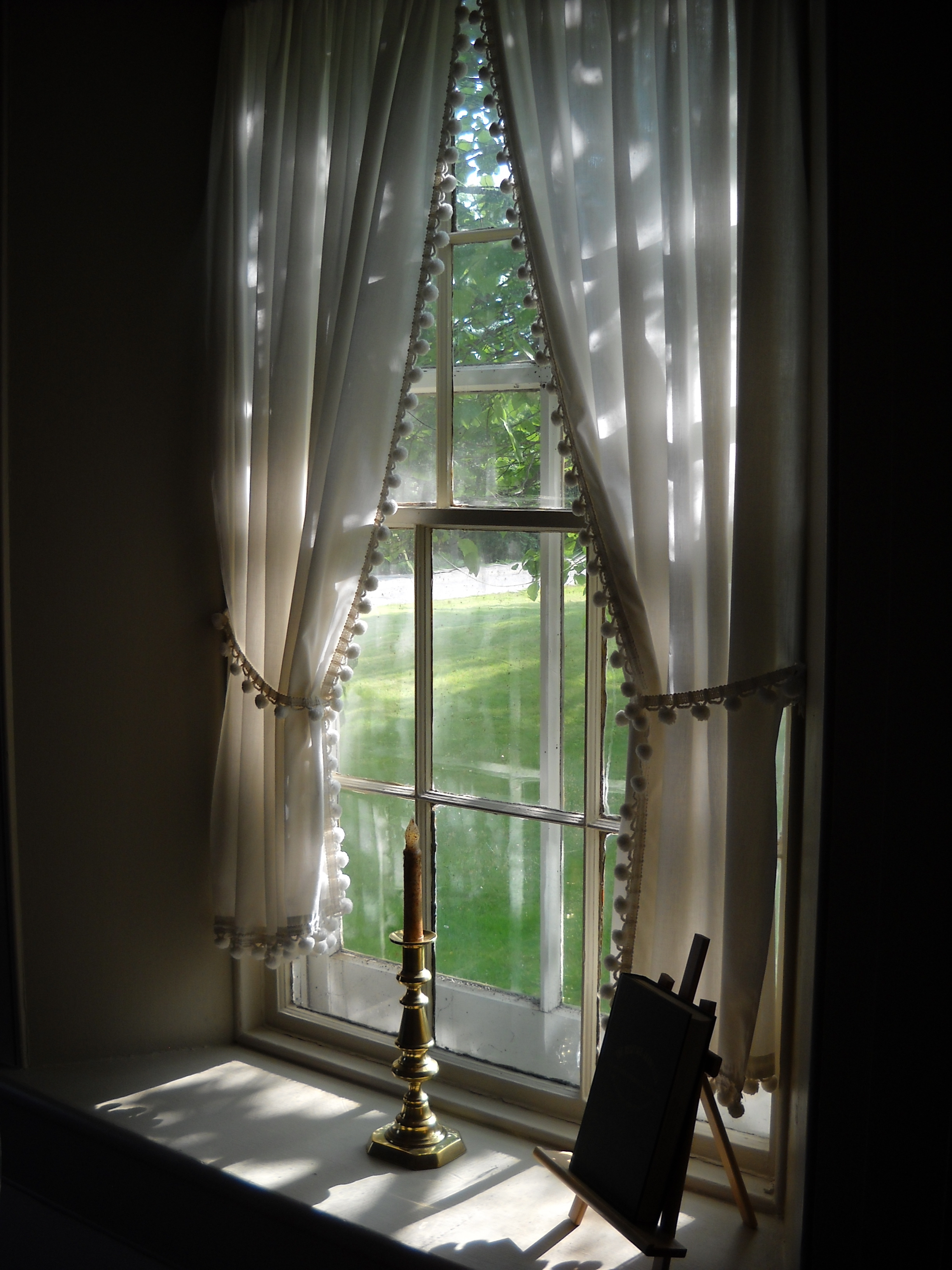
So let’s take a break, and enjoy a relaxing summer view from the Clark House. In this instance, a lovely July, 2015, view from the Clark’s front parlour, looking to the southwest toward present-day Bonniwell Road. According to the 1872 “Shoolmap” of Mequon, neighbors John Kurz and J. H. Townsend lived just across the street. A bit farther west down the road were—still—the farms of old friends and original Mequon settlers William Bonniwell and Jesse Hubbard.

Photo by Anna Perkins, used by permission. Click to open larger image in new window.

Monday: Map Day! – “Shoolmap” of Mequon, c. 1872

Today’s Monday: Map Day! introduces a rare and very interesting map, from a wonderful digital collection of maps. It’s the c. 1872 “SHOOLMAP of the TOWN of MEQUON,” from the University of Wisconsin–Milwaukee’s American Geographical Society Digital Map Collection, and it is packed with information and unique details:

Shoolmap of the Town of Mequon / School Map of the Town of Mequon, 1872?, University of Wisconsin-Milwaukee, American Geographical Society Digital Map Collection. Manuscript map. Mequon-Thiensville Historical Society, donor. Copyright notice here, presented in this post as a public domain item and/or under fair use provisions of U.S. copyright law.

To view a beautiful, large version of today’s map, click here, or on the map image (above). That will open a new window and take you to the University of Wisconsin–Milwaukee’s American Geographical Society Digital Map Collection, and the home page of this map. It will look something like this:

Continue reading