UPDATED 16 July 2022, to correct typo in Alfred’s death year. Correct year is 1895.
At last month’s annual meeting of the Friends of the Jonathan Clark House, assistant director Nina Look mentioned that she had some sort of research project coming later this year, involving the youngest Bonniwell brother, Alfred T. Bonniwell (1826-1895). I’m not quite sure what Nina’s project will focus on, but Alfred is, perhaps, the least-known Bonniwell, and deserves further study.
As a Bonniwell brother, Alfred plays his part in the establishment of one of Mequon’s first cleared and populated areas, the Bonniwell Settlement. The Clark house—and Clark family—played an important role in the early decades of this settlement, and the history of the Clark family is intimately tied up with their neighbors, the Bonniwells. How intimately?
Updated February 22, 2022 to fix a few minor typos, and to add a link to a brief history of American samplers, with an illustrated list of 73 of the 137 American samplers in the Textile Collection of the National Museum of American History.
In addition to raising and educating her children, a 19th-century farm wife like Mary Turck Clark had many other responsibilities, including planning and tending a farm garden, preserving its produce, preparing daily meals for the family and hired hands, and keeping the farm house clean and organized. And Mary, like many women of her era, probably made some or all of her own and her family’s clothes.
The sewing arts
Like most girls of her era, Mary Turck (born in New York, 1821) probably learned the craft of needlework from her mother and, perhaps, as part of her school education. When a young girl like Mary mastered some of the many practical and decorative sewing stitches, she might demonstrate her proficiency by making a sampler.
A sampler might feature simple examples of sewn letters, numbers and perhaps a popular saying or Bible verse. But many samplers were more complex and artistic. An accomplished embroiderer might produce an elaborate sampler featuring detailed images and texts, as in this 1829 sampler from Connecticut.
Thompson, Mariette (1817-1851), [Sampler with family register], 1829. Yale Art Gallery, public domain. Click to open larger image in new window.
It’s a New Year (yikes!—we’re already three weeks into the New Year!), and I thought I’d take a break from researching and note-taking for quick look back at our 2021 year of blogging at Clark House Historian. The blog is about to celebrate its seventh anniversary (on March 29), and 2021 was our most productive year so far, sharing more posts, documents, and historic maps and images with our readers than ever before.
The author, hard at work. For full photo credits, see below. Click to open larger image in new window.
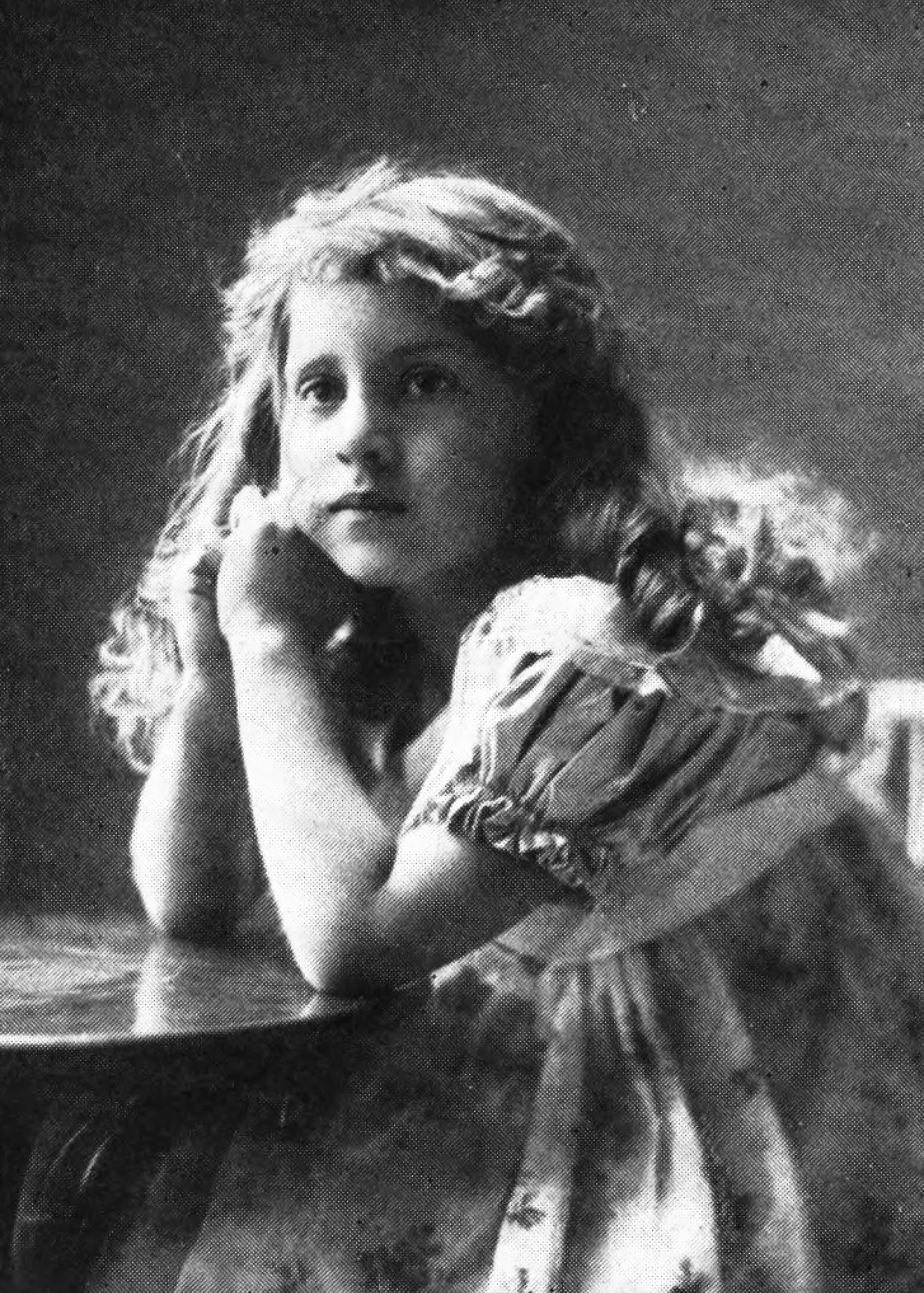
Christmas is coming, and to get in the holiday mood, how about a seasonal Turck family anecdote, “a true story,” as related in the pages of Correct English magazine, written, edited and published by Peter Turck’s granddaughter—and Mary (Turck) Clark’s niece—Josephine Turck Baker, and later collected with other similar tales and published as a book, Correct English in the Home, Chicago, 1909.
In the foreword to her book, the author explains:
When I was a little girl, like most children, I was very fond of listening to stories; but unlike most children, I did not care for fairy tales, my first question invariably being, ” IS IT A TRUE STORY?” I don’t want a “once upon a time” story. This is a true story. The children, their names, the incidents narrated, are all true. Beatrice, Roschen, and the “Boitie,” are my children […] For those who like really true stories of really true people with really true names, this little book is written. That it may instruct and entertain all readers, both little and big, young and grown up, is the earnest wish of Yours for Correct English, Josephine Turck Baker
Veterans Day is today. I’m preparing a new post on one of our Clark House veterans, Mary (Turck) Clark’s youngest sibling, Benjamin Turck (1839-1926), but it’s not quite ready yet. For a wider perspective on the day—and our early Mequon veterans—here’s a post originally published at Clark House Historian on November 11, 2016, and revised, expanded and republished on November 11, 2020. I’ve also incorporated a list of Mequon’s Civil War soldiers, originally published here on May 24, 2020.
Armistice Day
One hundred and three years ago, on the eleventh day, of the eleventh month, at the eleventh hour—Paris time—the Armistice of Compiègne took effect, officially ending the fighting on the Western Front and marking the end of World War I, the optimistically named “War to End All Wars.”
In the United States, the commemoration of the war dead and the Allied victory began in 1919 as Armistice Day, by proclamation of President Woodrow Wilson. Congress created Armistice Day as a legal holiday in 1938. Starting in 1945, a World War II veteran named Raymond Weeks proposed that the commemorations of November 11 be expanded to celebrate all veterans, living and dead. In 1954 Congress and President Eisenhower made that idea official, and this is what we commemorate today. There are many veterans with a connection to the Jonathan Clark house. We honor a few of them in this post.
Jonathan Clark, Henry Clark, and the U.S. Army
Jonathan M. Clark (1812-1857) enlisted as a Private in Company K, Fifth Regiment of the U. S. Army, and served at Ft. Howard, Michigan (later Wisconsin) Territory, from 1833 until mustering out, as Sargent Jonathan M. Clark, in 1836. In the 1830s, Fort Howard was on the nation’s northwestern frontier. JMC’s Co. K spent much of the summers of 1835 and 1836 cutting the military road across Wisconsin, from Ft. Howard toward Ft. Winnebago, near modern Portage, Wisconsin.
Fort Howard, Wisconsin Territory, circa 1855, from Marryat, Frederick, and State Historical Society Of Wisconsin. “An English officer’s description of Wisconsin in 1837.” Madison: Democrat Printing Company, State Printers, 1898. Library of Congress. Click to open larger image in new window.
In a recent post, Caroline Clark – public school teacher, we examined Caroline Clark’s brief tenure as a teacher in the grammar department of Milwaukee’s Ninth Ward School, and concluded:
Caroline Clark’s employment as a Grammar Department teacher began on September 1, 1860. According to the 1861 Report, she taught for eight months. That would mean she left her teaching position around the beginning of May, 1861. Why? One factor might have been her salary […] But the more likely reason for her departure from the Ninth Ward School was that on May 15, 1861, she married Milwaukee county farmer William Wallace Woodward. For much (all?) of the nineteenth century, it was customary for female school teachers to be single; once they married, they were expected to leave the profession and set up housekeeping with their new husband and, eventually, start a family of their own. I think it’s safe to assume that this is what happened to “Miss Caroline M. Clark” in May, 1861.
Finding Caroline’s marriage record
Long before I found Caroline’s 1893 biographical sketch, or her profile and interview in the OmahaDaily Bee (March 30, 1916, page 11), or read her several long obituaries, I was able to determine when—and whom—she married. How? By using the Wisconsin Historical Society’s invaluable—but not infallible—Pre-1907 Vital Records Database (Birth, Marriage, Death). Yes, the interface is a bit clunky, but if you search for “Clark, Caroline,” one of the results you’ll find is:
Seems plausible, right? But how do we know it’s “our” Caroline? And how do we match her with a spouse?
As we discussed earlier, Caroline M. Clark (1840-1924), the oldest child of Mary (Turck) Clark and the late Jonathan M. Clark, studied for two years at Milwaukee’s first public high school, led by the noted educationist John G. McKindley. McKindley’s second academic “exhibition” of his Seventh Ward High School students took place at Albany Hall, Milwaukee, on August 9, 1861. It was McKindley’s final appearance as Principal of the Seventh Ward High School. I expect that 19-year-old Caroline M. Clark was there also, as the event marked the end of her years as a student in the Mequon and Milwaukee public schools.
After two years of study in the Milwaukee high school under John G. McKi[n]dley, famed as a teacher and organizer of educational work, she taught in the public schools of [Milwaukee].
Once she finished her high school studies, Caroline would have been qualified to teach Primary, Intermediate, or—perhaps—Grammar school classes in Milwaukee’s public schools. And she did.
Caroline got a job!
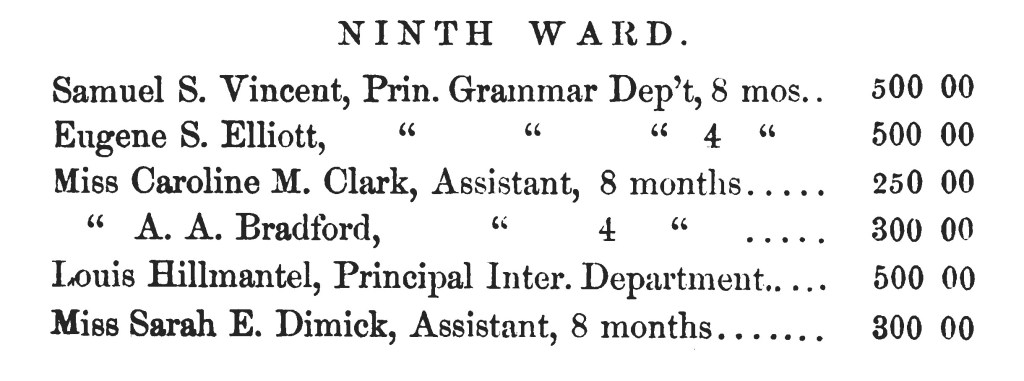
Annual Report of the Board of School Commissioners of the City of Milwaukee, to his honor the mayor and the common council of Milwaukee, for the year ending September 1, 1861, Milwaukee, 1861, p 15-16, via GoogleBooks.
“Miss Caroline M. Clark” was hired as an Assistant teacher in the Grammar Department of the city’s Ninth Ward school, for 8 of the 12 months of the academic year beginning September 1, 1860. For those eight months, she was paid a total of $250. (Why did she only work for eight months? More on that, below.)
I’m still catching my breath after writing Thursday’s big post on the life of Caroline Clark’s mentor, John G. McKindley. We’ll return to Caroline (Clark) Woodward, and see how her time with McKindley influenced her adult life and work, in just a bit.
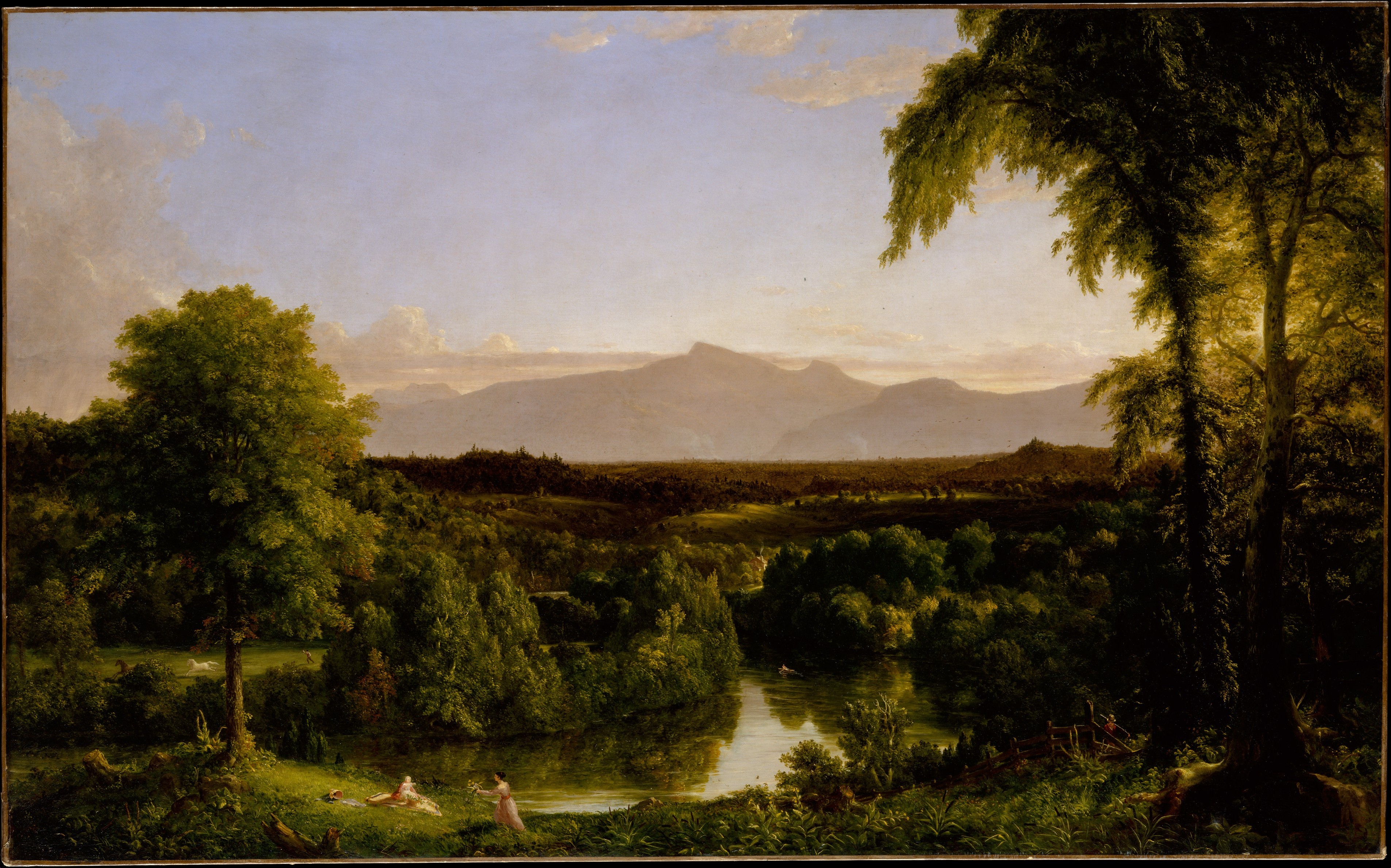
In the meantime, here’s a lovely fall scene that would have looked very familiar to Mary (Turck) Clark’s mother Rachael (Gay) Turck, and to Rachael’s Gay and Van Loon / Van Loan parents and ancestors:
Cole, Thomas, View on the Catskill—Early Autumn, 1836-1837. The Metropolitan Museum of Art, New York, gift in memory of Jonathan Sturges by his children, 1895. Public domain. Click to open larger image in new window.
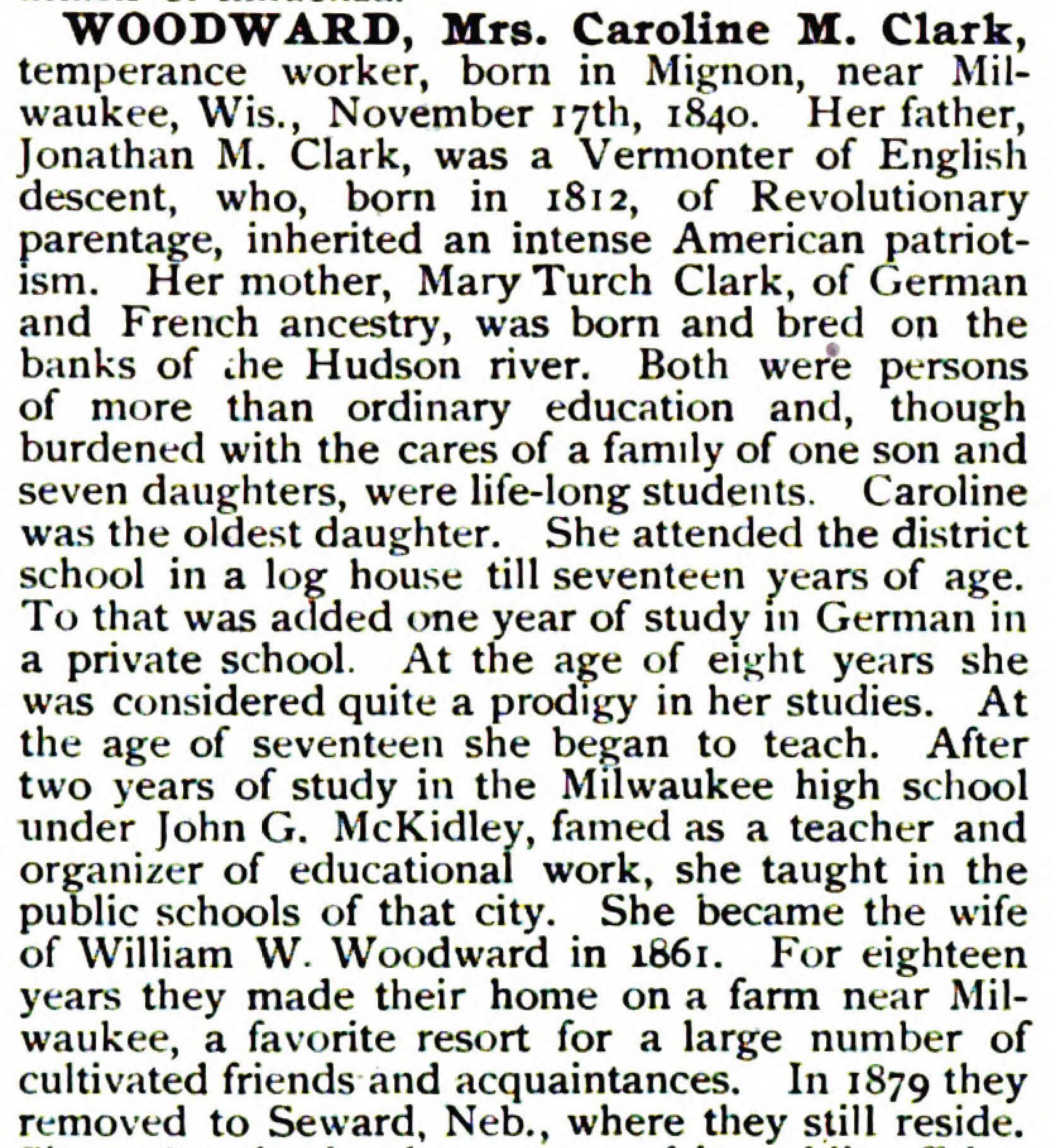
Today, as we continue to explore the life of Jonathan M. and Mary (Turck) Clark’s eldest child, Caroline Mary Clark—later usually known as Mrs. C. M. Woodward—we’ll take a fact-by-fact look at the biographical sketch of Caroline that was published in 1893, re-printed unchanged in 1897, then abridged and reprinted in 1912. For a full discussion of these three publications, see last Monday’s Caroline M. (Clark) Woodward: first steps toward a biography.
Willard, Frances E., and Mary A. Livermore. 1893. A woman of the century ; fourteen hundred-seventy biographical sketches accompanied by portraits of leading American women in all walks of life ; ed. by Frances E. Willard and Mary A. Livermore, assisted by a corps of able contributors, title page and page 779.
Today’s post will be less of a fully-formed essay, and more of a running analysis, commentary, and proof-reading of this 1893 biographical sketch. We’ll take one portion at at time, starting at the beginning. The source text will be presented as a shaded quotation, followed by my commentary and corrections in simple black text on white background, with highlighted links to additional sources and explanations and, of course, a few footnotes, too. Here we go…
In our most recent blog post, Another family portrait! Caroline (Clark) Woodward, c. 1890s, we located and discussed the history of a previously unknown photo of Jonathan M. and Mary (Turck) Clark’s eldest child, Caroline Mary Clark, later usually known as Mrs. C. M. Woodward:
Townsend Elite Studio, [Portrait, Caroline M. (Clark) Woodward], inscribed “Mrs. C. M. Woodward, Supt. Work among Railroad Employes, N.W.C.T.U.”, photograph, circa 1889-1900. Photo courtesy Frances Willard House Museum & WCTU Archives, Evanston, Illinois. Click to open larger image in new window.
Caroline’s life was the most public—and perhaps best documented—of all the members of Jonathan M. Clark family, and is overdue for a closer examination. So today we begin a multi-part look at Caroline’s story, starting with three biographical sketches that were published during her lifetime.








 Clark House Historian