RBOH: Weston & Western, Loomis & Loomer, and how do you pronounce Isham?

Time for a few Random Bits of History: Early Mequon Settlers’ Disambiguation Edition.

John Weston & John Western

Mequon’s first postmaster, John Weston, is mentioned many times in the essential local history book, the History of Washington and Ozaukee Counties, Wisconsin … Illustrated. Western Historical Publishing Co., Chicago, 1881. Using the “Find” function on my PDF copy of the book,1 I found results for “John Weston” on pages 475, 476, 523, 524 and 545.

There is also an entry for “T. Weston” among the names on the “First Poll-List of Washington County” on page 316. I am confident that this is a typographical error and that “T. Weston” is actually John Weston.

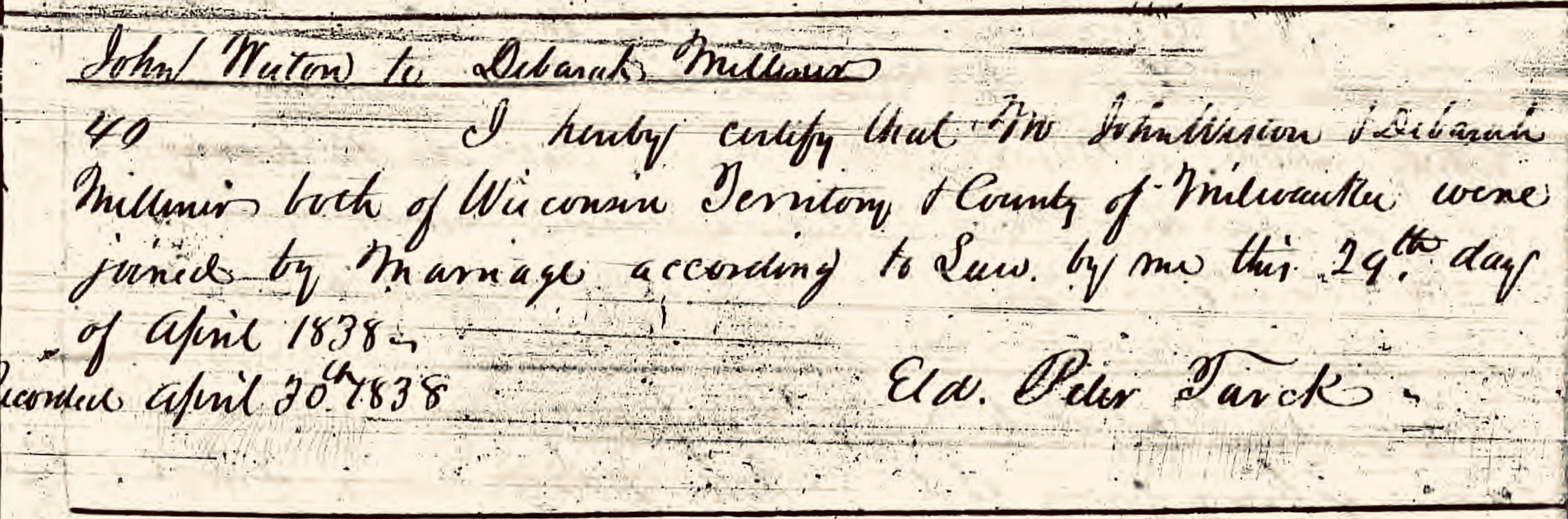
The same source also records, among the early area settlers, one “John Western,” on pages 316, 477 and 478. Is this the same man as John Weston? I have carefully compared a number of sources, including the early minutes of the county road supervisors and deeds in the Washington/Ozaukee county deed books, and I am convinced that during the early years of settlement in the Mequon-Milwaukee area, “John Weston” and “John Western” are the same person, namely John Weston, born in New York about 1800, and married to Deborah Milliner in Milwaukee County in April, 1838. I’ll have examples from the documents that explain my reasoning in a future post.

Fun fact: Mary (Turck) Clark’s father, (Baptist) “Elder” Peter Turck, was the officiant at the Weston-Milliner wedding in 1838. It was the fortieth marriage recorded in the first volume of marriage records for Milwaukee county (and its still-attached for judicial purposes neighbor counties, including old Washington/Ozaukee county).2

With the Weston & Western mystery solved—for the moment—let’s see what other bits of error and confusion we can clear up…

Continue reading

Christmas-Tide: an 1860s Turck family tale

A True Story! from an unexpected source

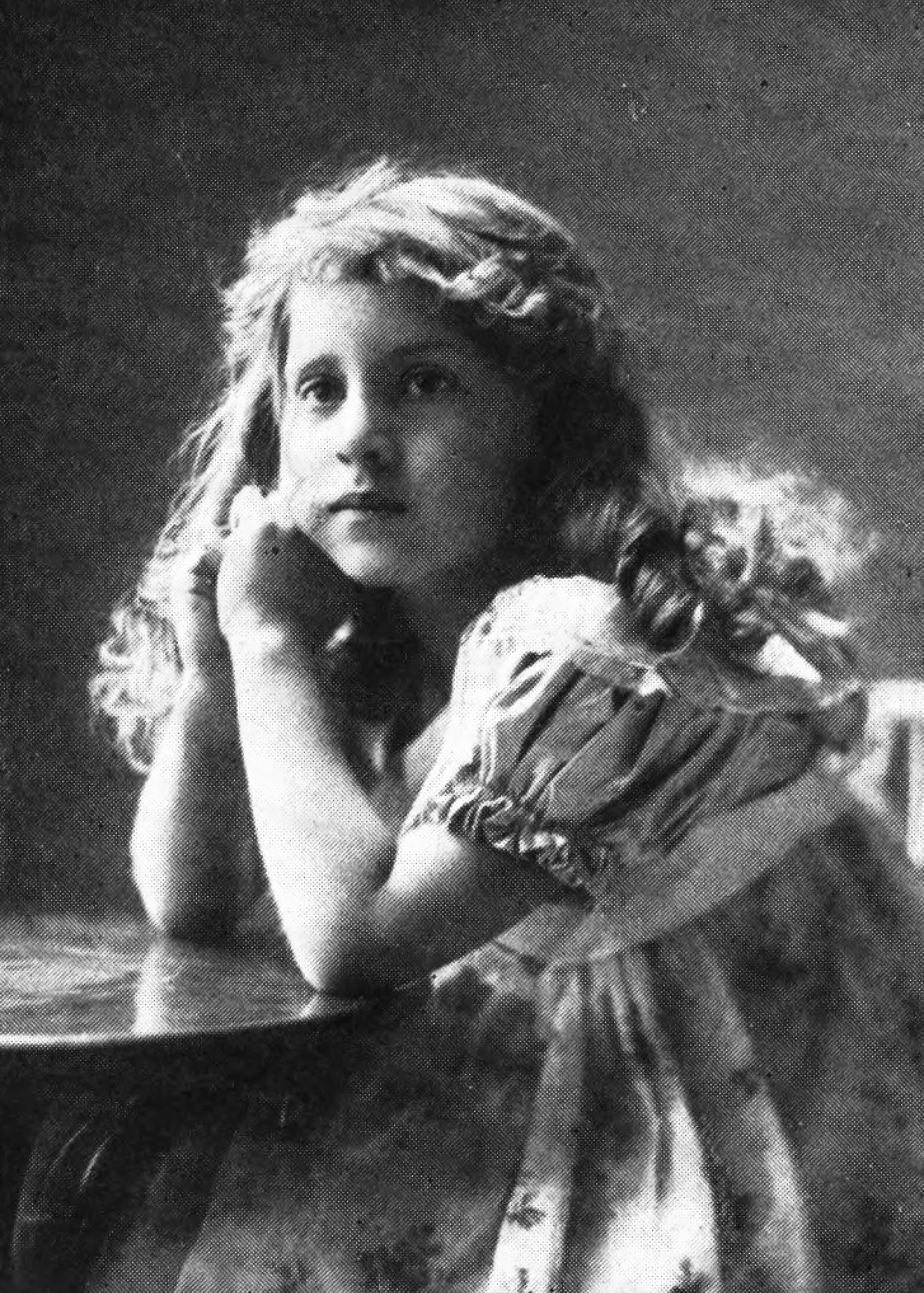
Christmas is here, and I thought you might enjoy a repeat of this seasonal Turck family anecdote, “a true story,” as related in the pages of Correct English magazine, written, edited and published by Peter Turck’s granddaughter—and Mary (Turck) Clark’s niece—Josephine Turck Baker, and later collected with other similar tales and published as a book, Correct English in the Home, Chicago, 1909.

In the foreword to her book, the author explains:

When I was a little girl, like most children, I was very fond of listening to stories; but unlike most children, I did not care for fairy tales, my first question invariably being, ” IS IT A TRUE STORY?” I don’t want a “once upon a time” story.

This is a true story. The children, their names, the incidents narrated, are all true. Beatrice, Roschen, and the “Boitie,” are my children […]


For those who like really true stories of really true people with really true names, this little book is written. That it may instruct and entertain all readers, both little and big, young and grown up, is the earnest wish of


Yours for Correct English,
Josephine Turck Baker

Our Protagonists

Photo credits and dates: see notes below. Click gallery for larger images

Continue reading

Veterans Day, 2023

Veterans Day is today. For a perspective on the day—and our early Mequon veterans—here’s a post originally published at Clark House Historian on November 11, 2016, and revised, expanded and republished several times since. For Veterans Day, 2023 I have added several new links and one new photograph.

Armistice Day

One hundred and five years ago, on the eleventh day, of the eleventh month, at the eleventh hour—Paris time—the Armistice of Compiègne took effect, officially ending the fighting on the Western Front and marking the end of World War I, the optimistically named “War to End All Wars.”

In the United States, the commemoration of the war dead and the Allied victory began in 1919 as Armistice Day, by proclamation of President Woodrow Wilson. Congress created Armistice Day as a legal holiday in 1938. Starting in 1945, a World War II veteran named Raymond Weeks proposed that the commemorations of November 11 be expanded to celebrate all veterans, living and dead. In 1954 Congress and President Eisenhower made that idea official, and this is what we commemorate today. There are many veterans with a connection to the Jonathan Clark house. We honor a few of them in this post.

Jonathan Clark, Henry Clark, and the U.S. Army

Jonathan M. Clark (1812-1857) enlisted as a Private in Company K, Fifth Regiment of the U. S. Army, and served at Ft. Howard, Michigan (later Wisconsin) Territory, from 1833 until mustering out, as Sargent Jonathan M. Clark, in 1836. In the 1830s, Fort Howard was on the nation’s northwestern frontier. Jonathan’s Co. K spent much of the summers of 1835 and 1836 cutting the military road across Wisconsin, from Ft. Howard toward Ft. Winnebago, near modern Portage, Wisconsin.

Fort Howard, Wisconsin Territory, circa 1855, from Marryat, Frederick, and State Historical Society Of Wisconsin. “An English officer’s description of Wisconsin in 1837.” Madison: Democrat Printing Company, State Printers, 1898. Library of Congress. Click to open larger image in new window.

Continue reading

Searching for JMC’s roots: another (!) Stanstead Associates petition, 1792

Our previous post, Searching for JMC’s roots: Stanstead’s original Associates petition, 1792, went into some detail about the creation of the original petition to the Crown for the township that would become Stanstead, Lower Canada. In order to avoid repetition—and keep today’s post to a manageable length—I’m going to recommend that you read that post before reading this one. Because today we have another, competing petition, by a (mostly?) different set of Leaders and Associates, also signed in Rutland, Vermont, not quite two weeks after the previous petition.

I’m not going to examine all the aspects of this second petition today, but there are some features that we should note as we search for Jonathan M. Clark’s kin along the New England and Lower Canada border regions in the 1790s and early 1800s.

John Prentiss…and Associates

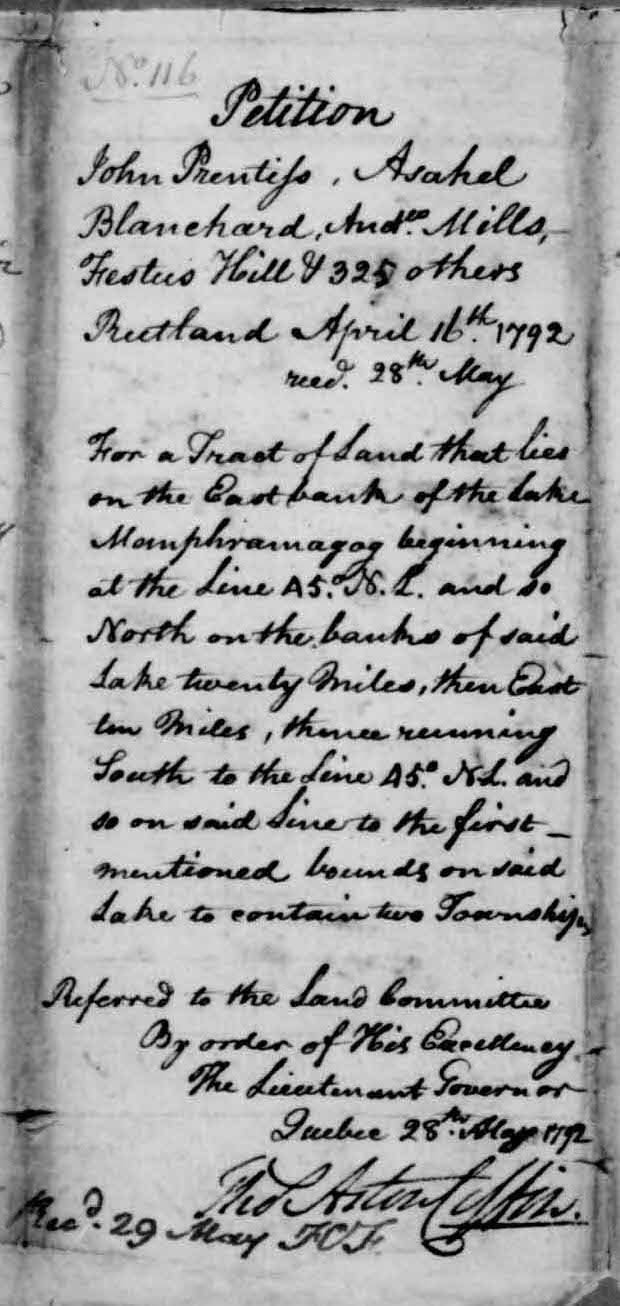
Library and Archives Canada, Petition of John Prentiss, detail showing government notations. See below for full citation.

The organizing meeting for this second group of would-be Stanstead (and Hatley) associates appears to have been held in Rutland, Vermont, on April 16th, 1792. As you’ll see (below), the ink and handwriting of the first signer, John Prentiss, appear identical with that of the petition statement itself (and many of the other signatures at the head of the petition!).

According to the Land Committee clerk’s handwritten notes (above), the petition was presented by and endorsed with the signatures of [presumed Leader] John Prentiss, [presumed Associates] Asahel Blanchard, Andw. [Andrew] Mills, Festus Hill and 325 others in Rutland, April 16th, 1792. It was received by the Lieutenant Governor’s office on May 28th and referred to the Land Committee the next day.

The petition, front side

Below is the front side to the original, complete, Associates petition for the two proposed townships, as found among the Land Petitions of Lower Canada, 1764-1841, RG 1 L3L, Vol. 160, archival page number 78473. As with the previous (Josiah Sawyer) petition, it appears that the microfilm camera operator needed two exposures to capture the full contents of the front side of this oversized page. I have used software to stitch the overlapping images back together, so that you can view the page as it looked in 1792:

Continue reading

Searching for JMC’s roots: Stanstead’s original Associates petition, 1792

UPDATED: 25, 27 and 28 Oct. 2023. See note 8 for details.

Under the unique Leaders and Associates land grant system of early Lower Canada, one of the first and essential steps in obtaining a grant of land from the Crown was to assemble at least 40 (purported) would-be immigrants—often from northern New York and the New England states—and have them sign an official petition requesting a grant of such land. The leaders might be directly involved in the signature gathering process, or they might delegate their tasks to an “agent.”

In 1791, when the Constitutional Act creating Upper and Lower Canada was passed by the British Parliament, Stanstead’s original leaders Eleazar Fitch and Issac Ogden were living and doing business in St. John’s and Montréal, respectively. It’s probable that neither man ever got close to the future Stanstead Township, or northern New York and the New England states1. As we suggested at the end of an earlier post, Fitch and Ogden appear to have delegated the petition process to a farmer (and would-be “Leader” of yet another Eastern Township or two) named Josiah Sawyer.2

Library and Archives Canada, search results for today’s petition. See below for full citation.

Josiah Sawyer, agent

From what I can surmise, one of the main functions of an Agent in the Lower Canada land grant process was to begin the new township project by obtaining the signatures of the required minimum number of Associates on a petition to the government for that land. As we learned earlier, this would usually include a payment from the Leaders to each petition-signing Associate, and—for those Associates that did not intend to actually settle in the new township—the collection of the necessary signed forms deeding the Associates’ hoped-for 200 acre allotments back to the Leaders, for them to hold or re-sell as they deemed most profitable.

The organizing meeting for Stanstead’s associates appears to have been held in Rutland3, Vermont, on April 3rd, 1792. The ink and handwriting of the first signer, Josiah Sawyer, appear identical with that of the petition statement itself, suggesting that Josiah Sawyer was, indeed, the man that organized the signing of this document.

The original petition, front side

Here is the front side to the original, complete Associates’ petition for the proposed Township of Stanstead, as found in the Land Petitions of Lower Canada, 1764-1841, RG 1 L3L, Vol. 175, archival page number 84887. Originally, the microfilm camera operator needed two exposures to capture the full contents of each side of this oversized page.4 I have used software to stitch the overlapping images back together, so that you can view (and try to read!) the document as it looked in 1792.

Continue reading

Memorial Day, 2023

Lest We Forget

Our annual Memorial Day post, first published in 2020. Updated for 2023 with new information about Evander B. Bonniwell’s service.

Graves of Unknown Union Soldiers, Memphis National Cemetery, photo by Clayton B. Fraser, (Library of Congress), public domain. Memphis National Cemetery is the final resting place of Mequon’s Watson Peter Woodworth, and almost 14,000 of his Union Army comrades.

Today is the day our nation officially observes Memorial Day. For many Americans, Memorial Day represents “the first day of summer,” and is traditionally celebrated with trips to the lake, picnics, parades, and sales on cars, appliances, and other consumer goods.

But for many of us, Memorial Day remains rooted in its origins as Decoration Day. The first national observance was in 1868, when retired general John A. Logan, commander and chief of the Grand Army of the Republic—the Union veterans’ organization—issued his General Order Number 11, designating May 30 as a memorial day “for the purpose of strewing with flowers or otherwise decorating the graves of comrades who died in defense of their country during the late rebellion, and whose bodies now lie in almost every city, village, and hamlet churchyard in the land.”

On this Memorial Day, let’s take a moment to remember what this day truly represents.

Continue reading

The farm garden

It’s already the third week of May, 2023, and summertime will soon be here. At our southeastern Wisconsin home the first spring flowers are done, and the next round of blossoms have been blooming for a week or two. The peas are in the ground and already about 8 inches high, the rhubarb is big enough to cut and make one or two pies, and we harvested the first half-dozen radishes today. We still have to put in the tomato and pepper seedlings and start the big patch of green beans. So with gardening on my mind, I thought you might enjoy a slightly-belated repost of this annual favorite, which first appeared here in April, 2021. Cheers!

Planning the garden

It’s early April, and the growing season is not far off. For a farmer like Jonathan M. Clark, it’s a little early yet for plowing and sowing, but not too early to make plans and sharpen the tools. For a farmer’s wife, like Mary (Turck) Clark, it’s not too soon to think about the farm garden, its crops and layout.

I don’t know if Mary and Jonathan were regular readers of the popular and affordable farmers’ almanacs of their era; I wouldn’t be surprised if they were. There were many to chose from. Perhaps they had a copy of something like:

The Cultivator […], New Series, Vol. VII, Albany, 1850, title page. Click to open larger image in new window.

Continue reading

Farewell to California! The Bonniwell party returns (part 4)

If you’re just joining us, you may want to read the first three parts of this series: (part 1), (part 2), and especially (part 3) before continuing with today’s Part 4.

April, 1851: Alfred T. and (George? or Charles?) Bonniwell to NYC

Based on the documents that I have been able to locate so far, the next members of the Bonniwell expeditions to return from California were Alfred T. Bonniwell and one of his older brothers.

Like Henry Bonniwell and P.M. Johnson at the end of 1850, in the spring of 1851 Alfred and his brother had a choice of routes and providers for the return home from San Francisco.

“Vessels Advertised,” for Panama and New York City, San Francisco Daily Alta California, January 10, 1851, page 1.

Like Henry Bonniwell and P.M. Johnson before them, Alfred and his brother appear to have chosen to travel on the ships of the Pacific Mail Steamship Company. They probably sailed on the steamer Sarah Sands from San Francisco to Panama (City). then crossed the isthmus of Panama (via some combination of horse, mule and/or canoe) and boarded the U.S.Mail Steamer Cherokee for the trip to New York:

Continue reading

JMC & the neighbors petition Congress, 1849

Today we have a surprise addition to our survey of Alfred T. Bonniwell documents. It’s a recent discovery, a very cool 1849 petition to Congress asking for a new postal road from Grafton to Waukesha, via Mequon. It’s signed by many of old Washington county’s most civic-minded men, including Grafton postmaster P.M. Johnson, Jonathan M. Clark, Peter Turck, and almost all of the Bonniwell men. It’s of interest to us, in part as an example of the citizen petition process in the early days of Wisconsin statehood, and more specifically as a record of “who was here?” in Washington county in a non-census year.

A growing county needs a new mail route

Petition of Phineas M. Johnson and others to U.S. Congress. [1849-02-06]. /documents/D275080, page 1, detail, salutation, The Papers of Abraham Lincoln Digital Library. Public domain.1, 5

Citizen petitions have been a part of American governance since early days. Check out our 2021 RBOH: Wisconsin Citizen Petitions for more information on a newly digitized collection of early Wisconsin territorial and state petitions, including a searchable database of petition images. Citizens could also petition the federal government for assistance; our petition is addressed To the Honorable the Senate and House of Representatives in Congress Assembled, and looks like this:

Continue reading