Census Records for the In-Between Years: 1855

A Growing Family in a Growing State

The late-1840s and early-1850s were boom years for Wisconsin settlement. The final territorial census was enumerated in 1847, and statehood arrived in 1848. The seventh decennial federal census was taken in 1850. (If you’re late to the party, we covered the Clark family and the 1850 census here, here, here, here and here.) And in 1853, the seven easternmost townships of old Washington county were established as Ozaukee county.

Such rapid growth called for frequent changes in political boundaries and representation. To make that happen, a number of state censuses were produced during the years between decennial federal censuses. The first of these was officially enumerated on June 1, 1855. The “Jon. M. Clark” family appears on line 20, page 1 of the Enumeration of the Inhabitants of the Town of Mequon, in Ozaukee County, State of Wisconsin […] taken by me, Wm. Zimmermann, Town Clerk.

Continue reading
Census Records for the In-Between Years: 1846

Our previous Clark House Historian post was an introduction to the Wisconsin territorial and state censuses, with a close look and complete images of Washington county’s pages from the 1842 census. If you missed that, or need a refresher on how to navigate the FamilySearch.org collection of (free!) census images, please read Part 1, here.

The focus of today’s post is the next Wisconsin territorial census, officially enumerated on June 1, 1846. It is available as FHL film number 1,293,920, aka DGS film number 8,117,163. Click one of the film numbers to navigate to the 1846 census images. The Washington county census page images begin on image number 922 of 1103

For this census, Washington county was divided into two districts, each with its own enumerator. Patrick Toland was the enumerator for District No. 1, the western division, consisting of the towns of Erin, Richfield, Germantown, Wright, Polk, Jackson, Addison and West Bend. His summary of the enumeration was placed at the front of the census folder (images 923-925). The essential results for District No. 1 are here, image 924 of 1103:

Continue reading

The Clark Family in 1850, part 3

Where y’all from? 

If you missed them, you might want to begin with Part 1 and Part 2 of our look at Jonathan and Mary Clark and their growing family on the 1850 federal decennial census. Those earlier posts focused in some detail on the names and ages of the various family members and how that information correlates with the manuscript Clark Family Record. In this post we’ll try and answer the question of where Jonathan, Mary, and the children were born, a simple question, right? Let’s start by taking another look at the census page: Continue reading

The Clark Family in 1850, part 1

Looking at the 1850 Census: A Growing Family

Continuing our look at important sources for Clark family history, let’s return to the decennial U.S. federal census. If you missed it, be sure to read our earlier post on Jonathan, Mary, and ? on the 1840 Census. The 1850 census was the seventh United States federal —and first “all name”— decennial census; every free person—man, woman or child—living on June 1, 1850, was to be counted and named on a separate line on the census form. It was also the first federal census to ask for certain additional information, such as each individual’s place of birth and occupation. (Enslaved African-Americans were enumerated on a separate form and not by name, but by sex, age, and owner. Click here for more information on the 1850 and 1860 so-called Slave Schedules.)

Based on what we know from the Clark Family Record and other sources, as of the official enumeration day, June 1, 1850, if the census enumerator and his Clark family “informant” were both accurate in providing and recording the data, we should expect to find the following living family members listed on the 1850 census: parents Jonathan and Mary Clark and their children Caroline, Henry, Elizabeth, Persis, and new baby Teresa. Let’s look at the census page and see what the enumerator recorded: Continue reading

Map of Ouisconsin Territory, 1836

UPDATED, February 11, 2024, to include a revised annotated map. But for the full update—with additional notes and corrections—please see the most recent version of this, posted on February 12, 2024.

In September, 1836, Sgt. Jonathan M. Clark was discharged from the U.S. Army at “Ft. Hamilton,” Wisconsin Territory, after serving his three-year term of service with Co. K, Fifth Regiment of Infantry.  One year later, in the autumn of 1837, Jonathan’s future wife Mary Turck would make the long trip from Palmyra, New York, to Milwaukee and finally Mequon, Washington County, Wisconsin, with her parents Peter and Rachael Turck and six younger siblings. By the end of 1840 Jonathan and Mary would be married and starting their family in Mequon.

That seems simple enough, until you take a moment to wonder how much Jonathan—or especially Mary and her family—knew about this new Wisconsin Territory.  Jonathan had been in the territory since October, 1833, building portions of the military road along the Fox River waterway from Ft. Howard (Green Bay) towards Ft. Winnebago (near modern Portage). As a road building soldier, Jonathan probably had seen—or helped draw—a variety of maps of the military road and its vicinity. But for a better overview of the larger territory, Jonathan or Mary might have sought out a map such as this:

Continue reading

Mary Turck Clark

UPDATE, January 30, 2021: this post was the second-ever post on Clark House Historian. It represented what we knew at the time about Mary Turck, the daughter of Peter Turck and Rachael Gay, wife of Jonathan M. Clark, and mother of the eight Clark family children. This original post was pretty accurate, and I’m leaving it here for reference. But we have learned a lot more about Mary and her Turck and Clark families in the intervening almost-5 years. For the most up-to-date info on Mary Turck Clark, please go the the revised version of this biographical sketch. Thanks for reading!

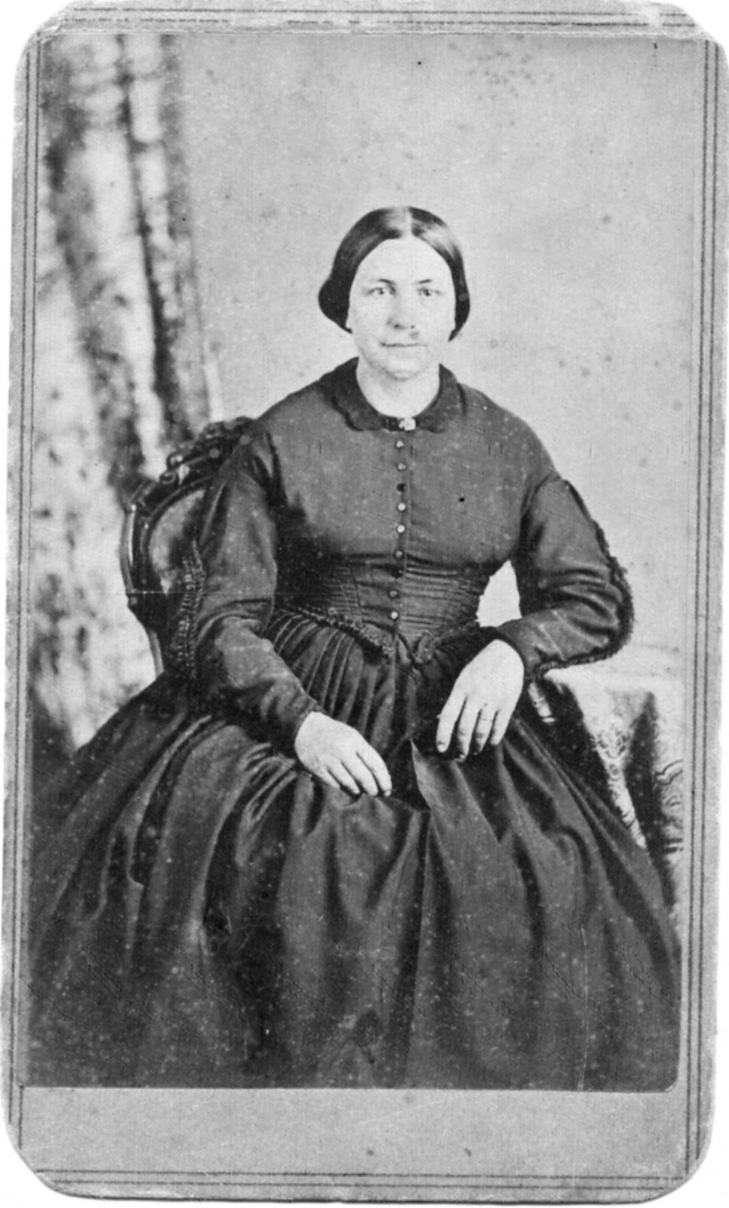
CLARK, Mary TURCK portrait

Mary Turck Clark. Photograph courtesy Liz Hickman.

It is a commonplace of genealogical and historical research that women and their stories are the “forgotten fifty percent.” In most North American societies it was, and in many places remains, the custom that upon marriage the woman took her husband’s surname. Some documents that recorded marriages, births and deaths might include a place for the woman’s surname, and sometimes the names of her parents, but this information was often left blank. After a generation or two, the woman’s name and those of her parents and grandparents would be completely forgotten, even by her closest descendants.

Continue reading