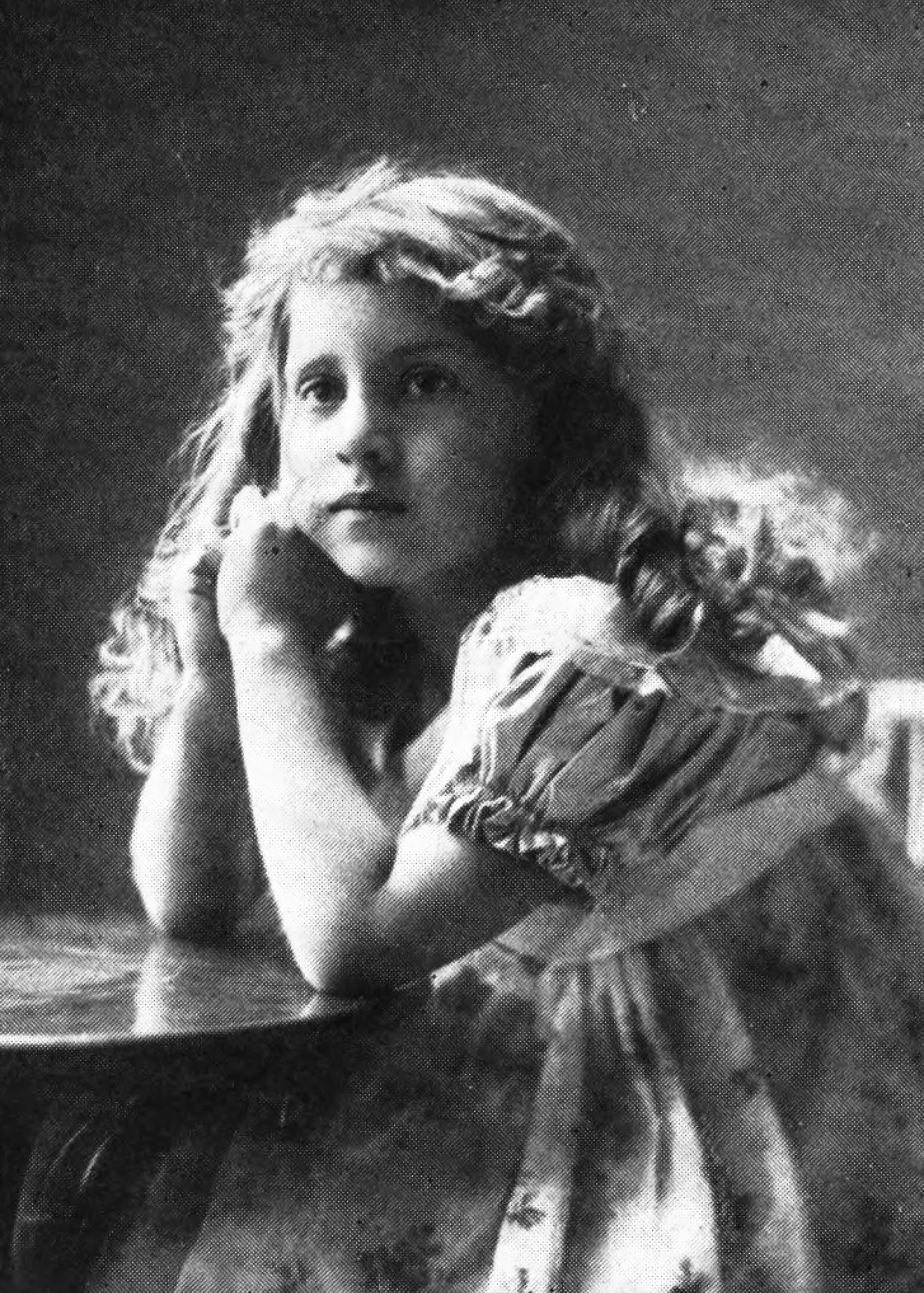
Christmas is here, and I thought you might enjoy this seasonal Turck family anecdote, “a true story,” as related in the pages of Correct English magazine, written, edited and published by Peter Turck’s granddaughter—and Mary (Turck) Clark’s niece—Josephine Turck Baker, and later collected with other similar tales and published as a book, Correct English in the Home, Chicago, 1909.
In the foreword to her book, the author explains:
When I was a little girl, like most children, I was very fond of listening to stories; but unlike most children, I did not care for fairy tales, my first question invariably being, ” IS IT A TRUE STORY?” I don’t want a “once upon a time” story. This is a true story. The children, their names, the incidents narrated, are all true. Beatrice, Roschen, and the “Boitie,” are my children […] For those who like really true stories of really true people with really true names, this little book is written. That it may instruct and entertain all readers, both little and big, young and grown up, is the earnest wish of Yours for Correct English, Josephine Turck Baker
Veterans Day is today. For a perspective on the day—and our early Mequon veterans—here’s a post originally published at Clark House Historian on November 11, 2016, and revised, expanded and republished several times since.
Armistice Day
One hundred and three years ago, on the eleventh day, of the eleventh month, at the eleventh hour—Paris time—the Armistice of Compiègne took effect, officially ending the fighting on the Western Front and marking the end of World War I, the optimistically named “War to End All Wars.”
In the United States, the commemoration of the war dead and the Allied victory began in 1919 as Armistice Day, by proclamation of President Woodrow Wilson. Congress created Armistice Day as a legal holiday in 1938. Starting in 1945, a World War II veteran named Raymond Weeks proposed that the commemorations of November 11 be expanded to celebrate all veterans, living and dead. In 1954 Congress and President Eisenhower made that idea official, and this is what we commemorate today. There are many veterans with a connection to the Jonathan Clark house. We honor a few of them in this post.
Jonathan Clark, Henry Clark, and the U.S. Army
Jonathan M. Clark (1812-1857) enlisted as a Private in Company K, Fifth Regiment of the U. S. Army, and served at Ft. Howard, Michigan (later Wisconsin) Territory, from 1833 until mustering out, as Sargent Jonathan M. Clark, in 1836. In the 1830s, Fort Howard was on the nation’s northwestern frontier. Jonathan’s Co. K spent much of the summers of 1835 and 1836 cutting the military road across Wisconsin, from Ft. Howard toward Ft. Winnebago, near modern Portage, Wisconsin.
Fort Howard, Wisconsin Territory, circa 1855, from Marryat, Frederick, and State Historical Society Of Wisconsin. “An English officer’s description of Wisconsin in 1837.” Madison: Democrat Printing Company, State Printers, 1898. Library of Congress. Click to open larger image in new window.
I had a fine day last month walking through our state’s wonderful outdoor living history museum, Old World Wisconsin, where I enjoyed this familiar view:
Photo credit: Reed Perkins, 2022.
There among the trees stood Milwaukee’s old St. Peter’s Roman Catholic Church, a building that was certainly well-known—at least on the exterior—to our Clark and Turck families.
The church was built in 1839, two years after young Mary Turck arrived in Wisconsin Territory with her parents, Peter and Rachael (Gay) Turck and her six siblings, and the same year that Jonathan M. Clark and the Bonniwell family first appeared in the Milwaukee-Mequon area.
I hope you liked our recent re-post of Back to School, 1839! And since I’m still working on a number of new but not-yet-ready projects, I thought you might also enjoy a revised and expanded version of a related post that was first published September 2, 2020.
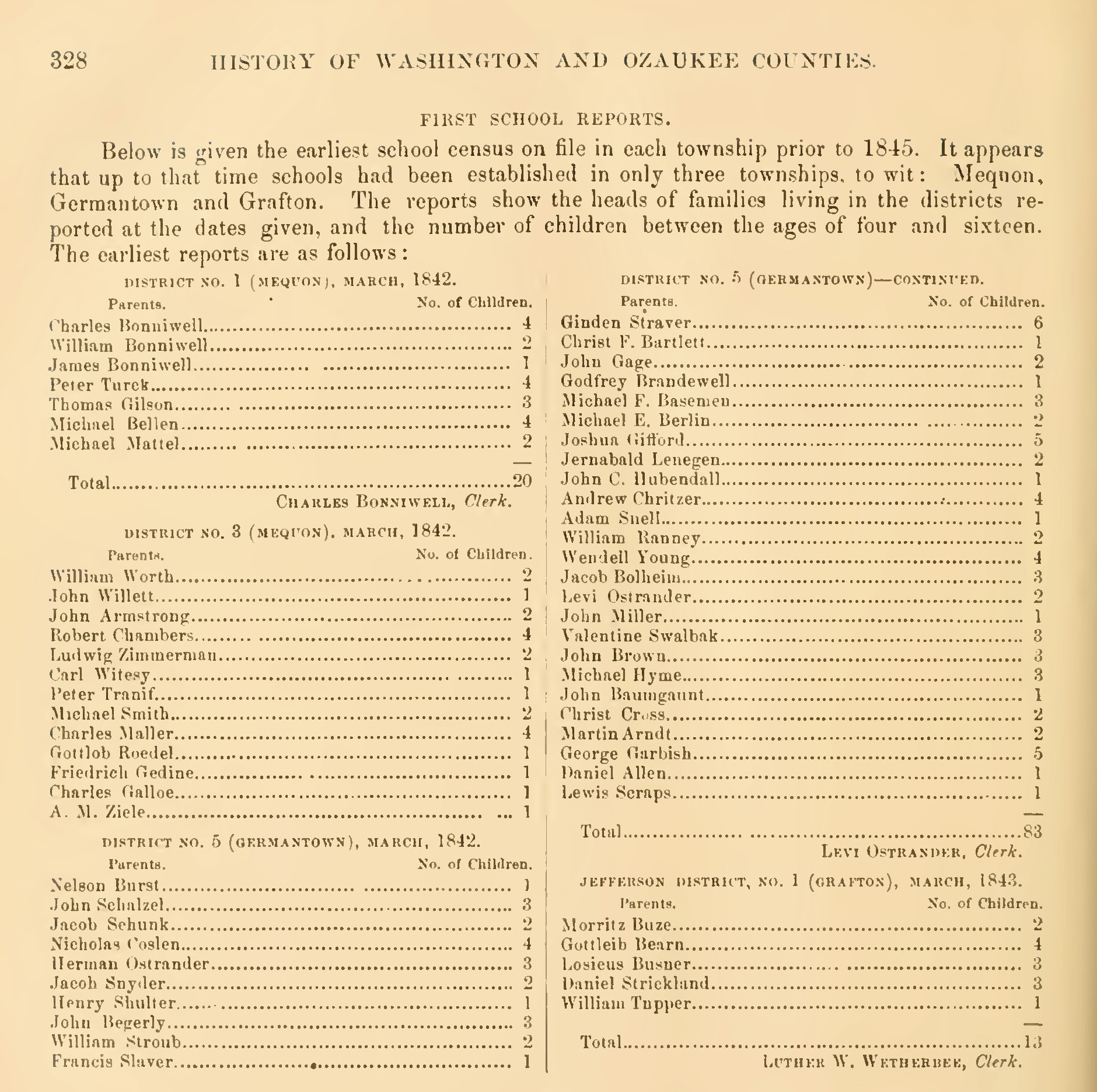
It’s “Back to School” time for many of us, so I thought you might be interested in this transcription of the earliest known school records of old Washington/Ozaukee county prior to 1845, published on page 328 of the History of Washington and Ozaukee Counties, Wisconsin […] Illustrated. Western Historical Co., Chicago, 1881:
Click to open a larger image in a new window, and see which of the early settler families had school age children, that is, children between the ages of 4 and 16, in 1842 and 1843. (Current Washington and Ozaukee county readers: do you have any kin listed in this summary of early school censuses? Let us hear from you via the Leave a Reply box, below.)
It’s that time of year again! And since I’m still working on a number of new but not-yet-ready projects, I thought you might enjoy this lightly-revised “Back to School” post from September 9, 2020.
There are a number of conflicting claims to the title of “first teacher” in Mequon. One of the first was Mary Turck Clark. She led classes for her siblings and four neighbor children in the loft of her father’s cabin in the summer of 1839.
The History of Washington and Ozaukee Counties, relates a number of other “firsts” for area schools and teachers. Among them is this story of how the school committee,1 led by Daniel Strickland (father of Sarah A. Strickland Clark), hired its first teacher.
UPDATE, Nov. 30, 2022: The discussion of the William Bonniwell signatures and dates, below, is not correct. I have lined-through the incorrect paragraph and added the correct info in two new paragraphs below the original misinformation.
It may not look like much on the outside. It’s old. Not very big. Whole pages are missing, others are damaged. The binding is worn.
Bonniwell Bible, front cover. Photo credit: Kendalyne Gentile, 2022
But this modest book was—for over 300 years—the family Bible for Mequon’s pioneer Bonniwell family, their ancestors and descendants. And last month, the Bible’s most recent owner, Bonniwell descendant Kendalyne Gentile, generously gave the Bible and other Bonniwell family documents to the Jonathan Clark House Museum where they will form an important part of our permanent collection.
I’m taking a bit of a break and have nothing new for you today. I have been doing a good bit of garden work around the house, and that reminded me of this post from April, 2021. Now we’re just finishing the first week of June, 2022, and it’s almost summertime. In southeastern Wisconsin the first spring flowers are done, and the next round of blossoms have been blooming for weeks. The tomato, bean and pepper seedlings are in the ground and doing nicely (although the rabbits have been nibbling on far too many green bean sprouts), and the roses are beginning to unfold. So even though this was originally an early-spring essay, I hope you enjoy this garden-themed repost from last year.
Planning the garden
It’s early April, and the growing season is not far off. For a farmer like Jonathan M. Clark, it’s a little early yet for plowing and sowing, but not too early to make plans and sharpen the tools. For a farmer’s wife, like Mary (Turck) Clark, it’s not too soon to think about the farm garden, its crops and layout.
I don’t know if Mary and Jonathan were regular readers of the popular and affordable farmers’ almanacs of their era; I wouldn’t be surprised if they were. There were many to chose from. Perhaps they had a copy of something like:
The Cultivator […], New Series, Vol. VII, Albany, 1850, title page. Click to open larger image in new window.
Our annual Memorial Day post, first published in 2020. This revised edition, originaly published in 2022, was inadvertently updated for the further-revised 2023 edition, making a few minor edits and adding new information about Evander B. Bonniwell’s service. So the original 2022 post is “gone” and I’m going to leave this revised-revised version of that post here for reference, in case it is bookmarked elsewhere on the blog or in a readers’ notes.
Graves of Unknown Union Soldiers, Memphis National Cemetery, photo by Clayton B. Fraser, (Library of Congress), public domain. Memphis National Cemetery is the final resting place of Mequon’s Watson Peter Woodworth, and almost 14,000 of his Union Army comrades.
Today is the day our nation officially observes Memorial Day. For many Americans, Memorial Day represents “the first day of summer,” and is traditionally celebrated with trips to the lake, picnics, parades, and sales on cars, appliances, and other consumer goods.
But for many of us, Memorial Day remains rooted in its origins as Decoration Day. The first national observance was in 1868, when retired general John A. Logan, commander and chief of the Grand Army of the Republic—the Union veterans’ organization—issued his General Order Number 11, designating May 30 as a memorial day “for the purpose of strewing with flowers or otherwise decorating the graves of comrades who died in defense of their country during the late rebellion, and whose bodies now lie in almost every city, village, and hamlet churchyard in the land.”
On this Memorial Day, let’s take a moment to remember what this day truly represents.
On Monday, I mentioned how I’ve been reading a lot of interesting documents lately, including some very cool and very old Clark House related manuscripts, and I was puzzled by this bit of manuscript marginalia, found in an old religious book, a real History Mystery:
I noted that this handwriting may (or may not) be a variation on the English writing style known as Secretary hand. I was stumped, and asked you readers to Help the Historian! with this mysterious passage. And although I didn’t have any prizes to award—except eternal fame and glory throughout our vast Clark House Historian readership—I hoped someone would step forward and claim their virtual laurel wreath. Well, the week is over, and the winner is…







 Clark House Historian