The American Revolution: are you watching?

The American War of Independence began 250 years ago, more than half a century before the forced removal of Wisconsin’s original native peoples and the beginnings of large-scale, government-sponsored, white settlement in the Wisconsin Territory of the 1830s.
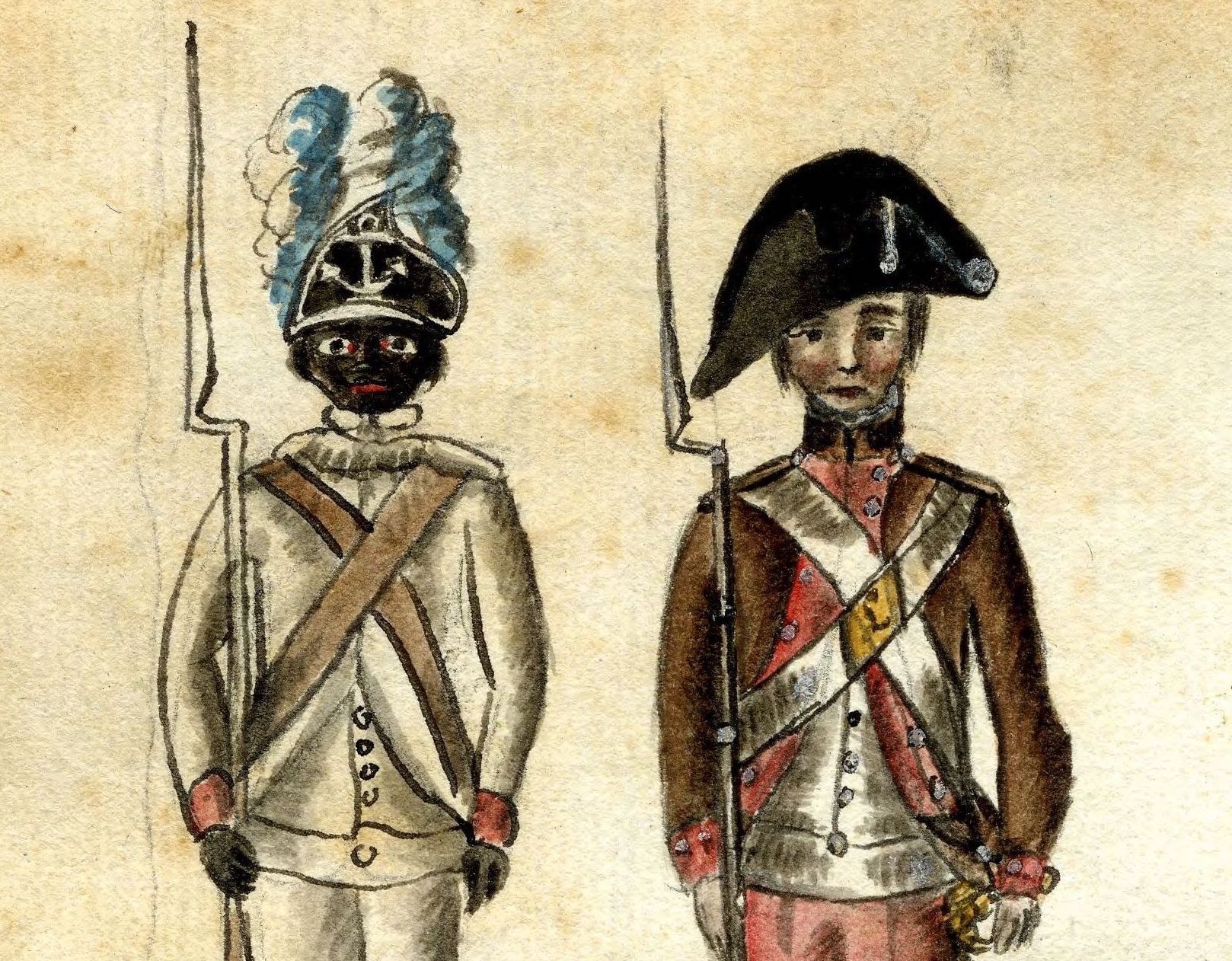
Verger, Jean Baptiste Antoine De, artist, [Soldiers in Uniform], 1781 (detail). The soldier on the right was a New England militiaman, one of many New Englanders (including, we believe, Jonathan Clark’s kin) that fought for the Patriot cause. More on this image, below.

PBS is commemorating the big anniversary by sponsoring and broadcasting “The American Revolution,” a six-part, 12-hour documentary film by Ken Burns and company, exploring the roots of the conflict, the military and diplomatic progress of the war, and the contributions to, and effects of, the war on its many military and civilian participants, including white, Black, and Native American men and women, both Loyalists & Patriots.

I’ve seen the first four episodes and found them lively, interesting, informative, and sometimes deeply moving. I’m no expert on the Revolutionary era, but I know quite a bit, and I find the series includes all the “important” events and persons that one would expect, along with all kinds of nuance and detail which are new to me.

It’s an excellent documentary, well worth your time, and is currently streaming—for free—on PBS.org. And in case you are wondering: yes, there are many topics in this Revolutionary War documentary that connect to, and later influence, the lives many of the early Mequon settler families, including the Clark and Turck families. In particular, be sure to watch the whole first episode, a clear and detailed explanation of the complex background and causes of the fight for American independence.

Continue reading

Memorial Day, 2025

Lest We Forget

Our annual Memorial Day post, first published in 2020, more relevant with each passing year.

Graves of Unknown Union Soldiers, Memphis National Cemetery, photo by Clayton B. Fraser, (Library of Congress), public domain. Memphis National Cemetery is the final resting place of Mequon’s Watson Peter Woodworth, and almost 14,000 of his Union Army comrades.

Today is the day our nation officially observes Memorial Day. For many Americans, Memorial Day represents “the first day of summer,” and is traditionally celebrated with trips to the lake, picnics, parades, and sales on cars, appliances, and other consumer goods.

But for many of us, Memorial Day remains rooted in its origins as Decoration Day. The first national observance was in 1868, when retired general John A. Logan, commander and chief of the Grand Army of the Republic—the Union veterans’ organization—issued his General Order Number 11, designating May 30 as a memorial day “for the purpose of strewing with flowers or otherwise decorating the graves of comrades who died in defense of their country during the late rebellion, and whose bodies now lie in almost every city, village, and hamlet churchyard in the land.”

On this Memorial Day, let’s take a moment to remember what this day truly represents.

Continue reading

Talking about the Civil War

That was fun!

I had a great time last Saturday evening at the Cedarburg History Museum, giving an illustrated talk as part of their big 2024 Civil War exhibition and lecture series. My subject was “From the ‘Burg to the Battlefield…and Back: Cedarburg’s Beckmann Family and the Civil War.” I tried to take a more personal and local look at the war by examining the military service of few of the Cedarburg relatives and future in-laws of 1868-1873 Clark House resident Fred Beckmann. In my research, I found some unique stories of their years of Union service in the 9th and 26th Wisconsin Infantry Regiments, as well as the impact of the war on families and friends back home in Wisconsin.

1864 National Color, 26th Wisconsin Volunteer Infantry Regiment (Wisconsin Veterans Museum, V1964.219.119)

Continue reading

Rev. Woodworth’s Autobiography

James W. Woodworth (1813-1893) and his brother Ephraim were among the earliest settlers in Mequon. They came from Nova Scotia, as did several other early Mequon settlers and families, including Isaac Bigelow, Daniel Strickland and Stephen Loomer. On March 1, 1838, J. W. Woodworth married fellow Nova Scotia emigrant and Mequon neighbor Mary Cerena Loomer. The marriage was believed to be the first Christian marriage in old Washington county and was performed by Mary Turck Clark’s father, Peter Turck, “an anabaptist preacher.”

J. W. Woodworth, like so many Protestant Christians of his era, was a man in search of a powerful and authentic connection to God. He found his answer in the 1830s and ’40s through Methodism. And, after many years of intense self-instruction, camp meetings, private prayer and preaching at local worship services, Woodworth was certified as a Methodist minister.

For much of his life Rev. Woodworth kept a diary of both the spiritual and mundane events of his life. He published the diary in Milwaukee in 1878 as My Path and the Way the Lord Led Me.  Continue reading