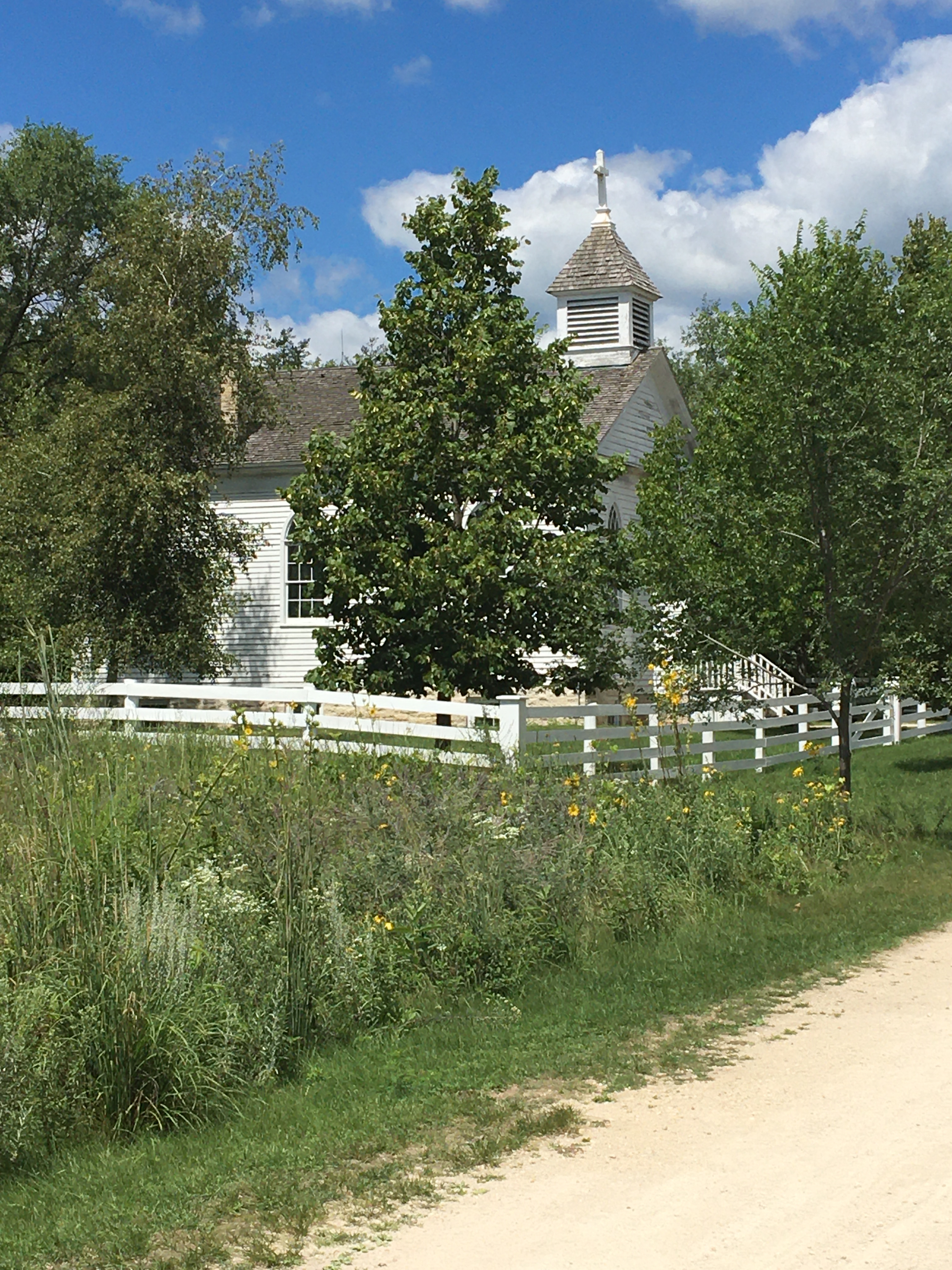
I had a fine day last month walking through our state’s wonderful outdoor living history museum, Old World Wisconsin, where I enjoyed this familiar view:
Photo credit: Reed Perkins, 2022.
There among the trees stood Milwaukee’s old St. Peter’s Roman Catholic Church, a building that was certainly well-known—at least on the exterior—to our Clark and Turck families.
The church was built in 1839, two years after young Mary Turck arrived in Wisconsin Territory with her parents, Peter and Rachael (Gay) Turck and her six siblings, and the same year that Jonathan M. Clark and the Bonniwell family first appeared in the Milwaukee-Mequon area.
On Monday, I mentioned how I’ve been reading a lot of interesting documents lately, including some very cool and very old Clark House related manuscripts, and I was puzzled by this bit of manuscript marginalia, found in an old religious book, a real History Mystery:
I noted that this handwriting may (or may not) be a variation on the English writing style known as Secretary hand. I was stumped, and asked you readers to Help the Historian! with this mysterious passage. And although I didn’t have any prizes to award—except eternal fame and glory throughout our vast Clark House Historian readership—I hoped someone would step forward and claim their virtual laurel wreath. Well, the week is over, and the winner is…
I’ve been reading a lot of interesting documents lately, including some very cool and very old Clark House related manuscripts. (More details on these exciting documents coming later this spring or early summer.) We’ve looked at many old manuscripts here at Clark House Historian, and I think I’m pretty good at deciphering most older English handwriting from about 1700 until the present and, with help, I can even figure out many German scripts from the late 18th- through the 19th-century.
But then there’s this, a real Clark House Historian History Mystery:
That’s the handwriting of a literate English-speaking man or woman of a certain era. I’ve seen handwriting like this before in old Cornwall parish records of my Perkins family. In my (limited) experience I’ve seen this style of writing on documents dating from the later-1600s through the early 1700s, perhaps as late as 1750 or so. But I’m not an expert on Early Modern English or English orthography, and it’s possible that this hand was in use as early as the 1500s. It may (or may not) be a variation on the English writing style known as Secretary hand.
For some reason, this writing style remains very difficult for me to read. I’ve spent enough time with examples of this hand—and the many spelling conventions of the era—that I’m not completely lost, but there is a lot here that I don’t understand. So I’m asking you readers to take a crack at it, and Help the Historian! with this mysterious passage.
Along the way, I recommend you click on each image to open it in a new, larger window. You’ll get the best, enlargeable, view of each mystery text and my annotations. Here are your clues:
Updated Feb. 14, 2022 to add the qualifier “English-speaking” to the second paragraph.
Did you watch the Big Game? Go out to eat? Maybe you had to put in a shift at work? Or did you just take a break and relax at home, gearing up for another week on the job? Perhaps you went to church on Sunday.
In Jonathan and Mary Clark’s era, many of their Mequon neighbors would honor the Sabbath by refraining from all work and worshiping privately at home with their families, or gathering with small groups of neighbors to pray and hear the Word. Beginning in the early-1840s, the English-speaking Protestant Christians living near the Clark House—including many members of the Clark, Bonniwell and Turck families—gathered at the new, one-room, Bonniwell School to worship together at Sunday services; these were often led by their neighbor, the farmer and evangelical Methodist preacher Rev. James W. Woodworth.
Rev. Woodworth has concerns…
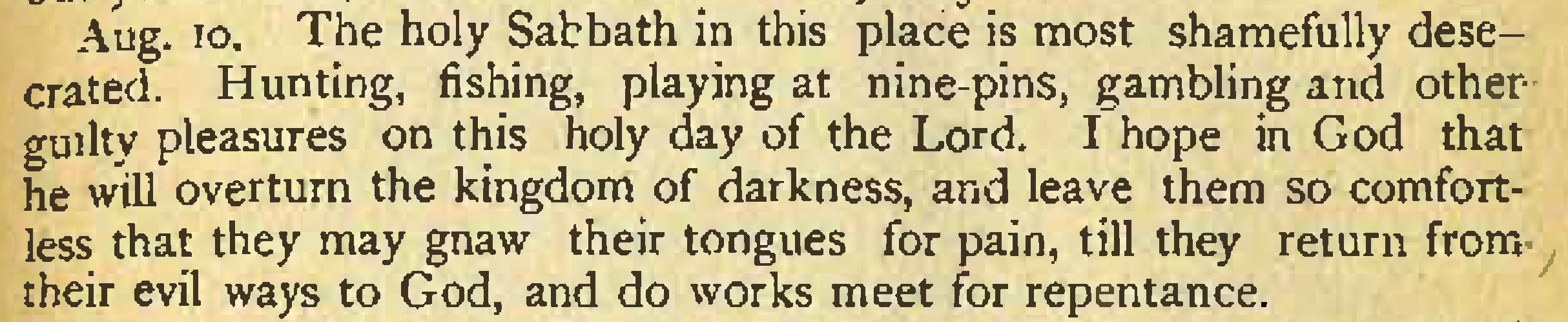
We have talked about Rev. Woodworth previously and, as we have seen before, he was constantly concerned about the state of his neighbors’ souls. It seems that even though the nation was still riding the wave of several decades of the religious revival now known as the Second Great Awakening, the settlers of the young Wisconsin territory and state were not always very good at “keeping the Sabbath holy.” In his diary entry for August 10, 1855, the reverend lamented:
Aug. 10. The holy Sabbath in this place is most shamefully desecrated. Hunting, fishing, playing at nine-pins, gambling and other guilty pleasures on this holy day of the Lord. I hope in God that he will overturn the kingdom of darkness, and leave them so comfortless that they may gnaw their tongues for pain, till they return from- their evil ways to God, and do works meet for repentance.
Woodworth, James W., My path and the way the Lord led me, Milwaukee, 1878, p. 79.
Tonight is Christmas Eve, and I thought you might enjoy an expanded reprise of our 1867 Santa Claus story, originally posted December 25 and 30, 2017. This year I have combined the two original posts and incorporated some new illustrations and a few revisions of the text. Here it is again, for your holiday enjoyment. Ho! Ho! Ho!
Christmas in early America
For many years now, Christmas has been celebrated by Americans as an important religious and (increasingly secular) community holiday. Christians gather to worship and commemorate the birth of Jesus, and they and other Americans enjoy a break from work to gather with family and friends to feast and exchange gifts. But it was not always this way.
In many of the American colonies, Christmas was not observed as a religious or secular holiday. The seventeenth-century Puritan leaders of the Massachusetts Bay Colony considered Christmas to be non-biblical and pagan influenced. In Boston and other parts of New England any observance of Christmas was prohibited and, for a few years, actually illegal:
Penalty for Keeping Christmas, 1659
Records of the Governor and Company of the Massachusetts Bay in New England. Printed by order of the Legislature, edited by Nathaniel B. Shurtleff, M.D., Vol. IV, Part I, 1650-1660, online at mass.gov (accessed 21 Dec. 2021). Click to open larger image in new window.
Transcription: For preventing disorders arising in several places within this jurisdiction, by reason of some still observing such festivals as were superstitiously kept in other countries, to the great dishonor of God and offence of others, it is therefore ordered by this Court and the authority thereof, that whosoever shall be found observing any such day as Christmas or the like, either by forbearing of labor, feasting, or any other way, upon such accounts as aforesaid, every such person so offending shall pay for every such offence five shillings, as a fine to the country.
Christmas was not generally accepted as a holiday in many parts of the United States until after the federal government made December 25 a national holiday in 1870.
On the other hand…
The Massachusetts Puritans may not have approved of “observing any such day as Christmas or the like, either by forbearing of labor, feasting, or any other way,” but Christmas was “kept in other countries” and increasing numbers of immigrants from those countries to the United States—particularly from Victorian England, Catholic Europe, and the German Lands—celebrated the day in their new American homes with many of their accustomed religious observances and national traditions.
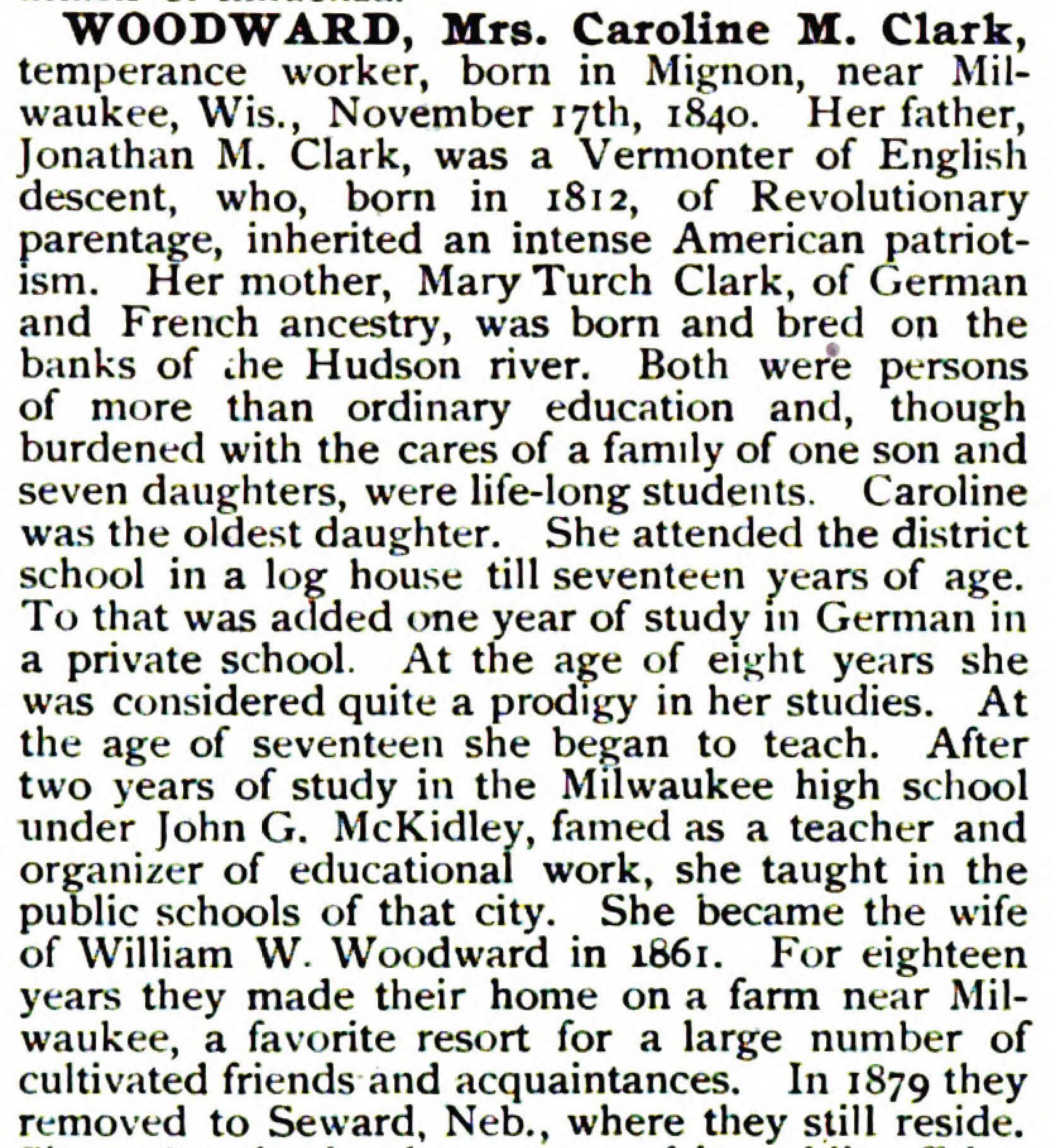
Today, as we continue to explore the life of Jonathan M. and Mary (Turck) Clark’s eldest child, Caroline Mary Clark—later usually known as Mrs. C. M. Woodward—we’ll take a fact-by-fact look at the biographical sketch of Caroline that was published in 1893, re-printed unchanged in 1897, then abridged and reprinted in 1912. For a full discussion of these three publications, see last Monday’s Caroline M. (Clark) Woodward: first steps toward a biography.
Willard, Frances E., and Mary A. Livermore. 1893. A woman of the century ; fourteen hundred-seventy biographical sketches accompanied by portraits of leading American women in all walks of life ; ed. by Frances E. Willard and Mary A. Livermore, assisted by a corps of able contributors, title page and page 779.
Today’s post will be less of a fully-formed essay, and more of a running analysis, commentary, and proof-reading of this 1893 biographical sketch. We’ll take one portion at at time, starting at the beginning. The source text will be presented as a shaded quotation, followed by my commentary and corrections in simple black text on white background, with highlighted links to additional sources and explanations and, of course, a few footnotes, too. Here we go…
In our previous post, we discovered that Henry M. Clark was drafted for Civil War military service on November 10, 1863. Today we will look at the existing evidence recording Henry’s death and burial in April, 1866, aged 23. So far, we lack reliable documentation for Henry’s life during the 28 months between those dates; we’ll continue the search for Henry’s possible Civil War service in a series of upcoming posts.
The question remains: why did Henry Clark, only son of Jonathan M. and Mary (Turck) Clark, die so young? Milwaukee death records for the 1860s are uneven and incomplete; it’s not surprising that no death certificate exists. I have not been able to find a death notice in the Milwaukee newspapers. But we do have two contemporary sources that can shed some light onto the mystery of this Clark family loss.
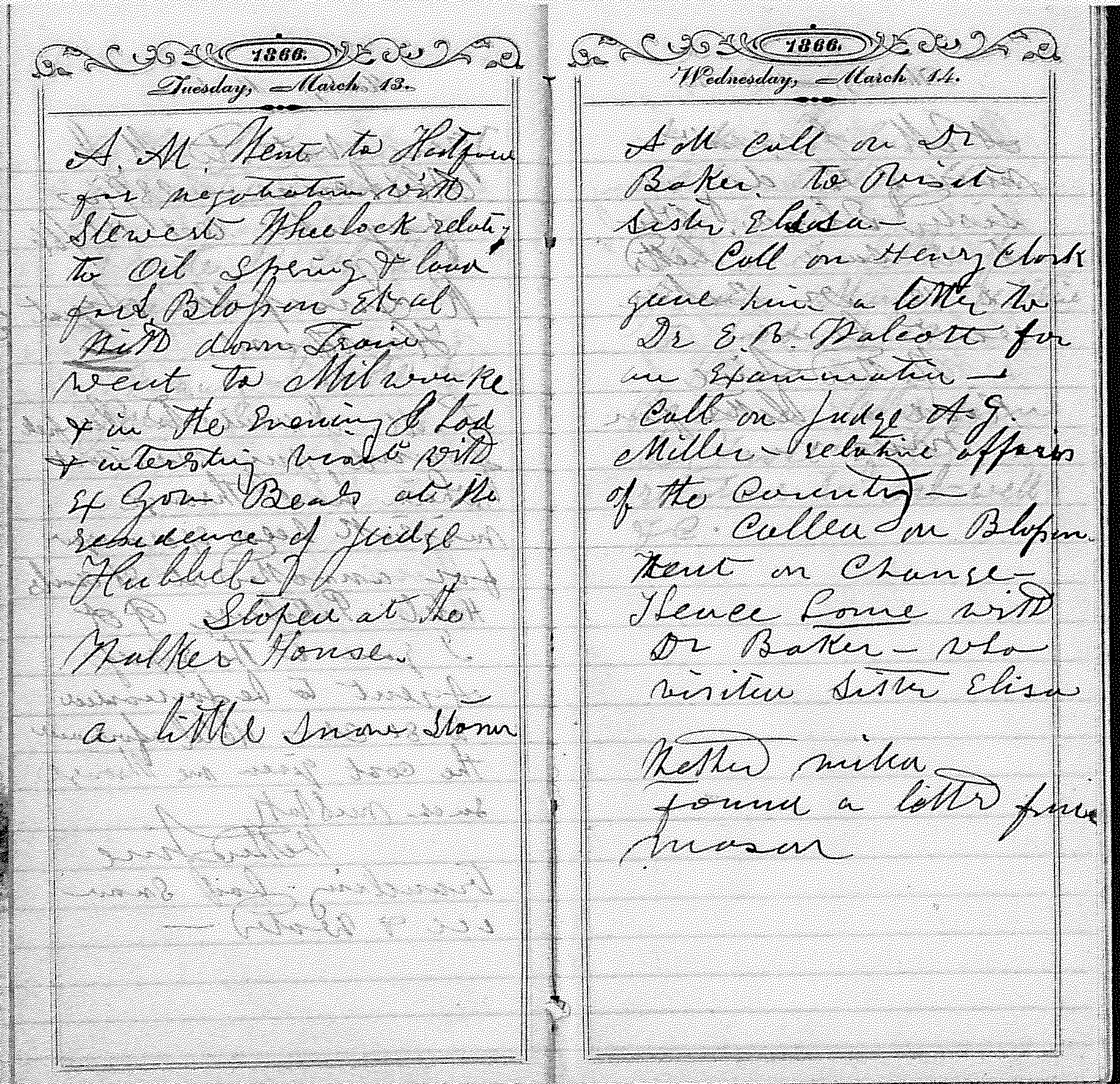
Densmore W. Maxon’s 1866 diary
On April 2, 1846, Mary Turck Clark’s younger sister Elizabeth Turck (1828-1913) married an ambitious young settler, Densmore W. Maxon (1820-1887). Maxon began his Wisconsin years as a surveyor, and eventually rose to prominence as a businessman and politician. He laid out the village of Cedar Creek, Town of Polk, Washington county, about 18 miles north and west of the Jonathan Clark house in Mequon. Densmore and Elizabeth Maxon lived in Cedar Creek for the next 41 years.
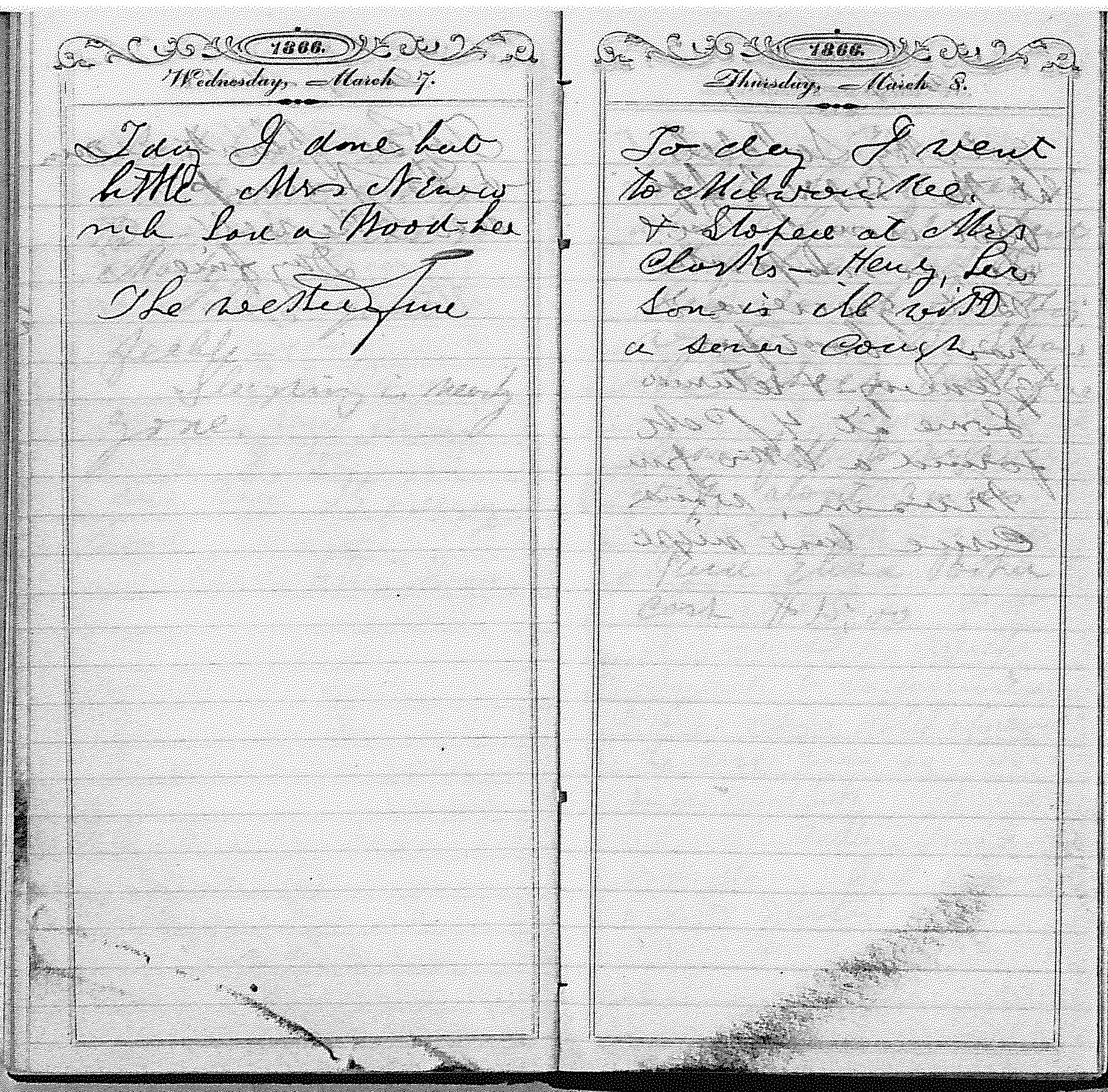
The lives of the Maxons, Clarks and Turcks are deeply intertwined from the 1840s onwards. For at least one year, 1866, Densmore Maxon kept a pocket diary. These pages contain his notes on the final days of nephew, Henry Clark:
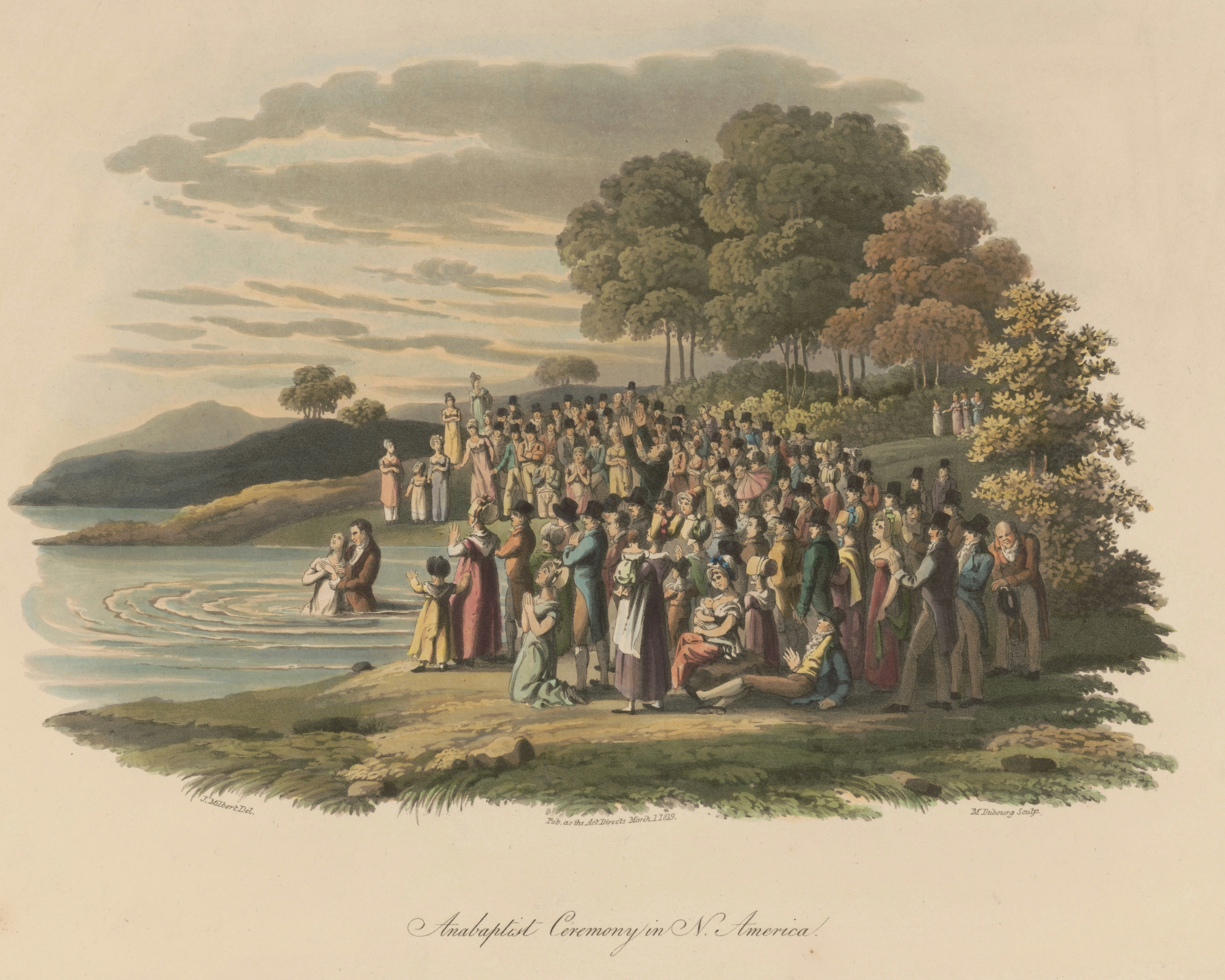
Religion played a large role in the lives of many—but by no means all—19th-century Americans. This was certainly true for Mary (Turck) Clark’s father, Peter Turck (1798-1872). In a number of ways, Peter Turck’s changing relationship to religion is a unique, personal story, but is also a story that encompasses many strands of the religious experience of this formative period in American history.
The Dutch-American heritage
Previously, we looked at Peter’s 1798 DRC baptismal record. Most, if not all, of his siblings were baptized in the Dutch Reformed Church (DRC) in various Columbia County, New York, churches. And as far as I have been able to discover, almost all of Peter Turck’s ancestors were baptized in and members of the DRC in early New Holland and New York, all the way back to the original Turck immigrant, Paulus Jacobsz. Turk (~1635-1703), who came to New Amsterdam (later New York City) before 1660. So how did someone with such long and deep family ties to the Reformed Church—such as Peter Turck—become “an ardent preacher of the Baptist faith”?1
The Second Great Awakening
The Dutch Reformed Church was not the only Christian denomination in the Hudson River valley during Peter Turck’s early years. While a large percentage of the area’s residents were of Dutch and DRC heritage, the valley had many Anglo- and German-Americans as well. All were served by various Protestant denominations including the Baptist, Lutheran and Protestant Episcopal churches, and the Society of Friends. More significantly, Peter Turck’s youth also coincided with the Second Great Awakening of religious fervor in America.
Christmas Eve is tomorrow night, so I thought you might enjoy another look at our previous Santa Claus posts, from December 25 and 30, 2017. I have combined the two original posts and incorporated a few revisions and updates to the text. Ho! Ho! Ho!
Christmas in early America
For many years now, Christmas has been celebrated by many Americans as an important religious and community holiday. Christians gather to worship and commemorate the birth of Jesus, and they and other Americans enjoy a break from work and gather with family to feast and exchange gifts. But it was not always this way.
But in many of the American colonies, Christmas was not observed as a religious or secular holiday. The seventeenth-century Puritan leaders of the Massachusetts Bay Colony considered Christmas to be non-biblical and pagan influenced. In Boston and other parts of New England any observance of Christmas was prohibited and, for a few years, actually illegal. The holiday was not generally accepted in many parts of the United States until after the federal government made December 25 a national holiday in 1870.







 Clark House Historian