Hail, Smiling morn! – 2025 edition

Happy New Year to all, and best wishes for an excellent 2025. I thought we’d start the year with a lightly edited re-post of an earlier CHH essay about a cheerful, festive song, one that may have been familiar to our Mequon settlers in the 1840s.1

A spot of Spofforth to ring in the New Year…

Our New Year’s sing-along number is “Hail Smiling morn” by the English composer Reginald Spofforth (1769-1827), a vocal quartet featured in the second part of the Milwaukee Beethoven Society’s March 23rd, 1843, premiere concert:

Milwaukee Weekly Sentinel March 15 1843, page 2. Click to open larger image in new window.

Spofforth was a man of many talents, but was particularly known for his glees. A glee is a kind of convivial part-song, typically for three or more voices and usually—but not always—sung without accompaniment. I’ll have more to say about this particular composer and piece later, but for now, it’s well enough to know that “Hail Smiling morn” is—according to musicologist Nicholas Temperly—”possibly the most popular glee in the entire repertory,” and that’s saying something!

Continue reading

Random Bits o’ Holiday News…

Well, whaddya know? Christmas is just around the corner…

JCH Parlour with Christmas tree and decor. Photo credit Reed Perkins

Holiday Lights 2024

December 2 & 3, 2024, brought us the latest edition of our Holiday Lights gathering of Clark house friends old and new. There was good food, tasty beverages, lively conversation, and fine seasonal music, all dished up in the unique ambience of our historic Jonathan Clark House Museum.

As we do every year, the house was decorated with appropriate 1840s-style decorations, including the table-top Christmas tree and ornaments, and the evergreen bough decorations on the window sills, shown above.

Continue reading

“Dear Santa,”

The Clark House Historian’s Christmas Wish List

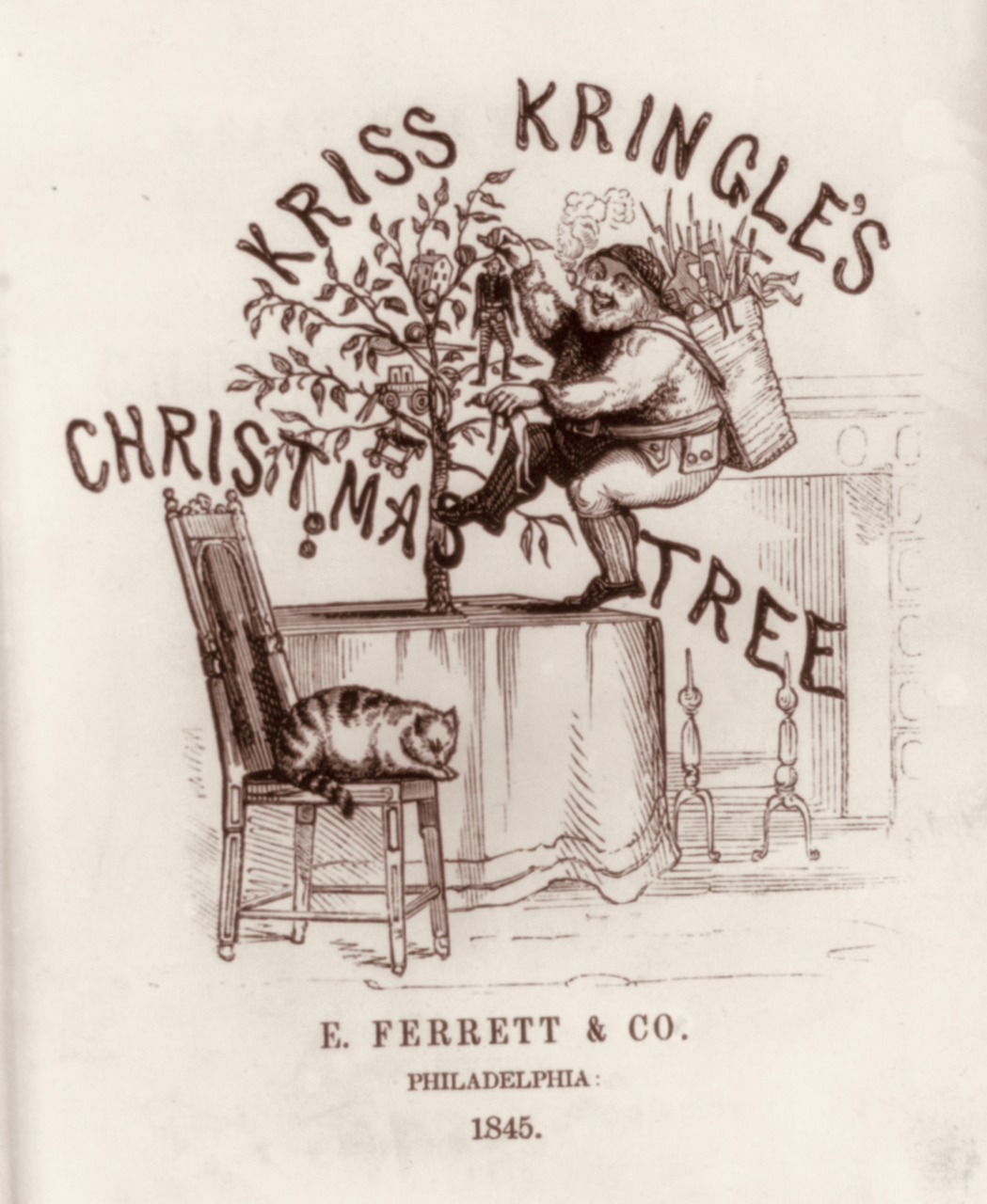
Kriss Kringle’s Christmas Tree [title page], E. Ferrett & Co., Philadelphia, 1845. Library of Congress

I grew up in the Chicago suburbs, and I remember the holiday thrill of riding the Chicago & Northwestern commuter train downtown with my parents, and then walking into the majestic State Street headquarters of Chicago’s grandest department store, Marshall Field & Company. Our mission? A trip up to the “toy floor” at Field’s, where we would wait in line to tell Santa all the wonderful things we would like to receive for Christmas that year.1

It goes without saying that I haven’t been able to fit on Santa’s lap for a very long time. But as the Clark House Historian, I still have holiday dreams and wishes, and today I’d like to share some of them with you. Who knows, perhaps Santa will work his magic once again?

(Official disclaimer: I do not serve on the JCH Board of Directors, or any of its committees. This is my Christmas daydream, a fantasy of what I’d like to see unfold at my favorite museum, given unlimited resources. And besides, as the great Chicago architect and city planner Daniel Burnham famously said: “Make no little plans. They have no magic to stir men’s blood!”)

My list is organized into several parts, the first of these is…

Continue reading

Who’s Who at Forts Howard & Winnebago, 1829-1837

I’m getting back into the blogging groove, and one of my first projects is to continue our series “Not our Jonathan: other “J. M. Clarks” in 1830s & ’40s Wisconsin.” And in my research for that, I’m looking into the identities of one or more men named “J. M. Clark” that served as chaplain at the 5th Regiment’s post at Fort Winnebago.

An important primary source for this research are the monthly “Returns” or reports, sent from the 5th Regiment’s posts at Forts Howard and Winnebago back to the army’s chief bureaucrat, the Adjutant General, in Washington, D.C. We’ve examined these Returns several times on Clark House Historian, including this post from 2016 which discussed this October, 1833, bit of U.S. Army record-keeping, the Return of the Regiment [for the 5th Regiment Infantry, at Fort Howard], October, 1833, verso:

NARA, Washington, D.C.; Returns from Regular Army Infantry Regiments, June 1821 – December 1916; Microfilm Serial: M665; Roll: 54 Military Year : 1832-1842. Return of the Regiment [for the 5th Regiment Infantry, at Fort Howard], October, 1833, verso, from Ancestry.com (pay site).

What’s that name???

For our purposes, one of the most useful features of these monthly Returns is the top left section of the form, which lists the officers of the regiment by [Company], Rank, Name, Post or Station, and with a space for Remarks about their assignments, temporary duty, leaves of absence, and so on. There’s a lot of useful information here, especially the names of the officers and the companies that they lead. But click the image to open a larger version of this image, and see if you can actually read those names:

On the one hand, the regimental clerk that filled out this October, 1833, form had pretty tidy penmanship, and the digitized microfilm image is not too bad. But even so, some of the names are hard to decipher. And knowing these names can be really useful, for example when looking for correspondence between these regimental officers and the Adjutant General’s office in D.C. (See our post here, for more on this archive.)

So how do we learn “Who’s Who” on the monthly “Returns from Post” and “Returns of the Regiment”? Fortunately, the government put all that info into a series of very useful books, which are now available, for free, online…

Continue reading

Talking about the Old Military Road, the DAR…and JMC

UPDATED October 5, 2024, at 9;30 pm to correct a number of typos and other infelicities.

Phew! What a busy September! I got to talk about some very interesting topics last month, to some very enthusiastic and attentive audiences. Lots of work, but very enjoyable. The first of these events was my September 13, 2024, after-dinner presentation at the Fall Workshop of the Wisconsin Society, Daughters of the American Revolution (WSDAR). My topic was “Building the Military Road, Wisconsin Territory’s First Federal Road.”

Photo credit: Laura Rexroth

I incorporated into the talk some important parts of the 1830s and ’40s army and road-building information that I’ve blogged about here at CHH, as well as new primary source materials and a whole bunch of relevant photographs and illustrations.

The WSDAR and the Military Road

An important, ongoing part of the WSDAR’s mission over the decades is historic preservation and education. The Wisconsin Society DAR’s main historic preservation effort involves the care and presentation of the last bit of Fort Winnebago still standing, the historic Fort Winnebago Surgeon’s Quarters.

“Fortifying the Border,” slide from my “Old Military Road” presentation.

This image of Fort Winnebago, at the Portage between the Fox and Wisconsin Rivers, was created in the mid-nineteenth century and reproduced on a 1909 postcard. In the detail shown here, the building that is now the WSDAR’s historic Fort Winnebago Surgeon’s Quarters museum is indicated by green arrow. The uncropped full image—including a view of the Historic Indian Agency House—is available from the Library of Congress.

The WSDAR also has an interest in Wisconsin’s Old Military Road that dates back at least to 1930, when Columbia County’s Wau-Bun Chapter, WSDAR placed a series of handsome cast-steel markers along their portion of the route of the Old Military Road. As you might imagine, these have suffered from almost a century of Wisconsin weather and random damage or theft. State regent Sandra Snow has made the restoration and replacement of the 1930 markers one of her signature projects. Here’s a before and after of one of those markers:

Continue reading

Labor Day – a photo essay

Today is Labor Day, the holiday celebrating the working men and women of our nation, and I thought I’d commemorate the day with a lightly-revised re-post of this piece from 2023.

This Labor Day, I’ll be at home, working on my upcoming lectures for the state DAR and the Cedarburg History Museum. Last year, I had to work at our local mercantile establishment. You know, a store kind of like this one, only much bigger, stocked with just about anything you need for modern living:

I don’t really have the day “off” today—too much writing to do—and won’t be marching in a parade, but I’d still like to honor the holiday and salute the American worker, past and present. With that in mind, let’s revisit some of the nineteenth-century occupations we’ve talked about previously at Clark House Historian, highlighting a few of the many skills, trades, and occupations common during the Clark House era.

Since it is a holiday, I’m not going to add long commentaries to each photo. Enjoy the photo galleries, and click each gallery to open larger versions of each image. And click the highlighted links to visit the original CHH posts, filled with lots more information about the different skills, tools, and jobs, and the full image credits.

Continue reading

JMC, Barney Clow and Milwaukee’s American House hotel

Updated, August 4, 2024, to add a few explanatory links, to clarify the years of arrival of B. Clow and D. Maxon, and to clarify which families stayed in Washington/Ozaukee county, and which sold out and moved on.

Home away from home

Until the late-1850s, there were no railroads connecting Mequon to Milwaukee. If you needed to go to the city—for shopping, shipping, social calls or legal business—you either had to ride a horse, a wagon, a carriage (a sleigh in the winter), or simply walk there and back. It was about a 19 mile journey, over roads of dubious quality and variable states of repair. Even in fine weather, a one way trip might take the better part of the day.

So it was not unusual for Mequon farmers, such as the Clarks and their neighbors, to need a place to stay overnight when they ventured to the city. And from early days, one of the top destinations for Milwaukee travelers was the American House hotel. In 1844, the American House looked like this…

Advertisement, “American House,” [Prairieville (later Waukesha), Wisconsin] American Freeman, 28 Sept 1844 p 4

Take a moment to click the image and open a larger version in a new window. Zoom in and admire the couples strolling on the balconies and the arriving, or departing, stagecoach at the front door. All in all this looks pretty deluxe, by 1840s’ standards. But the hotel business, then as now, was always changing. Less than six years later the American House would be expanded, refurnished, and under new management…

Continue reading

Monday: Map Day! – the first (?) map of Stanstead, 1772

I’m working on several substantial and related posts centered around maps and documents that describe the early settlement of Stanstead Township, Lower Canada, from about 1791 to 1810. There are several Clark families involved, and I am investigating whether any of these early Stanstead Clarks might be kin to our Jonathan M. Clark. Research is going along well enough, but the writing is taking more time than planned.

But I couldn’t let this Monday pass without sharing a special map with you, one that I came across while searching for more relevant maps in the digital collections of the Library and Archives Canada (LAC) website. Today’s map is, I believe, the earliest map of what would eventually become the Eastern Township of Stanstead, Lower Canada.

Continue reading

Music instruction in Milwaukee, 1845

I ran across this advertisement while doing some research on the Bonniwell Band, purportedly the first band to perform in the new Wisconsin Territory. The band featured brothers—and Clark House neighbors—James, Charles, William, Henry and Alfred Bonniwell, and their brother-in-law Philip Moss.

But the Bonniwell Band was not the only source of music in the area…

“Music.” [John M. Windus, music instruction], advertisement, Milwaukee Daily Sentinel 17 Nov 1845, page 3.

Music.
John W. Windus informs the lovers of good music that he has established himself in Milwaukie for the purpose of teaching the above science. His forte is principally marshal [sic] music, and he considers himself fully competent to teach Bands or persons on any wind instrument. References can be had of Holton & Goodall.
Mijwaukie [sic], Oct. 1845

Yep. In 1845, Milwaukee area “lovers of good music” could learn band instruments from Mr. Windus. And martial music was his forte.

Continue reading