Labor Day has come and gone, and for many this marks the unofficial “end of summer.” With that in mind, I thought you might enjoy a lightly revised and enhanced re-post of this CHH piece from 2023.
Many students start classes today. Others began school a week or two ago. Many Wisconsin families have spent the past few weeks (or months) preparing for the new school year, shopping for “Back to School” deals on clothing and school supplies at local, chain, and online retailers.
Harrison’s Columbian inks, black, scarlet, red, blue. [United States, publisher not transcribed], c. 1846. Library of Congress
Shopping for school supplies at the start of the school year is nothing new. But the origin of the now ubiquitous use of “Back to School!” as a marketing phrase is obscure. From what I’ve observed, it seems very much a post-World War II phenomenon. Yet with our current focus on three-ring binders, zippered pencil cases, and boxes of 64 Crayolas (with the built-in sharpener!), have you ever wondered what kind of school or office supplies might have been necessary or useful for Jonathan and Mary Clark, their children, and their neighbors? For a fun comparison, let’s take a look at just two of the many relevant advertisements from the columns of the Clarks’ local papers, in this case the [Milwaukee] Daily Free Democrat, November 2, 1850, page 4…
In a recent CHH post I wrote about my Saturday, August 16 visit to, and presentation at, the WSDAR’s excellent Fort Winnebago Surgeons Quarters historic site. That was worth a road trip in itself. But since I was heading up to Portage, I decided to make a history weekend out of the occasion. So on Friday the 15th, I spent a fine few hours touring the nearby Historic Indian Agency House and museum, just a short distance from the Surgeon’s Quarters across the old channel of the Fox River.
Historic Indian Agency House, 2025. Photo credit: Reed Perkins
The Historic Indian Agency House
The Historic Indian Agency House (HIAH) is one of Wisconsin’s oldest museums and a “must see”, for those of you interested in the early days of the Wisconsin Territory and the history of the state’s original Native American inhabitants and their forced removal during white settlement in the 1820s, ’30s and beyond. Like the nearby Fort Winnebago and its remaining Surgeon’s Quarters, the story of the HIAH overlaps and intersects with the story of Jonathan M. Clark and his 1833-1836 military service at Fort Winnebago’s headquarters post, Fort Howard, in Green Bay.
UPDATE: This was supposed to go out on Monday. I hit “publish” before the piece was ready. Here’s the updated 2025 version for your reading enjoyment. Sorry for any confusion (and, for you CHH subscribers, the premature email in your inbox).
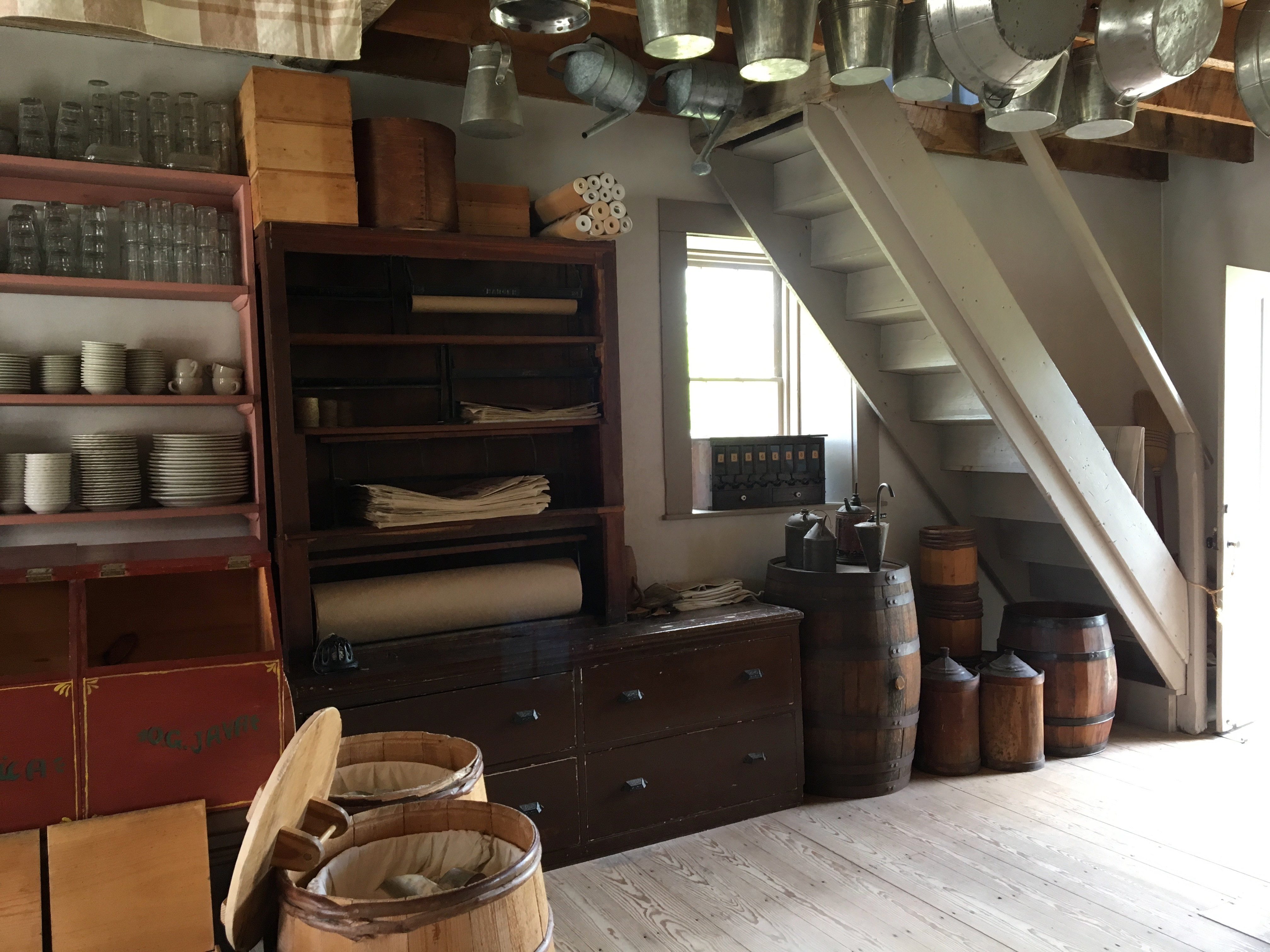
Monday, September 1st, is Labor Day, the holiday celebrating the working men and women of our nation, and I thought I’d commemorate the day with a lightly-revised re-post of this CHH piece from 2023. This Labor Day, as in 2023, I have to work a shift at our local mercantile establishment. You know, a store kind of like this one, only much bigger, stocked with just about anything you need for modern living:
Like many Americans, I don’t have the day “off” on Monday, and won’t be marching in a parade, but I’d still like to honor the holiday and salute the American worker, past and present. With that in mind, let’s revisit some of the nineteenth-century occupations we’ve talked about previously at Clark House Historian, highlighting a few of the many skills, trades, and occupations common during the Clark House era.
Since it is a holiday, I’m not going to add long commentaries to each photo. Enjoy the photo galleries, and be sure to click each gallery—and photo—to open and peruse larger versions of each image. And click the highlighted links to visit the original CHH posts, filled with lots more information about the different skills, tools, and jobs, and the full image credits.
It’s been a while, I know! One thing led to another and this summer ended up being a very quiet summer here on the CHH blog, with just a post or two over the past few months. My apologies to you all. However, I have been very busy “behind the scenes,” reading, researching and writing all summer long, and I have lots of new historical information and stories to share with you.
Fort Winnebago Surgeons Quarters—and more
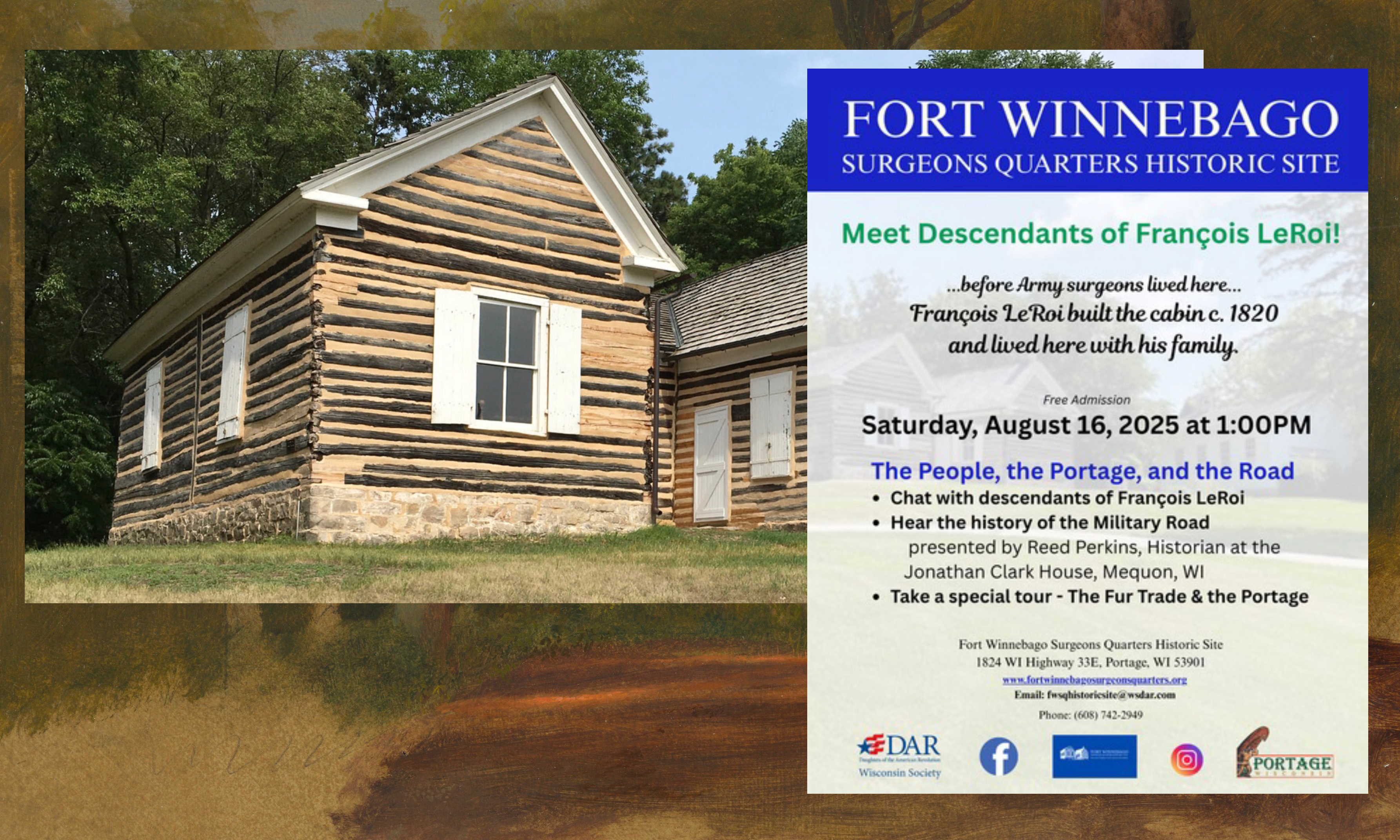
One of the projects that has kept me busy this summer was researching and preparing a presentation that I gave last Saturday, at the historic Fort Winnebago Surgeons Quarters museum as part of their The People, the Portage and the Road event. Originally, my talk was going to be a lightly-revised update of my September, 2024 talk at the Wisconsin Society of the Daughters of the American Revolution’s Fall Workshop in Oshkosh.
That talk, “Building the Military Road,” contained about 45 minutes of detailed information about Wisconsin’s first federal road, and the men that built it—including our own Sgt. Jonathan M. Clark—tightly squeezed into about a half-hour time slot. The presentation was well-received, and I was invited to repeat that talk at this August, 2025, event at the WSDAR’s Fort Winnebago Surgeons Quarters museum in Portage.
However! The August 16th event was also going to be a reunion of the descendants of François LeRoi (aka Francis LeRoy or Roy)—the man that first built and occupied the historic surgeon’s quarters (1816-1829), and it was suggested that I include some Francis LeRoy related information in my talk, a very reasonable request. Since I already knew quite a bit about the Military Road, the Portage, and the life and times at Forts Howard and Winnebago in the 1830s, I thought I would just need to make a few minor cuts to my original talk, find a few, possibly obscure or unknown, LeRoi documents, add them to the presentation and, well, that would be just the thing! Well…
249 years ago today, representatives of all thirteen of Britain’s American colonies, gathered “in congress” in Philadelphia, and publicly declared our independence from “George the Third, by the Grace of God, King of Great Britain, France, and Ireland, Defender of the Faith, and so forth,” and his distant and unresponsive legislature. The Americans proposed to separate—forever—from their Divinely appointed King, and form a new and independent nation, the “united States of America.” This decision was bold, completely unprecedented in a world dominated by autocratic monarchs, and potentially fatal for anyone that supported this Declaration of Independence. From the King’s point of view, the authors, his subjects, were committing treason.
After a public reading of the Declaration of Independence at Bowling Green, on July 9, 1776, New Yorkers pulled down the statue of King George III.
The authors of the Declaration were clear-eyed about the stakes, yet unwavering in their desire to separate from the King. They closed their—our—Declaration of Independence with their unanimous avowal that, […] for the support of this Declaration, with a firm reliance on the protection of divine Providence, we mutually pledge to each other our Lives, our Fortunes and our sacred Honor.
The Declaration of Independence is our pivotal foundational document. People risked their lives and fortunes by creating and signing it. Thousands of Patriots died in the subsequent War of Independence in order to make the “united States of America” a reality. A large number of British-Americans, still loyal to their monarch, fled the 13 colonies and migrated to the King’s remaining possessions to the north, including Nova Scotia and the Province of Quebec.
Through it all, the ideals expressed in the Declaration inspired generation after generation of Americans, including Jonathan Clark and his ancestors, as attested in this excerpt from daughter Caroline (Clark) Woodward’s 1893 biographical sketch:
[…] Jonathan M. Clark, was a Vermonter of English descent, who, born in 1812, of Revolutionary parentage, inherited an intense American patriotism.
Jonathan Clark and his Mequon neighbors—including native-born “Americans,” as well as more recent immigrants from Ireland, the German lands, the United Kingdom, Nova Scotia, and elsewhere—knew the Declaration, read it aloud at patriotic events (in English and German!), and shared its anti-monarchical sentiments.
This July 4th, before you head to the beach or light the barbecue, why not refresh your memory and read the document that created our nation, and forever declared our freedom from the “absolute Despotism” of kings?
In Congress, July 4, 1776.
The unanimous Declaration of the thirteen united States of America,
When in the Course of human events, it becomes necessary for one people to dissolve the political bands which have connected them with another, and to assume among the powers of the earth, the separate and equal station to which the Laws of Nature and of Nature’s God entitle them, a decent respect to the opinions of mankind requires that they should declare the causes which impel them to the separation.
This is the second part of a multi-part look at local (Mequon and Washington/Ozaukee County) history sources. If you missed Part 2, I recommend you click this link and read that first.
In today’s post, I’d like to guide you to and through another one of the local histories that I’ve bumped into over the last decade or so. As in Part 1, I’ll include a link to a PDF copy of the source, make comments on the range and quality of the information in the book, and sum it up with an overall grade for accuracy, style, and usefulness.
“All sources lie.” — Lawrence of Arabia (supposedly)
That provocative quote begins the forward of Elizabeth Shown Mills’s monumental Evidence Explained (third edition, revised, 2017), the “Bible” of genealogical research, source evaluation, and modern citation practices. It makes an arresting opening for her almost 900-page book, devoted to historical and genealogical sources and how to cite them.1 But what does the author mean by beginning her book with Lawrence’s (supposed) quote? Here is part of her explanation:
I’ve been preoccupied with all sorts of archival work lately, and I thought I’d pass along a few preservation tips for those of you that might have some “stuff” that you’d like to protect and save for the future.
Know your archival plastics!
Do you have photographs, artwork, manuscripts, letters, coins or currency that you’d like to preserve for years to come? Perhaps you’d like to enclose those items in a protective plastic enclosure, so that they may be viewed and handled with minimal damage? That’s a fine idea, but you should know that when it comes to archival storage, there are good plastics, and (very) bad plastics. With that in mind, I thought I’d share this helpful infographic, hoping that some of you may find it useful.
As always, feel free to click the image for a clearer, downloadable and/or printable version of the image.
Howdy! Sorry for the long blog silence. It’s not that I’m lacking for topics or material to share with you all, but I’ve been busy “behind the scenes” at the Clark House for the last month or so.
In particular, I’ve been working on two big projects. JCH executive director Nina Look and I have just published the Spring | May 2025 issue of the JCH Newsletter, and Nina and I have been collaborating with JCH intern Nicole Buerosse on a major, archival-quality upgrade for the preservation and display of the museum’s irreplaceable Bonniwell Family Bible.
Scaffolding at the Clark House? What’s up with that? Read on for more info…
Some of our recent and upcoming posts are focused on reading and evaluating source materials. The first of these posts, JCH Sources, part 1, was illustrated with this drawing…
Whistler, James McNeill, artist, Reading by Lamplight, etching and drypoint, 1859. MetMuseum. Bequest of Julia H. Manges, in memory of her husband, Dr. Morris Manges, 1960
This is James McNeill Whistler’s 1859 Reading by lamplight, an evocative drawing of a young woman, reading by the light of an oil lamp, a cup of tea at her side. The lamp is supported on a tall, slender metal stand. It’s light is raised even further by placing the lamp stand on a large, overturned bowl.
If I didn’t know better, I’d think this was Caroline Clark, or one of her other well-read sisters. Caroline would have been about 19 years old in 1859, when Whistler made this drawing. She was in the middle of her pioneering two-year high school course in Milwaukee, a talented, energetic young woman on the way to living a remarkable life of service. Here she is circa 1889-1900, around age 50, in the prime of life:
If you are interested in the history of the Jonathan Clark House, there are a number of published local histories that you might consult. Many of them are available online, as free, searchable, PDF downloads from Internet Archive, GoogleBooks, the Library of Congress, and other digital repositories. This is pretty cool but, as you might expect, not all sources are equal. Some are more reliable than others. Some contain detailed information about early settlement, settlers, government and politicians, pioneer businesses and other local affairs, often drawing upon old primary sources, some of which have since disappeared. Other histories are more content to paraphrase (and sometimes mangle) earlier volumes. How do you know which to trust?
A guide for the perplexed
In today’s post, I’d like to guide you to and through several of the published histories that I’ve spent a lot of time with. I’ll provide links to PDF copies where available, make a few comments on the range and quality of the information in each book, and give each book an overall grade for accuracy, style, and usefulness.






 Clark House Historian