Back at the General Store

I’ve recently returned to my job behind the counter at the local mercantile. This is good—for all sorts of practical reasons—but requires an adjustment to my research and writing schedule that I’ve not quite figured out. Yet.

Main counter and clerk, 1880s General Store at Old World Wisconsin, July, 2016. Photo by Reed Perkins. Click to open larger image in new window.

I should be back with the conclusion of Infrastructure Week! next week. Meanwhile, here are a few more photos of the General Store at Old World Wisconsin — “big box” retail at its finest, circa 1880.

Continue reading

RBOH – Photo Mystery, 1865

Another in our occasional series of Random Bits of History, illustrating life as experienced by the early Mequon settlers and their contemporaries. Today we examine a photograph that may—or may not—depict an early Mequon settler or their kin.

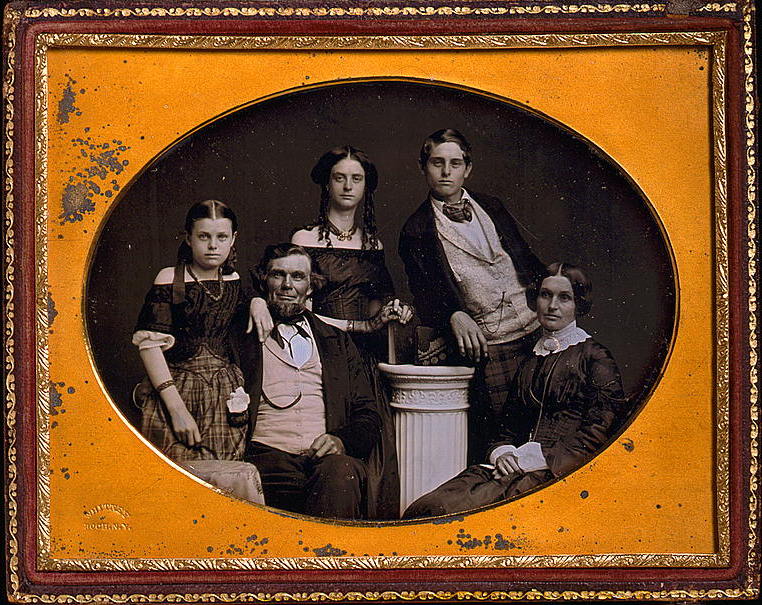
Is this a photo of young Sarah (Strickland) Clark?

Reader Eric Pearman is a descendant of early Mequon settlers Cyrus Clark and Sarah Strickland. For a while last year Clark House Historian spent some time tracing Cyrus and Sarah’s lives, and analyzing some old photographs of those Mequon pioneers here, here, here, here and here (and a few more places, too; just use the blog’s Search function and keyword “Cyrus” or “tintype”).

Eric recently sent me this, unidentified, photo that belonged to a Cyrus and Sarah Clark descendent, and wondered if it might be of a previously un-photographed member of the Cyrus Clark or Sarah Strickland families. Even if this is not a Cyrus Clark or Sarah Strickland family member, the photo has a unique feature that you may want to know about as you examine other old photos. Let’s take a look…

Continue reading

RBOH – Social Calls by Canoe, 1833

Another in our occasional series of Random Bits of History, illustrating life as experienced by the early Mequon settlers and their contemporaries. Today’s RBOH is an example of how strong early Wisconsin women could be, and how they used that strength to maintain community and social relationships across the vast distances between military posts.

Jonathan M Clark served with the U.S. Army’s 5th Regiment of Infantry at Fort Howard, Green Bay, Wisconsin Territory, from 1833-1836. The Fifth Regiment was responsible for four major outposts in the Old Northwest: Ft. Dearborn (Chicago), Ft. Howard (Green Bay), Ft. Winnebago (at the Fox and Wisconsin river portage) and Ft. Crawford (at Prairie du Chien).

We expect a soldier’s life on the frontier to be spartan and difficult, and in many ways is was. Generally speaking, enlisted men like JMC were unmarried and lived in together in the post’s barracks. But quite a few of the regiment’s officers were married, and brought their spouses—and children—to live with them on post or, occasionally, in homes in the adjacent village. As “officer’s ladies,” these women often lived separate lives from the civilian women of nearby settlements, such as Green Bay. So they formed their own bonds to provide mutual aid, comfort, society and entertainment while living in some of the army’s most isolated outposts.

And they did not let their social bonds break, even when friends were transferred to other forts. Here are some examples from about 1833:

Continue reading

RBOH – Walter Bonniwell’s first marriage

UPDATED: February 25, 2021. See notes, below, for details.

Introducing RBOH – Random Bits of History!

I have so much information to organize and share with fellow Clark House researchers and blog readers, and it doesn’t always fit into a one of our longer, regular blog posts. So today we begin an occasional series where I publish random bits and pieces of Mequon related history. With RBOH, I plan to write shorter posts that present new information or unknown documents, and try to solve mysteries or confirm existing, but undocumented, facts. Let me know if you have any questions, comments, suggestions or requests.

Walter Bonniwell’s first marriage documented!

Regular readers know that I often refer to George B. Bonniwell’s excellent history of Mequon’s early and influential pioneer family—and Clark House neighbors, friends, and in-laws—the Bonniwells. Like any work of history or genealogy, George’s book, The Bonniwells: 1000 Years, printed in 1999, has a few omissions and blank spots. But research has not stopped since his book was printed, and today we present three documents that give information about one of those missing bits of history, the marriage of Walter Bonniwell (1824-1884) and his first wife, Eleanor “Ellen” Bailey (c. 1827 to ????). In the process we’ll run into another key early settler—and man of many trades—Jonathan M. Clark’s father-in-law, Peter Turck.

Marriage License – January 18, 1845

The couple’s handwritten marriage license is image number 1211 in the Milwaukee Public Library’s collection of Milwaukee County Marriage Certificates. It reads:

Territory of Wisconsin }
Washington County }
License is hereby given to

Walter Bonniwell and Ellen
Bailey to Unite in Marriage according
to Law
Given under my hand this 18th day of January. A.D. 1845
{SL} Peter Turck Justice of the Peace

Source
Continue reading

Happy Anniversary!

The Clark House Historian blog is two years old today!

Our first post, “Welcome!,” was posted on March 29, 2016, and can be found here; it is also anchored at the top of the home page. More substantial posts (with photos!) followed  in April, introducing Jonathan M. Clark, his wife Mary Turck and the Clark House. In the years since, we’ve published 29 blog posts, almost 20,000 words, and dozens of historic images and maps. We’ve had over 2000 views from 512 visitors. Our readers are mostly from the United States, but we also have readers in Canada, the EU, South Korea, Germany and the Netherlands. Thank you all for your support!

Whether you are a new reader, or you’ve been following the blog since the beginning, here are some suggestions for catching up on missed posts or finding specific information that interests you: Continue reading