No new map today. I spent a good part of my early-October weekend cleaning up the family garden after our final harvests of tomatoes and peppers. The bush beans produced their last good beans a few weeks ago; they got tough and stringy after about mid-September.
It’s just the sort of thing Mary Turck Clark and the Clark children would have done in the 1840s and ’50s at the Jonathan Clark house, though I assume the Clarks grew and “put by” a good deal more in their family garden and root cellar than we do in our suburban backyard and chest freezer.
When I finished work, I put my tools and garden supplies in the garage for the winter. The Clark family didn’t have a garage. They had this sturdy fieldstone barn:
Dating and interpreting old photographs, part 4 of 4
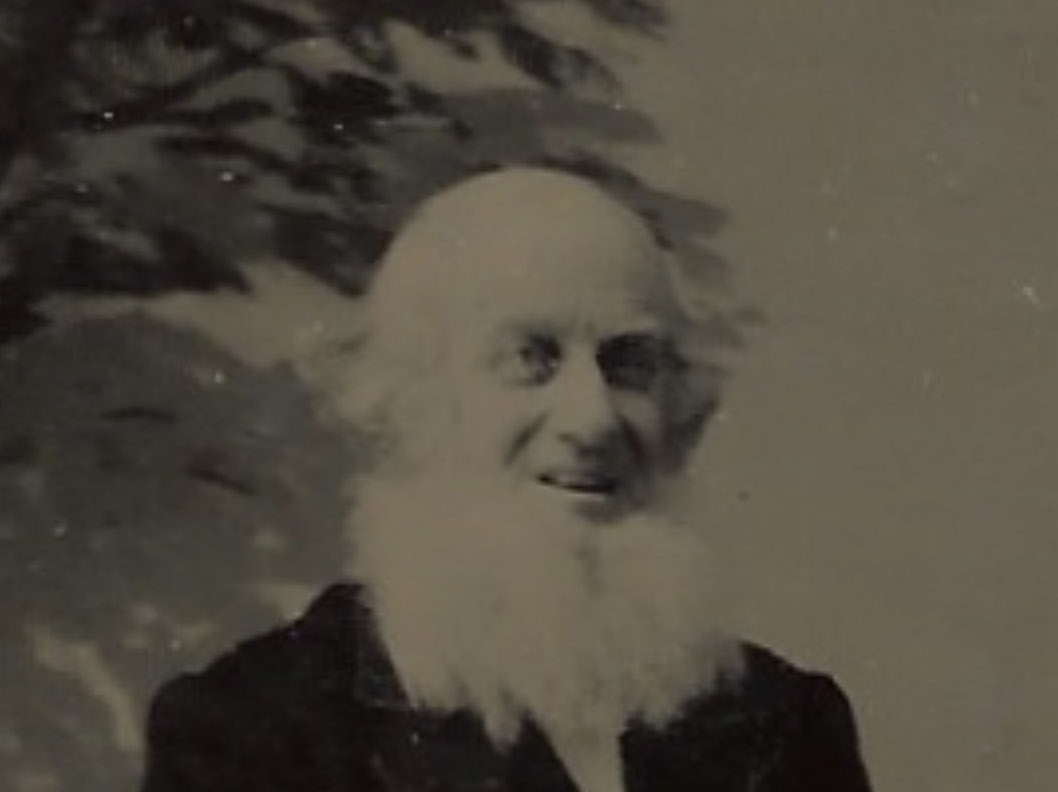
In our final look at photographs from the family of early Mequon settlers Cyrus and Sarah (Strickland) Clark, we’ll look at two more tintypes, one full-length portrait of Cyrus Clark, and a similar dual portrait of Cyrus and daughter Ida Estella (Clark) Van Slyke. We will examine the clothing, props, backgrounds and other aspects of both photographs, and try and determine when and where the photos were taken.
If you missed our previous explorations in photo analysis and the lives of Cyrus and Sarah Clark, you may—at least—want to check our previous tintype post, Why is Cyrus smiling?, before heading on to these wonderful photos:
Cyrus Clark (tintype, detail). Photo courtesy Steven Clark Van Slyke. Click to open image in new window.
Dating and interpreting old photographs, part 3 of 4
For our next to last look at photographs from the family of early Mequon settlers Cyrus and Sarah (Strickland) Clark we’ll start to take a closer look at three images made with another popular photographic process from the era, the tintype. We will examine the clothing, props, backgrounds and other aspects of the photographs, learn more about the tintype process, and try and determine when the photos were taken1. Once again, thanks to Clark and Strickland descendants Steven Clark Van Slyke and Lynnette Thompson for the photos and family history assistance.
If you’re new to the discussion, I recommend you read our previous post, Cyrus Clark’s Cabinet Card, and click the links there for additional background on the family and the other Clark portraits. To begin, let’s take a quick look at all three of our Cyrus Clark tintypes:
Today we take another dive into photo research and dating, as part of our look into the lives of Cyrus Clark and Sarah Strickland Clark (here, here, here, here and here). Thanks again to Clark and Strickland descendants Steven Clark Van Slyke and Lynnette Thompson. Without further ado, here is part two of our initial Clark House Historian attempt at analyzing historic photos1.
Let’s start with the photo of Cyrus that we’ve used on our previous Cyrus and Sarah posts. Here’s the front:
Our recent look at the lives of Cyrus Clark and Sarah Strickland Clark (here, here, here, and here) would not have happened without the interest of—and information shared by—Clark and Strickland descendants Steven Clark Van Slyke and Lynnette Thompson. I love “filling in the blanks” of local and family history, and discovering more about Cyrus and Sarah has been a very enjoyable challenge.
For me, one of the real pleasures of the project came from the Cyrus and Sarah (Strickland) Clark photos that Steve and Lynette were so kind to share. Both were keen to learn more about the photos, where and when were they taken, how old were the sitters, and so forth. So, in the spirit of adventure, here is our first Clark House Historian attempt at analyzing historic photos1.
We’ll start with the only photograph I have of Sarah Strickland Clark. Here’s the front:
UPDATE May 31, 2021: timeline revised to include “1864” in the dates of enlistment for sons Albert Byron Clark, Charles E. Clark, and Albert Byron’s brother-in-law Francis Rasey.
“The other Clarks” from Mequon to “the other Madison”
Today’s post is the third in a series of several focused on early Mequon settlers Cyrus Clark his wife, Sarah A. Strickland. You know, these folks:
Photos from the collection of Steven Clark Van Slyke. Courtesy Steven Clark Van Slyke and Lynette Thompson.
If you missed it, here are the links to Part 1, Part 2, and an earlier related Map Day post. You might want to take a minute to look at those posts first.
New families, new documents, new understandings
Because I’d spent less time researching Cyrus Clark’s and Sarah Strickland’s families than those of Jonathan Clark and Mary (Turck) Clark, I had a lot of catching up to do. Fortunately, I have been helped along the way by descendants Steven Clark Van Slyke and Lynette Thompson who have generously shared their notes and documents (and photographs!)
Inspired by their work, I have given Sarah and Cyrus the Clark House Historian “full treatment” (at least the pandemic-restricted, online-only version). So my Sarah Strickland and Cyrus Clark knowledge is definitely a work in progress, but it’s one that has yielded many new facts and sources that will help guide further research.
With that in mind, today’s post is less of an essay and more of a timeline, documenting what we know about this family, and what we don’t. We’ll focus on Sarah and Cyrus’s time in Mequon and the years afterward elsewhere in Wisconsin, before they “settled” in Madison, South Dakota.
This is the second in what was originally planned to be a three-part1 series on early Mequon settlers Cyrus Clark and Sarah A. Strickland Clark. If you missed it, click here for part one.Also, I suggest you read this post to view maps that will prove useful in following today’s discussion.
The Jonathan Clark House Museum, and my work as Clark House Historian, is not just about Jonathan M. Clark, Mary Turck Clark and their family. The mission of the museum—and this blog—is to:
Collect, preserve and share the history of the Jonathan Clark House and the early settlers of Mequon and Thiensville.
So with that in mind, I like to explore the stories of the Clark’s friends and neighbors in order to develop a more comprehensive picture of early Washington/Ozaukee county and it’s settlers. This week—thanks to an unexpected contact from blog reader Lynette Thompson—we will be focusing on not one, but two of Mequon and old Washington/Ozaukee county’s earliest settlers, Sarah Allise Strickland and her husband, Cyrus Clark. Why them? Just look at what I got in my inbox:
There’s a lot going on behind the scenes at Clark House Historian these days. I’ve got a half-dozen blog posts in various stages of completion, plus ongoing research and information-checking projects with Nina Look, Liz Hickman, and others. And, I’ve just heard from a third-great-granddaughter of two of the original Mequon settler families! How cool is that? More on those folks in an upcoming post—or two!
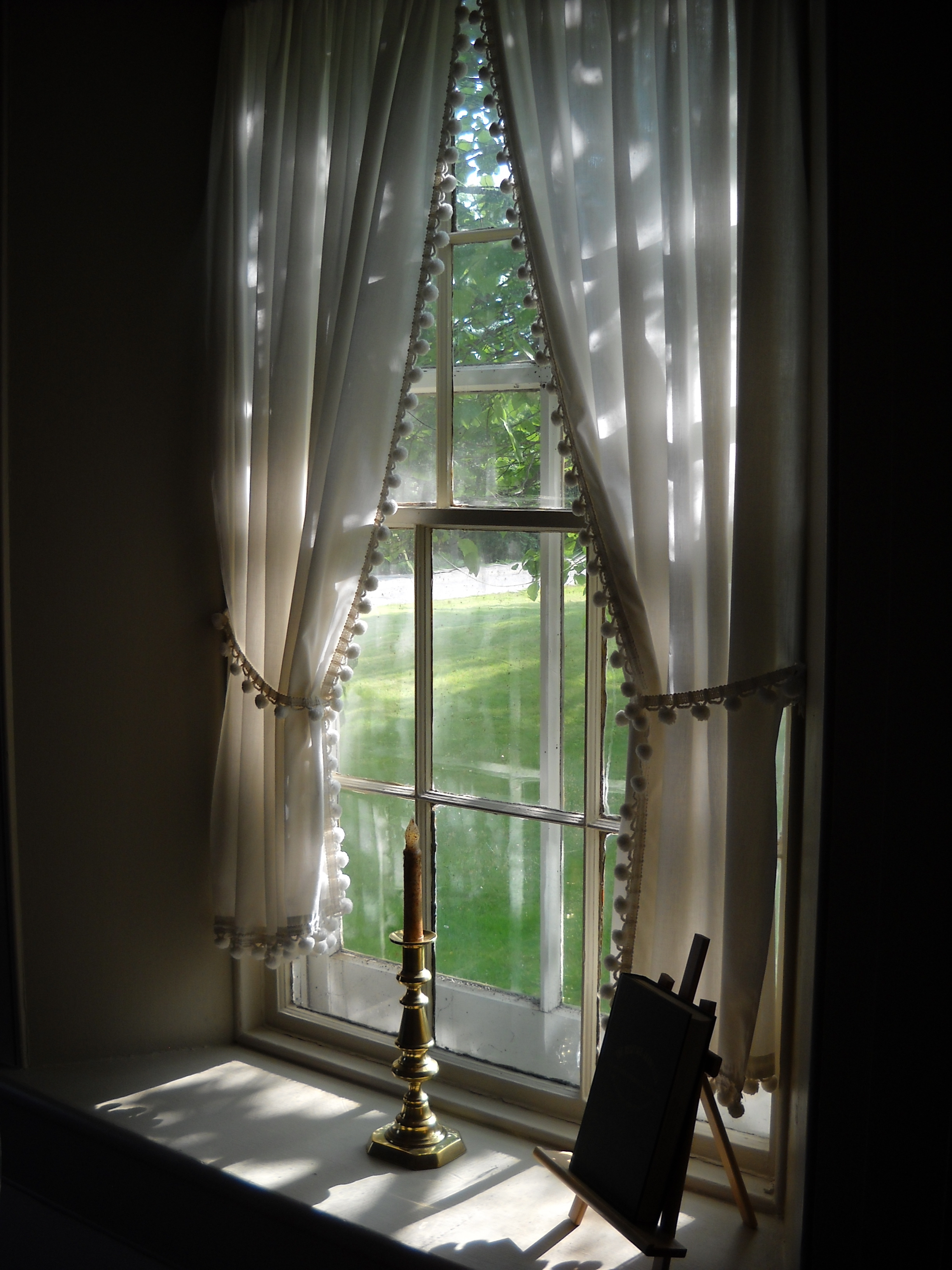
So let’s take a break, and enjoy a relaxing summer view from the Clark House. In this instance, a lovely July, 2015, view from the Clark’s front parlour, looking to the southwest toward present-day Bonniwell Road. According to the 1872 “Shoolmap” of Mequon, neighbors John Kurz and J. H. Townsend lived just across the street. A bit farther west down the road were—still—the farms of old friends and original Mequon settlers William Bonniwell and Jesse Hubbard.
Photo by Anna Perkins, used by permission. Click to open larger image in new window.
I’m working on a number of longer posts, none of which are ready yet. So how about a Jonathan Clark House Museum photo instead?
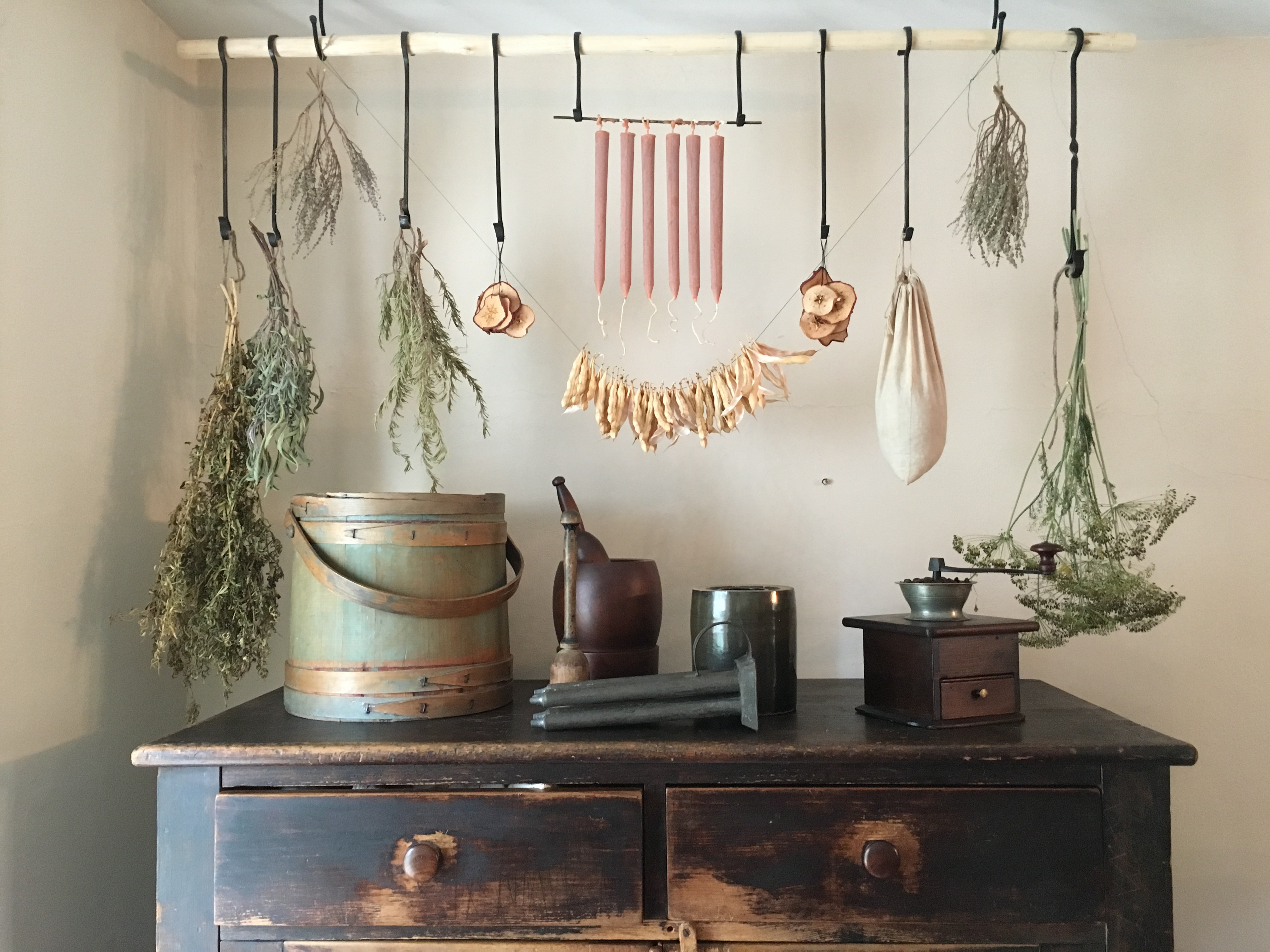
Part of the kitchen at the Jonathan Clark House museum, Mequon, Wisconsin, July, 2016. Photo by Anna Perkins, used by permission. Click to open larger image in new window.
Mary Turck Clark—and the Clark children—probably spent part of each spring, summer and early fall day tending a sizable herb and vegetable garden. Herbs added flavor to food and were also valued for their medicinal properties. But herbs often grow faster than you can use them. What to do? Hang them up to dry, and enjoy their scents, flavors and healing qualities throughout the coming year.
In early July, if the weather had been good—lots of sun and perhaps an inch or two of rain each week—the Clark family might have enjoyed the first fresh green beans of the summer. That would have been a real treat after months and months of dried produce and the last, tired, potatoes, turnips, onions, carrots and such from the root-cellar1.
By the time autumn arrived, the last beans on the bush would have been big and kind of stringy. Not as tasty as the mid-summer beans, they would be hung up to dry so that the beans could be saved, ready for planting the next spring.


 Clark House Historian