Caroline M. (Clark) Woodward: a closer look at that 1893 biography

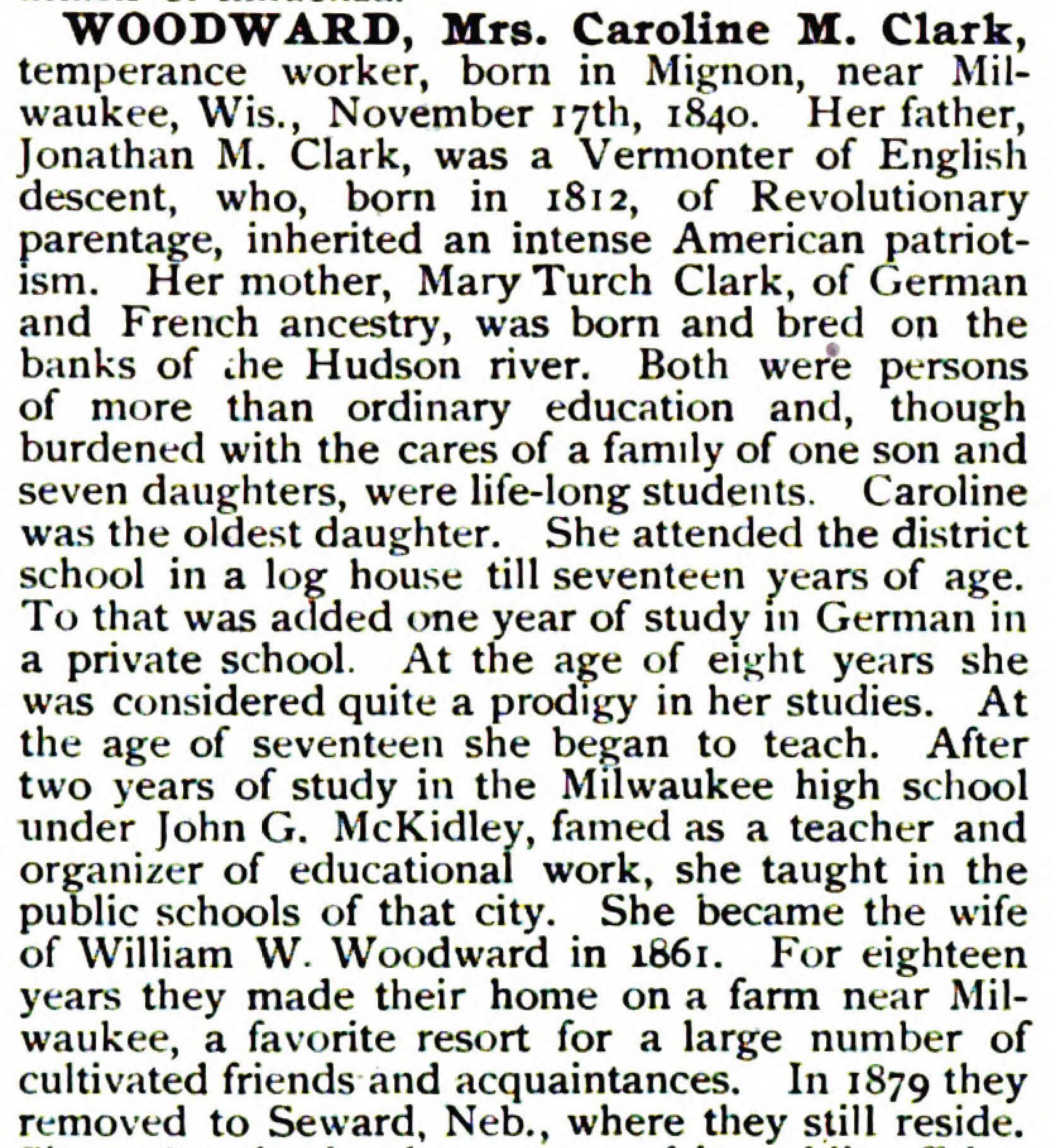
Today, as we continue to explore the life of Jonathan M. and Mary (Turck) Clark’s eldest child, Caroline Mary Clark—later usually known as Mrs. C. M. Woodward—we’ll take a fact-by-fact look at the biographical sketch of Caroline that was published in 1893, re-printed unchanged in 1897, then abridged and reprinted in 1912. For a full discussion of these three publications, see last Monday’s Caroline M. (Clark) Woodward: first steps toward a biography.

Willard, Frances E., and Mary A. Livermore. 1893. A woman of the century ; fourteen hundred-seventy biographical sketches accompanied by portraits of leading American women in all walks of life ; ed. by Frances E. Willard and Mary A. Livermore, assisted by a corps of able contributors, title page and page 779.

Today’s post will be less of a fully-formed essay, and more of a running analysis, commentary, and proof-reading of this 1893 biographical sketch. We’ll take one portion at at time, starting at the beginning. The source text will be presented as a shaded quotation, followed by my commentary and corrections in simple black text on white background, with highlighted links to additional sources and explanations and, of course, a few footnotes, too. Here we go…

Continue reading
Caroline M. (Clark) Woodward: first steps toward a biography

In our most recent blog post, Another family portrait! Caroline (Clark) Woodward, c. 1890s, we located and discussed the history of a previously unknown photo of Jonathan M. and Mary (Turck) Clark’s eldest child, Caroline Mary Clark, later usually known as Mrs. C. M. Woodward:

Townsend Elite Studio, [Portrait, Caroline M. (Clark) Woodward], inscribed “Mrs. C. M. Woodward, Supt. Work among Railroad Employes, N.W.C.T.U.”, photograph, circa 1889-1900. Photo courtesy Frances Willard House Museum & WCTU Archives, Evanston, Illinois. Click to open larger image in new window.

Caroline’s life was the most public—and perhaps best documented—of all the members of Jonathan M. Clark family, and is overdue for a closer examination. So today we begin a multi-part look at Caroline’s story, starting with three biographical sketches that were published during her lifetime.

Continue reading

Another family portrait! Caroline (Clark) Woodward, c. 1890s

UPDATED – October 9, 2021, with clarification that “NWCTU” means, indeed, the National (and not Nebraska) WCTU.
UPDATED – October 8, 2021, to correct typos in the date range of the photo. Correct (maximum) date range is 1889 to 1900. Also removed a few randomly duplicated words in the first paragraph.

More Big News! It was only a few weeks ago that we presented a previously unknown photo of the youngest child of Jonathan M. and Mary (Turck) Clark, Dr. Jennie Clark Morrison. Today we have another great find, a professional photo portrait of the Clark’s eldest child, Caroline Mary (Clark) Woodward (1840-1924):

Townsend Elite Studio, [Portrait, Caroline M. (Clark) Woodward], inscribed “Mrs. C. M. Woodward, Supt. Work among Railroad Employes, N.W.C.T.U.”, photograph, circa 1889-1900. Photo courtesy Frances Willard House Museum & WCTU Archives, Evanston, Illinois. Click to open larger image in new window.

Clark family descendant Liz Hickman and I have been gathering information about Caroline for many years. Spurred on by this new photo of Caroline in her prime, I think it’s finally time to assemble the sources, line up the facts, and begin to share more of what we know about Caroline’s remarkable life as a teacher, wife, mother, and social activist. There is a lot of material to work with, so today let’s stay focused and just take a closer look at this new-to-us photograph.

Continue reading

How’d they get here? Detroit to Ft. Howard, 1834 (part 2)

More Great Lakes Tourism – Summer, 1834

Our series of “How’d they get here?” posts is written to illustrate the nuts and bolts of how our early Mequon pioneers travelled from their original homes or ports of arrival in North America to the newly opened federal lands in Wisconsin Territory, circa 1830-1850. Today’s post continues our previous post, a first-person description of 1830s frontier tourism that we called How’d they get here? Detroit to Ft. Howard, 1834 (part 1).

Picking up where we left off…

Wednesday, July 16, arrival at Green Bay

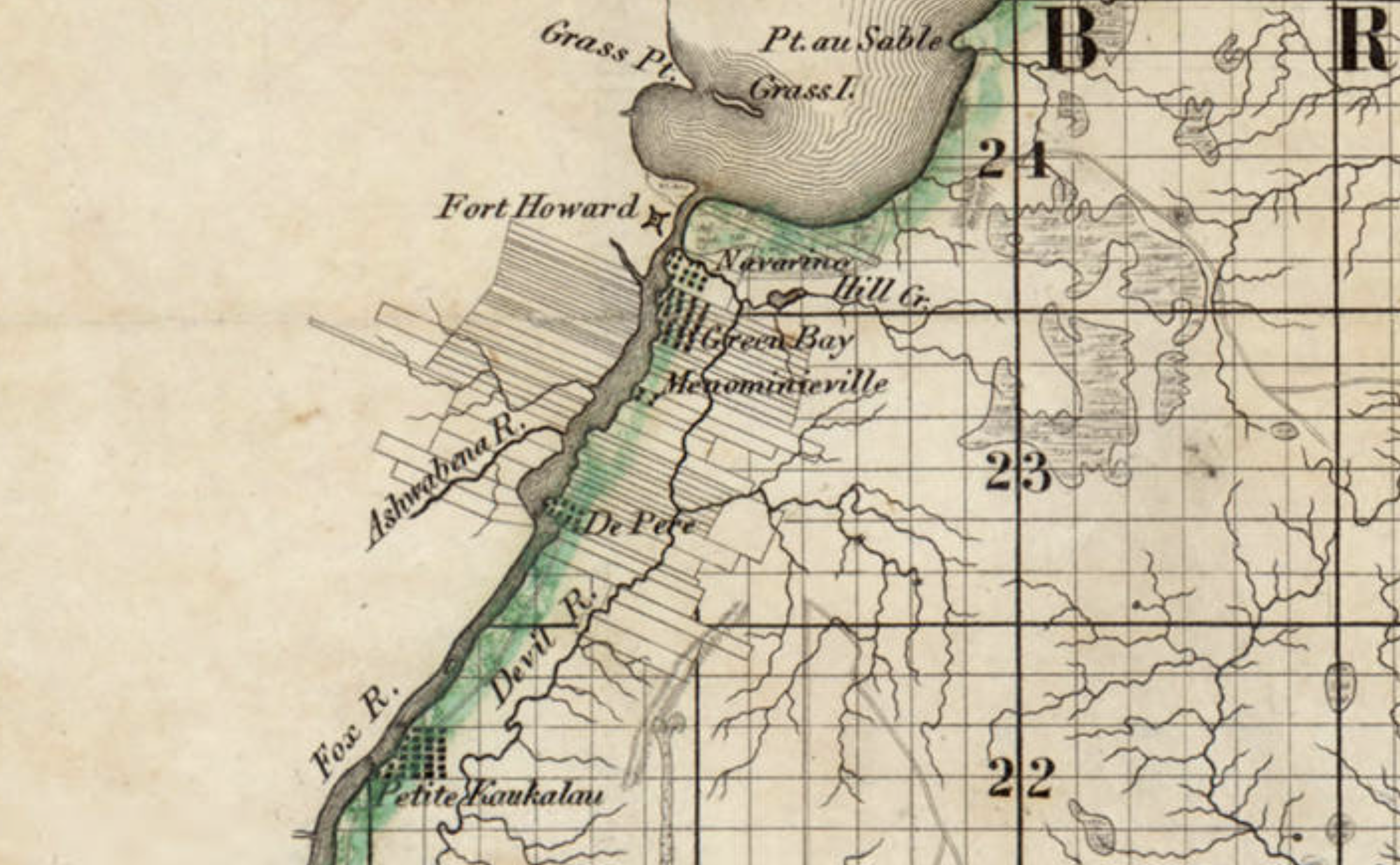
On Wednesday, as the Sun was slowly sinking to its repose in cloud of the most gorgeous and variegated colors, we arrived at the extremity of Green Bay, and about two miles up the Fox river, we landed at Navarino,2 receiving as we passed a salute from Fort Howard, on the opposite side of the river.

Detail, Topographical map of Wisconsin Territory / compiled from the Public Surveys on file in the Surveyor General’s office … by Samuel Morrison, Elisha Dwelle [and] Joshua Hathaway, 1837. American Geographical Society Library Digital Map Collection, University of Wisconsin–Milwaukee. Click the detail map to open a larger version in a new window. Click here for a link to the complete map at UW-M and its bibliographic information.

This map detail—showing Fort Howard, Navarino and, at the top, the southern end of Green Bay— is from the Topographical map of Wisconsin Territory, published in 1837 and the subject of a Monday: Map Day! post in December, 2020. As a reminder, this 1837 map shows all the lands officially surveyed by the federal government up to the time of publication. In 1837, the territory to the north and west of the Fox and Wisconsin rivers was still reserved for Wisconsin’s Native Americans, so the lands to the north and west of the Fox River are left (mostly) blank on this official map. But this land was not at all “empty.” The Indians, the forests, the wildlife, some of the old Métis and Anglo-American settlers—and the army—were all on the left bank of the Fox River in 1837, as they were in 1834, when the steamboat Michigan and its passengers arrived in Green Bay.

Continue reading

A family photograph! Jennie Clark Morrison, 1882

Big News! I’ve found a photograph of Jonathan M. and Mary (Turck) Clark’s eighth and final child, Jennie Marietta Clark, at the age of about 25 years old. This is one of only a handful of photos we have of any members of Jonathan and Mary Clark’s family and (to the best of my knowledge) the first image we have of Jennie:

Jennie Clark Morrison (“Mrs. F. S. Morrison”), detail from “Class of 1882, University of Michigan School of Dentistry; UM_DDS_1882.” Public domain, courtesy of University of Michigan Bentley Historical Library, University of Michigan Library Digital Collections. Accessed: September 15, 2021. Click to open larger image in new window.

Dental College, Class of 1882

Our portrait of Jennie is a detail taken from this composite portrait of the University of Michigan’s School of Dentistry, Class of 1882:

Continue reading

A Dental Divertimento…

UPDATED, September 17, 2021, to add a few details about the Morrison children, Jennie’s dental practice in the 1880s and ’90s, and the date of her divorce from second husband A. G. Widger.

Due to unforeseen circumstances, I won’t be blogging much this week. (Let’s just say that the cause of my hiatus has inspired today’s post, featuring a brief introduction to the life of the Clarks’ youngest child, Dr. Jennie M. Clark, D.D.S.)

Unknown photographer, [Dentist], daguerreotype with applied color, circa 1855. Smithsonian American Art Museum, Museum purchase from the Charles Isaacs Collection made possible in part by the Luisita L. and Franz H. Denghausen Endowment. CC0. si.edu. Click to open larger image in a new window.

Clark House dentists

I’m not sure who Mequon’s first dentist was, or when he set up shop. It’s entirely likely that the Jonathan Clark family did not visit a dentist until they moved to Milwaukee (and they still may not have seen a dentist once there). But Mequon’s Jonathan Clark House plays an important part in the lives of two Mequon/Milwaukee area dentists.

Continue reading

How’d they get here? Walking & riding

This is another installment in the transportation-themed series that began with our July 6, 2021, Monday: Map Day! – How’d they get here? and continues from there.

Queen, James Fuller, [A Man and a Woman Standing at the Entrance to a Trail Through a Forest] (detail), graphite drawing on cream paper, circa 1850-1870. Library of Congress

I’m still writing the next two (or three) longer, narrative installments of our “How’d they get here?” series, which I began working on to assist Clark House education director Margaret Bussone and our education team as they develop a transportation-themed project for use at the Jonathan Clark House later this summer.

For quite a while I was worried that I would not be able to find enough visual material to adequately illustrate our early Mequon immigrants’ journeys of the 1830s and ’40s. It turns out that I now have a lot of material to share with the education team—and with you. Rather than hold on to it until my longer posts are complete, I thought I’d do something different today.

Continue reading