Alfred Bonniwell documents – part 2: New York

Today’s post continues our series about the life of Alfred Bonniwell, youngest son of Mequon’s Bonniwell family, and brother-in-law of Jonathan and Mary (Turck) Clark. If you missed them, our first installments are herehere and here.
UPDATED, February 2, 2022, to include additional information and a link to an earlier post about Bonniwell brother-in-law Philip Moss.
UPDATED, May 22, 2022, to correct Charles Bonniwell’s birth year (should be 1806)

Following their father’s death and burial in Montréal, Lower Canada, on October 18, 1832, the Bonniwell family was at a crossroads. Their original plan to patent land in Lower Canada had to be abandoned. As eldest son Charles Bonniwell recalled;

[…] the family received letters from the brothers who had located in New York [George and William] to come there without delay, and so [we] lost no time in taking the trip by way of Lake Champlain and Whitehall. I went to work in New York [City] where my brothers had employment at the navy yard.1

Whitehall, New York state’s port of entry at the south end of Lake Champlain, was an important waypoint for the Bonniwells, as it would also be for Jonathan M. Clark and other future Mequon neighbors. For more on that, including a handsome lithograph of Whitehall as it appeared c. 1828-1829, see How’d they get here? – JMC, the Bonniwells, and Whitehall, NY

As it turns out, Charles Bonniwell’s statement, “[we] lost no time in taking the trip by way of Lake Champlain and Whitehall,” may be a bit of a generalization. While I have not had a chance to collect or examine copies of the actual naturalization documents for all the Bonniwell boys, the modern index cards for those papers indicate that at the time of father William T. B. Bonniwell’s death the family was already dispersed at several locations. They would eventually reunite and migrate to Wisconsin Territory in 1839.

Where’s Alfred?

Many aspects of the lives of the Bonniwell family in New York are not well documented, including the activities of young Alfred T. Bonniwell. Alfred was only six and a half years old when his father died in Montréal in October, 1832. According to his naturalization papers (filed in Milwaukee on April 6, 1849, and summarized on this modern index card), we know Alfred entered the United States at Whitehall, New York, sometime in November, 1832.
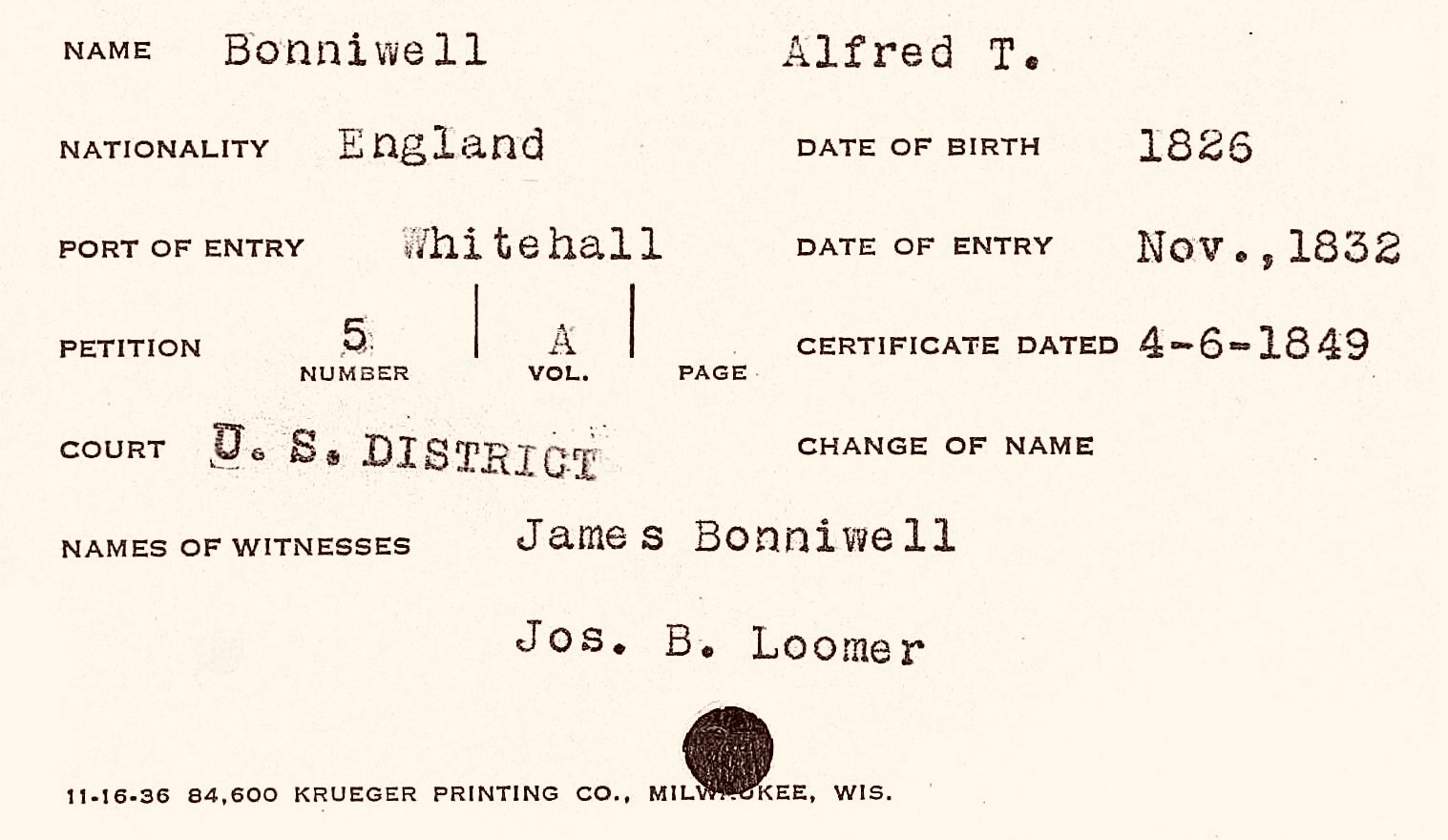
This index card—and Alfred’s 1849 final citizenship document that it summarizes—are the only two official records that I have located that document Alfred’s years in New York state. Without some of the Bonniwell family papers cited in The Bonniwells, and the newspaper articles featuring Charles’s recollections, much of Alfred’s—and his family’s—life from 1832 to 1839 would be a complete mystery.

Based on brother Charles’s recollections, and other documents we have, we can assume that when Alfred came to the U.S. he was accompanied by his mother and several of his siblings, including brothers Charles (27), James (21), and Walter (age 8), and sister Eleanor (18). But not brother Henry (age about 14); more on Henry’s wanderings, below. But my understanding of which Bonniwell migrated via which port, to which destination, and what they did after arrival, is not completely clear. In fact, the family did not all travel together from Montréal to New York, via Whitehall, in November, 1832. Let’s look at the documents for more information…

Continue reading
What did you do on Sunday?

Updated Feb. 14, 2022 to add the qualifier “English-speaking” to the second paragraph.

Did you watch the Big Game? Go out to eat? Maybe you had to put in a shift at work? Or did you just take a break and relax at home, gearing up for another week on the job? Perhaps you went to church on Sunday.

In Jonathan and Mary Clark’s era, many of their Mequon neighbors would honor the Sabbath by refraining from all work and worshiping privately at home with their families, or gathering with small groups of neighbors to pray and hear the Word. Beginning in the early-1840s, the English-speaking Protestant Christians living near the Clark House—including many members of the Clark, Bonniwell and Turck families—gathered at the new, one-room, Bonniwell School to worship together at Sunday services; these were often led by their neighbor, the farmer and evangelical Methodist preacher Rev. James W. Woodworth.

Rev. Woodworth has concerns…

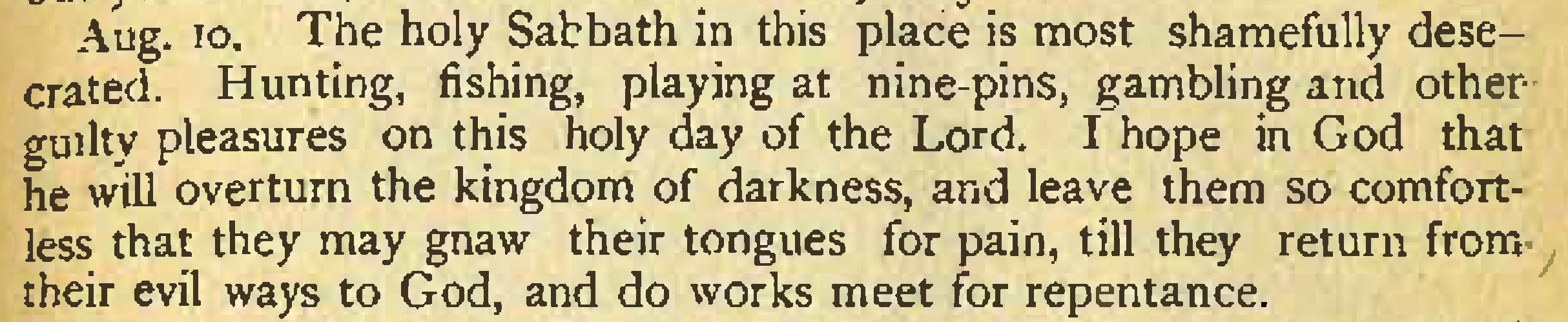
We have talked about Rev. Woodworth previously and, as we have seen before, he was constantly concerned about the state of his neighbors’ souls. It seems that even though the nation was still riding the wave of several decades of the religious revival now known as the Second Great Awakening, the settlers of the young Wisconsin territory and state were not always very good at “keeping the Sabbath holy.” In his diary entry for August 10, 1855, the reverend lamented:

Aug. 10. The holy Sabbath in this place is most shamefully dese­crated. Hunting, fishing, playing at nine-pins, gambling and other guilty pleasures on this holy day of the Lord. I hope in God that­ he will overturn the kingdom of darkness, and leave them so comfort­less that they may gnaw their tongues for pain, till they return from- their evil ways to God, and do works meet for repentance.

Woodworth, James W., My path and the way the Lord led me, Milwaukee, 1878, p. 79.

Continue reading

Veterans Day, 2021

Veterans Day is today. I’m preparing a new post on one of our Clark House veterans, Mary (Turck) Clark’s youngest sibling, Benjamin Turck (1839-1926), but it’s not quite ready yet. For a wider perspective on the day—and our early Mequon veterans—here’s a post originally published at Clark House Historian on November 11, 2016, and revised, expanded and republished on November 11, 2020. I’ve also incorporated a list of Mequon’s Civil War soldiers, originally published here on May 24, 2020.

Armistice Day

One hundred and three years ago, on the eleventh day, of the eleventh month, at the eleventh hour—Paris time—the Armistice of Compiègne took effect, officially ending the fighting on the Western Front and marking the end of World War I, the optimistically named “War to End All Wars.”

In the United States, the commemoration of the war dead and the Allied victory began in 1919 as Armistice Day, by proclamation of President Woodrow Wilson. Congress created Armistice Day as a legal holiday in 1938. Starting in 1945, a World War II veteran named Raymond Weeks proposed that the commemorations of November 11 be expanded to celebrate all veterans, living and dead. In 1954 Congress and President Eisenhower made that idea official, and this is what we commemorate today. There are many veterans with a connection to the Jonathan Clark house. We honor a few of them in this post.

Jonathan Clark, Henry Clark, and the U.S. Army

Jonathan M. Clark (1812-1857) enlisted as a Private in Company K, Fifth Regiment of the U. S. Army, and served at Ft. Howard, Michigan (later Wisconsin) Territory, from 1833 until mustering out, as Sargent Jonathan M. Clark, in 1836. In the 1830s, Fort Howard was on the nation’s northwestern frontier. JMC’s Co. K spent much of the summers of 1835 and 1836 cutting the military road across Wisconsin, from Ft. Howard toward Ft. Winnebago, near modern Portage, Wisconsin.

Fort Howard, Wisconsin Territory, circa 1855, from Marryat, Frederick, and State Historical Society Of Wisconsin. “An English officer’s description of Wisconsin in 1837.” Madison: Democrat Printing Company, State Printers, 1898. Library of Congress. Click to open larger image in new window.

Continue reading

Caroline gets married – but where?

May, 1861

In a recent post, Caroline Clark – public school teacher, we examined Caroline Clark’s brief tenure as a teacher in the grammar department of Milwaukee’s Ninth Ward School, and concluded:

Caroline Clark’s employment as a Grammar Department teacher began on September 1, 1860. According to the 1861 Report, she taught for eight months. That would mean she left her teaching position around the beginning of May, 1861. Why? One factor might have been her salary […] But the more likely reason for her departure from the Ninth Ward School was that on May 15, 1861, she married Milwaukee county farmer William Wallace Woodward. For much (all?) of the nineteenth century, it was customary for female school teachers to be single; once they married, they were expected to leave the profession and set up housekeeping with their new husband and, eventually, start a family of their own. I think it’s safe to assume that this is what happened to “Miss Caroline M. Clark” in May, 1861.

Finding Caroline’s marriage record

Long before I found Caroline’s 1893 biographical sketch, or her profile and interview in the Omaha Daily Bee (March 30, 1916, page 11), or read her several long obituaries, I was able to determine when—and whom—she married. How? By using the Wisconsin Historical Society’s invaluable—but not infallible—Pre-1907 Vital Records Database (Birth, Marriage, Death). Yes, the interface is a bit clunky, but if you search for “Clark, Caroline,” one of the results you’ll find is:

Seems plausible, right? But how do we know it’s “our” Caroline? And how do we match her with a spouse?

Continue reading

Caroline Clark – from student to teacher

We’re looking into the life of Jonathan M. and Mary (Turck) Clark’s first child, Caroline Clark. If you need to catch up, you might start with some pivotal dates and events in the lives of Caroline and her Clark family in:

Then check out these previous posts in our current Caroline (Clark) Woodward series:

The biographical materials we looked at in those posts were a good introduction to Caroline’s life (through 1893), but lacked some key information about her youth, and especially her transition from a scholastic “prodigy” in rural Mequon to—supposedly—a teacher in Milwaukee’s public schools. And in order to examine her time as a Milwaukee public school student and teacher, we had to take a deep dive into the life and work of her esteemed high school principal, Caroline Clark’s mentor, John G. McKindley.

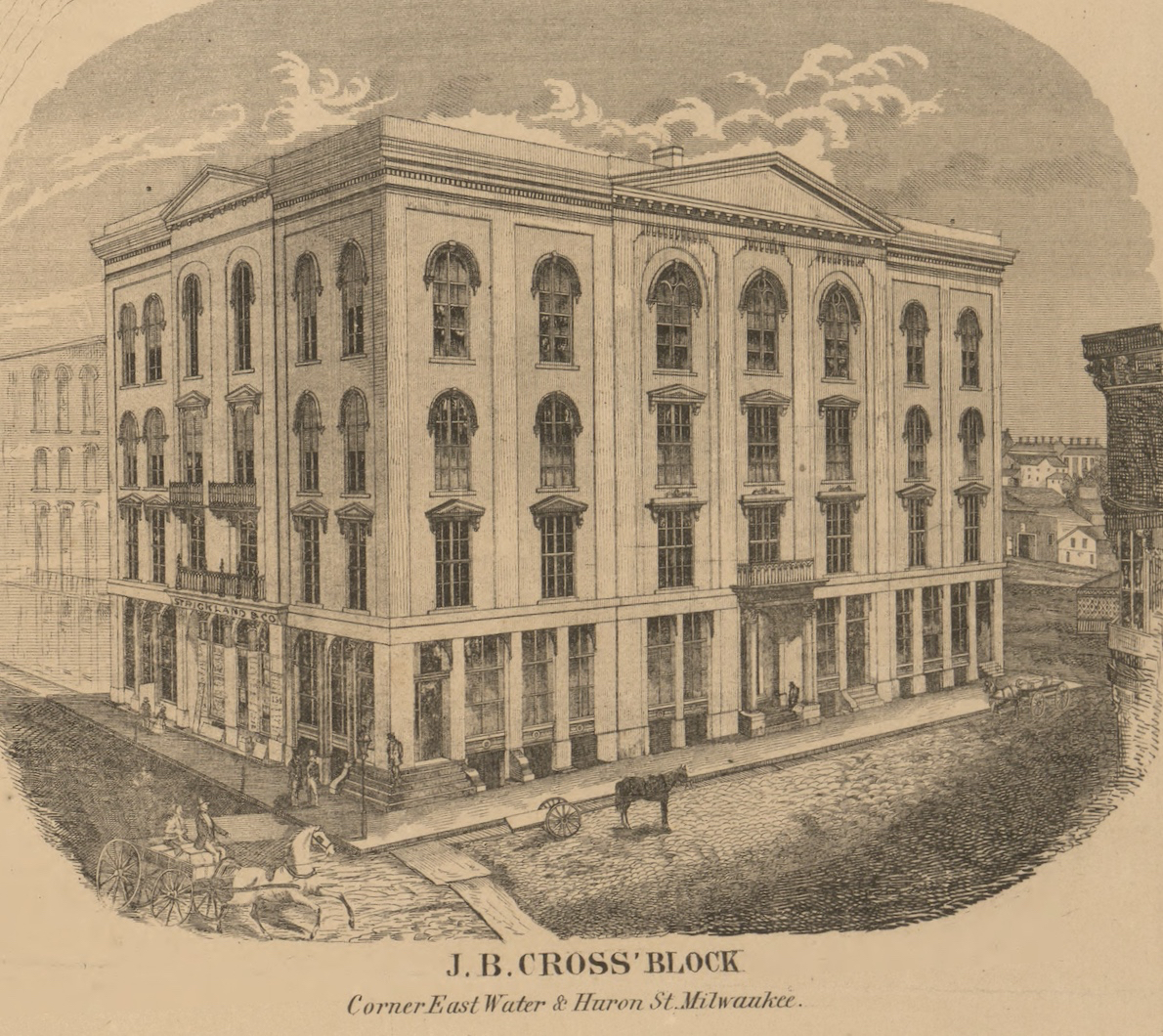
Walling, Henry Francis. Map of the county of Milwaukee, Wisconsin. New York: M.H. Tyler, 1858, Library of Congress, (inset showing Cross’ Block).

View of Cross’ Block circa 1858, home of the Milwaukee School Board until destroyed by fire on December 30, 1860.1, 2

Continue reading

Caroline Clark’s mentor, John G. McKindley

In today’s post, we continue our examination of the life and work of Jonathan M. and Mary (Turck) Clark’s oldest child, Caroline Mary (Clark) Woodward (1840-1924). In our earlier post, Caroline M. (Clark) Woodward: a closer look at that 1893 biography, we came across this passage:

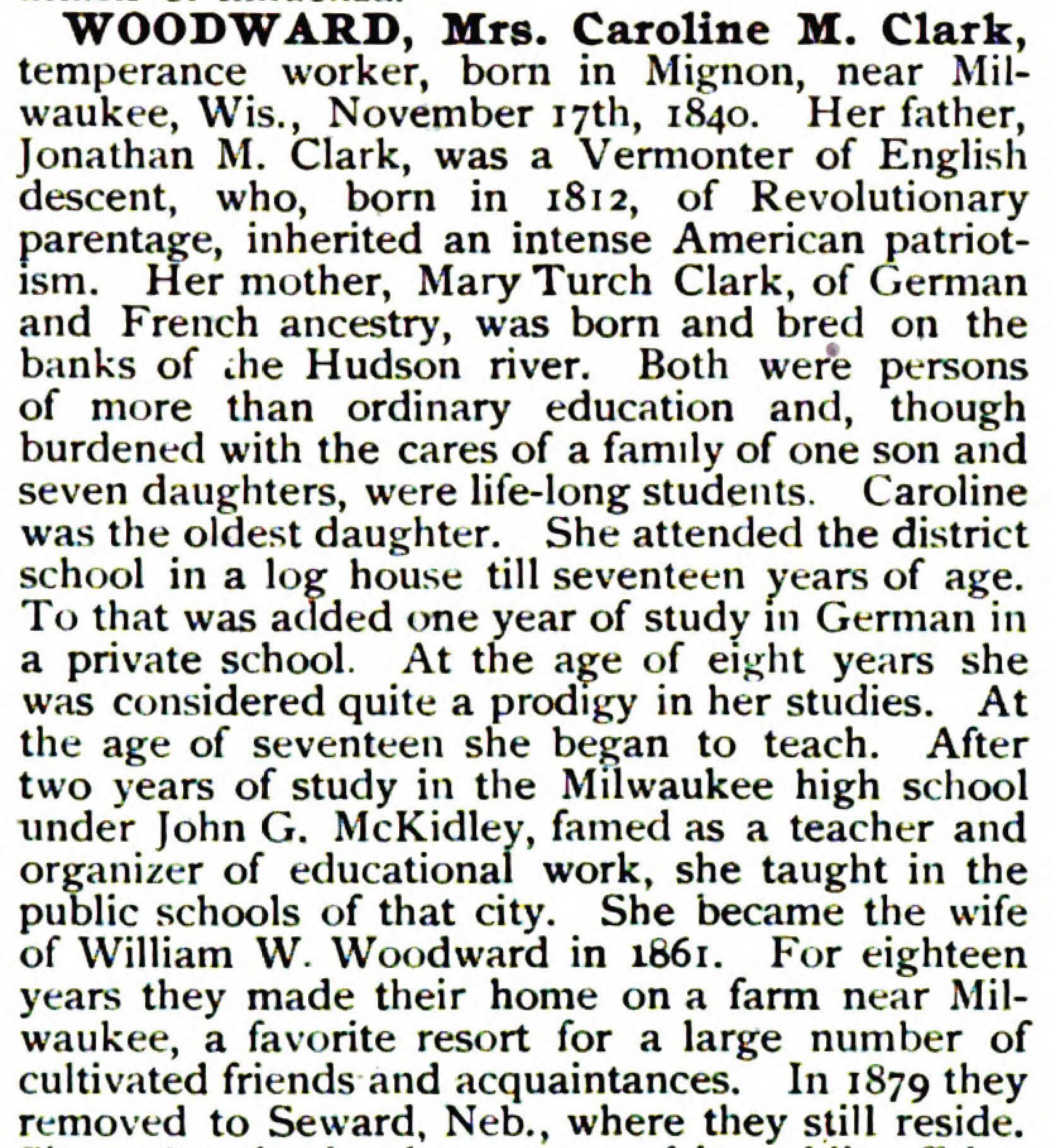
Caroline was the oldest daughter. She attended the district school in a log house till seventeen years of age. To that was added one year of study in German in a private school. At the age of eight years she was considered quite a prodigy in her studies. At the age of seventeen she began to teach. After two years of study in the Milwaukee high school under John G. McKidley [sic, McKindley], famed as a teacher and organizer of educational work, she taught in the public schools of that city.

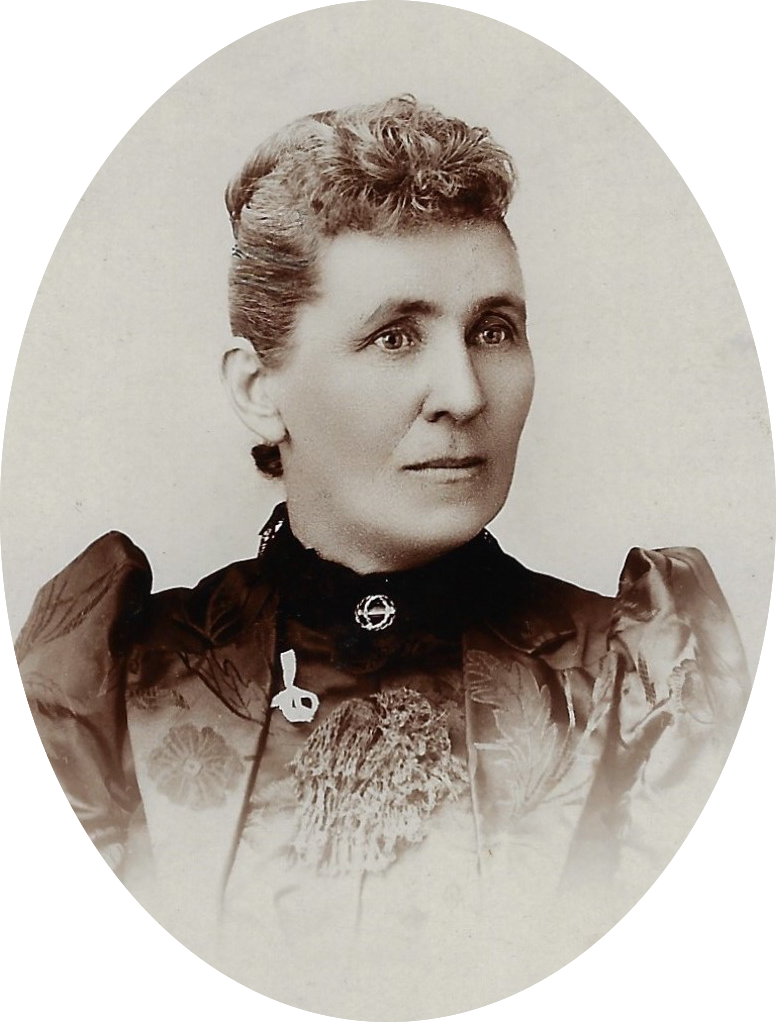
Photo of Caroline M. (Clark) Woodward courtesy of Frances Willard House Museum & WCTU Archives, Evanston, Illinois. Text: Willard, Frances E., and Mary A. Livermore, editors. A woman of the century ; fourteen hundred-seventy biographical sketches […], Buffalo, 1873, page 779.

Think back…

Imagine this: You are now more than 50-years-old. You have achieved statewide and national prominence as an organizer for the largest women’s social and political organization of the 19th-century. You and your spouse manage a family farm, continue to raise your several adopted and foster children, and you have a successful business of your own, selling insurance. And when you are asked to provide the details of your life for inclusion in a major biographical dictionary of leading American women, you make sure to include, by name…one of your high school teachers?

That’s exactly what Caroline (Clark) Woodward did in 1893, when she highlighted her two years of study with John G. McKindley at the Milwaukee public high school. And that prompts a few questions: who was J. G. McKindley? why is he cited in Caroline’s 1893 biography? when would he have worked with Caroline? was he really “famed as a teacher and organizer of educational work”? and how big a deal was “high school” in Wisconsin in the 1850s and ’60s, anyway?

Continue reading

Caroline M. (Clark) Woodward: a closer look at that 1893 biography

Today, as we continue to explore the life of Jonathan M. and Mary (Turck) Clark’s eldest child, Caroline Mary Clark—later usually known as Mrs. C. M. Woodward—we’ll take a fact-by-fact look at the biographical sketch of Caroline that was published in 1893, re-printed unchanged in 1897, then abridged and reprinted in 1912. For a full discussion of these three publications, see last Monday’s Caroline M. (Clark) Woodward: first steps toward a biography.

Willard, Frances E., and Mary A. Livermore. 1893. A woman of the century ; fourteen hundred-seventy biographical sketches accompanied by portraits of leading American women in all walks of life ; ed. by Frances E. Willard and Mary A. Livermore, assisted by a corps of able contributors, title page and page 779.

Today’s post will be less of a fully-formed essay, and more of a running analysis, commentary, and proof-reading of this 1893 biographical sketch. We’ll take one portion at at time, starting at the beginning. The source text will be presented as a shaded quotation, followed by my commentary and corrections in simple black text on white background, with highlighted links to additional sources and explanations and, of course, a few footnotes, too. Here we go…

Continue reading

A Bonniwell Bonus: Views of Ramsgate and Chatham, England

UPDATED, Oct. 4, 2021, with a few minor edits and to add an additional footnote.

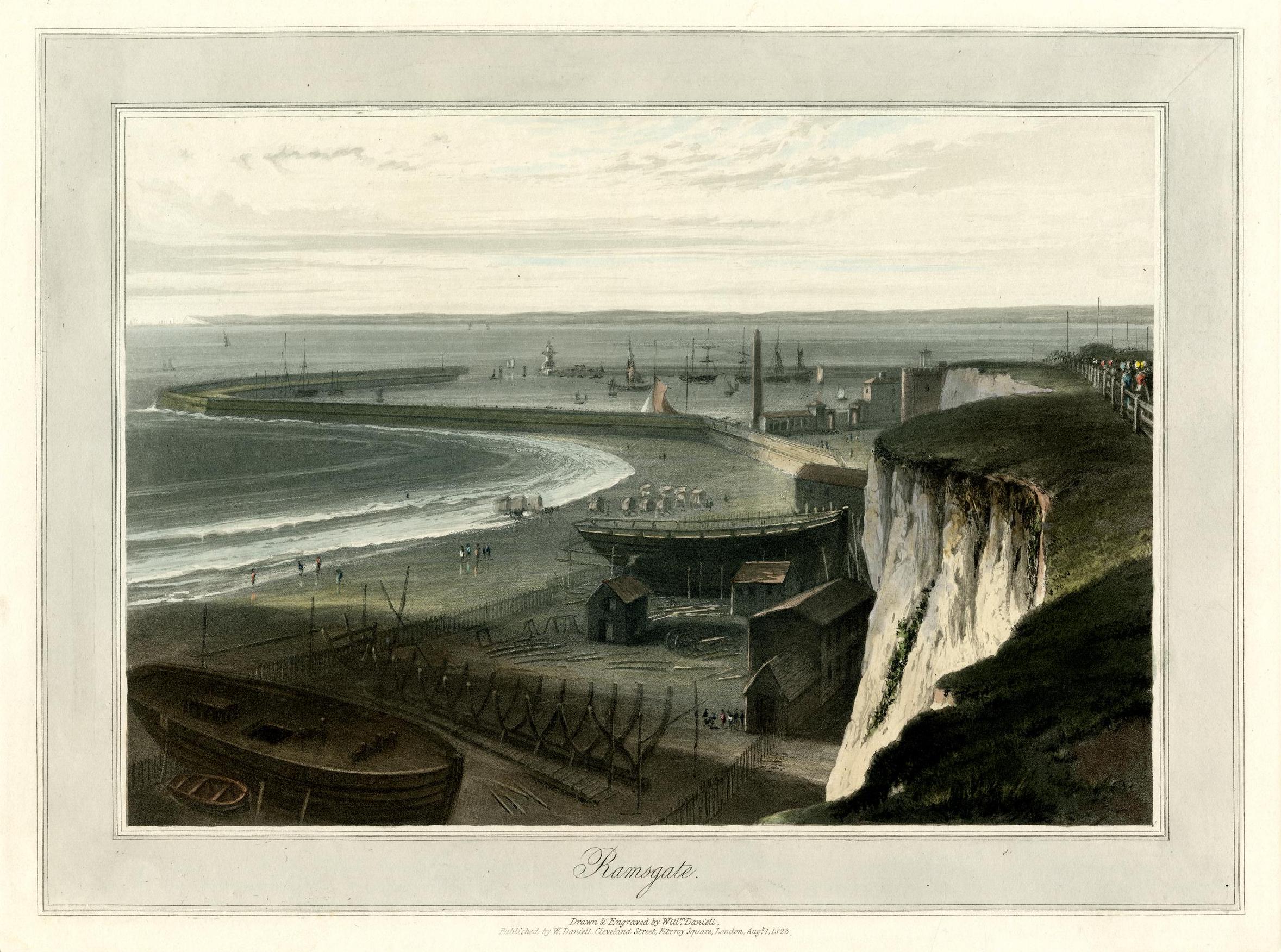
I’m still working on some longer posts; they should be ready soon. Meanwhile, I thought you might enjoy two lovely images, beginning with this nineteenth-century print, a view that would have been very familiar to a surprising number of our early Mequon immigrants:

Continue reading

River walk

There was still some daylight left after the annual “Pie on the Patio” event at the Clark House last week, so I thought I’d stop by Mequon’s historic Isham Day House on my way home. Isham Day was one of Mequon’s first settlers, and he built his tidy home, sometimes known as the “Yankee Settler’s Cottage,” in 1839. It’s a town landmark, and I’d never been to see it.

While enjoying my first look at the Day House, I also took the opportunity to meander through the adjacent Settlers Park. It’s a beautiful little park, with an accessible boardwalk that leads down to and along the west bank of the Milwaukee River. It’s a short, easy stroll; I highly recommend it. By the time you reach the riverbank you’ll forget you are in a busy 21st-century downtown.

Photo credit: Anna Perkins, 2021. Click any photo to open gallery and access larger versions of the images.

Continue reading

Monday: Map Day! – How’d they get here?

UPDATED, February 11, 2024, to include a revised version of the annotated detail map of Ouisconsin, 1836. But for the full update—with additional notes and corrections—please see the most recent version of our discussion the Ouisconsin map of 1836 on our post of February 12, 2024.
UPDATED, July 6, 2021, to answer a reader’s question: “Where was Jonathan Clark just before he went to Fort Howard?” Scroll down to Comments for the answer.

How the early settlers came to Mequon, c. 1835-1850 (part 1)

Clark House education director Margaret Bussone and our education team are putting together a project centered on how our Mequon pioneers traveled to southeast Wisconsin in the early days of white settlement, between roughly 1835 and 1850. I thought I’d help out by gathering some relevant materials and sharing them with the education team—and you—here on the blog.1

So this week we’re going to look at how the settlers found their way here, and how they traveled on land, lake, or river. Rather than writing lots of words about each map or image, I’d like to gather a whole bunch of useful items in each post and put them out there as resources for all to use. Later in the week, we’ll look at various modes of travel on land and on water. Today we’ll look at some maps.2 Some of these maps were readily available to our would-be immigrants, others might have been one-of-a-kind or otherwise hard to obtain.

An overview, The U.S. in 1834

When the following map was published in 1834, Jonathan M. Clark was finishing the first year of his three-year enlistment in the U.S. army. He was stationed at Ft. Howard, on the Green Bay of Lake Michigan, in what was then the civil District of Huron, a soon-to-be-outdated term for the western portion of the Michigan Territory.3

Mequon’s earliest settlers would be coming to lands that were poorly mapped and little understood by most European-Americans. The most this map could show—in a very general way—is where the “open” areas were for future migration and settlement.

Norris, William, and Daniel K Minor. Map of the railroads and canals, finished, unfinished, and in contemplation, in the United States. New York: Railroad Journal, 1834. Map. Library of Congress. Click to open larger map in new window.

Continue reading