Meet the neighbors: the Loomis family

I’m in the middle of several larger CHH research projects and I find myself swamped with information on early Mequon area pioneers. So rather than wait until I’ve got it all sorted out and then organize it into a big essay or two (or more!), I’ll be putting up some of these new bits and pieces on the blog as I find them.

Today’s subjects are the families of Jonathan Loomis (1776-1849) and his eldest child, Issac Chester Loomis (1802-1882), two of old Washington/Ozaukee county’s first white settler families. I’ve mentioned some of these folks in previous CHH posts. And while the Loomis name does appear in some of the early county histories and land records, so far I’d not been able to learn much about the family or how they came to the Wisconsin Territory in the 1830s. In fact, given that the mid-1800s penmanship on some of the source documents was often florid to the point of being unreadable, I was sometimes unsure whether documents discussing or signed by “J. Loomis” versus “I. Loomis” represented the same man, or two individuals. Today’s source goes a long way toward solving these questions.1

Descendants of Joseph Loomis in America

Loomis, Elias, and Charles Arthur Hoppin. Descendants of Joseph Loomis in America, and his antecedents in the old world. edited by Loomis, Elisha S [Berea? O, 1909], Library of Congress.

As luck would have it, I just ran across a useful digitized book in the collection of the Library of Congress, titled Descendants of Joseph Loomis in America, and his antecedents in the old world. I’m not an expert in Loomis genealogy, and thus not entirely sure how accurate this book is, but what I have read here mostly checks out when compared to what I have found elsewhere. With that said, below are the key bits of the book that are related to very early Washington/Ozaukee county history and, in particular, Isaac Chester Loomis and his family. What follows is taken verbatim from pages 193 and 390-391, though I’ve taken the liberty of expanding many of the abbreviations and adding a few paragraph breaks for ease of reading. I’ve also added a few footnotes to explain some possibly obscure references.

Let’s begin with the patriarch of the family, Jonathan Loomis…

Continue reading

Old Washington/Ozaukee county’s first postmasters, 1837-1844

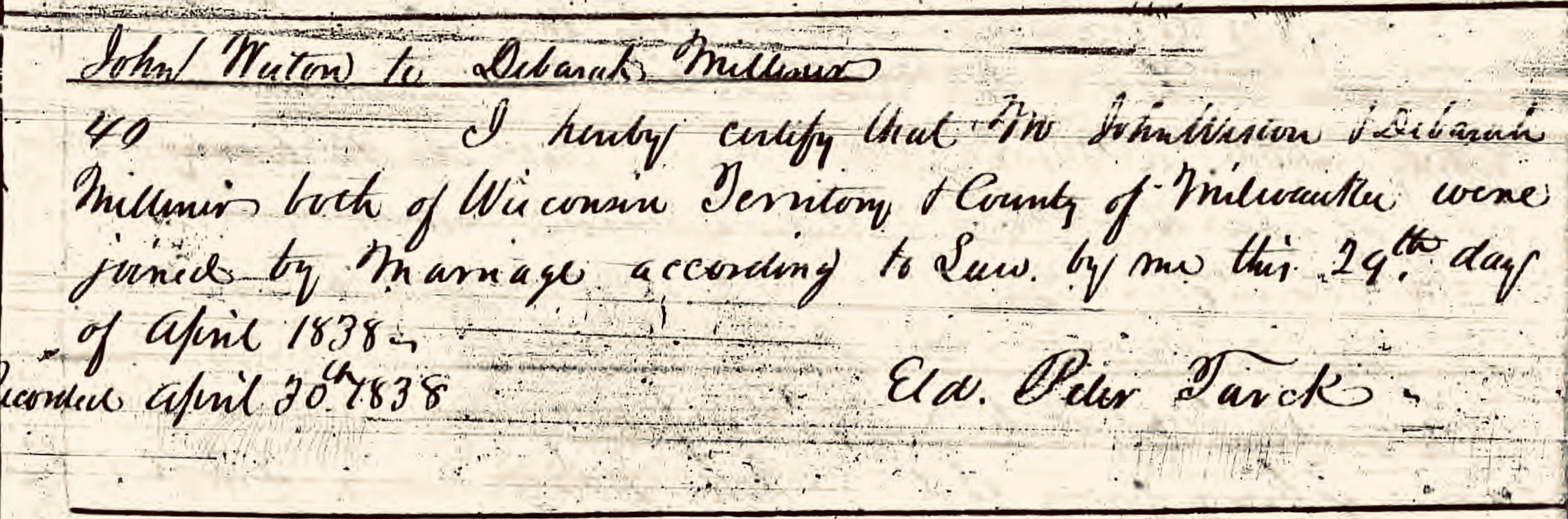
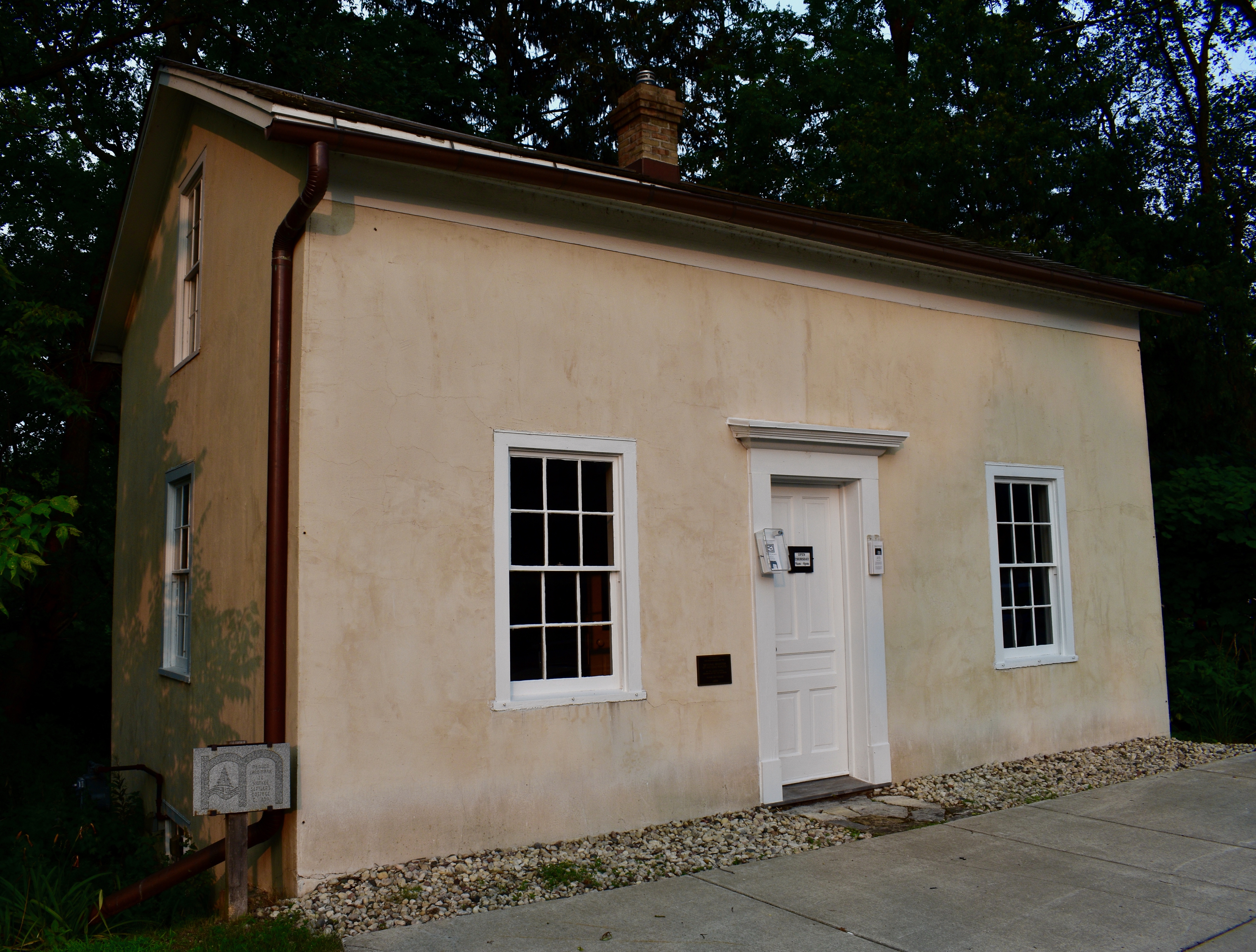
I’m working on a subject suggested by my friends Sam Cutler and Bob Blazich from the Mequon-Thiensville Historical Society. Among other projects over the last few decades, they and their colleagues at the MTHS have restored what is believed to be Ozaukee county’s oldest building on its original foundation, the historic Isham Day house, and developed its interior into the Mequon River Postal Museum. Now my friends at the MTHS want to know more about the life of Mequon River Post Office’s original postmaster, one of Mequon’s very first pioneer settlers, John Weston.

Isham Day house, exterior, west front. Photo credit: Anna Perkins, 2021

So for the last several weeks I’ve been doing a great deal of behind-the-scenes reading and re-reading of primary and secondary sources, as well as a lot of searching for additional relevant documents, including early Milwaukee and Washington/Ozaukee county deeds and other land records. In the process, I’m learning a lot about John Weston, Isham Day, Henry Thien, and some of our other first white settlers. But I’m not quite ready to write a John Weston profile, and I still need to clear up some mysteries about Isham Day’s land and house, too.

First Postmaster(s)

New post office…at Mequan River…John Weston appointed postmaster, Milwaukee Advertiser, Oct. 10, 1840, page 2

Let’s get our bearings by making an accurate list of the county’s first postmasters and their terms of office. Our source is from the National Archives in Washington, DC, the Record of Appointment of Postmasters, 1832-Sept. 30, 1971; Records of the Post Office Department; Record Group Number: 28; Series: M841; Roll Number: 144. County: Polk – Wood, Vol. 12B, circa 1832-1844, pages 794-795, currently available via Ancestry.com as U.S., Appointments of U. S. Postmasters, 1832-1971 [database on-line], 2010, image 428 of 583 (accessed 18 Jan 2024). Here’s the microfilmed image of the two-page ledger recording Washington county’s first post offices and postmasters, slightly retouched to make for easier reading:

Click the image for a higher-resolution view, and then read on for more details about old Washington/Ozaukee county’s first two post offices and their original postmasters.

Continue reading

CHH blog roundup, 2023

As the volunteer historian for the Jonathan Clark House Museum, it’s my privilege to investigate, document, and share with you the stories of the Clarks, their relatives, neighbors, friends, and try to bring to life the world in which they lived. Much of my work involves finding, studying and analyzing relevant documents and visual images, and much of that work happens “behind the scenes,” so to speak.

The Clark House Historian at work (note discarded drafts and as-yet unfinished projects).1

Each week (well, “each week” is the goal…) I share some of my findings with you on this blog. Now that the old year is gone, I thought it might be worthwhile to see what we accomplished at Clark House Historian in 2023. Let’s begin by taking a quick look at the numbers…

Continue reading

Veterans Day, 2023

Veterans Day is today. For a perspective on the day—and our early Mequon veterans—here’s a post originally published at Clark House Historian on November 11, 2016, and revised, expanded and republished several times since. For Veterans Day, 2023 I have added several new links and one new photograph.

Armistice Day

One hundred and five years ago, on the eleventh day, of the eleventh month, at the eleventh hour—Paris time—the Armistice of Compiègne took effect, officially ending the fighting on the Western Front and marking the end of World War I, the optimistically named “War to End All Wars.”

In the United States, the commemoration of the war dead and the Allied victory began in 1919 as Armistice Day, by proclamation of President Woodrow Wilson. Congress created Armistice Day as a legal holiday in 1938. Starting in 1945, a World War II veteran named Raymond Weeks proposed that the commemorations of November 11 be expanded to celebrate all veterans, living and dead. In 1954 Congress and President Eisenhower made that idea official, and this is what we commemorate today. There are many veterans with a connection to the Jonathan Clark house. We honor a few of them in this post.

Jonathan Clark, Henry Clark, and the U.S. Army

Jonathan M. Clark (1812-1857) enlisted as a Private in Company K, Fifth Regiment of the U. S. Army, and served at Ft. Howard, Michigan (later Wisconsin) Territory, from 1833 until mustering out, as Sargent Jonathan M. Clark, in 1836. In the 1830s, Fort Howard was on the nation’s northwestern frontier. Jonathan’s Co. K spent much of the summers of 1835 and 1836 cutting the military road across Wisconsin, from Ft. Howard toward Ft. Winnebago, near modern Portage, Wisconsin.

Fort Howard, Wisconsin Territory, circa 1855, from Marryat, Frederick, and State Historical Society Of Wisconsin. “An English officer’s description of Wisconsin in 1837.” Madison: Democrat Printing Company, State Printers, 1898. Library of Congress. Click to open larger image in new window.

Continue reading

Labor Day – a photo essay

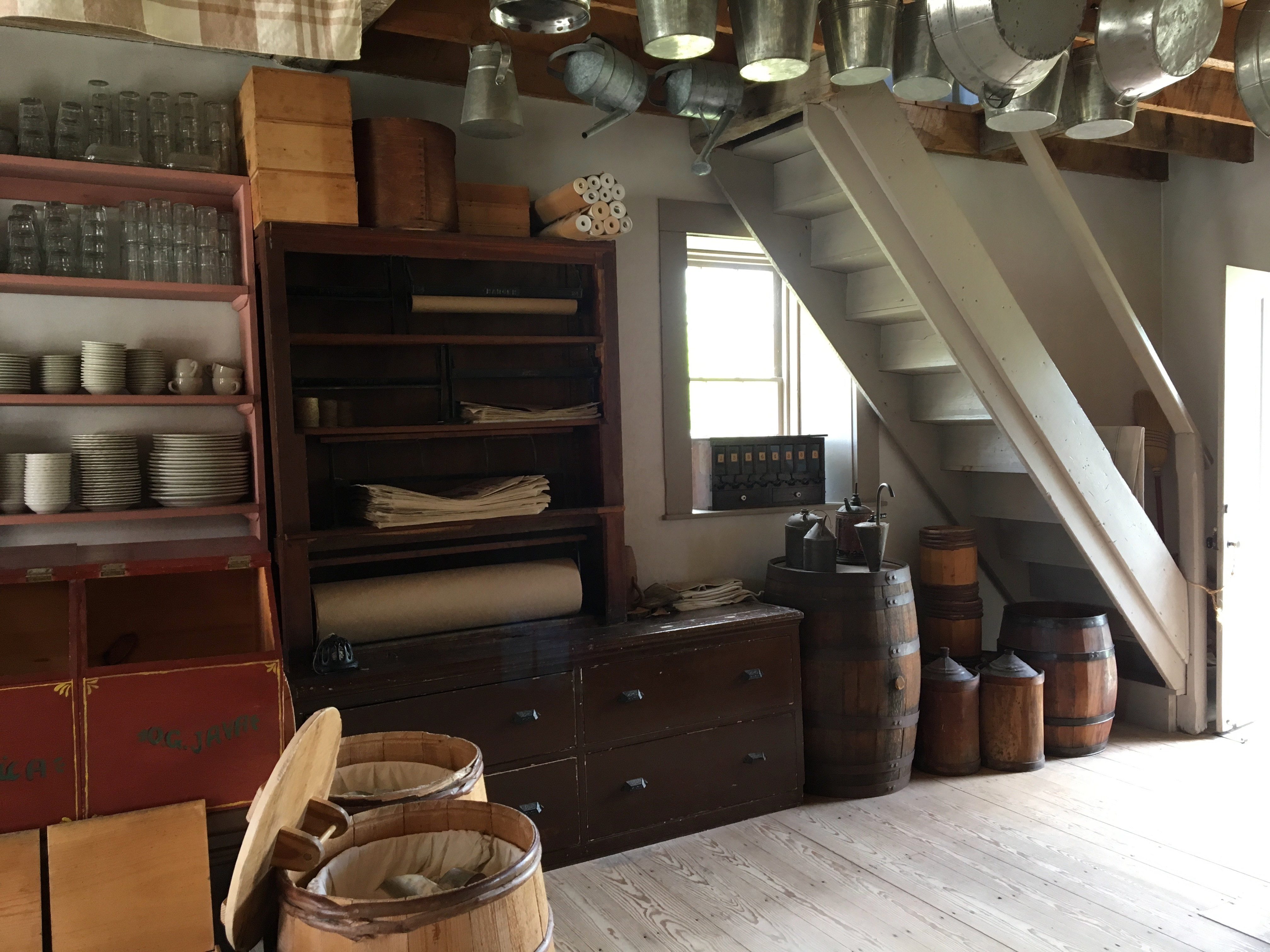
Even thought it’s Labor Day, the holiday celebrating the working men and women of our nation, I’ll be at work, back at our local mercantile establishment. You know, a store kind of like this one, stocked with just about anything you need for modern living:

I don’t have the day off, and won’t be marching in a parade, but I’d still like to honor the holiday and salute the American worker, past and present. With that in mind, let’s revisit some of the nineteenth-century occupations we’ve talked about previously at Clark House Historian, highlighting a few of the many skills, trades, and occupations common during the Clark House era.

Since it is a holiday, I’m not going to add much commentary today. Enjoy the photos, and click the links to visit the original CHH posts with lots more information about the different skills and jobs, and for full image credits.

Continue reading

Memorial Day, 2023

Lest We Forget

Our annual Memorial Day post, first published in 2020. Updated for 2023 with new information about Evander B. Bonniwell’s service.

Graves of Unknown Union Soldiers, Memphis National Cemetery, photo by Clayton B. Fraser, (Library of Congress), public domain. Memphis National Cemetery is the final resting place of Mequon’s Watson Peter Woodworth, and almost 14,000 of his Union Army comrades.

Today is the day our nation officially observes Memorial Day. For many Americans, Memorial Day represents “the first day of summer,” and is traditionally celebrated with trips to the lake, picnics, parades, and sales on cars, appliances, and other consumer goods.

But for many of us, Memorial Day remains rooted in its origins as Decoration Day. The first national observance was in 1868, when retired general John A. Logan, commander and chief of the Grand Army of the Republic—the Union veterans’ organization—issued his General Order Number 11, designating May 30 as a memorial day “for the purpose of strewing with flowers or otherwise decorating the graves of comrades who died in defense of their country during the late rebellion, and whose bodies now lie in almost every city, village, and hamlet churchyard in the land.”

On this Memorial Day, let’s take a moment to remember what this day truly represents.

Continue reading

The farm garden

It’s already the third week of May, 2023, and summertime will soon be here. At our southeastern Wisconsin home the first spring flowers are done, and the next round of blossoms have been blooming for a week or two. The peas are in the ground and already about 8 inches high, the rhubarb is big enough to cut and make one or two pies, and we harvested the first half-dozen radishes today. We still have to put in the tomato and pepper seedlings and start the big patch of green beans. So with gardening on my mind, I thought you might enjoy a slightly-belated repost of this annual favorite, which first appeared here in April, 2021. Cheers!

Planning the garden

It’s early April, and the growing season is not far off. For a farmer like Jonathan M. Clark, it’s a little early yet for plowing and sowing, but not too early to make plans and sharpen the tools. For a farmer’s wife, like Mary (Turck) Clark, it’s not too soon to think about the farm garden, its crops and layout.

I don’t know if Mary and Jonathan were regular readers of the popular and affordable farmers’ almanacs of their era; I wouldn’t be surprised if they were. There were many to chose from. Perhaps they had a copy of something like:

The Cultivator […], New Series, Vol. VII, Albany, 1850, title page. Click to open larger image in new window.

Continue reading

The Cooper

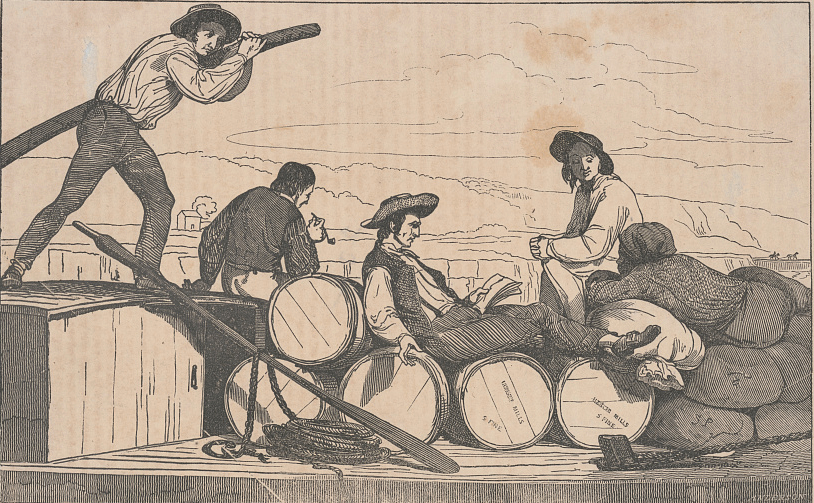
In the 1800s there were no corrugated cardboard boxes or padded shipping envelopes. If you needed to store or ship any liquid—and most dry goods—the barrel (and its larger and smaller cousins) was almost always your container of choice.

Anderson, Alexander, engraver. Five Men on a Flatboat With Barrels and Sacks; One Man Operates the Keel from Above the Boathouse, the Others Are Resting on the Freight, circa 1830-1860, Library of Congress.

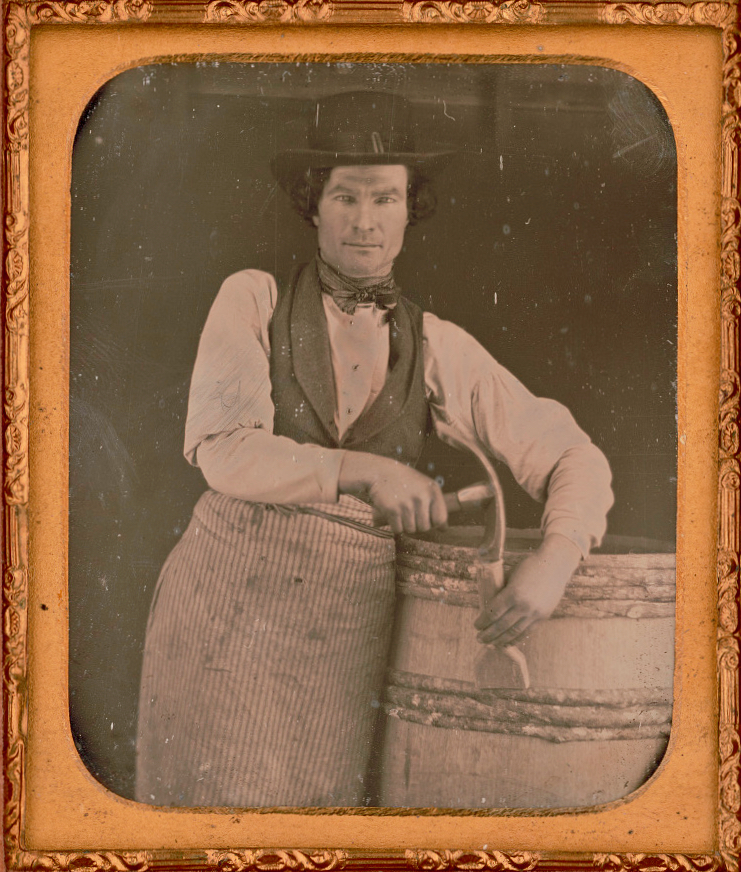
And when you needed a barrel, hogshead, keg, cask or firkin, or just an oaken bucket for your well, you would get it from a cooper.

Unknown photographer. Occupational Portrait of a Cooper, Three-Quarter Length, With Barrel and Tools, circa 1840-1860, Library of Congress.

Continue reading

Time flies!

[Editor], daguerreotype with added color highlights c.1855 (slightly cropped, and color adjusted), Smithsonian American Art Museum, Gift of Charles Isaacs, (link), Creative Commons CC0 license. Click to open larger image in new window.

Hey! It’s almost been a month since my last post. Sorry about that. I haven’t gone this long between posts in several years, I think, and now I’ve got (the digital equivalent of) a towering pile of half-written posts to finish and topics to discuss. That said, I have been busy…

Continue reading

1850 census: more neighbors “in Wisconsin”– while prospecting in California

Recently, we took a closer look at the 1850 census for old Washington county1 and noticed that six men from the neighboring Bonniwell families—men that we know from other records were actually half a continent away, prospecting for gold in California—were officially enumerated as members of their Wisconsin families in census schedules for Mequon and Grafton. In addition, we now know that those six Bonniwell men were not the only members of their expedition to be enumerated with the families they left behind in old Washington county.

Persons “whose usual place of abode…”

In the months since my original attempt to identify and list all the members of the Bonniwell 1849 and 1850 expeditions in Gold! – The Bonniwells go west…but when? and who?, I have been able to identify—with varying degrees of confidence—several other members of their California expeditions. I have more details to share about the lives of these men later, when time permits. For today, I’d like to briefly introduce each of them and make note of their presence on the 1850 census schedules for old Washington Co., Wisconsin, even though all were still seeking fortunes in California at the time they were enumerated.

Phineas Miller “P.M.” Johnson (1808-1876)

P. M. Johnson was, with William T. Bonniwell, one of the co-organizers of the Bonniwell 1849 and 1850 expeditions to the California gold region. We know that he was still in California in 1849-1850, but he was enumerated on lines 37-42, page 229a of the 1850 census for Grafton, Washington Co., Wisconsin with his wife, Orra Ann (Collins) Johnson and his four eldest children: Ransom W., Samuel C., William H., and George.2

The P.M Johnson family’s 1850 enumeration concludes on the reverse of this schedule, lines 1-4, page 229b, with the information for their youngest four offspring, Anna, Edwin, Julia, and four-month-old Harriet.

Continue reading