It’s been several weeks of seemingly endless organizing at my house. A useful and productive time, perhaps, spent sorting, reading, and filing paperwork, updating the household accounts, and getting ready to host our family’s Thanksgiving celebration. But not much time or energy for writing Clark House Historian posts. So in lieu of a new post, I thought you might enjoy an expanded reprise of this piece, first published here in March, 2022.
The need to sort, repair and organize is not limited to our era. I suspect the Clarks, Turcks, Bonniwells—and their neighbors—spent a good bit of time trying to catch up with their 19th-century chores, like this fellow, at work in his barn…
Guy, Seymour Joseph (1824–1910), Utilizing a Spare Moment, oil on canvas, c. 1860-1870. Yale UniversityArt Gallery, public domain (CC0 1.0). Click to open larger image in new window.
Today’s image is an original oil painting from about 1860-1870, by the American artist Seymour Joseph Guy (1824-1910). It comes to us courtesy of the Yale University Art Gallery. The Yale curators had this to say about the work:
Veterans Day is today. For a perspective on the day—and our early Mequon veterans—here’s a post originally published at Clark House Historian on November 11, 2016, and revised, expanded and republished several times since. These stories, by the way, are not the only stories of local veterans that I have collected. My recent research has discovered some amazing stories of German immigrant and Black American soldiers that fought for the Union—and Ozaukee county—as part of Wisconsin’s Civil War experience. And I still have much to learn about the Civil War service of Mary Clark’s brother, Benjamin Turck and the post-war travails of Persie Clark’s husband, the war-wounded U.S. Navy veteran and pensioner Henry D. Gardner. I hope to tell those stories here, at Clark House Historian, in the near future.
Armistice Day
One hundred and six years ago, on the eleventh day, of the eleventh month, at the eleventh hour—Paris time—the Armistice of Compiègne took effect, officially ending the fighting on the Western Front and marking the end of World War I, the optimistically named “War to End All Wars.”
In the United States, the commemoration of the war dead and the Allied victory began in 1919 as Armistice Day, by proclamation of President Woodrow Wilson. Congress created Armistice Day as a legal holiday in 1938. Starting in 1945, a World War II veteran named Raymond Weeks proposed that the commemorations of November 11 be expanded to celebrate all veterans, living and dead. In 1954 Congress and President Eisenhower made that idea official, and this is what we commemorate today. There are many veterans with a connection to the Jonathan Clark house. We honor a few of them in this post.
Jonathan Clark, Henry Clark, and the U.S. Army
Jonathan M. Clark (1812-1857) enlisted as a Private in Company K, Fifth Regiment of the U. S. Army, and served at Ft. Howard, Michigan (later Wisconsin) Territory, from 1833 until mustering out, as Sargent Jonathan M. Clark, in 1836. In the 1830s, Fort Howard was on the nation’s northwestern frontier. Jonathan’s Co. K spent much of the summers of 1835 and 1836 cutting the military road across Wisconsin, from Ft. Howard toward Ft. Winnebago, near modern Portage, Wisconsin.
Fort Howard, Wisconsin Territory, circa 1855, from Marryat, Frederick, and State Historical Society Of Wisconsin. “An English officer’s description of Wisconsin in 1837.” Madison: Democrat Printing Company, State Printers, 1898. Library of Congress. Click to open larger image in new window.
Join us at the Cedarburg History Museum this Saturday!
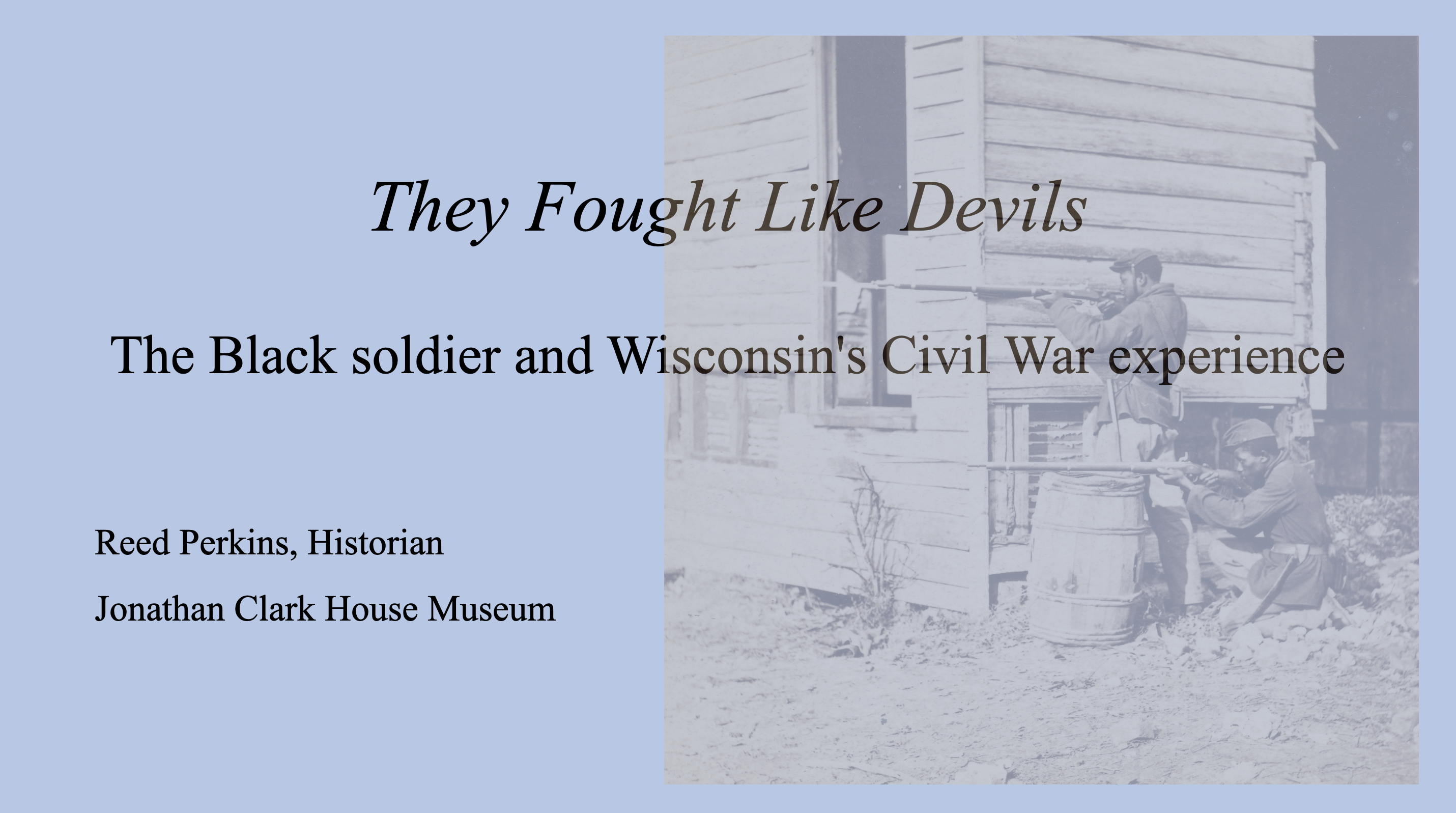
Just a reminder: I’ve been asked back to the Cedarburg History Museum to give another talk in their 2024 Civil War lecture series. My topic will be “They Fought Like Devils” – the Black soldier and Wisconsin’s Civil War experience , a multi-faceted subject that is often overlooked when discussing Wisconsin’s part in the Civil War. All are invited to the presentation at 6:00 p.m., Saturday, September 28. Seating is limited, so to attend my talk—or any of the CHM free lectures—don’t forget to RSVP to museum director Joel Willems at 262-377-5856 or joel@cedarburghm.org to reserve a place.
Today is Labor Day, the holiday celebrating the working men and women of our nation, and I thought I’d commemorate the day with a lightly-revised re-post of this piece from 2023.
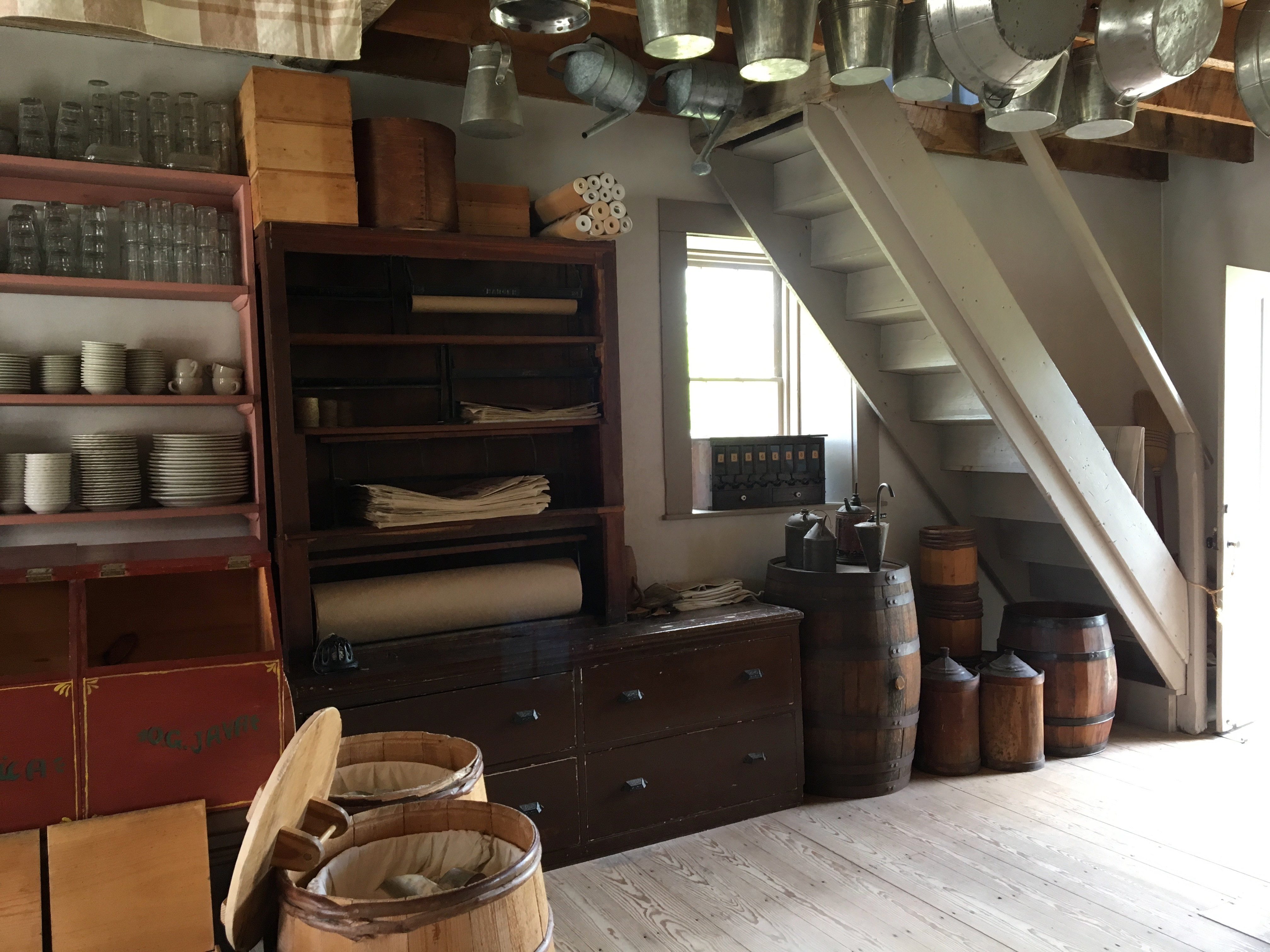
This Labor Day, I’ll be at home, working on my upcoming lectures for the state DAR and the Cedarburg History Museum. Last year, I had to work at our local mercantile establishment. You know, a store kind of like this one, only much bigger, stocked with just about anything you need for modern living:
I don’t really have the day “off” today—too much writing to do—and won’t be marching in a parade, but I’d still like to honor the holiday and salute the American worker, past and present. With that in mind, let’s revisit some of the nineteenth-century occupations we’ve talked about previously at Clark House Historian, highlighting a few of the many skills, trades, and occupations common during the Clark House era.
Since it is a holiday, I’m not going to add long commentaries to each photo. Enjoy the photo galleries, and click each gallery to open larger versions of each image. And click the highlighted links to visit the original CHH posts, filled with lots more information about the different skills, tools, and jobs, and the full image credits.
Our annual Memorial Day post, first published in 2020. Updated for 2024 with new information about the Civil War service of Isham and Emily (Bigelow) Day’s eldest child, Cpl. James Lemon Day (1834-1863).
Graves of Unknown Union Soldiers, Memphis National Cemetery, photo by Clayton B. Fraser, (Library of Congress), public domain. Memphis National Cemetery is the final resting place of Mequon’s Watson Peter Woodworth, and almost 14,000 of his Union Army comrades.
Today is the day our nation officially observes Memorial Day. For many Americans, Memorial Day represents “the first day of summer,” and is traditionally celebrated with trips to the lake, picnics, parades, and sales on cars, appliances, and other consumer goods.
But for many of us, Memorial Day remains rooted in its origins as Decoration Day. The first national observance was in 1868, when retired general John A. Logan, commander and chief of the Grand Army of the Republic—the Union veterans’ organization—issued his General Order Number 11, designating May 30 as a memorial day “for the purpose of strewing with flowers or otherwise decorating the graves of comrades who died in defense of their country during the late rebellion, and whose bodies now lie in almost every city, village, and hamlet churchyard in the land.”
On this Memorial Day, let’s take a moment to remember what this day truly represents.
It’s already the second week of May, 2024, and summertime will soon be here. At our southeastern Wisconsin home the first spring flowers are done, and the next round of blossoms have been blooming for a week or two. The peas will soon be in the ground, and we already harvested enough rhubarb to make two and a half small jars of jam. The tomato and pepper seedlings and the squashes will go in soon, and I need to put up a trellis or two so we can start the big patch of green beans. So even though it’s “early” by the standards of previous years, we’ve got gardening on the mind here at the Historian’s house, and I thought you might enjoy a slightly-belated repost of this annual favorite, which first appeared here in April, 2021. Cheers!
Planning the garden
It’s early April, and the growing season is not far off. For a farmer like Jonathan M. Clark, it’s a little early yet for plowing and sowing, but not too early to make plans and sharpen the tools. For a farmer’s wife, like Mary (Turck) Clark, it’s not too soon to think about the farm garden, its crops and layout.
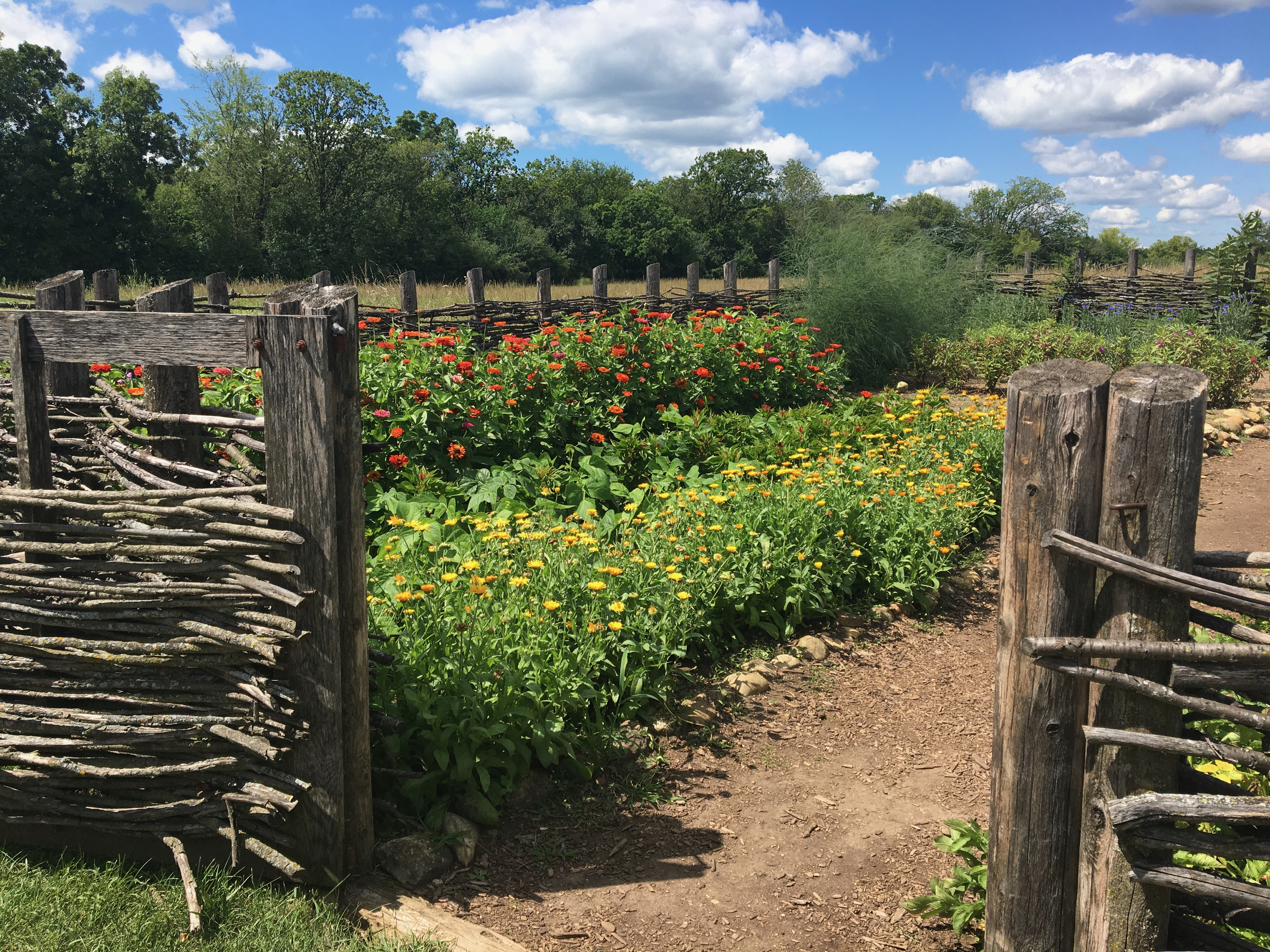
Garden at the Turck-Schottler House, 1870s Hessian Immigrant Farm, Old World Wisconsin. Photo credit Reed Perkins, 2022.1
I don’t know if Mary and Jonathan were regular readers of the popular and affordable farmers’ almanacs of their era; I wouldn’t be surprised if they were. There were many to chose from. Perhaps they had a copy of something like:
…as I prepare my March 9th Civil War presentation for the Cedarburg History Museum, try to sort out the full story of Mequon-Thiensville’s earliest settlers and landowners (including first postmaster John Weston), and look through a bushel of fresh sources in our ongoing search for Jonathan Clark’s kin who hail, we think, from somewhere up around where Derby, Vermont meets Stanstead, Québec.
The Clark House Historian and his crack research team, searching for answers in the written record…1
As you can see, I’ve got work to do in order to dig out from under—and make sense of—the big pile of historical documents that I’ve accumulated over the past several weeks.
So no new CHH post today, but I’ll be back soon with more Clark House history.
Time for a few Random Bits of History: Early Mequon Settlers’ Disambiguation Edition.
John Weston & John Western
Mequon’s first postmaster, John Weston, is mentioned many times in the essential local history book, the History of Washington and Ozaukee Counties, Wisconsin … Illustrated. Western Historical Publishing Co., Chicago, 1881. Using the “Find” function on my PDF copy of the book,1 I found results for “John Weston” on pages 475, 476, 523, 524 and 545.
There is also an entry for “T. Weston” among the names on the “First Poll-List of Washington County” on page 316. I am confident that this is a typographical error and that “T. Weston” is actually John Weston.
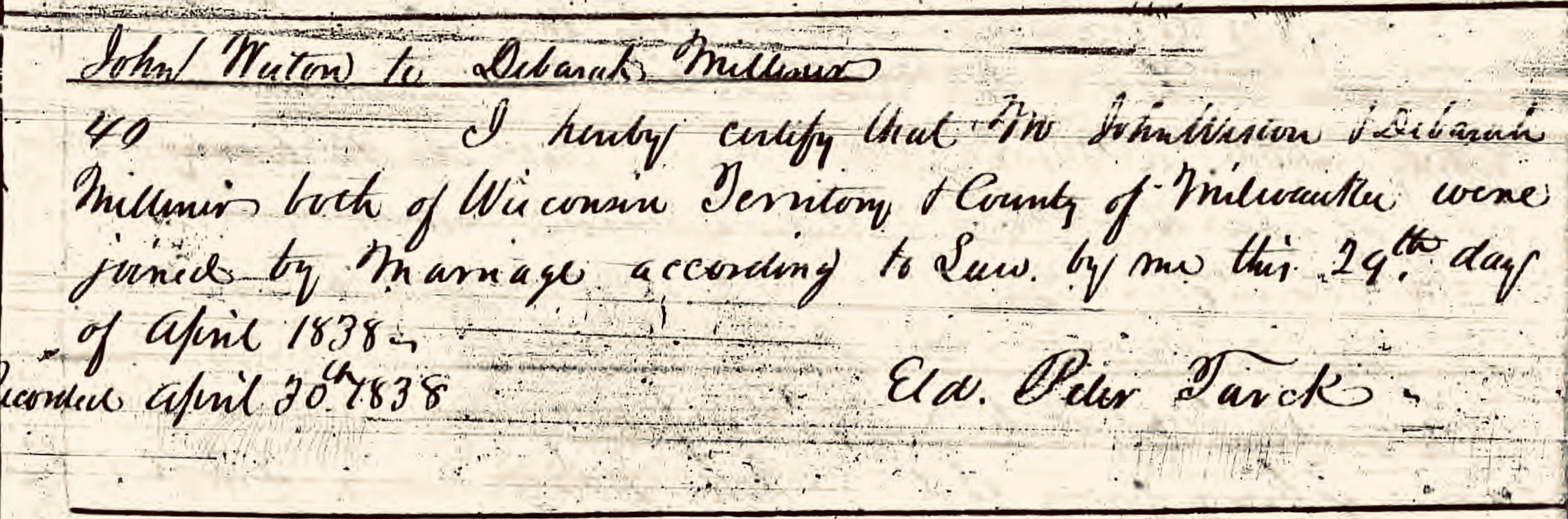
The same source also records, among the early area settlers, one “John Western,” on pages 316, 477 and 478. Is this the same man as John Weston? I have carefully compared a number of sources, including the early minutes of the county road supervisors and deeds in the Washington/Ozaukee county deed books, and I am convinced that during the early years of settlement in the Mequon-Milwaukee area, “John Weston” and “John Western” are the same person, namely John Weston, born in New York about 1800, and married to Deborah Milliner in Milwaukee County in April, 1838. I’ll have examples from the documents that explain my reasoning in a future post.
Fun fact: Mary (Turck) Clark’s father, (Baptist) “Elder” Peter Turck, was the officiant at the Weston-Milliner wedding in 1838. It was the fortieth marriage recorded in the first volume of marriage records for Milwaukee county (and its still-attached for judicial purposes neighbor counties, including old Washington/Ozaukee county).2
With the Weston & Western mystery solved—for the moment—let’s see what other bits of error and confusion we can clear up…
I’m in the middle of several larger CHH research projects and I find myself swamped with information on early Mequon area pioneers. So rather than wait until I’ve got it all sorted out and then organize it into a big essay or two (or more!), I’ll be putting up some of these new bits and pieces on the blog as I find them.
Today’s subjects are the families of Jonathan Loomis (1776-1849) and his eldest child, Issac Chester Loomis (1802-1882), two of old Washington/Ozaukee county’s first white settler families. I’ve mentioned some of these folks in previous CHH posts. And while the Loomis name does appear in some of the early county histories and land records, so far I’d not been able to learn much about the family or how they came to the Wisconsin Territory in the 1830s. In fact, given that the mid-1800s penmanship on some of the source documents was often florid to the point of being unreadable, I was sometimes unsure whether documents discussing or signed by “J. Loomis” versus “I. Loomis” represented the same man, or two individuals. Today’s source goes a long way toward solving these questions.1
Descendants of Joseph Loomis in America
Loomis, Elias, and Charles Arthur Hoppin. Descendants of Joseph Loomis in America, and his antecedents in the old world. edited by Loomis, Elisha S [Berea? O, 1909], Library of Congress.
As luck would have it, I just ran across a useful digitized book in the collection of the Library of Congress, titled Descendants of Joseph Loomis in America, and his antecedents in the old world. I’m not an expert in Loomis genealogy, and thus not entirely sure how accurate this book is, but what I have read here mostly checks out when compared to what I have found elsewhere. With that said, below are the key bits of the book that are related to very early Washington/Ozaukee county history and, in particular, Isaac Chester Loomis and his family. What follows is taken verbatim from pages 193 and 390-391, though I’ve taken the liberty of expanding many of the abbreviations and adding a few paragraph breaks for ease of reading. I’ve also added a few footnotes to explain some possibly obscure references.
Let’s begin with the patriarch of the family, Jonathan Loomis…
I’m working on a subject suggested by my friends Sam Cutler and Bob Blazich from the Mequon-Thiensville Historical Society. Among other projects over the last few decades, they and their colleagues at the MTHS have restored what is believed to be Ozaukee county’s oldest building on its original foundation, the historic Isham Day house, and developed its interior into the Mequon River Postal Museum. Now my friends at the MTHS want to know more about the life of Mequon River Post Office’s original postmaster, one of Mequon’s very first pioneer settlers, John Weston.
Isham Day house, exterior, west front. Photo credit: Anna Perkins, 2021
So for the last several weeks I’ve been doing a great deal of behind-the-scenes reading and re-reading of primary and secondary sources, as well as a lot of searching for additional relevant documents, including early Milwaukee and Washington/Ozaukee county deeds and other land records. In the process, I’m learning a lot about John Weston, Isham Day, Henry Thien, and some of our other first white settlers. But I’m not quite ready to write a John Weston profile, and I still need to clear up some mysteries about Isham Day’s land and house, too.
First Postmaster(s)
New post office…at Mequan River…John Weston appointed postmaster, Milwaukee Advertiser, Oct. 10, 1840, page 2
Let’s get our bearings by making an accurate list of the county’s first postmasters and their terms of office. Our source is from the National Archives in Washington, DC, the Record of Appointment of Postmasters, 1832-Sept. 30, 1971; Records of the Post Office Department; Record Group Number: 28; Series: M841; Roll Number: 144. County: Polk – Wood, Vol. 12B, circa 1832-1844, pages 794-795, currently available via Ancestry.com as U.S., Appointments of U. S. Postmasters, 1832-1971 [database on-line], 2010, image 428 of 583 (accessed 18 Jan 2024). Here’s the microfilmed image of the two-page ledger recording Washington county’s first post offices and postmasters, slightly retouched to make for easier reading:
Click the image for a higher-resolution view, and then read on for more details about old Washington/Ozaukee county’s first two post offices and their original postmasters.










 Clark House Historian