Another Road into the Woods, 1841

An Infrastructure Week Fortnight Month mystery!

Another episode in our Infrastructure! series, a group of posts focused on the first government “improvements” in old Washington/Ozaukee county. If you need to catch up, start with Monday: Map Day – The First County Roads, 1841, then Marking Out the Roads, and our most recent post, Roads into the Woods, 1841, where we rediscovered the routes of old Washington/Ozaukee county’s very first roads.

First federal and county roads

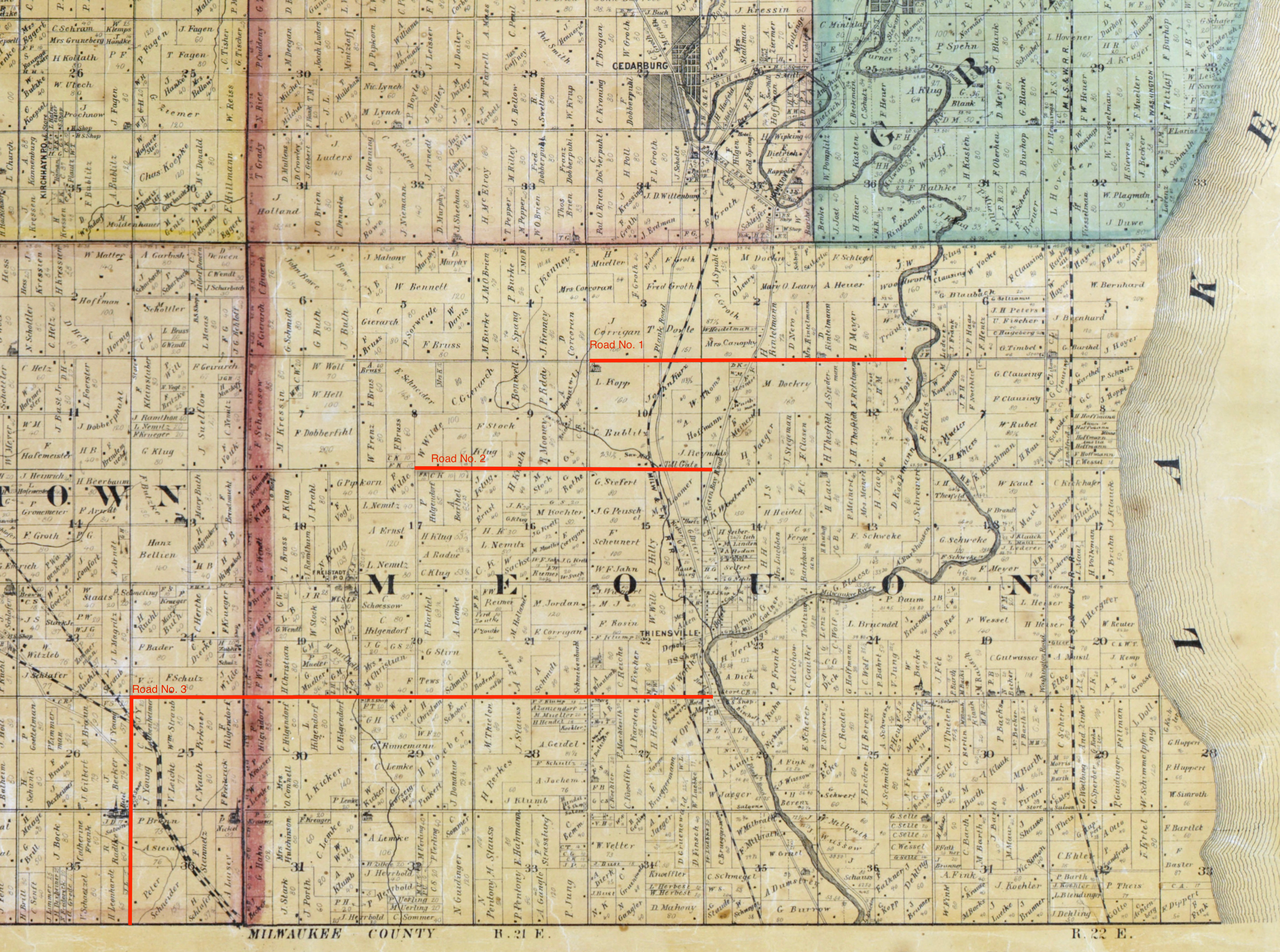
In early 1841, before the commissioners approved county roads Nos. 1, 2, and 3, there was already one federal road in the county. The Green Bay road was a federal road, cut by the troops of the U.S. army’s 5th regiment. It ran generally south to north, joining Ft. Dearborn in Chicago to the regiment’s headquarters at Ft. Howard in Green Bay. Along the way it passed through a number of growing settlements including the three villages that would become Milwaukee, and the future towns of Mequon, Cedarburg, and Grafton. On the map below the Green Bay road is west of and occasionally parallels the Milwaukee River. It is sometimes labeled Green Bay Road, and sometimes—in the southern part of this map—Plank Road (the planking came later, in the 1850s).

Mapping out the first three Washington/Ozaukee county roads is not difficult. The proposals by the road supervisors, as recorded in the official minutes1, were quite precise. Clear starting and ending points were given, using the standard terminology of towns, ranges, sections, quarter sections and so on, and the lengths of each proposed road had been precisely measured in miles, with fractional miles given as a number of additional chains, rods or links. A map of those first three roads—superimposed on a later map of Washington and Ozaukee counties from 1874—looks like this:

Continue reading

Roads into the Woods, 1841

Infrastructure Week Fortnight Month continues!

Our Infrastructure! series— a short group of posts focused on the first county government “improvements” in old Washington/Ozaukee county began (almost a month ago!) with Monday: Map Day!, discussing the 1841 appointment of the first county road supervisors and the organization of the county’s first seven road districts. That was followed up with a discussion of surveyors, their tools, and Jonathan M. Clark’s experiences as a military road builder. Today we’ll take a look at the first few roads laid out and built in old Washington/Ozaukee county in early 1841.

Continue reading

Monday: Map Day! – The First County Roads, 1841

Infrastructure Week! — part 1

Last week’s Monday: Map Day! discussed the Milwaukee and Superior railroad, and the right-of-way through the middle of the Clark farm property that it purchased from Jonathan and Mary Clark in 1857. Even if you already read it, take another look. I’ve recently updated that post to include corrections and new information from reader Sam Cutler (thanks, Sam!).

Today’s post begins Infrastructure Week! a short series focused on the first infrastructure projects in old Washington/Ozaukee county, beginning with the 1841 appointment of the first county road supervisors and their districts.

Old Washington/Ozaukee County, 1837

In order to proceed with county business, the original county commissioners must have had an authoritative map that showed the official county and township boundaries. I would not be surprised if they owned a copy of the 1837 Topographical map of Wisconsin Territory, showing the lands that had been surveyed by, and were available for purchase from, the federal government. As we discussed earlier, this was the first large-scale map of the Wisconsin Territory based on actual surveys. Here’s a detail from that map, showing old Washington county as the 1841 county commissioners would have understood it:

Continue reading

County Government – Early Records

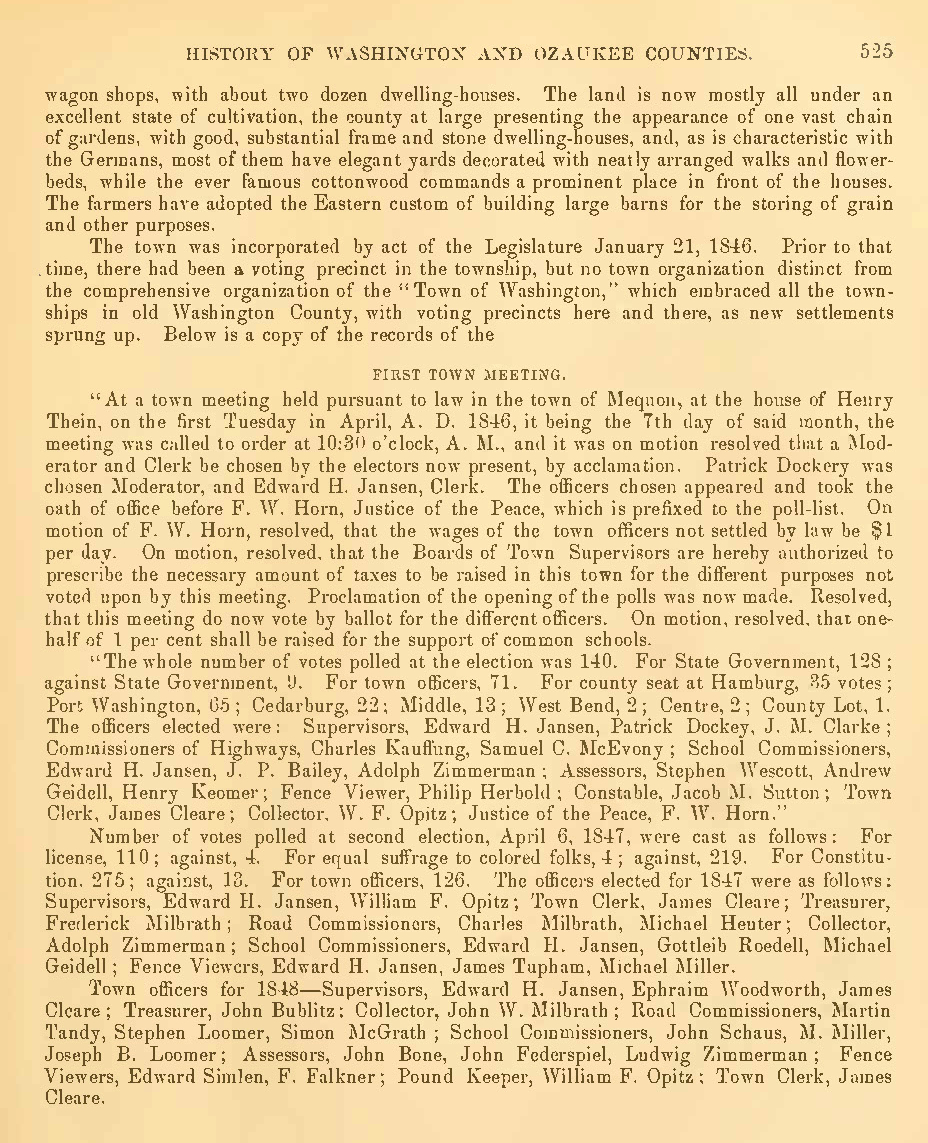
The Jonathan M. Clark House is located in Mequon, Ozaukee (formerly Washington) County, Wisconsin. In our previous post, Mequon – What’s in a name?, we looked into how Mequon became a political entity and how its goverment evolved from the county system to the town system.

From…which archives?

Where do you look when you’d like to read (and download) the handwritten minutes of the meetings of old Washington county’s commissioners, circa 1841-1846? How about…the Washington Co. Highway Department!

This actually makes more sense than you might think, since many of the county’s earliest decisions and expenditures involved proposing, surveying and cutting roads to connect new settlements to each other, to the rest of Wisconsin Territory, and beyond. So—in a fine example of professional organization and public service—the Washington county highway department has gathered together and put online many of their oldest records.

The County Highway Register was an attempt to search out, correlate, and record all known information concerning the laying out of all roads in the county. Some of these books have not been updated since the mid to late 1950’s. Read the forward in the index to understand how these books were created.

(link)

If you follow the link, you’ll find an long list of pdfs, organized by Washington County towns, that contain the collected official highway records and some of the earliest records of county government.

But…Washington County?

Continue reading

Monday: Map Day! – 1874 map of Washington and Ozaukee Counties

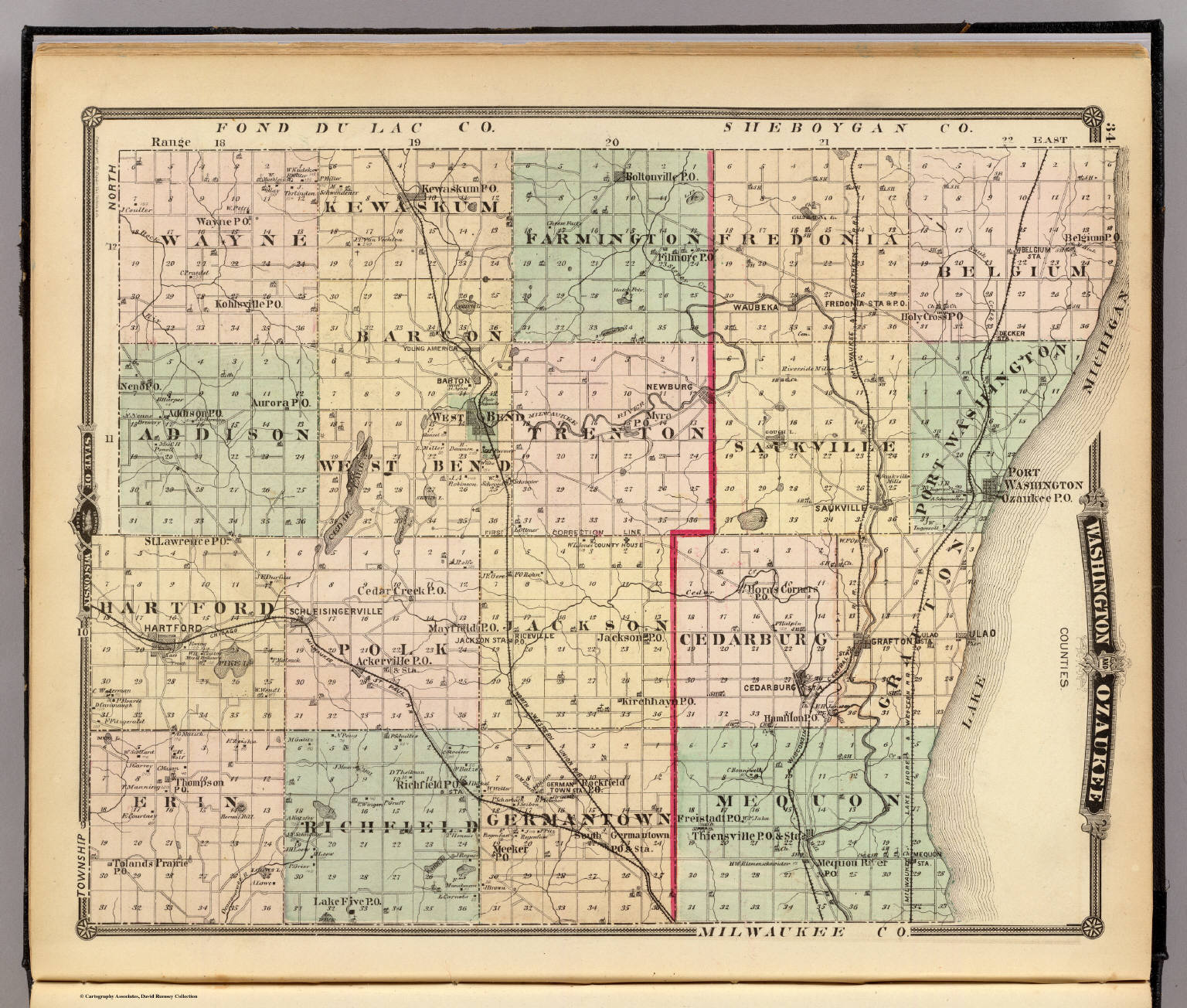
Today’s map is another unique and wonderful map from the University of Wisconsin–Milwaukee, American Geographical Society Digital Map Collection. It is map of Washington and Ozaukee Counties from 1874, and it is packed with information and unique details.

Map of Washington and Ozaukee Counties, Wisconsin 1873-4 / drawn, compiled and published by G.V. Nash & M.G. Tucker ; engraved & printed by J. Knauber & Co. ; colored and mounted by E.M. Harney. University of Wisconsin-MilwaukeeAmerican Geographical Society Digital Map Collection. Full copyright notice here, presented in this post as a public domain item and/or under fair use provisions of U.S. copyright law. Click map to go to the UWM collection and open larger image in new window.

Continue reading

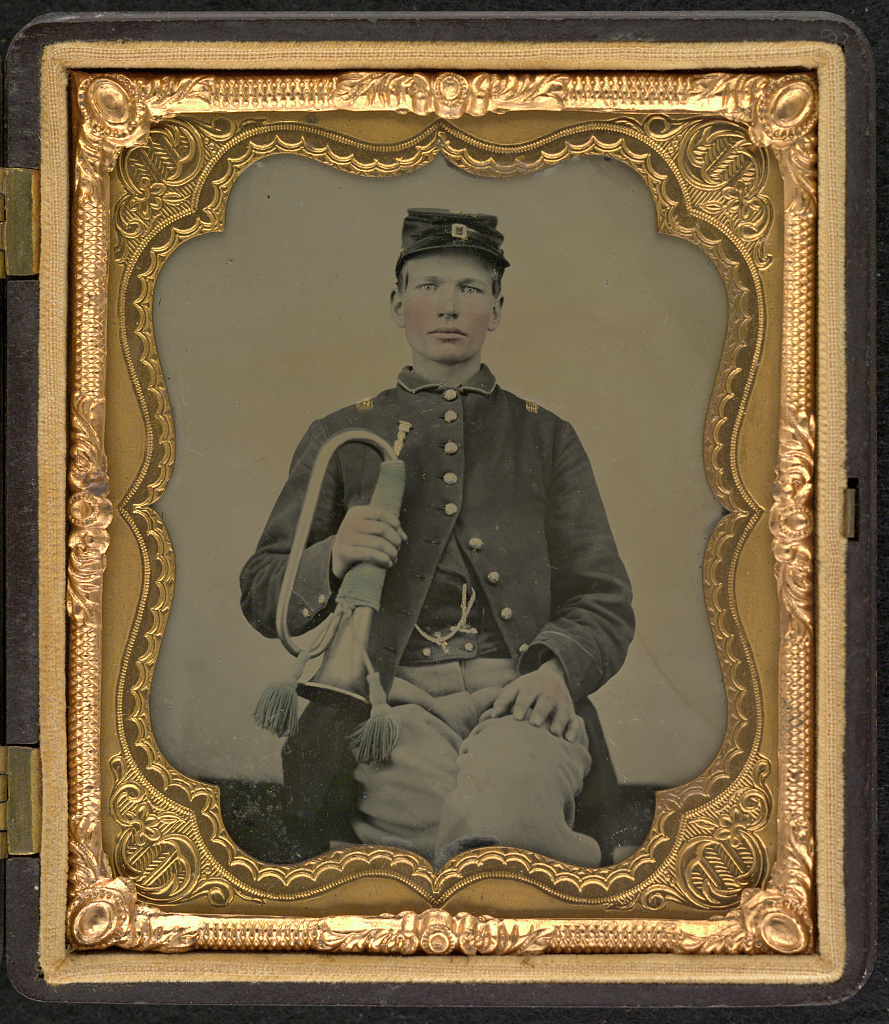
RBOH – Photo Mystery, 1865

Another in our occasional series of Random Bits of History, illustrating life as experienced by the early Mequon settlers and their contemporaries. Today we examine a photograph that may—or may not—depict an early Mequon settler or their kin.

Is this a photo of young Sarah (Strickland) Clark?

Reader Eric Pearman is a descendant of early Mequon settlers Cyrus Clark and Sarah Strickland. For a while last year Clark House Historian spent some time tracing Cyrus and Sarah’s lives, and analyzing some old photographs of those Mequon pioneers here, here, here, here and here (and a few more places, too; just use the blog’s Search function and keyword “Cyrus” or “tintype”).

Eric recently sent me this, unidentified, photo that belonged to a Cyrus and Sarah Clark descendent, and wondered if it might be of a previously un-photographed member of the Cyrus Clark or Sarah Strickland families. Even if this is not a Cyrus Clark or Sarah Strickland family member, the photo has a unique feature that you may want to know about as you examine other old photos. Let’s take a look…

Continue reading

Erie Canal – the Woodworth family, 1835 (part 2)

Continuing our look at the influence of the Erie Canal on the lives of Mequon pioneers such as Jonathan M. Clark and the Peter and Rachael (Gay) Turck family (here and here), and the Bonniwell family (here). Today’s post continues our look at the first of two migrations of brother Ephraim and James Woodworth from Nova Scotia to their eventual home in Mequon. This post will make more sense if you read Part 1 first. The Woodworths were among many immigrants from Nova Scotia—including the Strickland, Loomer, Bigelow and West families—that came to Mequon and other parts of old Washington/Ozaukee county, Wisconsin Territory, during the early decades of settlement. 

Setting the scene: Eastern Canada and the Northeast United States, c. 1835

Here’s an annotated version of the map we featured in Part 1. As always, be sure to click the map to open a larger, high-resolution version in a new window. (If you’d like to see an enlarged, zoomable version of the original map, just click here.) Today’s annotated map illustrates the Woodworths’ 1835 trip as recorded in James W. Woodworth’s published diary.1 Later in this post we have another—more detailed— map to show the brothers’ wanderings in Ohio.

Continue reading

Erie Canal – the Woodworth family, 1835 (part 1)

We’ve been looking at the influence of the Erie Canal on the early lives of both Jonathan M. Clark and the Peter and Rachael (Gay) Turck family (here and here), and the Bonniwell family (here), I thought I’d share more stories of Mequon settlers that used the canal to make their way westward to the wilds of the Wisconsin Territory in the 1830s and ’40s. Today’s focus is on immigrants from Nova Scotia, particularly the Woodworth brothers, Ephraim and James.

We’re going to need a bigger map!

We’ve had numerous occasions to quote from the memoirs of early Mequon pioneer—and Turck and Clark family friend—James W. Woodworth. Unlike many pioneers who came west, bought land, and never returned home, James W. Woodworth and various members of his family made the round-trip journey between Nova Scotia to the newly opened lands of the midwestern U.S. several times in the 1830s and ’40s. Descriptions of three separate trips can be found in Rev. Woodworth’s book, and they give additional color and detail to our understanding of what immigration to “the West” was like in that era. But to give you a proper feel for the hardiness of these 19th-century migrants, we’re going to need a bigger map!

Eastern Canada and the Northeast United States, c. 1835

Continue reading