I’m in the thick of researching and writing several series of illustrated posts for the blog, as well as for some upcoming public talks that I’m giving this spring and summer, and it’s kept me from posting lately. And as is often the case with these big projects, I find I have so much fresh material, and so many interesting, interconnecting, events and stories, that the problem becomes sorting and organizing all that information, and all those images, into coherent and not-overwhelmingly-long posts and presentations. (Heh. We’ll see about that…)
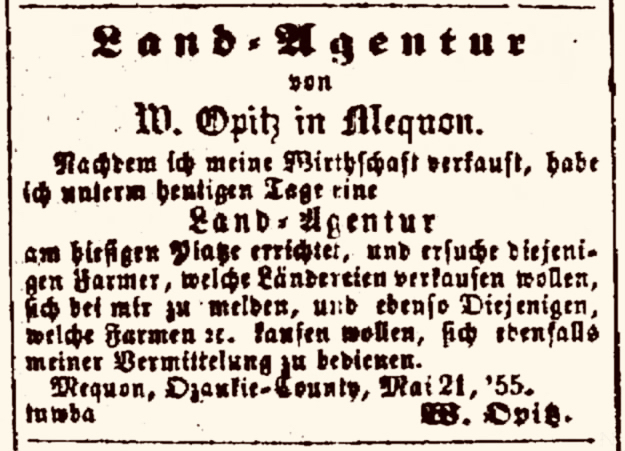
Anyway, while I continue my writing and editing behind the scenes, I thought you might enjoy this random bit of Mequon history I found while looking for some other, entirely different, information. It’s an advertisement originally dated May 21, 1855; this copy was published on page 3 of the Milwaukee Banner und Volksfreund [Banner and People’s Friend] on February 6, 1856. The ad announces a new business venture by one of Mequon’s earliest and most influential German settlers, Wilhelm Ferdinand “William F.” Opitz (1813 or 1816 – 1882):
How’s that? Your German language and Fraktur-reading skills are a bit too rusty to enjoy this historical advert? Well, just click and read on for all the details!
Our previous two posts (here and here) examined the 1888 recollections of a Mequon man that migrated from Germany to Mequon-Thiensville in 1848-1849, just after completing his schooling. His recollections were published in the form of two “letters” addressed to the Cedarburg News in May, 1888. Both letters were signed with just the initial “L.” Today I’d like to see what we know about our author — “L.” — and whether we can identify him.
But—before we start solving mysteries, there are errors to correct…
Updated dates!
I goofed! I fell into a record-keeping, citation-making trap. As I started this new post, I decided to take yet another look at my sources. And much to my chagrin, I noted that the date at the head of each of our “Mequon Correspondence” letters does not agree with the date that each letter was actually printed in the Cedarburg News. That’s not so strange; I would expect that a letter would be written, dated, and sent to the paper’s editor before the newspaper’s date of publication. But in our case, the letters are dated almost a full week after the newspaper date of publication. What’s that all about?
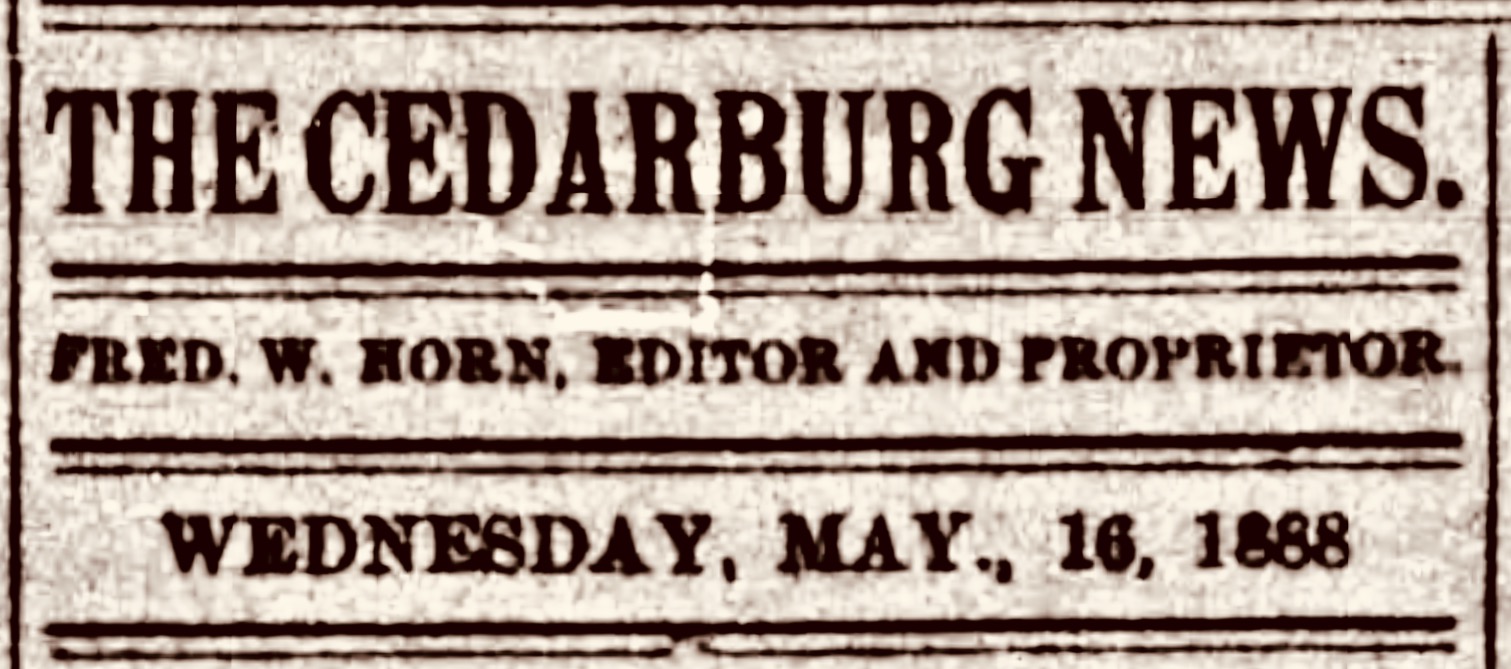
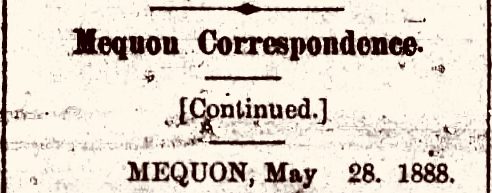
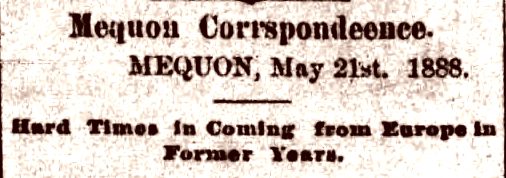
Anyway, here’s the correct info: • the first letter of two, titled “Mequon Corrspondeence” [sic], was published on page 2 of the Cedarburg News on May 16, 1888, but the “letter” was dated, in its headline, “May 21, 1888.” • the second letter, titled “Mequon Correspondence. [Continued.]” appeared the following week, May 23, 1888, also on page 2, but the “letter” was dated, in its headline, “May 28, 1888.”
For the record, earlier today (28 Feb. 2026) I added this corrected date information to thosse two previous CHH posts. And now that we’ve settled that, let’s see what we can do to solve today’s History Mystery!
UPDATED, Feb. 28, 2026, to correct erroneous dates of publication of the two Cedarburg News “letters.“
Migration memories, 1848, continued
In our previous post we presented the first part of a personal memoir of travel from Germany to New York City and, eventually, Mequon-Thiensville, circa 1848. Those recollections were published as the first of two “letters” to the Cedarburg News in May, 1888. Both letters were pseudonymous, signed only with the initial “L.”
The first letter of the pair, titled “Mequon Corrspondeence” [sic], was published on page 2 of the Cedarburg News on May 16, 1888, but note that the letter itself was dated, in its headline, “May 21, 1888.” If you missed it, I recommend you begin with that earlier post and then come back here for the conclusion. Today we complete the author’s reminiscences with excerpts from his second letter, titled “Mequon Correspondence. [Continued.]” appeared the following week, May 23, 1888, also on page 2, but the letter was dated, in its headline, “May 28, 1888.”
An 1840s “prank” in NYC
The May 28th, 1888, letter begins with two anecdotes from our immigrant’s first day in New York City. The first incident involves a schoolboy “prank” in which a bottomless peach basked is used to trap the arms of an unsuspecting “fat old bachelor, the universal fool of our ship [illegible] to the greatest merriment of the bystanders.”
UPDATED, Feb. 28, 2026, to correct erroneous dates of publication of the two Cedarburg News “letters.”
Hard Times in Coming from Europe
You may have wondered why I haven’t written much about the German immigrant history and heritage of our corner of southeast Wisconsin. After all, since the late-1830s, and especially following the “Revolutionary Year” of 1848 in Europe, waves of Europeans—including hundreds of thousands of emigrants from the German Lands— left their homes in the Old World and set out to make a fresh start in America. Many of these German-speaking emigrants would find their way to Wisconsin, where they and their descendants would leave a lasting imprint on the culture and development of the new state.
The story of the Jonathan Clark House, however, centers around the lives of the Clarks and their immediate neighbors and in-laws, especially the Bonniwell and Turck families. All were prominent players in the earliest days of white migration to and settlement of Mequon, old Washington/Ozaukee county, and the city of Milwaukee. The Clarks, Turcks and Bonniwells came to Wisconsin Territory from New York, New England, English-speaking Canada and the United Kingdom in the later 1830s. Their Wisconsin story was not so well known or documented, so I have spent much of my time over the past decade or so researching their families, lives, and the events of their day.
Having said that, we need to remember that these “Yankee-Yorkers” and other English-speaking pioneers were not the only early immigrants to our area. Irish and German families were, indeed, already present and establishing farms and businesses in old Washington/Ozaukee county by the late-1830s, including at the large German Freistadt Colony and the early Irish neighborhood centered between the Jonathan Clark House and the crossroads hamlet of Hamilton. All of these overseas immigrants were the Clarks’ neighbors, and their stories are intertwined throughout the early history of Mequon.
And one thing those 19th-century Irish and German and British immigrants all had in common was time spent on a ship, making the uncertain and difficult voyage from Europe to America. In the next few posts we will look at some first-person recollections of a school boy who came with his mother and brother from the German Lands to Mequon-Thiensville around 1848, as recollected and published in 1888.
The lives of Mary Clark’s sister Elizabeth (Turck) Maxon, her husband Densmore W. Maxon, and the Maxon children are deeply intertwined with the history of Washington and Ozaukee counties, and with the lives of many of the early settlers, especially the Clark, Turck and Clow families.
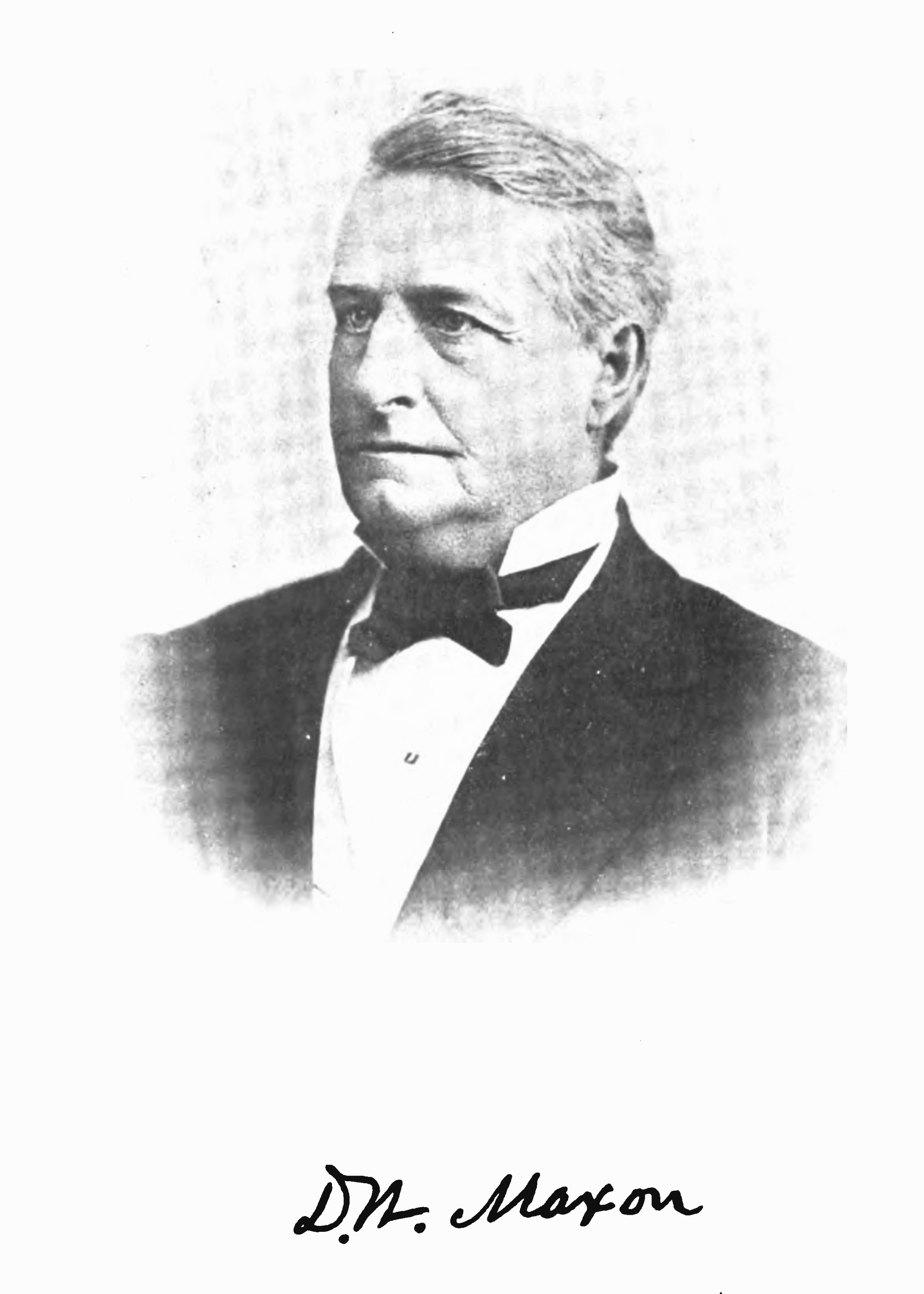
From the early 1840s until at least the 1880s, members of the Maxon family—and especially D. W. Maxon— played important, recurring roles in Clark and Turck family affairs. That being the case, I thought we might benefit from a reasonably detailed overview of D. W. Maxon’s life, and I found a good one in A. M. Thomson’s A Political History of Wisconsin, second edition (C. N. Caspar Company, Milwaukee, 1902).
D. W. Maxon
The biography spans pages 431-433. D. W. Maxon’s portrait, with signature (above), is found facing page 236. I have proofread the transcribed text and added some paragraph breaks and headers for ease of reading. Otherwise the text, displayed here in grey-background “quotation” paragraphs, is complete as published in 1902.
We’re coming up on the tenth (!) anniversary of Clark House Historian, and I realize that in those ten years I have not yet written about all of Mary (Turck) Clark’s immediate family. Regular readers will recall that the Vermont and/or Canadian ancestry of Mary’s husband Jonathan M. Clark remains, in spite of our best efforts, mysterious and—so far—mostly unknown. But we actually know a lot about Mary Clark’s people, the Peter Turck family, including her seven siblings. Over the years I’ve blogged a bit about Mary’s oldest sibling, Joseph R. Turck, and her youngest, brother Benjamin Turck. I think it’s about time I started to write about Mary Clark’s other brothers and sisters, beginning with younger sister Elizabeth Turck, later Mrs. Densmore Maxon.
Elizabeth Turck Maxon’s memoir
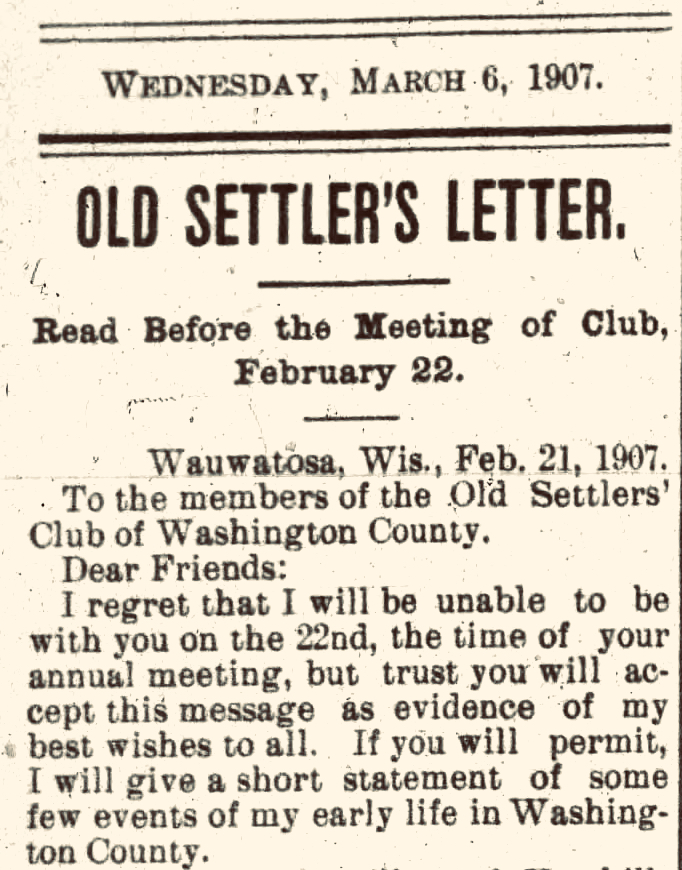
A memoir from the Turck family, even a short one, would be a substantial addition to what we know about the family and the events of their pioneer lives. In 1907, near the end of her long and productive life, Elizabeth Turck Maxon wrote down some of her recollections of early days in the area, in the form of a letter to the Old Settler’s Club of Washington County, Wisconsin.
When that 1907 letter was new, some—but not all—of its contents were published in various Wisconsin newspapers. In 1912, editor Carl Quickert included his selection of “the most interesting passages” from Elizabeth’s letter on pages 64-65 of his book Washington County Wisconsin Past and Present, Vol 1 (Chicago, S.J. Clarke Publishing Co., 1912).
In all the various 1907 newspaper editions, and in Quickert’s 1912 history, the omitted passages were usually noted with three asterisks, like this * * * This was typical editorial practice for the time. But, of course, those asterisks piqued my interest. What had been cut? What additional things might Elizabeth’s full text tell us about the early days in old Washington/Ozaukee county?
Old Settler’s Letter, 1907
I spent over a decade looking for Elizabeth’s unabridged, original, text and I think I finally found it. It was published on page 4 of the West Bend [WI] News of March 6, 1907. It’s a long letter, a full column of text, beginning with Elizabeth’s salutation to the members of the club, dated February 21, 1907.
The greetings are followed by the main text, beginning with her birth information and the story of the Peter Turck family’s migration from New York state to Wisconsin Territory in 1837. Below is the unabridged text (in the grey text boxes), interspersed with paragraph headers and my comments in plain type. FYI, I have blogged previously about a number of the events and characters in Elizabeth’s letter here on CHH, and have added links to some of those posts. Be sure to click the links for more information, and some interesting illustrations and maps.
In our previous post, we were introduced to the Desmond family, early Irish immigrants to old Washington/Ozaukee county and neighbors of Jonathan and Mary Clark. To our good fortune, one of the Desmond sons, Humphrey Desmond, wrote a memoir of his father Thomas that includes some unique family genealogy and tales of pioneer days in our area.
If you missed Part 1, I suggest you go ahead and read that post first. Then return here to continue with Part 2 of selections from A Memoir of Thomas Desmond, with a chapter on The Desmond Genealogy, by Humphrey J. Desmond, 77 pages, Milwaukee, 1905. And remember: you can read the complete memoir at this link, which is a part of the admirably organized and comprehensive online genealogy project The Desmond Archives.
Pioneer Days
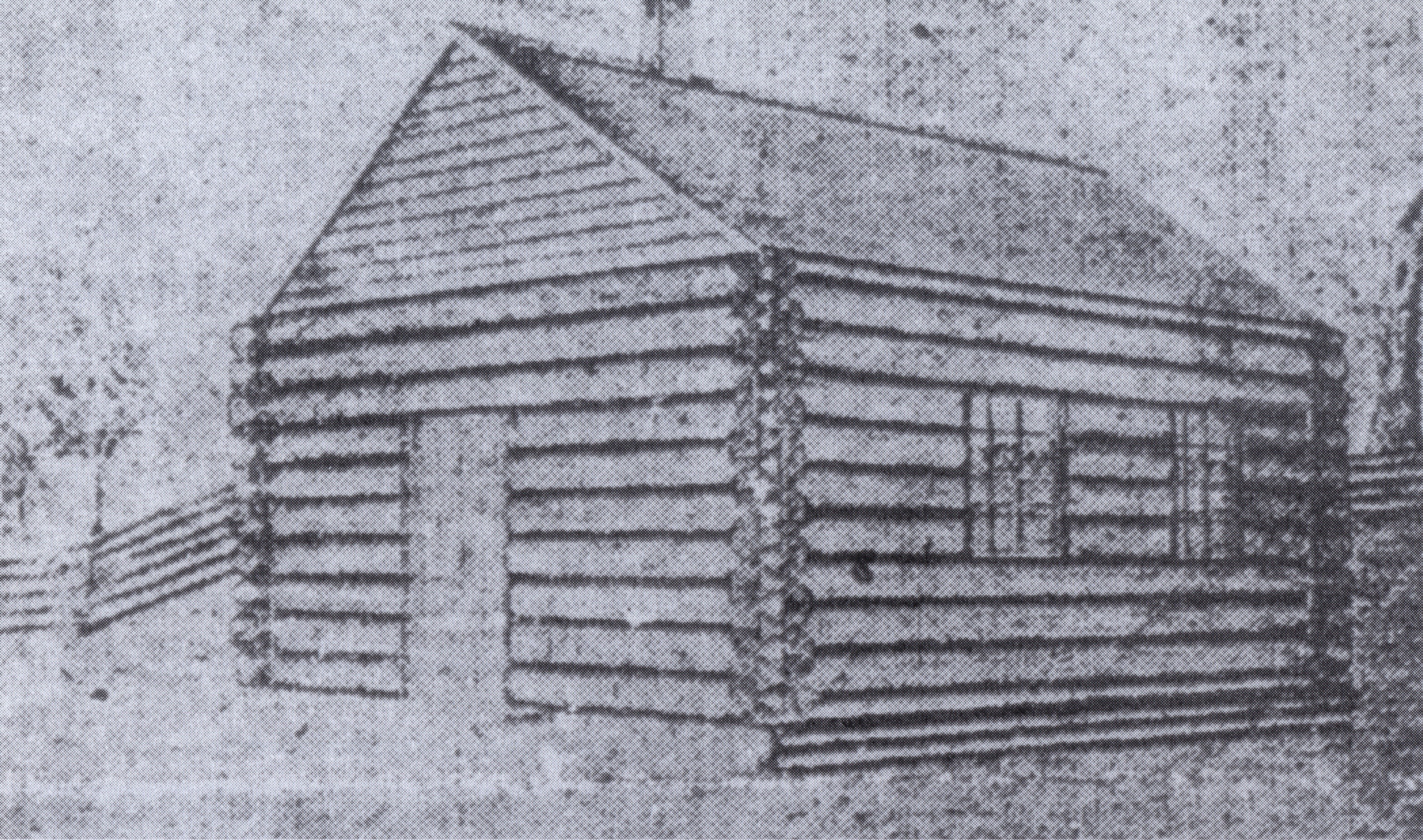
Chapter 3 of Desmond’s memoir will be of particular interest to CHH readers. It relates various early Mequon events, some involving the Desmond family’s Catholic faith, their Bonniwell neighbors, and the local school that the Bonniwells helped build in the early 1840s. That first “Bonniwell School,” located less than a mile west of the Jonathan Clark house on what is now the southeast corner of Bonniwell and Wauwatosa roads in Mequon, was sketched in 1864 by Evander Bonniwell. The sketch (above) is reproduced here from page 71 of George B. Bonniwell’s comprehensive family history, The Bonniwells: 1000 Years. (Used by permission.)
[31]        III.   PIONEER DAYS

THE "hazard of new fortunes" undertaken by the Desmond family involved the clearing away of woods with the ax of the pioneer and the building of a commodious log house.
    The pioneers of this neighborhood were the Bonniwell brothers, who had settled there about 1835 [sic, 1839], and it was known as the Bonniwell settlement.
    Indians still roamed the forests of southeastern Wisconsin in 1843. My [32] father, then ten years old, alone in the house one day, was visited by a brave to whom he gave a large loaf of bread. The Indian loosened his belt as he ate the loaf, and when it was all gone departed peaceably on his journey.
    There was a log school house to which my father went. Books were not plentiful in those days. He studied his spelling lesson during the noon hour from the book of a desk mate. He had to start at the foot of the class, but one day he got to the head and kept his place.
In an earlier post, I mentioned a local history source that was previously unknown to me, the Memoir of Thomas Desmond, written by his son Henry Desmond. It was cited by Walter D. Corrigan in the bibliography of his otherwise error-prone and forgettable History of the town of Mequon, Ozaukee County, Wisconsin, brought down to about 1870.
I was intrigued. I already knew that Thomas Desmond and his brother Dennis were pioneer residents of the Town of Mequon and neighbors of the Jonathan Clark family for several decades. The Thomas and Dennis Desmond farm parcels were located in the NW quarter of Section 3, T9N-R21E, Town of Mequon. The Desmond farms, and the adjacent John Corcoran farm, were situated due north of the Jesse Hubbard, Jr., farm, due west of the Ferdinand and Friedrich Groth properties, and immediately adjacent to the northwest corner of the Jonathan and Mary Clark farm, which occupied all of the southeast quarter of section 3.
You can see the Thomas Desmond and Dennis Desmond parcels in the upper left quadrant of this detail from the Shoolmap of the Town of Mequon / School Map of the Town of Mequon, pre-1872, UW-Milwaukee–AGS Digital Map Collection, showing Sec. 3, T9N-R21E. The southeast quarter section is labeled “Widow Clark,” and suggests that the map was made sometime after Jonathan Clark’s death in 1857, but before Mary Turck Clark and her daughters sold the property in 1872. (For more on this unique, useful map, see our post Monday: Map Day! – “Shoolmap” of Mequon, c. 1872.)
A Memoir
A memoir of any early Mequon settler, especially a Clark family neighbor, is always something I’d like to read. But the Desmond memoir was privately published, in 1905, in an edition of only 50 copies, to be distributed only to the immediate family. I checked Worldcat, and it had a citation for the book, but did not know of any libraries that had a copy. Might someone, somewhere, have this little book? Well…
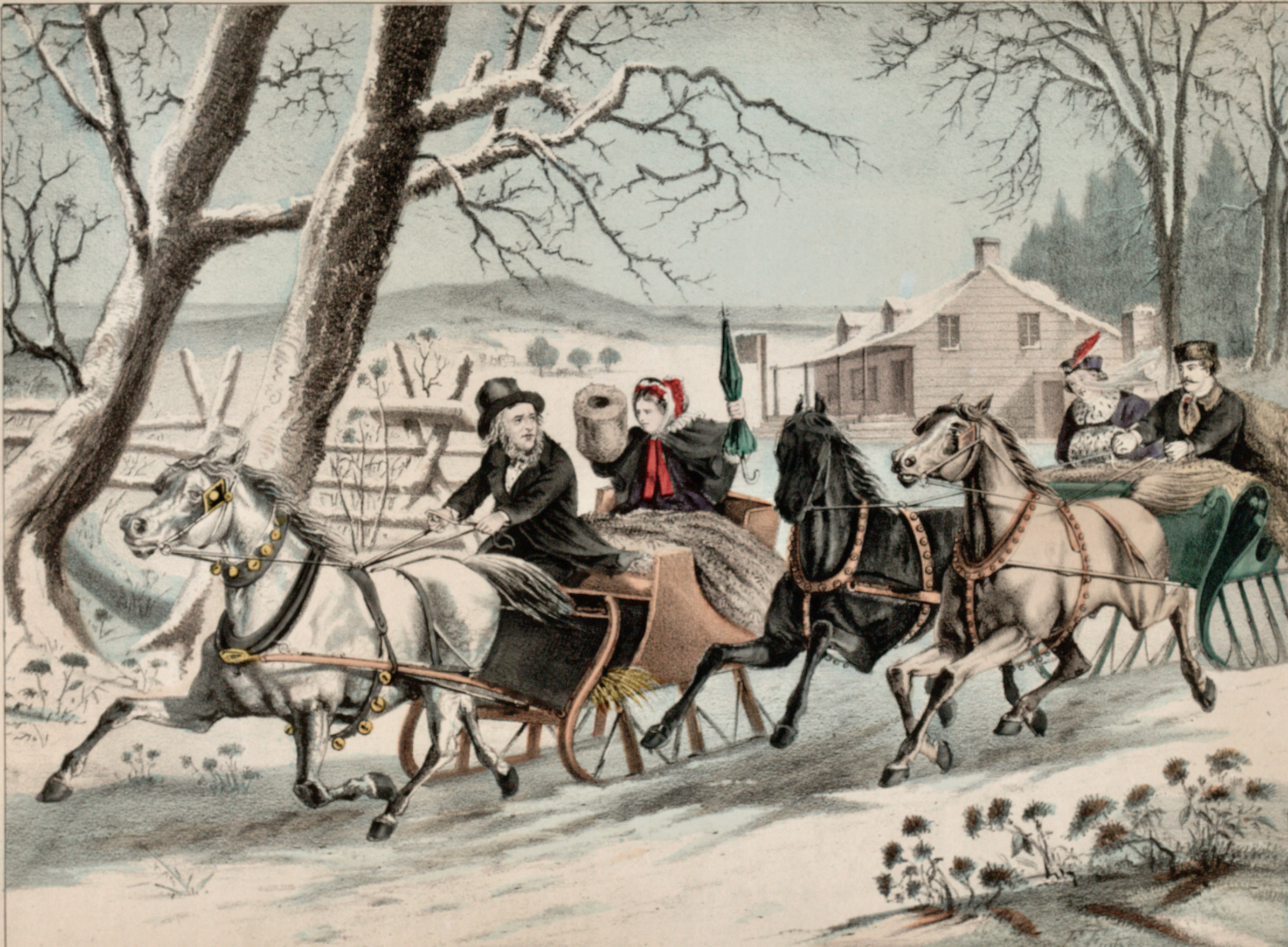
As I write this, southeastern Wisconsin is in the midst of our first substantial snowfall of Winter, 2025-2026. In Jonathan and Mary Clark’s lifetime, the day after a storm like this meant it was time to hitch up the sleigh and have some fun “dashing through the snow.” Here’s a lightly-revised and expanded repeat of a post that celebrates Clark-era “sleighing time” and “jingle bells.” (And be sure to click the highlighted links for more vintage wintertime images and info.)
Kimmel and Forster, publishers, “Winter Pleasure in the Country,” circa 1865. National Museum of American History, Peters Prints Collection, Smithsonian Institution.1 Note the modest straps of jingle bells on the one-horse sleigh and the much more ostentatious—and louder—straps of bells on the two-horse sleigh.
Last winter, our earlier CHH posts Snow!, Shoveling out -and other winter chores and Stuff Happens – on a sleigh ride, got me wondering again about winter travel in old Washington/Ozaukee county during the Clarks’ era of the mid-1830s through the 1860s or so. Assuming most of the more successful farmers—such as the Clarks, Bonniwells and Turcks—owned a one- or two-horse sleigh, how easy was it to navigate that sleigh on the early county roads? Could you sleigh ride all the way to Milwaukee? And if you could, how long might that take?
Veterans Day is today. For a perspective on the day—and our early Mequon veterans—here’s a post originally published at Clark House Historian on November 11, 2016, and revised, expanded and republished several times since.
Armistice Day — Veterans Day
One hundred and seven years ago today, at the eleventh hour, of the eleventh day, of the eleventh month—Paris time—the Armistice of Compiègne took effect, officially ending the fighting on the Western Front and marking the end of World War I, the optimistically named “War to End All Wars.”
In the United States, the commemoration of the war dead and the Allied victory began in 1919 as Armistice Day, by proclamation of President Woodrow Wilson. Congress created Armistice Day as a legal holiday in 1938. Starting in 1945, a World War II veteran named Raymond Weeks proposed that the commemorations of November 11 be expanded to celebrate all veterans, living and dead. In 1954 Congress and President Eisenhower made that idea official, and this is what we commemorate today. There are many veterans with a connection to the Jonathan Clark house. We honor a few of them in this post.
114th Regimental Reunion, May 30, 1897, Norwich, N. Y., Library of Congress [cropped and adjusted]. Many Clark neighbors served during the Civil War, and many remained active in the Grand Army of the Republic, the national organization for Union Army veterans, including these men from rural New York, gathered together in 1897.


 Clark House Historian