“Dashing through the snow…”

As I write this, southeastern Wisconsin is in the midst of our first substantial snowfall of Winter, 2025-2026. In Jonathan and Mary Clark’s lifetime, the day after a storm like this meant it was time to hitch up the sleigh and have some fun “dashing through the snow.” Here’s a lightly-revised and expanded repeat of a post that celebrates Clark-era “sleighing time” and “jingle bells.” (And be sure to click the highlighted links for more vintage wintertime images and info.)
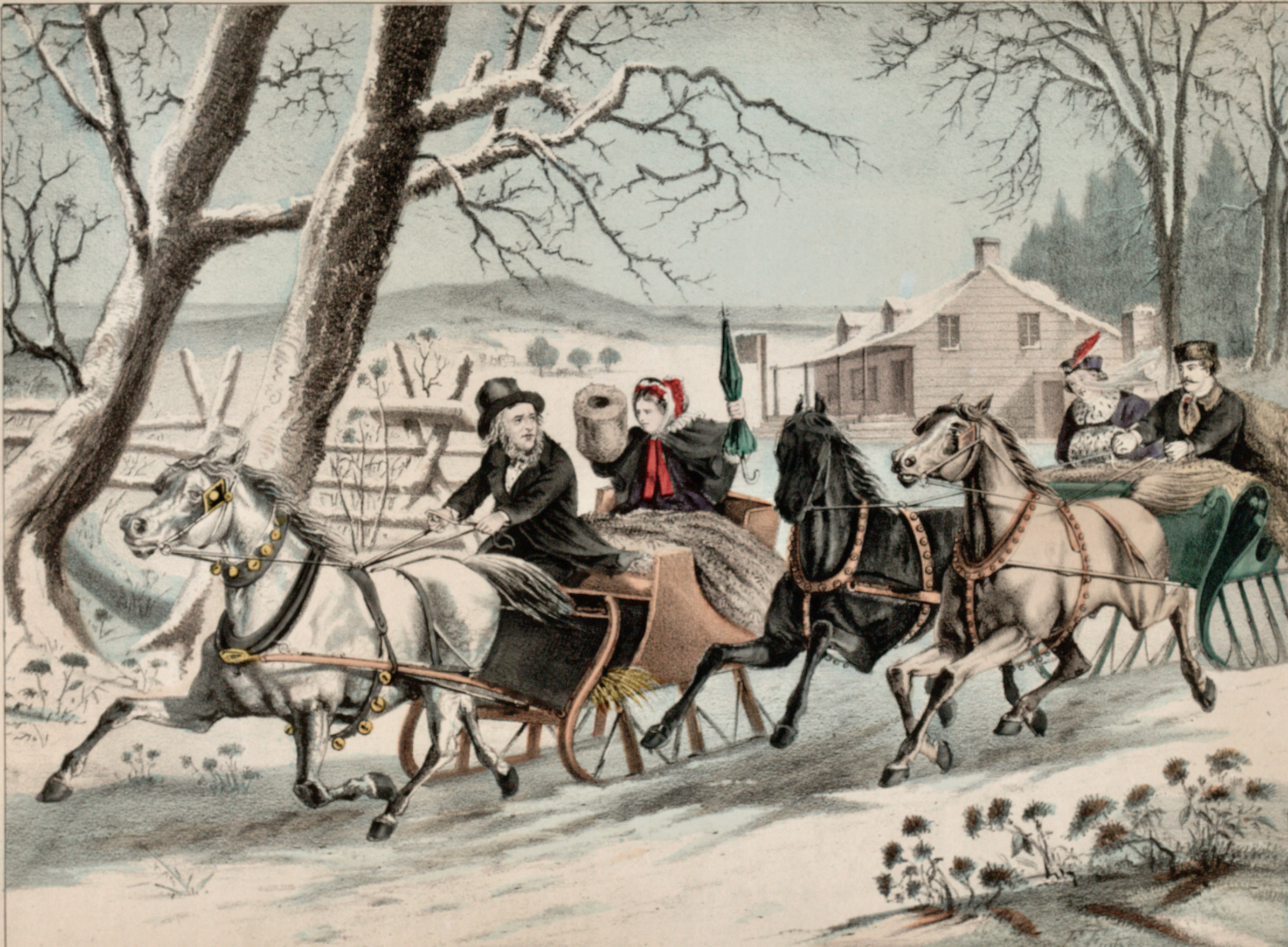
Kimmel and Forster, publishers, “Winter Pleasure in the Country,” circa 1865. National Museum of American History, Peters Prints Collection, Smithsonian Institution.1 Note the modest straps of jingle bells on the one-horse sleigh and the much more ostentatious—and louder—straps of bells on the two-horse sleigh.

Last winter, our earlier CHH posts Snow!, Shoveling out -and other winter chores and Stuff Happens – on a sleigh ride, got me wondering again about winter travel in old Washington/Ozaukee county during the Clarks’ era of the mid-1830s through the 1860s or so. Assuming most of the more successful farmers—such as the Clarks, Bonniwells and Turcks—owned a one- or two-horse sleigh, how easy was it to navigate that sleigh on the early county roads? Could you sleigh ride all the way to Milwaukee? And if you could, how long might that take?

Continue reading

Memorial Day, 2025

Lest We Forget

Our annual Memorial Day post, first published in 2020, more relevant with each passing year.

Graves of Unknown Union Soldiers, Memphis National Cemetery, photo by Clayton B. Fraser, (Library of Congress), public domain. Memphis National Cemetery is the final resting place of Mequon’s Watson Peter Woodworth, and almost 14,000 of his Union Army comrades.

Today is the day our nation officially observes Memorial Day. For many Americans, Memorial Day represents “the first day of summer,” and is traditionally celebrated with trips to the lake, picnics, parades, and sales on cars, appliances, and other consumer goods.

But for many of us, Memorial Day remains rooted in its origins as Decoration Day. The first national observance was in 1868, when retired general John A. Logan, commander and chief of the Grand Army of the Republic—the Union veterans’ organization—issued his General Order Number 11, designating May 30 as a memorial day “for the purpose of strewing with flowers or otherwise decorating the graves of comrades who died in defense of their country during the late rebellion, and whose bodies now lie in almost every city, village, and hamlet churchyard in the land.”

On this Memorial Day, let’s take a moment to remember what this day truly represents.

Continue reading

“Dashing through the snow…”

Kimmel and Forster, publishers, “Winter Pleasure in the Country,” circa 1865. National Museum of American History, Peters Prints Collection, Smithsonian Institution.1

Talk of sleighs and sleighing in our recent CHH posts on Snow! and Shoveling out -and other winter chores, plus our January, 2022, essay on Stuff Happens – on a sleigh ride, got me wondering again about winter travel in old Washington/Ozaukee county during the Clarks’ era. Assuming most of the more successful farmers—such as the Clarks, Bonniwells and Turcks—owned a one- or two-horse sleigh, how easy was it to navigate that sleigh on the early county roads? Could you ride all the way to Milwaukee? And if you could, how long might that take?

Continue reading
Hail, Smiling morn! – 2025 edition

Happy New Year to all, and best wishes for an excellent 2025. I thought we’d start the year with a lightly edited re-post of an earlier CHH essay about a cheerful, festive song, one that may have been familiar to our Mequon settlers in the 1840s.1

A spot of Spofforth to ring in the New Year…

Our New Year’s sing-along number is “Hail Smiling morn” by the English composer Reginald Spofforth (1769-1827), a vocal quartet featured in the second part of the Milwaukee Beethoven Society’s March 23rd, 1843, premiere concert:

Milwaukee Weekly Sentinel March 15 1843, page 2. Click to open larger image in new window.

Spofforth was a man of many talents, but was particularly known for his glees. A glee is a kind of convivial part-song, typically for three or more voices and usually—but not always—sung without accompaniment. I’ll have more to say about this particular composer and piece later, but for now, it’s well enough to know that “Hail Smiling morn” is—according to musicologist Nicholas Temperly—”possibly the most popular glee in the entire repertory,” and that’s saying something!

Continue reading

Music instruction in Milwaukee, 1845

I ran across this advertisement while doing some research on the Bonniwell Band, purportedly the first band to perform in the new Wisconsin Territory. The band featured brothers—and Clark House neighbors—James, Charles, William, Henry and Alfred Bonniwell, and their brother-in-law Philip Moss.

But the Bonniwell Band was not the only source of music in the area…

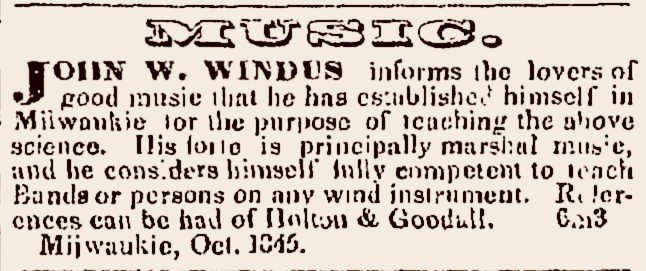
“Music.” [John M. Windus, music instruction], advertisement, Milwaukee Daily Sentinel 17 Nov 1845, page 3.

Music.
John W. Windus informs the lovers of good music that he has established himself in Milwaukie for the purpose of teaching the above science. His forte is principally marshal [sic] music, and he considers himself fully competent to teach Bands or persons on any wind instrument. References can be had of Holton & Goodall.
Mijwaukie [sic], Oct. 1845

Yep. In 1845, Milwaukee area “lovers of good music” could learn band instruments from Mr. Windus. And martial music was his forte.

Continue reading

Memorial Day, 2024

Lest We Forget

Our annual Memorial Day post, first published in 2020. Updated for 2024 with new information about the Civil War service of Isham and Emily (Bigelow) Day’s eldest child, Cpl. James Lemon Day (1834-1863).

Graves of Unknown Union Soldiers, Memphis National Cemetery, photo by Clayton B. Fraser, (Library of Congress), public domain. Memphis National Cemetery is the final resting place of Mequon’s Watson Peter Woodworth, and almost 14,000 of his Union Army comrades.

Today is the day our nation officially observes Memorial Day. For many Americans, Memorial Day represents “the first day of summer,” and is traditionally celebrated with trips to the lake, picnics, parades, and sales on cars, appliances, and other consumer goods.

But for many of us, Memorial Day remains rooted in its origins as Decoration Day. The first national observance was in 1868, when retired general John A. Logan, commander and chief of the Grand Army of the Republic—the Union veterans’ organization—issued his General Order Number 11, designating May 30 as a memorial day “for the purpose of strewing with flowers or otherwise decorating the graves of comrades who died in defense of their country during the late rebellion, and whose bodies now lie in almost every city, village, and hamlet churchyard in the land.”

On this Memorial Day, let’s take a moment to remember what this day truly represents.

Continue reading

Memorial Day, 2023

Lest We Forget

Our annual Memorial Day post, first published in 2020. Updated for 2023 with new information about Evander B. Bonniwell’s service.

Graves of Unknown Union Soldiers, Memphis National Cemetery, photo by Clayton B. Fraser, (Library of Congress), public domain. Memphis National Cemetery is the final resting place of Mequon’s Watson Peter Woodworth, and almost 14,000 of his Union Army comrades.

Today is the day our nation officially observes Memorial Day. For many Americans, Memorial Day represents “the first day of summer,” and is traditionally celebrated with trips to the lake, picnics, parades, and sales on cars, appliances, and other consumer goods.

But for many of us, Memorial Day remains rooted in its origins as Decoration Day. The first national observance was in 1868, when retired general John A. Logan, commander and chief of the Grand Army of the Republic—the Union veterans’ organization—issued his General Order Number 11, designating May 30 as a memorial day “for the purpose of strewing with flowers or otherwise decorating the graves of comrades who died in defense of their country during the late rebellion, and whose bodies now lie in almost every city, village, and hamlet churchyard in the land.”

On this Memorial Day, let’s take a moment to remember what this day truly represents.

Continue reading

Back to School, 1839!

It’s that time of year again! And since I’m still working on a number of new but not-yet-ready projects, I thought you might enjoy this lightly-revised “Back to School” post from September 9, 2020.

Currier & Ives. God Bless Our School. United States, ca. 1874. New York: Published by Currier & Ives, 125 Nassau St. Library of Congress. This image first appeared on Clark House Historian as part of our 2021 post Caroline M. Clark’s classroom & curricula, 1858-1860

Daniel Strickland hires “the first teacher

There are a number of conflicting claims to the title of “first teacher” in Mequon. One of the first was Mary Turck Clark. She led classes for her siblings and four neighbor children in the loft of her father’s cabin in the summer of 1839.

The History of Washington and Ozaukee Counties, relates a number of other “firsts” for area schools and teachers. Among them is this story of how the school committee,1 led by Daniel Strickland (father of Sarah A. Strickland Clark), hired its first teacher.

Continue reading

Memorial Day, 2022

Lest We Forget

Our annual Memorial Day post, first published in 2020. This revised edition, originaly published in 2022, was inadvertently updated for the further-revised 2023 edition, making a few minor edits and adding new information about Evander B. Bonniwell’s service. So the original 2022 post is “gone” and I’m going to leave this revised-revised version of that post here for reference, in case it is bookmarked elsewhere on the blog or in a readers’ notes.

Graves of Unknown Union Soldiers, Memphis National Cemetery, photo by Clayton B. Fraser, (Library of Congress), public domain. Memphis National Cemetery is the final resting place of Mequon’s Watson Peter Woodworth, and almost 14,000 of his Union Army comrades.

Today is the day our nation officially observes Memorial Day. For many Americans, Memorial Day represents “the first day of summer,” and is traditionally celebrated with trips to the lake, picnics, parades, and sales on cars, appliances, and other consumer goods.

But for many of us, Memorial Day remains rooted in its origins as Decoration Day. The first national observance was in 1868, when retired general John A. Logan, commander and chief of the Grand Army of the Republic—the Union veterans’ organization—issued his General Order Number 11, designating May 30 as a memorial day “for the purpose of strewing with flowers or otherwise decorating the graves of comrades who died in defense of their country during the late rebellion, and whose bodies now lie in almost every city, village, and hamlet churchyard in the land.”

On this Memorial Day, let’s take a moment to remember what this day truly represents.

Continue reading

Hail, Smiling morn! – 2022 edition

Happy New Year to all, and best wishes that 2022 will be an improvement on the past year. (A low bar, I know.) Anyway, when I first published this post, on January 1, 2021, I wrote: I’m almost done with my research on the second half of the 1843 concert by the Milwaukie Beethoven Society. (If you missed our earlier posts on that concert, links are here and here.) But it’s New Year’s Day, and I’m not quite done writing about “Part Second.”

Well, it turns out that “not quite done” was an optimistic estimate, as I became distracted by so many other research topics and posts and never got around to discussing the second part of the Milwaukee Beethoven Society’s concert. New Year’s Day is here again, and I’m still not done, alas, but I have not forgotten and—with luck—I will finish that post some time this winter.

A spot of Spofforth to ring in the New Year…

Meanwhile, let’s start the New Year on a cheerful note by reprising last year’s festive musical selection, drawn from that second part of the Milwaukee Beethoven Society’s 1843 premiere concert:

Milwaukee Weekly Sentinel March 15 1843, page 2. Click to open larger image in new window.

Continue reading