Alfred Bonniwell documents – part 3: Wisconsin, 1840

Today’s post continues our series about the life of Alfred Bonniwell, youngest son of Mequon’s Bonniwell family, and brother-in-law of Jonathan and Mary (Turck) Clark. If you missed them, our first installments are hereherehere and here. And for more on how the Bonniwells got from New York to Wisconsin in 1839, see Erie Canal – the Bonniwell Family 1832-39 , complete with a handsome, annotated map.

Alfred enters the public record

In our previous posts, we have discussed the lack of specific records documenting Alfred Bonniwell’s life after his baptism in Chatham, Kent, England in 1826, through his migration to Canada and his years in New York.1 That began to change once the family arrived in Wisconsin. Today I’d like to add to our knowledge of Alfred and his family by investigating an essential census schedule that provides important information about their first year in Wisconsin.

1836 & 1838 – Wisconsin’s first territorial censuses

The Bonniwells were still in New York at the time of Wisconsin’s first two territorial censuses in 1836 and 1838, but other notable Mequon pioneers were enumerated as they claimed and cleared land for new farms. If you missed our discussions of these early censuses, you can catch up by reading:
Census Records for the In-Between Years: 1836, locating Jonathan Clark’s unit as they cut the Military Road along the Fox River, and
Census Records for the In-Between Years: 1838, the first census for the original Washington county.

1840 – Federal decennial census

The 1840 federal decennial census2 is the first census that records members of the Bonniwell family in Wisconsin. It was enumerated in “Wiskansin Territory, Washington County, June 1, 1840.”

Ancestry.com. 1840 United States Federal Census [database on-line], Washington, Wisconsin Territory; Roll: 580; Page: 123; Hyde and Bonniwell households; Family History Library Film: 0034498. Image annotated, lightly tinted, and cropped. Click to open larger image in new window.

Continue reading
Alfred Bonniwell documents – part 2: New York

Today’s post continues our series about the life of Alfred Bonniwell, youngest son of Mequon’s Bonniwell family, and brother-in-law of Jonathan and Mary (Turck) Clark. If you missed them, our first installments are herehere and here.
UPDATED, February 2, 2022, to include additional information and a link to an earlier post about Bonniwell brother-in-law Philip Moss.
UPDATED, May 22, 2022, to correct Charles Bonniwell’s birth year (should be 1806)

Following their father’s death and burial in Montréal, Lower Canada, on October 18, 1832, the Bonniwell family was at a crossroads. Their original plan to patent land in Lower Canada had to be abandoned. As eldest son Charles Bonniwell recalled;

[…] the family received letters from the brothers who had located in New York [George and William] to come there without delay, and so [we] lost no time in taking the trip by way of Lake Champlain and Whitehall. I went to work in New York [City] where my brothers had employment at the navy yard.1

Whitehall, New York state’s port of entry at the south end of Lake Champlain, was an important waypoint for the Bonniwells, as it would also be for Jonathan M. Clark and other future Mequon neighbors. For more on that, including a handsome lithograph of Whitehall as it appeared c. 1828-1829, see How’d they get here? – JMC, the Bonniwells, and Whitehall, NY

As it turns out, Charles Bonniwell’s statement, “[we] lost no time in taking the trip by way of Lake Champlain and Whitehall,” may be a bit of a generalization. While I have not had a chance to collect or examine copies of the actual naturalization documents for all the Bonniwell boys, the modern index cards for those papers indicate that at the time of father William T. B. Bonniwell’s death the family was already dispersed at several locations. They would eventually reunite and migrate to Wisconsin Territory in 1839.

Where’s Alfred?

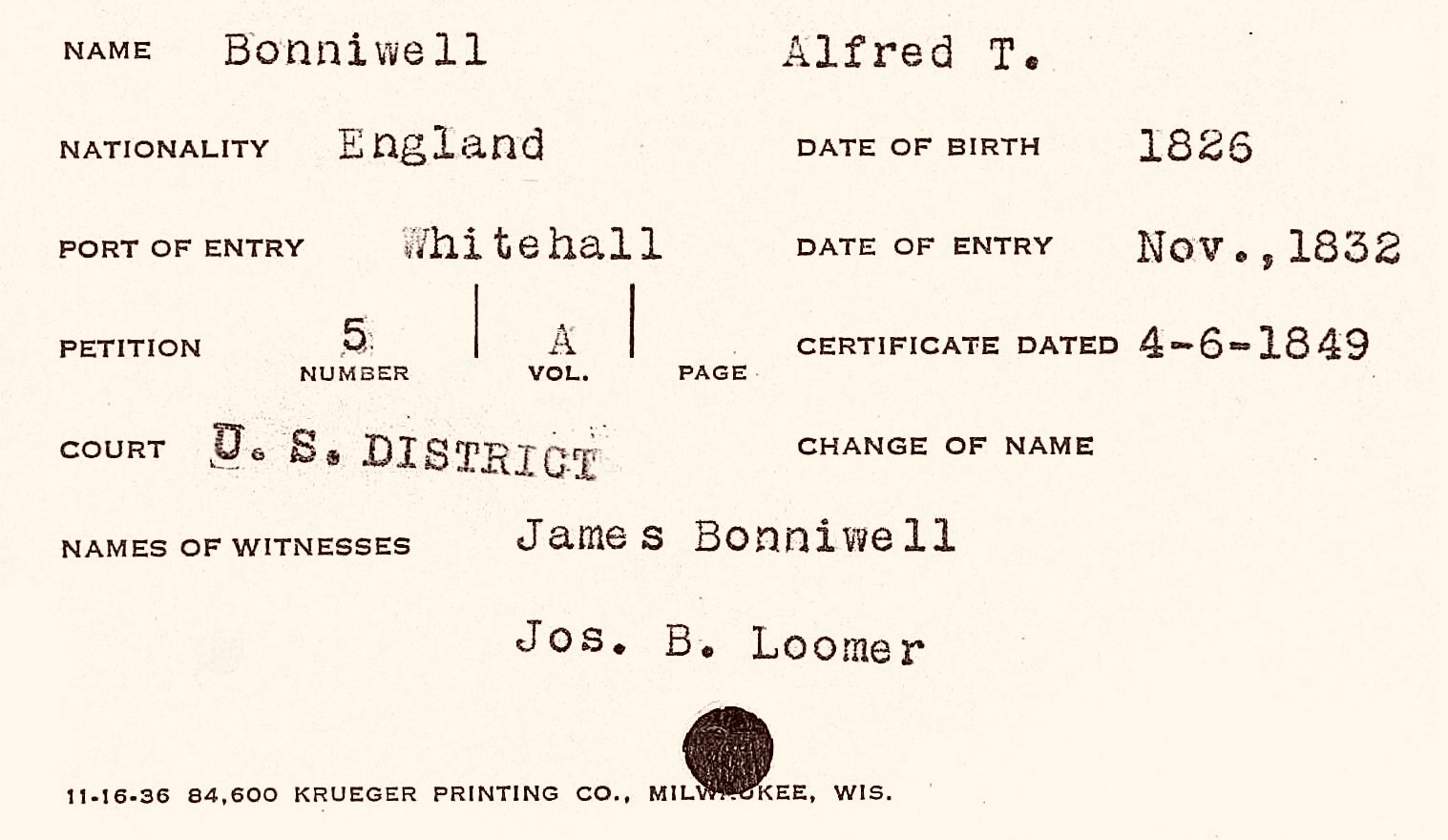
Many aspects of the lives of the Bonniwell family in New York are not well documented, including the activities of young Alfred T. Bonniwell. Alfred was only six and a half years old when his father died in Montréal in October, 1832. According to his naturalization papers (filed in Milwaukee on April 6, 1849, and summarized on this modern index card), we know Alfred entered the United States at Whitehall, New York, sometime in November, 1832.

This index card—and Alfred’s 1849 final citizenship document that it summarizes—are the only two official records that I have located that document Alfred’s years in New York state. Without some of the Bonniwell family papers cited in The Bonniwells, and the newspaper articles featuring Charles’s recollections, much of Alfred’s—and his family’s—life from 1832 to 1839 would be a complete mystery.

Based on brother Charles’s recollections, and other documents we have, we can assume that when Alfred came to the U.S. he was accompanied by his mother and several of his siblings, including brothers Charles (27), James (21), and Walter (age 8), and sister Eleanor (18). But not brother Henry (age about 14); more on Henry’s wanderings, below. But my understanding of which Bonniwell migrated via which port, to which destination, and what they did after arrival, is not completely clear. In fact, the family did not all travel together from Montréal to New York, via Whitehall, in November, 1832. Let’s look at the documents for more information…

Continue reading

Sewing for the family

Updated February 22, 2022 to fix a few minor typos, and to add a link to a brief history of American samplers, with an illustrated list of 73 of the 137 American samplers in the Textile Collection of the National Museum of American History.

In addition to raising and educating her children, a 19th-century farm wife like Mary Turck Clark had many other responsibilities, including planning and tending a farm garden, preserving its produce, preparing daily meals for the family and hired hands, and keeping the farm house clean and organized. And Mary, like many women of her era, probably made some or all of her own and her family’s clothes.

The sewing arts

Like most girls of her era, Mary Turck (born in New York, 1821) probably learned the craft of needlework from her mother and, perhaps, as part of her school education. When a young girl like Mary mastered some of the many practical and decorative sewing stitches, she might demonstrate her proficiency by making a sampler.

A sampler might feature simple examples of sewn letters, numbers and perhaps a popular saying or Bible verse. But many samplers were more complex and artistic. An accomplished embroiderer might produce an elaborate sampler featuring detailed images and texts, as in this 1829 sampler from Connecticut.

Thompson, Mariette (1817-1851), [Sampler with family register], 1829. Yale Art Gallery, public domain. Click to open larger image in new window.

Continue reading
What did you do on Sunday?

Updated Feb. 14, 2022 to add the qualifier “English-speaking” to the second paragraph.

Did you watch the Big Game? Go out to eat? Maybe you had to put in a shift at work? Or did you just take a break and relax at home, gearing up for another week on the job? Perhaps you went to church on Sunday.

In Jonathan and Mary Clark’s era, many of their Mequon neighbors would honor the Sabbath by refraining from all work and worshiping privately at home with their families, or gathering with small groups of neighbors to pray and hear the Word. Beginning in the early-1840s, the English-speaking Protestant Christians living near the Clark House—including many members of the Clark, Bonniwell and Turck families—gathered at the new, one-room, Bonniwell School to worship together at Sunday services; these were often led by their neighbor, the farmer and evangelical Methodist preacher Rev. James W. Woodworth.

Rev. Woodworth has concerns…

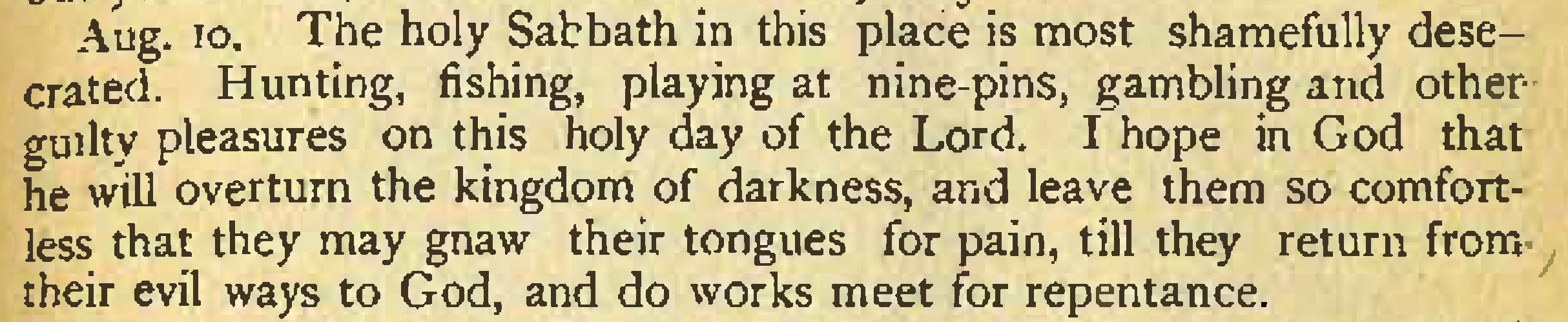
We have talked about Rev. Woodworth previously and, as we have seen before, he was constantly concerned about the state of his neighbors’ souls. It seems that even though the nation was still riding the wave of several decades of the religious revival now known as the Second Great Awakening, the settlers of the young Wisconsin territory and state were not always very good at “keeping the Sabbath holy.” In his diary entry for August 10, 1855, the reverend lamented:

Aug. 10. The holy Sabbath in this place is most shamefully dese­crated. Hunting, fishing, playing at nine-pins, gambling and other guilty pleasures on this holy day of the Lord. I hope in God that­ he will overturn the kingdom of darkness, and leave them so comfort­less that they may gnaw their tongues for pain, till they return from- their evil ways to God, and do works meet for repentance.

Woodworth, James W., My path and the way the Lord led me, Milwaukee, 1878, p. 79.

Continue reading

Winter fun, 1868

Updated Feb. 11, 2022, with information about Milwaukee’s “original Ice Bear,” Henry Kroeger (see comments, below).

The 24th Winter Olympic Games are now under way in Beijing, with a dizzying profusion of modern sliding and gliding winter sports. Of course, outdoor winter games and sports pre-date the modern Olympics by hundreds, if not thousands, of years. Among the oldest and most popular of these is ice skating.

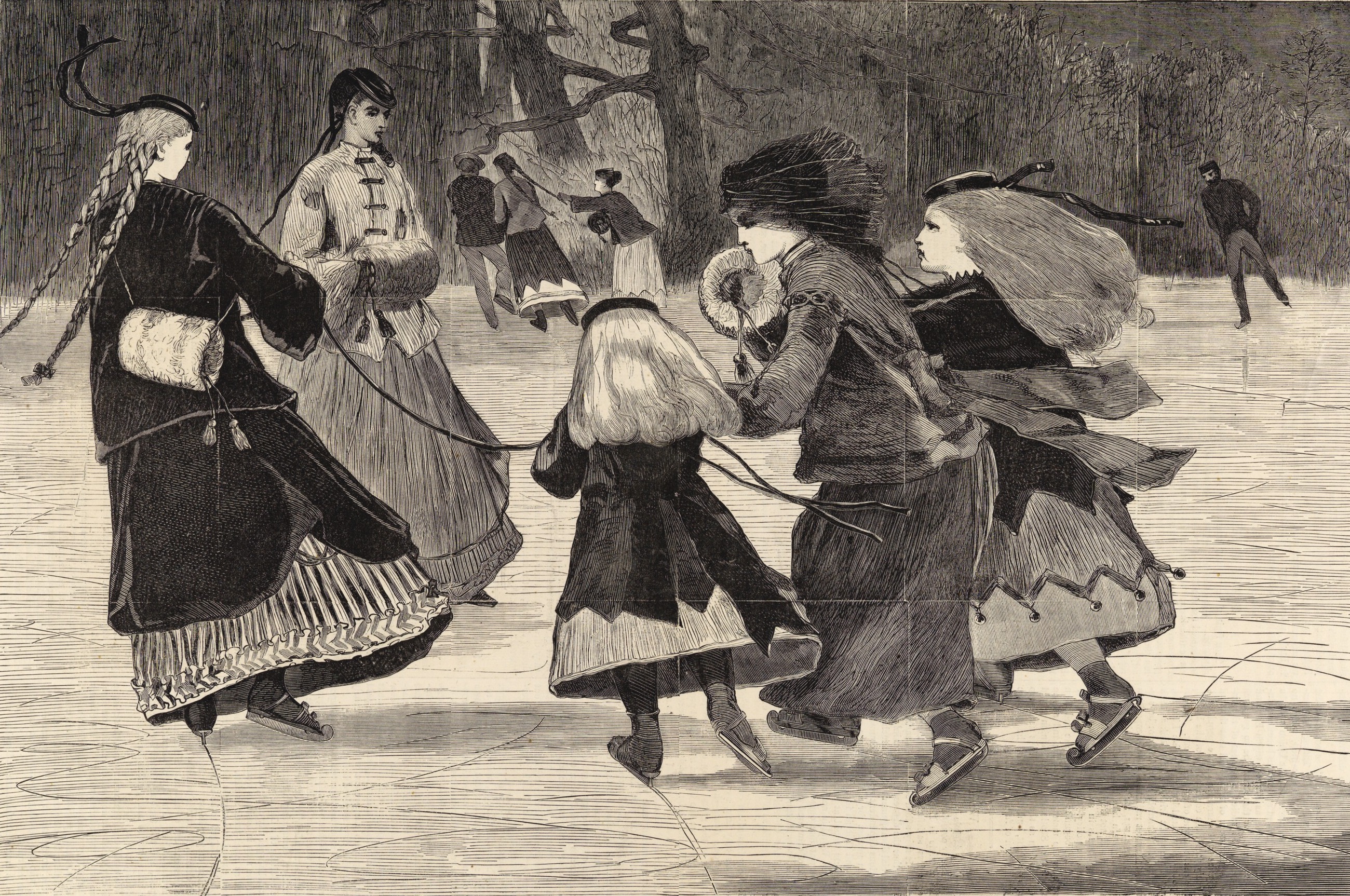
Homer, Winslow, “Winter” — A Skating Scene, from Harper’s Weekly, January 25, 1868. Smithsonian American Art Museum, The Ray Austrian Collection, gift of Beatrice L. Austrian, Caryl A. Austrian and James A. Austrian. Public domain, CC0. Click to open larger image in new window

Continue reading

Santa Claus visits Milwaukee, 1867

Tonight is Christmas Eve, and I thought you might enjoy an expanded reprise of our 1867 Santa Claus story, originally posted December 25 and 30, 2017. This year I have combined the two original posts and incorporated some new illustrations and a few revisions of the text. Here it is again, for your holiday enjoyment. Ho! Ho! Ho!

Christmas in early America

For many years now, Christmas has been celebrated by Americans as an important religious and (increasingly secular) community holiday. Christians gather to worship and commemorate the birth of Jesus, and they and other Americans enjoy a break from work to gather with family and friends to feast and exchange gifts. But it was not always this way.

In many of the American colonies, Christmas was not observed as a religious or secular holiday. The seventeenth-century Puritan leaders of the Massachusetts Bay Colony considered Christmas to be non-biblical and pagan influenced. In Boston and other parts of New England any observance of Christmas was prohibited and, for a few years, actually illegal:

Penalty for Keeping Christmas, 1659

Records of the Governor and Company of the Massachusetts Bay in New England. Printed by order of the Legislature, edited by Nathaniel B. Shurtleff, M.D., Vol. IV, Part I, 1650-1660, online at mass.gov (accessed 21 Dec. 2021). Click to open larger image in new window.

Transcription:
For preventing disorders arising in several places within this jurisdiction, by reason of some still observing such festivals as were superstitiously kept in other countries, to the great dishonor of God and offence of others, it is therefore ordered by this Court and the authority thereof, that whosoever shall be found observing any such day as Christmas or the like, either by forbearing of labor, feasting, or any other way, upon such accounts as aforesaid, every such person so offending shall pay for every such offence five shillings, as a fine to the country.

Christmas was not generally accepted as a holiday in many parts of the United States until after the federal government made December 25 a national holiday in 1870.

On the other hand…

The Massachusetts Puritans may not have approved of “observing any such day as Christmas or the like, either by forbearing of labor, feasting, or any other way,” but Christmas was “kept in other countries” and increasing numbers of immigrants from those countries to the United States—particularly from Victorian England, Catholic Europe, and the German Lands—celebrated the day in their new American homes with many of their accustomed religious observances and national traditions.

Continue reading

Christmas-Tide: a Turck family tale

A True Story! from an unexpected source

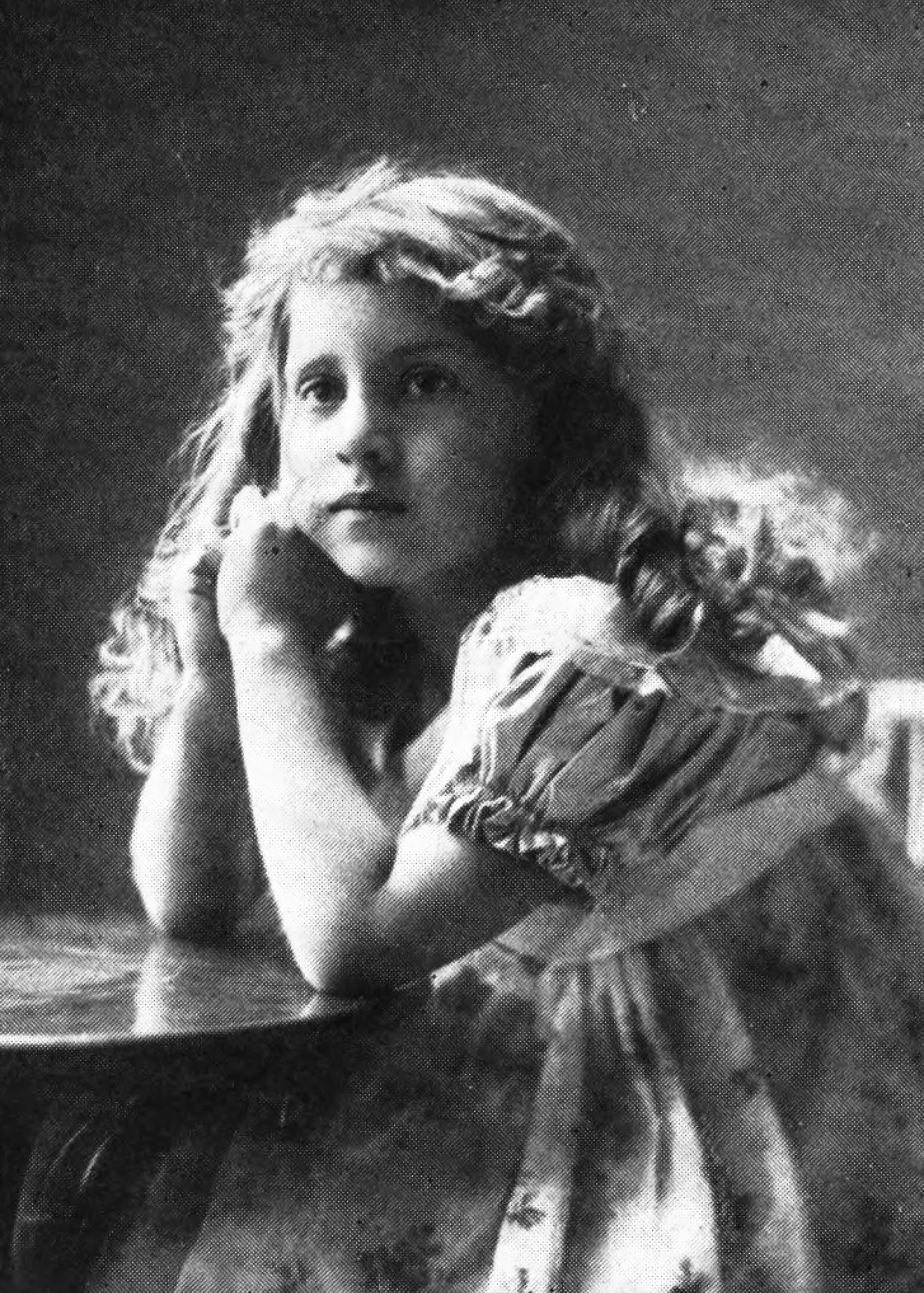
Christmas is coming, and to get in the holiday mood, how about a seasonal Turck family anecdote, “a true story,” as related in the pages of Correct English magazine, written, edited and published by Peter Turck’s granddaughter—and Mary (Turck) Clark’s niece—Josephine Turck Baker, and later collected with other similar tales and published as a book, Correct English in the Home, Chicago, 1909.

In the foreword to her book, the author explains:

When I was a little girl, like most children, I was very fond of listening to stories; but unlike most children, I did not care for fairy tales, my first question invariably being, ” IS IT A TRUE STORY?” I don’t want a “once upon a time” story.

This is a true story. The children, their names, the incidents narrated, are all true. Beatrice, Roschen, and the “Boitie,” are my children […]


For those who like really true stories of really true people with really true names, this little book is written. That it may instruct and entertain all readers, both little and big, young and grown up, is the earnest wish of


Yours for Correct English,
Josephine Turck Baker

Our Protagonists

Photo credits and dates: see notes below. Click gallery for larger images

Continue reading

Caroline gets married – but where?

May, 1861

In a recent post, Caroline Clark – public school teacher, we examined Caroline Clark’s brief tenure as a teacher in the grammar department of Milwaukee’s Ninth Ward School, and concluded:

Caroline Clark’s employment as a Grammar Department teacher began on September 1, 1860. According to the 1861 Report, she taught for eight months. That would mean she left her teaching position around the beginning of May, 1861. Why? One factor might have been her salary […] But the more likely reason for her departure from the Ninth Ward School was that on May 15, 1861, she married Milwaukee county farmer William Wallace Woodward. For much (all?) of the nineteenth century, it was customary for female school teachers to be single; once they married, they were expected to leave the profession and set up housekeeping with their new husband and, eventually, start a family of their own. I think it’s safe to assume that this is what happened to “Miss Caroline M. Clark” in May, 1861.

Finding Caroline’s marriage record

Long before I found Caroline’s 1893 biographical sketch, or her profile and interview in the Omaha Daily Bee (March 30, 1916, page 11), or read her several long obituaries, I was able to determine when—and whom—she married. How? By using the Wisconsin Historical Society’s invaluable—but not infallible—Pre-1907 Vital Records Database (Birth, Marriage, Death). Yes, the interface is a bit clunky, but if you search for “Clark, Caroline,” one of the results you’ll find is:

Seems plausible, right? But how do we know it’s “our” Caroline? And how do we match her with a spouse?

Continue reading

Caroline Clark – public school teacher

Leaving High School – August, 1860

As we discussed earlier, Caroline M. Clark (1840-1924), the oldest child of Mary (Turck) Clark and the late Jonathan M. Clark, studied for two years at Milwaukee’s first public high school, led by the noted educationist John G. McKindley. McKindley’s second academic “exhibition” of his Seventh Ward High School students took place at Albany Hall, Milwaukee, on August 9, 1861. It was McKindley’s final appearance as Principal of the Seventh Ward High School. I expect that 19-year-old Caroline M. Clark was there also, as the event marked the end of her years as a student in the Mequon and Milwaukee public schools.

After high school: teaching in Milwaukee?

Caroline’s 1893 biographical sketch included this statement:

After two years of study in the Milwaukee high school under John G. McKi[n]dley, famed as a teacher and organizer of educational work, she taught in the public schools of [Milwaukee].

Once she finished her high school studies, Caroline would have been qualified to teach Primary, Intermediate, or—perhaps—Grammar school classes in Milwaukee’s public schools. And she did.

Caroline got a job!

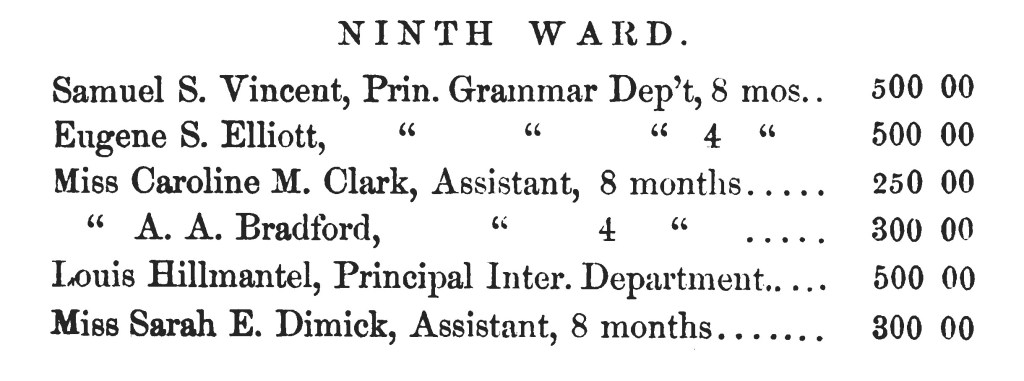
Annual Report of the Board of School Commissioners of the City of Milwaukee, to his honor the mayor and the common council of Milwaukee, for the year ending September 1, 1861, Milwaukee, 1861, p 15-16, via GoogleBooks.

“Miss Caroline M. Clark” was hired as an Assistant teacher in the Grammar Department of the city’s Ninth Ward school, for 8 of the 12 months of the academic year beginning September 1, 1860. For those eight months, she was paid a total of $250. (Why did she only work for eight months? More on that, below.)

Continue reading

Caroline M. Clark’s classroom & curricula, 1858-1860

Before laptops and iPads…

Currier & Ives. God Bless Our School. United States, ca. 1874. New York: Published by Currier & Ives, 125 Nassau St. Library of Congress. Click to open larger image in new window.

This colorful lithograph was published in 1874, but the books, maps, globe, slates for writing on, inkwell and dip pen, and other classroom supplies are very consistent with the materials that Caroline Clark would have encountered in her Seventh Ward High School classroom between 1858 and 1860. Her Clark siblings would have used similar materials during their time as students in the Milwaukee public schools during the 1860s and ’70s.

Continue reading