School supplies…and more, 1850

Almost three weeks remain until Labor Day marks the unofficial end of summer, and already many Wisconsin families are preparing for the new school year. “Back to School” promotions and special merchandise can be found in many local, chain, and online retailers. The history of “Back to School” as a marketing theme in the U.S. is obscure, but from what I’ve observed, it seems very much a post-World War II phenomenon.

With our current the focus on three-ring binders, zippered pencil cases, and boxes of 64 Crayolas (with the built-in sharpener!), have you ever wondered what kind of school or office supplies might have been necessary or useful for Jonathan and Mary Clark, their children, and their neighbors? Just for fun, here are just two of the many informative advertisements from the columns of the local papers, in this case the [Milwaukee] Daily Free Democrat, November 2, 1850, page 4:

Your local book & stationery shop

Milwaukee book & stationery retailer Rood & Whittemore had a fine selection of supplies for the scholar, letter writer, or professional man or woman of 1850:

Something for everyone, including the “country traders” and teachers that often served as buyers and distributors of school textbooks for their rural areas. For their efforts, the traders and teachers received “liberal terms,” presumably some sort of discount (for cash accounts, of course), from Rood & Whittemore.

And as you might expect, even from its earliest days Milwaukee was not a one-store town. In the words of the immortal Ron Popiel

Continue reading

Bad Handwriting: not just a problem from the past

I hope you enjoyed Monday’s post Help the Historian — what’s Nellie’s last name? and that you’re now working on your best guess for Nellie’s almost-illegible surname.

A historical handwriting puzzle like this is fun when the stakes are low and you don’t have any pressure to get the job done quickly. But did you know that there are several hundred federal employees in Salt Lake City who decipher thousands and thousands of bad or damaged printed and handwritten addresses every day? Let’s let YouTube’s excellent experience-it-yourself man, Tom Scott, show us how it’s done:

How the U.S. Postal Service reads terrible handwriting

It’s an amazing system, when you think of it. To begin with, the speed and accuracy of optical character recognition (OCR) technology has improved dramatically over the years. But when the writing is really bad, or smudged? Then the mail is viewed by the men and women of the USPS Remote Encoding Center in Salt Lake City process, and they read and key in 1.2 billion (that’s billion with a B) images of mail every year. My hat’s off to the USPS employees that can do this fast-paced detective work so efficiently, day after day. Meanwhile, how about you and your deciphering skills?

Continue reading

Help the Historian — what’s Nellie’s last name?

Today was supposed to be a lavishly illustrated “Monday: Map Day!” post, to accompany our recent posts on the Bonniwell family’s roots in Chatham, Kent, England. But, of course, I ran into some interesting—although pretty much off-topic and confusing—Bonniwell documents. These records added a previously unknown1 second marriage to the story of early Mequon pioneer, Jonathan Clark House neighbor, and Washington/Ozaukee county mover-and-shaker William T. Bonniwell.

It’s a complicated story. A second marriage for him, a second marriage for her, and there is a seven-year-old child named Nellie (of somewhat obscure parentage) living with them. So, of course, I dropped what I was doing and dug in to try and solve these new mysteries. I’m now close to understanding what happened with W. T. Bonniwell’s short-lived second marriage, but I have a problem.

Cn u rd ths?

Can you read this?

As always, click the images to open higher-resolution versions of each.

I read a lot of handwritten documents, mostly from about 1600 to the present day. I’m pretty good at deciphering most English and German writing styles from those years, but every now and then I’m stumped.

This is an 1870 document in the hand of young Nellie’s trustee, one Jedd P. C. Cottrill (sp?), acknowledging the receipt of her share of the estate of her deceased foster father, Nelson Webster. Nellie’s name is inside the red rectangle: Nellie J. [hmm?]. What do you think Nellie’s surname is supposed to be? Is the first letter an F or a T or something else? And after that? Is it ?urck, ?urch, ?inck, ?inch? I’m leaning toward Finch or, maybe, Finck. But I’m not sure. Perhaps if we compared other examples of Nellie’s surname from the same probate file…

Continue reading

1836: Astounding Produce News!

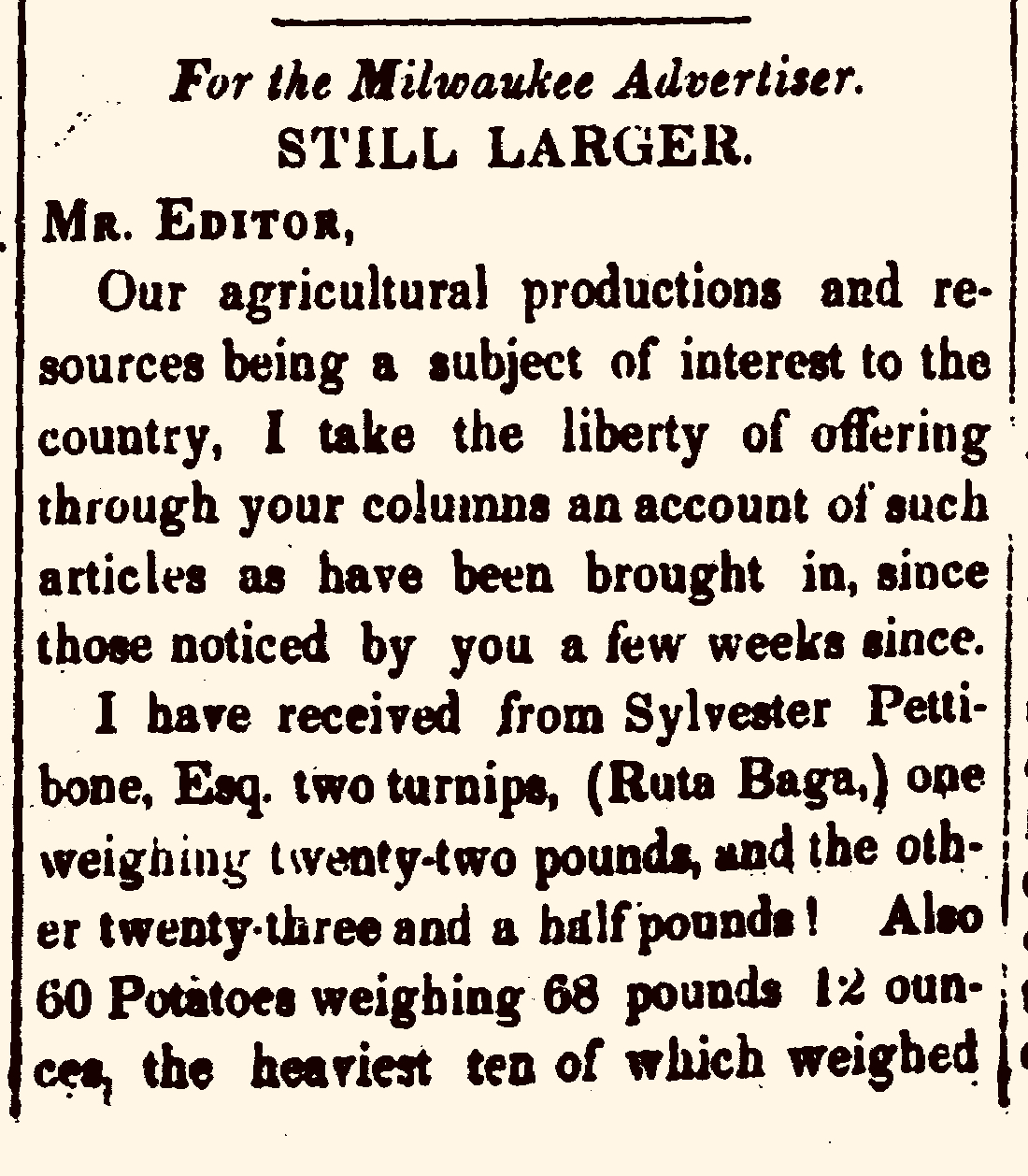
While researching the life of one of Mequon’s first white settlers, Isham Day, I ran across the following breathless bit of regional puffery and promotion, penned by Milwaukee co-founder Byron Kilbourn. It’s from page 2 of the November 17, 1836, edition of the Milwaukee Advertiser:

Lawyer Pettibone has, indeed, grown some astounding turnips (“Ruta Baga”), ‘taters, and carrots in the fertile soil of Milwaukee. Likewise Mr. Douglass with his enormous radishes and “common English” turnips. Have others done anything comparable? Indeed they have, and Mr. Kilbourn has the details…

Continue reading

Peter Turck and Irish Relief

It’s St. Patrick’s Day, and to celebrate, here’s an update of my CHH post from March 17, 2021. Slàinte!

Today is St. Patrick’s Day, originally the religious observance of the feast day of the principal patron saint of Eire.1 In honor of the day, let’s take a look at a few aspects of Irish life in early southeast Wisconsin and the involvement of Mary (Turck) Clark’s father Peter Turck in a civic effort to relieve Irish suffering during the Great Famine.

Irish immigrants in early Wisconsin

The first white visitors to Wisconsin were seventeenth-century French-Canadian explorers, priests and fur trappers, at home along Wisconsin’s lakes and rivers. They were followed by a smattering of British and French settlers in the mid- and later-eighteenth century. Cornish lead miners arrived in the southwest corner of the territory around the turn of the nineteenth-century. And in the mid-1830s, when the federal government officially “opened” the southeast corner of Wisconsin for settlement, there was a large influx of New Englanders and New Yorkers.

There were also a substantial number immigrants from across the sea among the Wisconsin pioneers of the 1830s and ’40s, including settlers from Upper and Lower Canada, Nova Scotia, Great Britain, the Netherlands, the German-speaking lands, and Ireland. By the time of the 1850 federal decennial census, Irish men, women, and children comprised the second-largest group of foreign-born immigrants in the state, surpassed in number only by immigrants from the German-speaking lands.

Continue reading

Christmas-Tide: an 1860s Turck family tale

A True Story! from an unexpected source

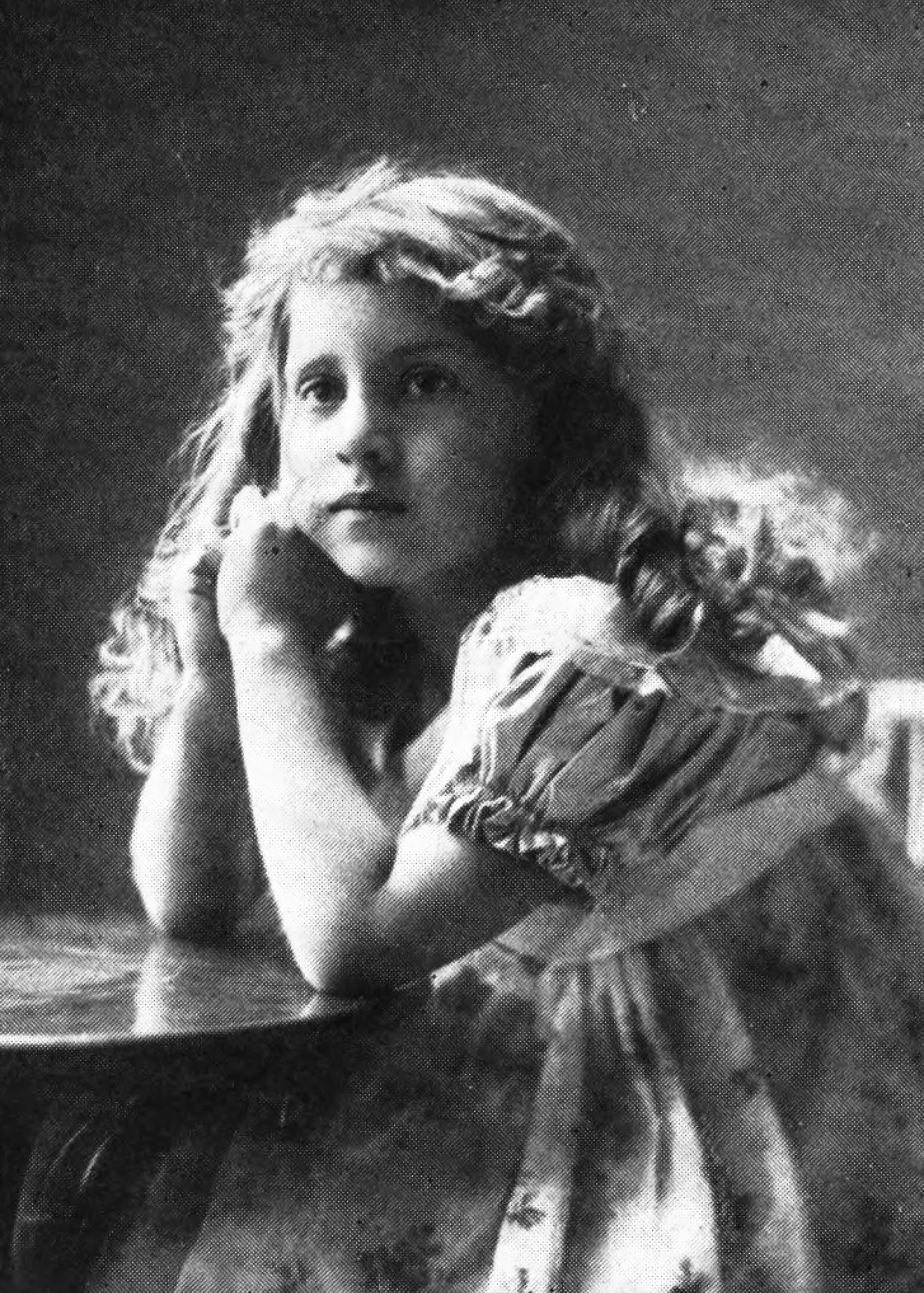
Christmas is here, and I thought you might enjoy this seasonal Turck family anecdote, “a true story,” as related in the pages of Correct English magazine, written, edited and published by Peter Turck’s granddaughter—and Mary (Turck) Clark’s niece—Josephine Turck Baker, and later collected with other similar tales and published as a book, Correct English in the Home, Chicago, 1909.

In the foreword to her book, the author explains:

When I was a little girl, like most children, I was very fond of listening to stories; but unlike most children, I did not care for fairy tales, my first question invariably being, ” IS IT A TRUE STORY?” I don’t want a “once upon a time” story.

This is a true story. The children, their names, the incidents narrated, are all true. Beatrice, Roschen, and the “Boitie,” are my children […]


For those who like really true stories of really true people with really true names, this little book is written. That it may instruct and entertain all readers, both little and big, young and grown up, is the earnest wish of


Yours for Correct English,
Josephine Turck Baker

Our Protagonists

Photo credits and dates: see notes below. Click gallery for larger images

Continue reading

Santa Claus visits Milwaukee, 1867

Tonight is Christmas Eve, and I thought you might enjoy an expanded reprise of our 1867 Santa Claus story, originally posted December 25 and 30, 2017. Last year I combined the two original posts and incorporated some new illustrations and a few revisions of the text. Here it is again, for your holiday enjoyment. Ho! Ho! Ho!

Christmas in early America

For many years now, Christmas has been celebrated by Americans as an important religious and (increasingly secular) community holiday. Christians gather to worship and commemorate the birth of Jesus, and they and other Americans enjoy a break from work to gather with family and friends to feast and exchange gifts. But it was not always this way.

In many of the American colonies, Christmas was not observed as a religious or secular holiday. The seventeenth-century Puritan leaders of the Massachusetts Bay Colony considered Christmas to be non-biblical and pagan influenced. In Boston and other parts of New England any observance of Christmas was prohibited and, for a few years, actually illegal:

Penalty for Keeping Christmas, 1659

Records of the Governor and Company of the Massachusetts Bay in New England. Printed by order of the Legislature, edited by Nathaniel B. Shurtleff, M.D., Vol. IV, Part I, 1650-1660, online at mass.gov (accessed 21 Dec. 2021). Click to open larger image in new window.

Transcription:
For preventing disorders arising in several places within this jurisdiction, by reason of some still observing such festivals as were superstitiously kept in other countries, to the great dishonor of God and offence of others, it is therefore ordered by this Court and the authority thereof, that whosoever shall be found observing any such day as Christmas or the like, either by forbearing of labor, feasting, or any other way, upon such accounts as aforesaid, every such person so offending shall pay for every such offence five shillings, as a fine to the country.

Christmas was not generally accepted as a holiday in many parts of the United States until after the federal government made December 25 a national holiday in 1870.

On the other hand…

The Massachusetts Puritans may not have approved of “observing any such day as Christmas or the like, either by forbearing of labor, feasting, or any other way,” but Christmas was “kept in other countries” and increasing numbers of immigrants from those countries to the United States—particularly from Victorian England, Catholic Europe, and the German Lands—celebrated the day in their new American homes with many of their accustomed religious observances and national traditions.

Continue reading

A familiar sight: St. Peter’s Church, 1839

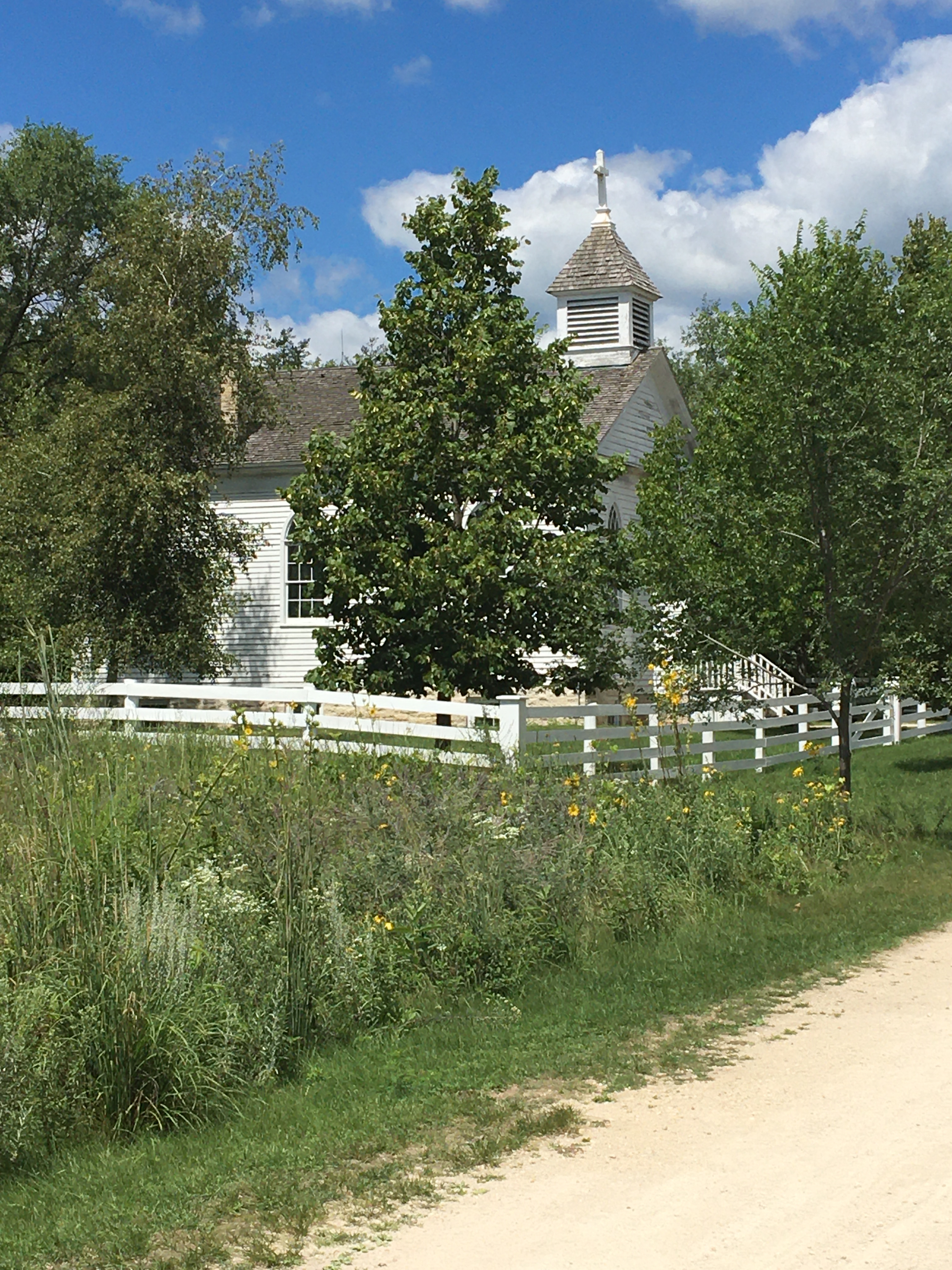
I had a fine day last month walking through our state’s wonderful outdoor living history museum, Old World Wisconsin, where I enjoyed this familiar view:

Photo credit: Reed Perkins, 2022.

There among the trees stood Milwaukee’s old St. Peter’s Roman Catholic Church, a building that was certainly well-known—at least on the exterior—to our Clark and Turck families.

The church was built in 1839, two years after young Mary Turck arrived in Wisconsin Territory with her parents, Peter and Rachael (Gay) Turck and her six siblings, and the same year that Jonathan M. Clark and the Bonniwell family first appeared in the Milwaukee-Mequon area.

Continue reading

RBOH: Chewing Gum

Lately, I’ve been spending a lot of time looking through digitized historical newspapers, trying to fill in some of the missing pieces of the Clark House story. In the process, I’ve managed to discover some unique and important information about the Clarks, Turcks, Bonniwells and their neighbors. And I’ve also run into a lot of off-topic but fascinating tidbits about daily life in Wisconsin during the Clarks’ era, such as this random bit of history:

Continue reading

Alfred Bonniwell documents – part 6: U.S. Citizen, 1849

Today’s post in our Bonniwell document series1 focuses on one important item, Alfred T. Bonniwell’s Petition for Naturalization as a United States citizen, completed in Milwaukee, at the U.S. District Court for the District of Wisconsin, November 6, 1849.

Bonniwell, Alfred, Petition for Naturalization 6 Nov 1849; for full citation see note 2, below. Click to open larger image in new window.

This petition was the final step in a relatively simple citizenship process whose basic outlines had not changed much since the early days of the republic. Alfred T. Bonniwell’s 1849 citizenship petition follows a form typical of such documents, but has a few extra bits of information that are particular to his immigration story. Let’s take a closer look.

Continue reading