In an earlier post, “Intensely Cold Weather,” we examined the negative effects of several episodes of bitterly cold winter weather during the Clark family’s era and shortly afterwards. Today we look at some of the positive aspects of frigid winters in our part of the Old Northwest.
It’s no secret. Wisconsinites like to do stuff outdoors in the winter cold. Ice fishing. Skating. Cheering for the Packers.
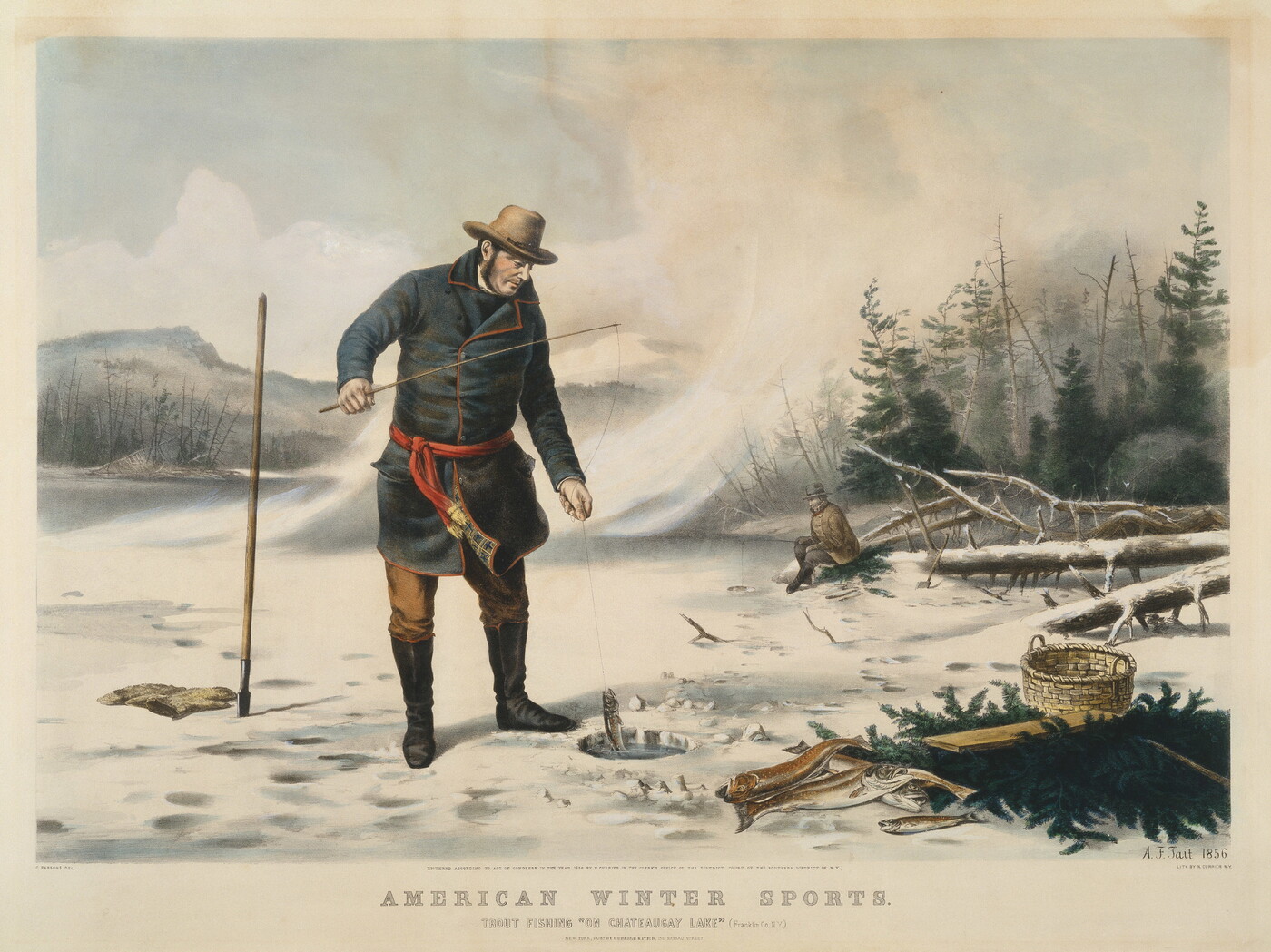
But the Green Bay Packers professional football team wasn’t organized until 1919, a full eighty years after Jonathan M. Clark bought his first parcel of Mequon land in 1839. So what did our intrepid Wisconsin pioneers do back in the mid-1800s when those deep snows fell and cold north winds began to blow? Well, if you believe the newspapers of the era, there was no finer way to occupy a clear, frosty day—or moonlit evening—than to bundle up, go outside, and enjoy a…
In our previous post, we were introduced to the Desmond family, early Irish immigrants to old Washington/Ozaukee county and neighbors of Jonathan and Mary Clark. To our good fortune, one of the Desmond sons, Humphrey Desmond, wrote a memoir of his father Thomas that includes some unique family genealogy and tales of pioneer days in our area.
If you missed Part 1, I suggest you go ahead and read that post first. Then return here to continue with Part 2 of selections from A Memoir of Thomas Desmond, with a chapter on The Desmond Genealogy, by Humphrey J. Desmond, 77 pages, Milwaukee, 1905. And remember: you can read the complete memoir at this link, which is a part of the admirably organized and comprehensive online genealogy project The Desmond Archives.
Pioneer Days
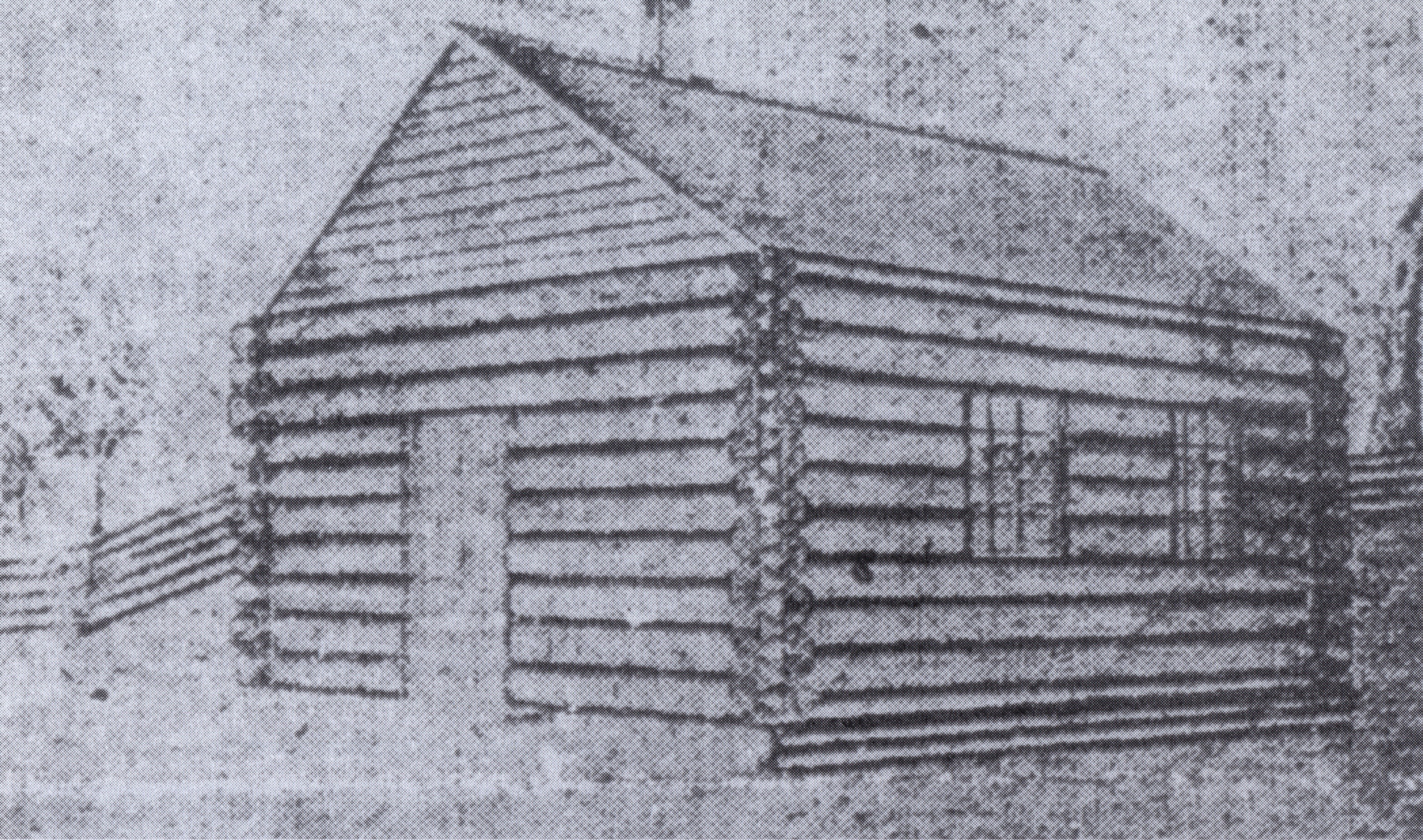
Chapter 3 of Desmond’s memoir will be of particular interest to CHH readers. It relates various early Mequon events, some involving the Desmond family’s Catholic faith, their Bonniwell neighbors, and the local school that the Bonniwells helped build in the early 1840s. That first “Bonniwell School,” located less than a mile west of the Jonathan Clark house on what is now the southeast corner of Bonniwell and Wauwatosa roads in Mequon, was sketched in 1864 by Evander Bonniwell. The sketch (above) is reproduced here from page 71 of George B. Bonniwell’s comprehensive family history, The Bonniwells: 1000 Years. (Used by permission.)
[31]        III.   PIONEER DAYS

THE "hazard of new fortunes" undertaken by the Desmond family involved the clearing away of woods with the ax of the pioneer and the building of a commodious log house.
    The pioneers of this neighborhood were the Bonniwell brothers, who had settled there about 1835 [sic, 1839], and it was known as the Bonniwell settlement.
    Indians still roamed the forests of southeastern Wisconsin in 1843. My [32] father, then ten years old, alone in the house one day, was visited by a brave to whom he gave a large loaf of bread. The Indian loosened his belt as he ate the loaf, and when it was all gone departed peaceably on his journey.
    There was a log school house to which my father went. Books were not plentiful in those days. He studied his spelling lesson during the noon hour from the book of a desk mate. He had to start at the foot of the class, but one day he got to the head and kept his place.
We’re having some very cold weather this weekend, not unusual for Wisconsin in mid-winter. But it got me thinking, wondering what sort of winter weather did the Clarks and Turcks and Bonniwells experience, and what effect the did the cold have on their daily lives?
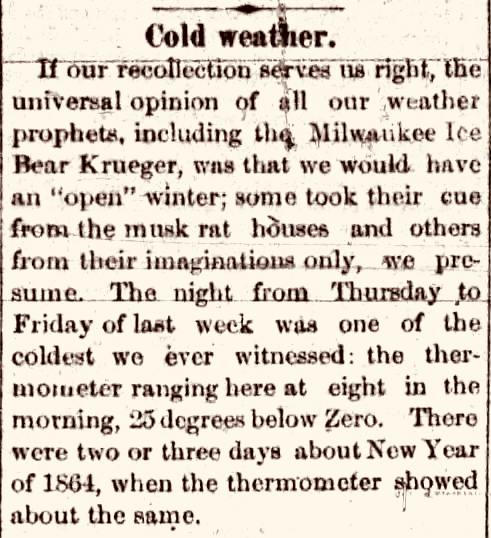
To find out, I started by searching digitized old newspapers, looking for the phrase “below zero,” in Wisconsin, between the years 1833-1899. Oh boy, did I get results! After narrowing my search to more local sources, I found this news item on page 2 of the Wednesday, January 2, 1884 issue of the Cedarburg News:
This article suggests that the winter of 1883-1884 was expected to be somewhat mild; an “open” winter was one with little or no snow cover on the ground. All the signs and predictions thought this would be the case. Apparently, the local muskrats had built their houses differently in 1883, as muskrats do when they expect a milder winter. The “universal opinion” of the “local weather prophets”—including Milwaukee’s famed “Ice Bear,” Henry Kroeger—thought so, too. But on the night of December 28-29, 1883, the thermometers in Cedarburg—just a few miles from the old Jonathan Clark farm—dropped to 25 degrees below zero (Farenheit). It was the coldest morning in decades.
But by the 1880s many of the older members of the Clark, Turck, and Bonniwell families had died, and many of the younger generation had left Ozaukee county and relocated to Milwaukee, Chicago, Minnesota, and elsewhere. Some or most of them may have missed this late-1883 cold snap. But this short article also mentions another, similar record cold spell, one that Mary Turck Clark and her children actually lived through, in Milwaukee, around the New Year of 1864.
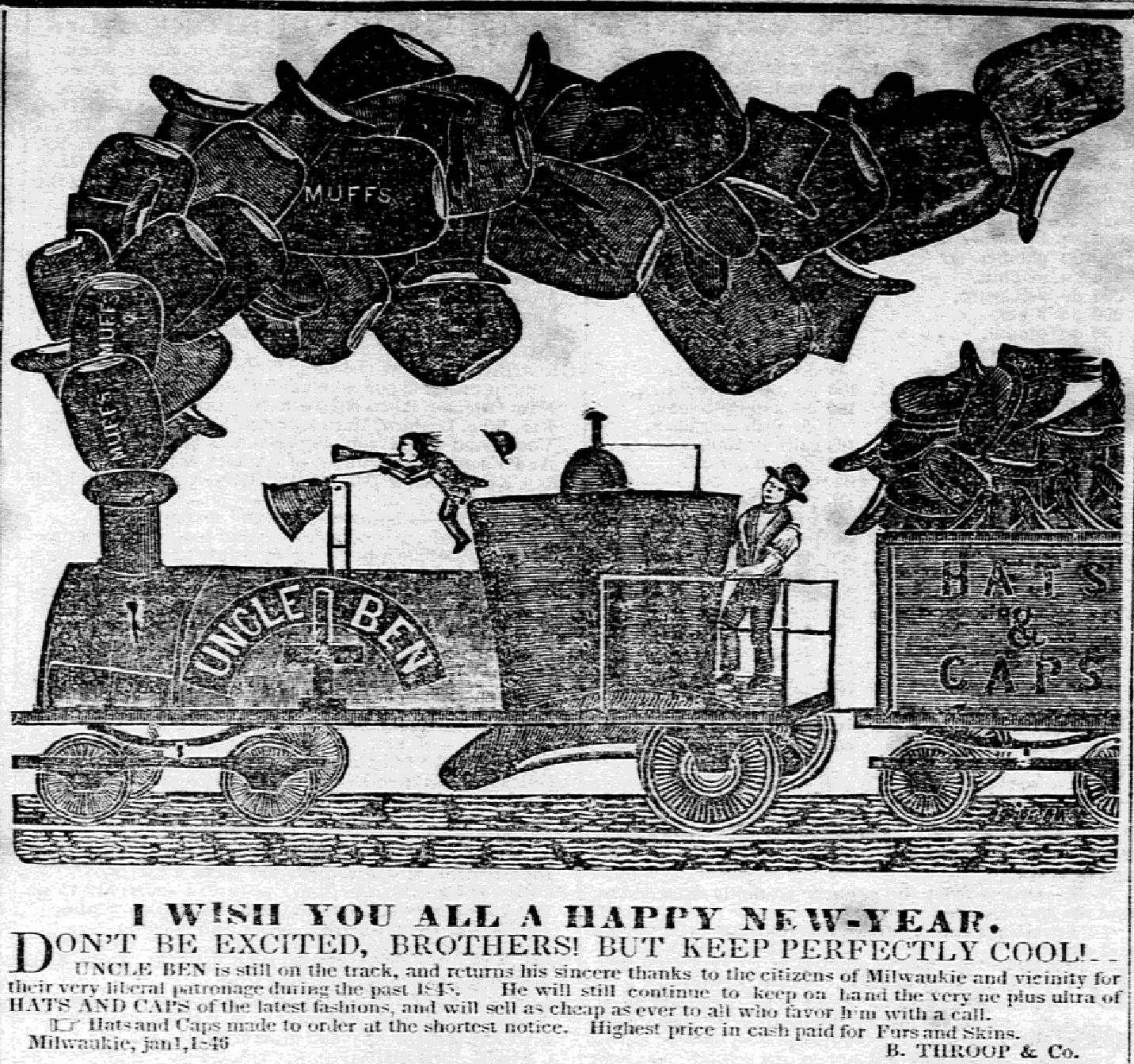
180 years ago, on New Year’s Day, 1846, this amusing woodcut appeared on page 3 of the Milwaukee Daily Sentinel, advertising the shop of pioneering Milwaukee merchant—and local character—Bazille “Uncle Ben” Throop:
That same morning, Jonathan and Mary Clark awoke to their fifth New Year’s Day together as a married couple. Living with them were their first three (of an eventual eight) children: Caroline (5 years old), Henry (almost 3) and Elizabeth “Libbie” (9 months). They were probably still living in their original log cabin home; it would be at least two more years until Jonathan M. Clark carved his name and “1848” in the keystone above the front door lintel of the two-story stone house that is now the Jonathan Clark House Museum.
Did the Clarks see “Uncle Ben’s” ad on January 1st? It’s not impossible, but I’d be at least mildly surprised if our young farm couple spent their earnings on a subscription to a Milwaukee daily newspaper. On the other hand, given their love of lifelong learning, it would not be out of character if they did. But we really don’t know.
As I write this, southeastern Wisconsin is in the midst of our first substantial snowfall of Winter, 2025-2026. In Jonathan and Mary Clark’s lifetime, the day after a storm like this meant it was time to hitch up the sleigh and have some fun “dashing through the snow.” Here’s a lightly-revised and expanded repeat of a post that celebrates Clark-era “sleighing time” and “jingle bells.” (And be sure to click the highlighted links for more vintage wintertime images and info.)
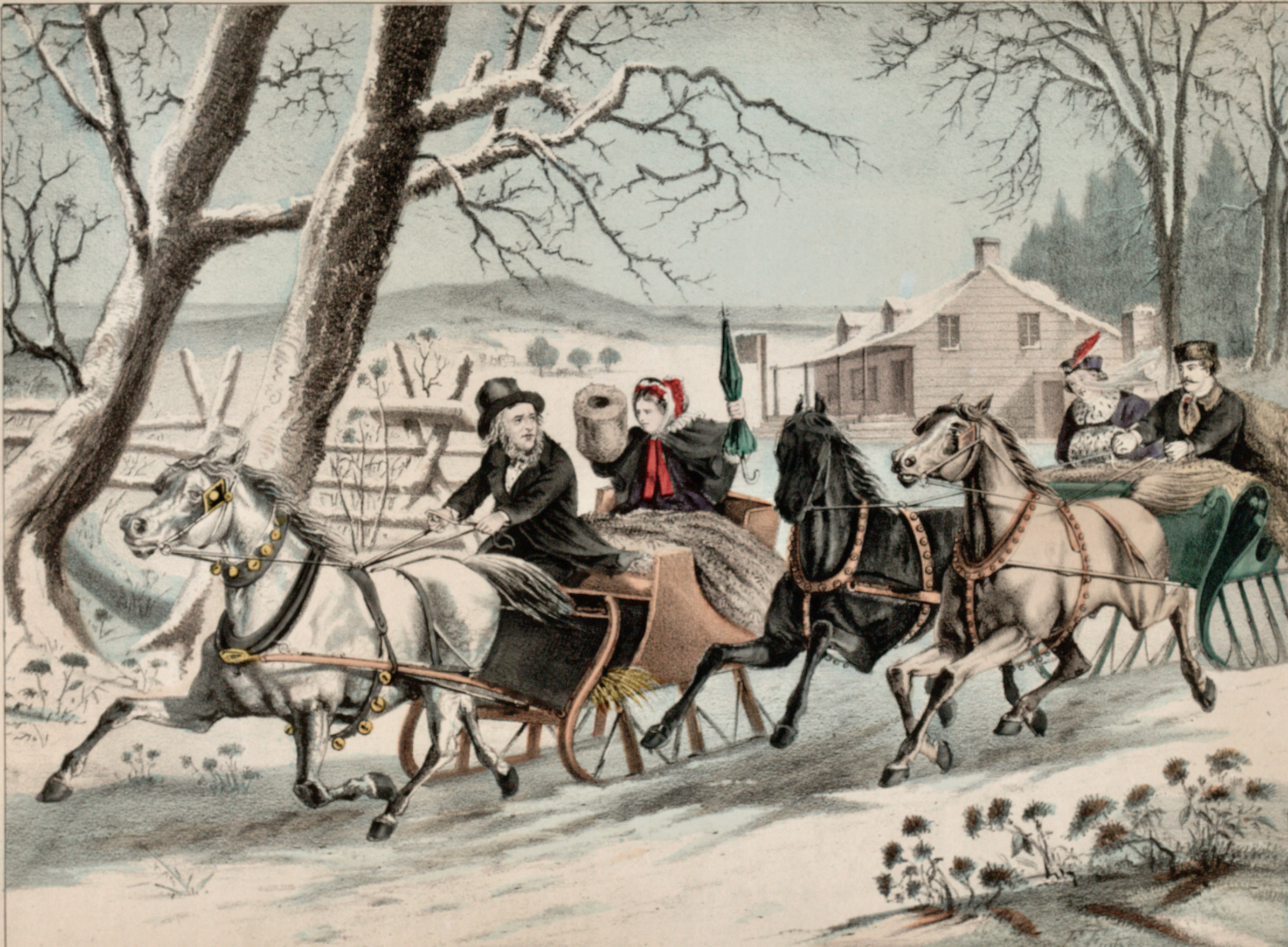
Kimmel and Forster, publishers, “Winter Pleasure in the Country,” circa 1865. National Museum of American History, Peters Prints Collection, Smithsonian Institution.1 Note the modest straps of jingle bells on the one-horse sleigh and the much more ostentatious—and louder—straps of bells on the two-horse sleigh.
Last winter, our earlier CHH posts Snow!, Shoveling out -and other winter chores and Stuff Happens – on a sleigh ride, got me wondering again about winter travel in old Washington/Ozaukee county during the Clarks’ era of the mid-1830s through the 1860s or so. Assuming most of the more successful farmers—such as the Clarks, Bonniwells and Turcks—owned a one- or two-horse sleigh, how easy was it to navigate that sleigh on the early county roads? Could you sleigh ride all the way to Milwaukee? And if you could, how long might that take?
Labor Day has come and gone, and for many this marks the unofficial “end of summer.” With that in mind, I thought you might enjoy a lightly revised and enhanced re-post of this CHH piece from 2023.
Many students start classes today. Others began school a week or two ago. Many Wisconsin families have spent the past few weeks (or months) preparing for the new school year, shopping for “Back to School” deals on clothing and school supplies at local, chain, and online retailers.
Harrison’s Columbian inks, black, scarlet, red, blue. [United States, publisher not transcribed], c. 1846. Library of Congress
Shopping for school supplies at the start of the school year is nothing new. But the origin of the now ubiquitous use of “Back to School!” as a marketing phrase is obscure. From what I’ve observed, it seems very much a post-World War II phenomenon. Yet with our current focus on three-ring binders, zippered pencil cases, and boxes of 64 Crayolas (with the built-in sharpener!), have you ever wondered what kind of school or office supplies might have been necessary or useful for Jonathan and Mary Clark, their children, and their neighbors? For a fun comparison, let’s take a look at just two of the many relevant advertisements from the columns of the Clarks’ local papers, in this case the [Milwaukee] Daily Free Democrat, November 2, 1850, page 4…
UPDATE: This was supposed to go out on Monday. I hit “publish” before the piece was ready. Here’s the updated 2025 version for your reading enjoyment. Sorry for any confusion (and, for you CHH subscribers, the premature email in your inbox).
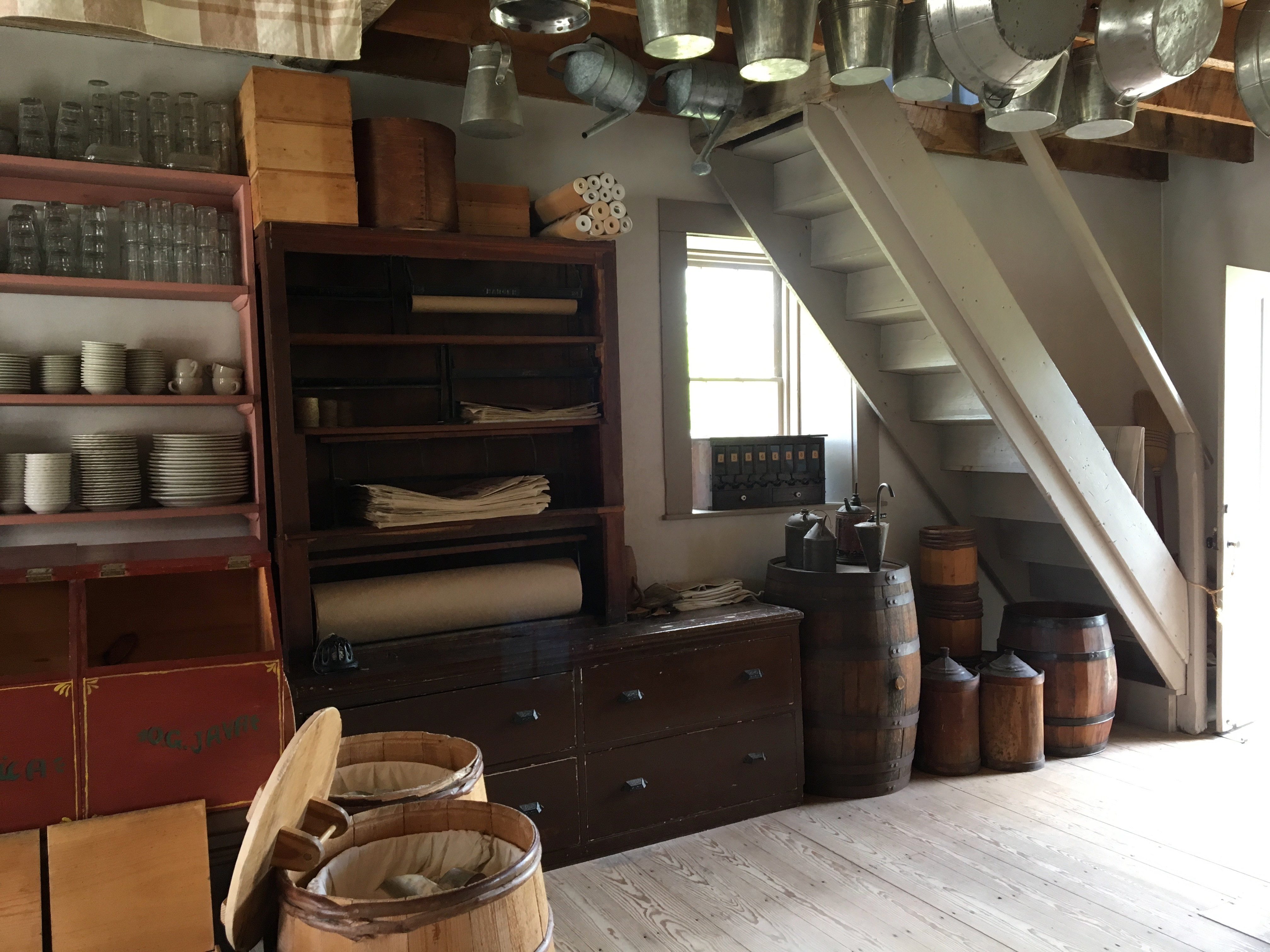
Monday, September 1st, is Labor Day, the holiday celebrating the working men and women of our nation, and I thought I’d commemorate the day with a lightly-revised re-post of this CHH piece from 2023. This Labor Day, as in 2023, I have to work a shift at our local mercantile establishment. You know, a store kind of like this one, only much bigger, stocked with just about anything you need for modern living:
Like many Americans, I don’t have the day “off” on Monday, and won’t be marching in a parade, but I’d still like to honor the holiday and salute the American worker, past and present. With that in mind, let’s revisit some of the nineteenth-century occupations we’ve talked about previously at Clark House Historian, highlighting a few of the many skills, trades, and occupations common during the Clark House era.
Since it is a holiday, I’m not going to add long commentaries to each photo. Enjoy the photo galleries, and be sure to click each gallery—and photo—to open and peruse larger versions of each image. And click the highlighted links to visit the original CHH posts, filled with lots more information about the different skills, tools, and jobs, and the full image credits.
Kimmel and Forster, publishers, “Winter Pleasure in the Country,” circa 1865. National Museum of American History, Peters Prints Collection, Smithsonian Institution.1
Talk of sleighs and sleighing in our recent CHH posts on Snow! and Shoveling out -and other winter chores, plus our January, 2022, essay on Stuff Happens – on a sleigh ride, got me wondering again about winter travel in old Washington/Ozaukee county during the Clarks’ era. Assuming most of the more successful farmers—such as the Clarks, Bonniwells and Turcks—owned a one- or two-horse sleigh, how easy was it to navigate that sleigh on the early county roads? Could you ride all the way to Milwaukee? And if you could, how long might that take?
Christmas is here, and I thought you might enjoy a repeat of this seasonal Turck family anecdote, “a true story,” as related in the pages of Correct English magazine, written, edited and published by Mequon pioneer Peter Turck’s granddaughter—and Mary (Turck) Clark’s niece—Josephine Turck Baker, and later collected with other similar tales and published as a book, Correct English in the Home, Chicago, 1909.
In the foreword to her book, the author explains:
When I was a little girl, like most children, I was very fond of listening to stories; but unlike most children, I did not care for fairy tales, my first question invariably being, ” IS IT A TRUE STORY?” I don’t want a “once upon a time” story. This is a true story. The children, their names, the incidents narrated, are all true. Beatrice, Roschen, and the “Boitie,” are my children […] For those who like really true stories of really true people with really true names, this little book is written. That it may instruct and entertain all readers, both little and big, young and grown up, is the earnest wish of Yours for Correct English, Josephine Turck Baker
Tonight is Christmas Eve, and I thought you might enjoy an expanded reprise of our 1867 Santa Claus story, originally posted in two parts, December 25 and 30, 2017. In 2021 I combined the two original posts and incorporated some new illustrations and a few revisions of the text. Here it is again, for your holiday enjoyment. Ho! Ho! Ho!
Christmas in early America
For many years now, Christmas has been celebrated by Americans as an important religious and (increasingly secular) community holiday. Christians gather to worship and commemorate the birth of Jesus, and they and other Americans enjoy a break from work to gather with family and friends to feast and exchange gifts. But it was not always this way.
In many of the American colonies, Christmas was not observed as a religious or secular holiday. The seventeenth-century Puritan leaders of the Massachusetts Bay Colony considered Christmas to be non-biblical and pagan influenced. In Boston and other parts of New England any observance of Christmas was prohibited and, for a few years, actually illegal:
Penalty for Keeping Christmas, 1659
Records of the Governor and Company of the Massachusetts Bay in New England. Printed by order of the Legislature, edited by Nathaniel B. Shurtleff, M.D., Vol. IV, Part I, 1650-1660, online at mass.gov (accessed 21 Dec. 2021). Click to open larger image in new window.
Transcription: For preventing disorders arising in several places within this jurisdiction, by reason of some still observing such festivals as were superstitiously kept in other countries, to the great dishonor of God and offence of others, it is therefore ordered by this Court and the authority thereof, that whosoever shall be found observing any such day as Christmas or the like, either by forbearing of labor, feasting, or any other way, upon such accounts as aforesaid, every such person so offending shall pay for every such offence five shillings, as a fine to the country.
Christmas was not generally accepted as a holiday in many parts of the United States until after the federal government made December 25 a national holiday in 1870.
On the other hand…
The Massachusetts Puritans may not have approved of “observing any such day as Christmas or the like, either by forbearing of labor, feasting, or any other way,” but Christmas was “kept in other countries” and increasing numbers of immigrants from those countries to the United States—particularly from Victorian England, Catholic Europe, and the German Lands—celebrated the day in their new American homes with many of their accustomed religious observances and national traditions.





 Clark House Historian