It’s that time of year again! And since I’m still working on a number of new but not-yet-ready projects, I thought you might enjoy this lightly-revised “Back to School” post from September 9, 2020.
There are a number of conflicting claims to the title of “first teacher” in Mequon. One of the first was Mary Turck Clark. She led classes for her siblings and four neighbor children in the loft of her father’s cabin in the summer of 1839.
The History of Washington and Ozaukee Counties, relates a number of other “firsts” for area schools and teachers. Among them is this story of how the school committee,1 led by Daniel Strickland (father of Sarah A. Strickland Clark), hired its first teacher.
I’m taking a bit of a break and have nothing new for you today. I have been doing a good bit of garden work around the house, and that reminded me of this post from April, 2021. Now we’re just finishing the first week of June, 2022, and it’s almost summertime. In southeastern Wisconsin the first spring flowers are done, and the next round of blossoms have been blooming for weeks. The tomato, bean and pepper seedlings are in the ground and doing nicely (although the rabbits have been nibbling on far too many green bean sprouts), and the roses are beginning to unfold. So even though this was originally an early-spring essay, I hope you enjoy this garden-themed repost from last year.
Planning the garden
It’s early April, and the growing season is not far off. For a farmer like Jonathan M. Clark, it’s a little early yet for plowing and sowing, but not too early to make plans and sharpen the tools. For a farmer’s wife, like Mary (Turck) Clark, it’s not too soon to think about the farm garden, its crops and layout.
I don’t know if Mary and Jonathan were regular readers of the popular and affordable farmers’ almanacs of their era; I wouldn’t be surprised if they were. There were many to chose from. Perhaps they had a copy of something like:
The Cultivator […], New Series, Vol. VII, Albany, 1850, title page. Click to open larger image in new window.
Our annual Memorial Day post, first published in 2020. This revised edition, originaly published in 2022, was inadvertently updated for the further-revised 2023 edition, making a few minor edits and adding new information about Evander B. Bonniwell’s service. So the original 2022 post is “gone” and I’m going to leave this revised-revised version of that post here for reference, in case it is bookmarked elsewhere on the blog or in a readers’ notes.
Graves of Unknown Union Soldiers, Memphis National Cemetery, photo by Clayton B. Fraser, (Library of Congress), public domain. Memphis National Cemetery is the final resting place of Mequon’s Watson Peter Woodworth, and almost 14,000 of his Union Army comrades.
Today is the day our nation officially observes Memorial Day. For many Americans, Memorial Day represents “the first day of summer,” and is traditionally celebrated with trips to the lake, picnics, parades, and sales on cars, appliances, and other consumer goods.
But for many of us, Memorial Day remains rooted in its origins as Decoration Day. The first national observance was in 1868, when retired general John A. Logan, commander and chief of the Grand Army of the Republic—the Union veterans’ organization—issued his General Order Number 11, designating May 30 as a memorial day “for the purpose of strewing with flowers or otherwise decorating the graves of comrades who died in defense of their country during the late rebellion, and whose bodies now lie in almost every city, village, and hamlet churchyard in the land.”
On this Memorial Day, let’s take a moment to remember what this day truly represents.
We have new partnership project with the Mequon Nature Preserve and MATC’s Kate Erickson, the Brown Bag Series: Mother Earth is Where We All Meet. Today is the second installment in the series, and our executive director Dana Hansen will be speaking on “European Settlement and the Shift of Mindset About the Earth.”
Old World Wisconsin, July, 2016. Photo credit: Anna Perkins. Click to open larger image in new window.
When the extended Bonniwell family arrived in Wisconsin Territory in May, 1839, youngest son Alfred T. Bonniwell was not quite two months past his 13th birthday, and his brother Walter was only two years older. Because of their youth, neither Alfred nor Walter were able join their mother and brothers as they purchased government land and established what became known as Mequon’s Bonniwell Settlement.1
That changed for Alfred on June 7, 1845, when his mother, Eleanor (Hills Bonniwell) Hyde, gave him the eastern 80 acres of her original federal land patent.
Hyde, Eleanor (grantor) to A. T. Bonniwell (grantee), deed for 80 acres, June 7, 1845. See note 2 for source and details. Click to open larger image in new window.
Alfred would buy and sell several other properties in the 1850s and ’60s, but he held on to this parcel until his death, fifty years later. Let’s see what he got…
Today’s post in our Bonniwell document series1 focuses on one important item, Alfred T. Bonniwell’s Petition for Naturalization as a United States citizen, completed in Milwaukee, at the U.S. District Court for the District of Wisconsin, November 6, 1849.
Bonniwell, Alfred, Petition for Naturalization 6 Nov 1849; for full citation see note 2, below. Click to open larger image in new window.
This petition was the final step in a relatively simple citizenship process whose basic outlines had not changed much since the early days of the republic. Alfred T. Bonniwell’s 1849 citizenship petition follows a form typical of such documents, but has a few extra bits of information that are particular to his immigration story. Let’s take a closer look.
Continuing our look at the life of Alfred Bonniwell, today’s post focuses on two documents, the Wisconsin territorial censuses of 1846 and 1847. We’ll take a close look at the Bonniwell families as enumerated on the Wisconsin territorial census of 1846, and discuss briefly the status of the 1847 census schedules for old Washington/Ozaukee county.1
The Wisconsin Territorial census of 1846:
The next Wisconsin territorial census after 1842 was officially enumerated on June 1, 1846. The record of Mequon’s various Bonniwell families begins on the third line of page 43 of the Washington county schedules:
For full citation, see note 2, below; image lightly tinted. Click to open larger image in new window.
For our purposes today, the key “heads of families” and their households begin on line 3. They are the households of:
We see that by mid-1846 there were seven Bonniwell family households in Mequon’s “Bonniwell Settlement.” Five were headed by Bonniwell sons: William T., Charles, James, George and Henry, and another by Bonniwell brother-in-law Philip Moss. And Matriarch Eleanor (Hills Bonniwell) Hyde still led her own substantial household.
Who’s who in 1846?
As we noted in our discussion of the 1842 territorial census, identifying “who’s who?” in each family takes some guesswork, and the identifications are never 100% certain. But let’s try and make some educated guesses about who is living with whom in each of the 1846 Bonniwell family households. Let’s start with the families of the Bonniwell sons:
Continuing on with our series of Alfred Bonniwell documents, today’s post looks at one of two censuses that (probably) record Alfred Bonniwell in Wisconsin Territory between the federal decennial censuses of 1840 and 1850. If you need to catch up, our previous installments are here, here, here, here and here. UPDATED May 22, 2022, to correct Charles Bonniwell, Sr.’s birth year to 1806
The Wisconsin territorial census of 1842
For background on the 1842 Wisconsin territorial census, its enumeration in old Washington/Ozaukee county, and its relation to the Clark, Turck and Bonniwell families and their neighbors, you’ll want to read Census Records for the In-Between Years: 1842.1
The official enumeration date for this census was June 1, 1842; the enumeration of old Washington county—still attached to Milwaukee County for legal purposes—was done by Levi Ostrander and officially completed on July 1, 1842. Here’s page 65 of that census. The extended Bonniwell family—and some of their notable neighbors—are circled in red.2
Full source details in note 2, below. Click to open larger image in new window.
Let’s take a closer look at each of these families and try and understand which Bonniwells were living where, in Mequon, in mid-summer, 1842…
Today’s post continues our series about the life of Alfred Bonniwell, youngest son of Mequon’s Bonniwell family, and brother-in-law of Jonathan and Mary (Turck) Clark. If you missed them, our first installments are here, here, here and here. And for more on how the Bonniwells got from New York to Wisconsin in 1839, see Erie Canal – the Bonniwell Family 1832-39 , complete with a handsome, annotated map.
Alfred enters the public record
In our previous posts, we have discussed the lack of specific records documenting Alfred Bonniwell’s life after his baptism in Chatham, Kent, England in 1826, through his migration to Canada and his years in New York.1 That began to change once the family arrived in Wisconsin. Today I’d like to add to our knowledge of Alfred and his family by investigating an essential census schedule that provides important information about their first year in Wisconsin.
1836 & 1838 – Wisconsin’s first territorial censuses
The Bonniwells were still in New York at the time of Wisconsin’s first two territorial censuses in 1836 and 1838, but other notable Mequon pioneers were enumerated as they claimed and cleared land for new farms. If you missed our discussions of these early censuses, you can catch up by reading: • Census Records for the In-Between Years: 1836, locating Jonathan Clark’s unit as they cut the Military Road along the Fox River, and • Census Records for the In-Between Years: 1838, the first census for the original Washington county.
1840 – Federal decennial census
The 1840 federal decennial census2 is the first census that records members of the Bonniwell family in Wisconsin. It was enumerated in “Wiskansin Territory, Washington County, June 1, 1840.”
Ancestry.com. 1840 United States Federal Census [database on-line], Washington, Wisconsin Territory; Roll: 580; Page: 123; Hyde and Bonniwell households; Family History Library Film: 0034498. Image annotated, lightly tinted, and cropped. Click to open larger image in new window.
Today’s post continues our series about the life of Alfred Bonniwell, youngest son of Mequon’s Bonniwell family, and brother-in-law of Jonathan and Mary (Turck) Clark. If you missed them, our first installments are here, here and here. UPDATED, February 2, 2022, to include additional information and a link to an earlier post about Bonniwell brother-in-law Philip Moss. UPDATED, May 22, 2022, to correct Charles Bonniwell’s birth year (should be 1806)
Following their father’s death and burial in Montréal, Lower Canada, on October 18, 1832, the Bonniwell family was at a crossroads. Their original plan to patent land in Lower Canada had to be abandoned. As eldest son Charles Bonniwell recalled;
[…] the family received letters from the brothers who had located in New York [George and William] to come there without delay, and so [we] lost no time in taking the trip by way of Lake Champlain and Whitehall. I went to work in New York [City] where my brothers had employment at the navy yard.1
Whitehall, New York state’s port of entry at the south end of Lake Champlain, was an important waypoint for the Bonniwells, as it would also be for Jonathan M. Clark and other future Mequon neighbors. For more on that, including a handsome lithograph of Whitehall as it appeared c. 1828-1829, see How’d they get here? – JMC, the Bonniwells, and Whitehall, NY
As it turns out, Charles Bonniwell’s statement, “[we] lost no time in taking the trip by way of Lake Champlain and Whitehall,” may be a bit of a generalization. While I have not had a chance to collect or examine copies of the actual naturalization documents for all the Bonniwell boys, the modern index cards for those papers indicate that at the time of father William T. B. Bonniwell’s death the family was already dispersed at several locations. They would eventually reunite and migrate to Wisconsin Territory in 1839.
Where’s Alfred?
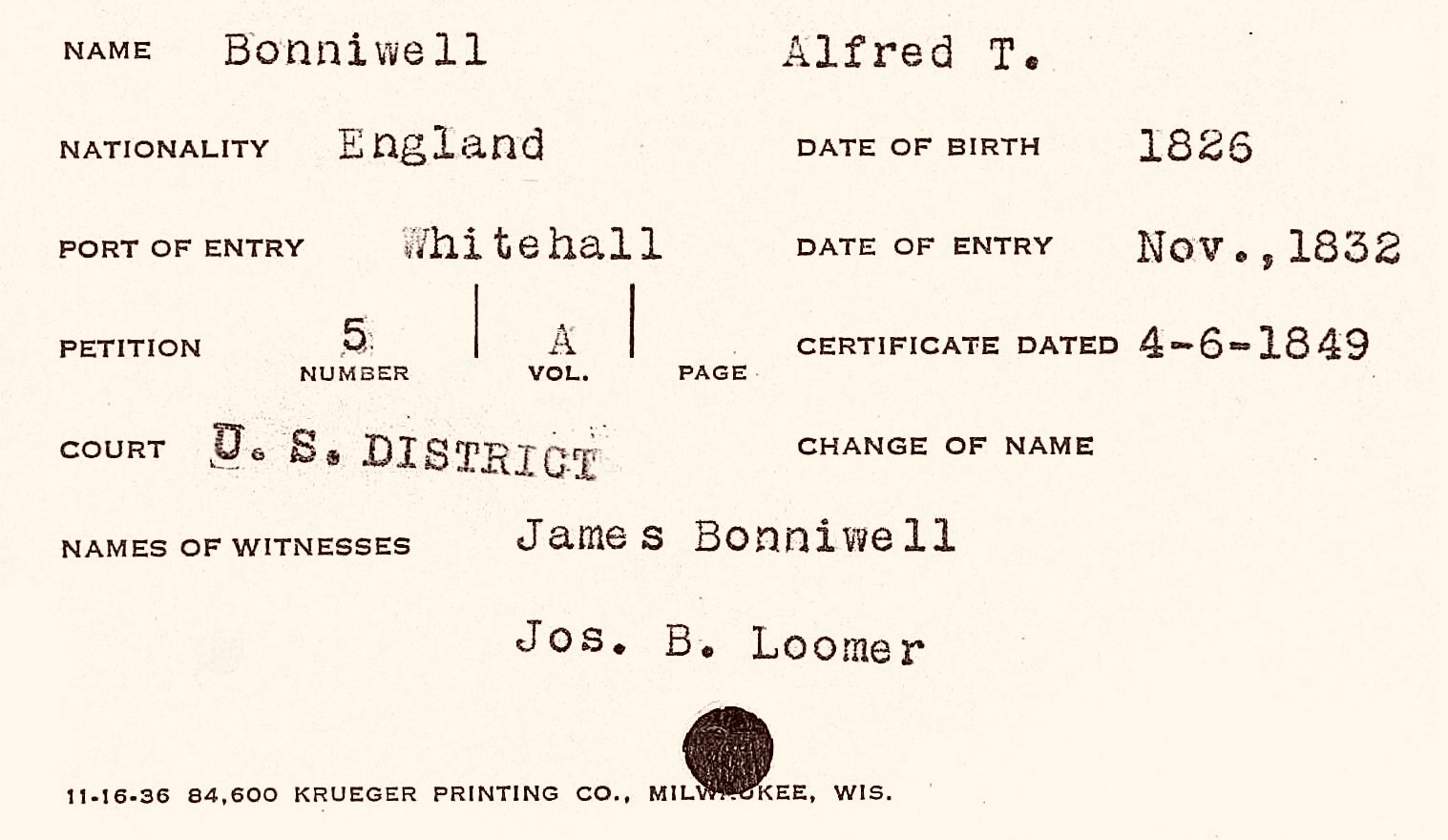
Many aspects of the lives of the Bonniwell family in New York are not well documented, including the activities of young Alfred T. Bonniwell. Alfred was only six and a half years old when his father died in Montréal in October, 1832. According to his naturalization papers (filed in Milwaukee on April 6, 1849, and summarized on this modern index card), we know Alfred entered the United States at Whitehall, New York, sometime in November, 1832.
This index card—and Alfred’s 1849 final citizenship document that it summarizes—are the only two official records that I have located that document Alfred’s years in New York state. Without some of the Bonniwell family papers cited in The Bonniwells, and the newspaper articles featuring Charles’s recollections, much of Alfred’s—and his family’s—life from 1832 to 1839 would be a complete mystery.
Based on brother Charles’s recollections, and other documents we have, we can assume that when Alfred came to the U.S. he was accompanied by his mother and several of his siblings, including brothers Charles (27), James (21), and Walter (age 8), and sister Eleanor (18). But not brother Henry (age about 14); more on Henry’s wanderings, below. But my understanding of which Bonniwell migrated via which port, to which destination, and what they did after arrival, is not completely clear. In fact, the family did not all travel together from Montréal to New York, via Whitehall, in November, 1832. Let’s look at the documents for more information…


 Clark House Historian