RBOH: Weston & Western, Loomis & Loomer, and how do you pronounce Isham?

Time for a few Random Bits of History: Early Mequon Settlers’ Disambiguation Edition.

John Weston & John Western

Mequon’s first postmaster, John Weston, is mentioned many times in the essential local history book, the History of Washington and Ozaukee Counties, Wisconsin … Illustrated. Western Historical Publishing Co., Chicago, 1881. Using the “Find” function on my PDF copy of the book,1 I found results for “John Weston” on pages 475, 476, 523, 524 and 545.

There is also an entry for “T. Weston” among the names on the “First Poll-List of Washington County” on page 316. I am confident that this is a typographical error and that “T. Weston” is actually John Weston.

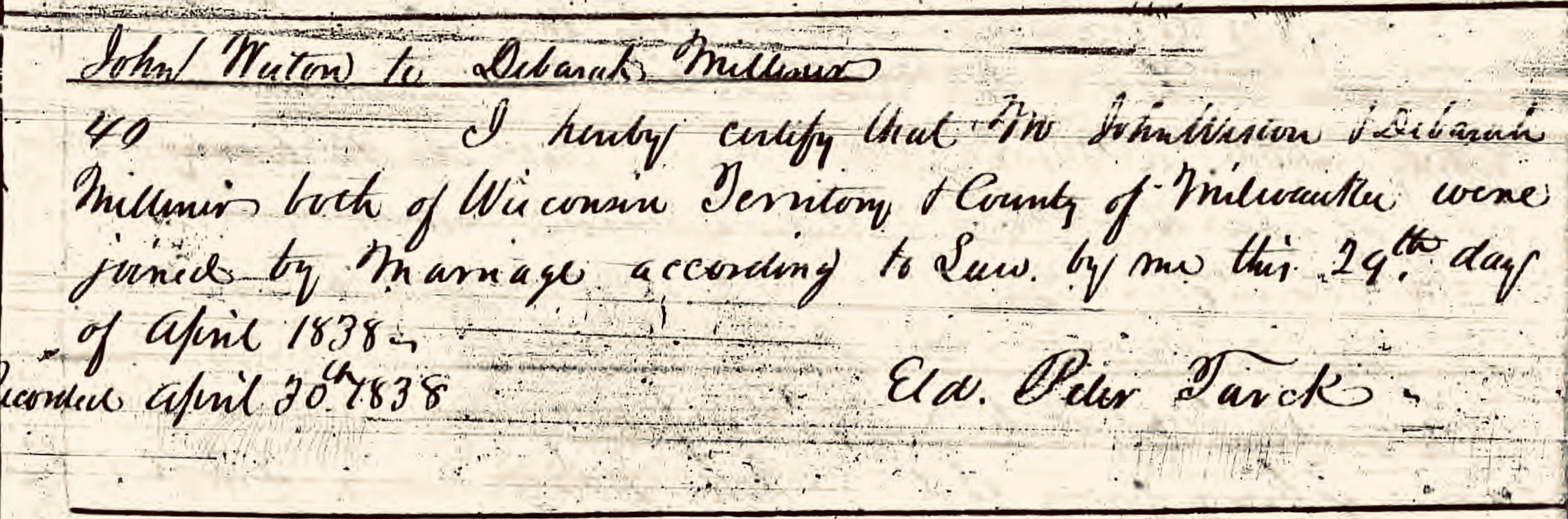
The same source also records, among the early area settlers, one “John Western,” on pages 316, 477 and 478. Is this the same man as John Weston? I have carefully compared a number of sources, including the early minutes of the county road supervisors and deeds in the Washington/Ozaukee county deed books, and I am convinced that during the early years of settlement in the Mequon-Milwaukee area, “John Weston” and “John Western” are the same person, namely John Weston, born in New York about 1800, and married to Deborah Milliner in Milwaukee County in April, 1838. I’ll have examples from the documents that explain my reasoning in a future post.

Fun fact: Mary (Turck) Clark’s father, (Baptist) “Elder” Peter Turck, was the officiant at the Weston-Milliner wedding in 1838. It was the fortieth marriage recorded in the first volume of marriage records for Milwaukee county (and its still-attached for judicial purposes neighbor counties, including old Washington/Ozaukee county).2

With the Weston & Western mystery solved—for the moment—let’s see what other bits of error and confusion we can clear up…

Continue reading

Meet the neighbors: the Loomis family

I’m in the middle of several larger CHH research projects and I find myself swamped with information on early Mequon area pioneers. So rather than wait until I’ve got it all sorted out and then organize it into a big essay or two (or more!), I’ll be putting up some of these new bits and pieces on the blog as I find them.

Today’s subjects are the families of Jonathan Loomis (1776-1849) and his eldest child, Issac Chester Loomis (1802-1882), two of old Washington/Ozaukee county’s first white settler families. I’ve mentioned some of these folks in previous CHH posts. And while the Loomis name does appear in some of the early county histories and land records, so far I’d not been able to learn much about the family or how they came to the Wisconsin Territory in the 1830s. In fact, given that the mid-1800s penmanship on some of the source documents was often florid to the point of being unreadable, I was sometimes unsure whether documents discussing or signed by “J. Loomis” versus “I. Loomis” represented the same man, or two individuals. Today’s source goes a long way toward solving these questions.1

Descendants of Joseph Loomis in America

Loomis, Elias, and Charles Arthur Hoppin. Descendants of Joseph Loomis in America, and his antecedents in the old world. edited by Loomis, Elisha S [Berea? O, 1909], Library of Congress.

As luck would have it, I just ran across a useful digitized book in the collection of the Library of Congress, titled Descendants of Joseph Loomis in America, and his antecedents in the old world. I’m not an expert in Loomis genealogy, and thus not entirely sure how accurate this book is, but what I have read here mostly checks out when compared to what I have found elsewhere. With that said, below are the key bits of the book that are related to very early Washington/Ozaukee county history and, in particular, Isaac Chester Loomis and his family. What follows is taken verbatim from pages 193 and 390-391, though I’ve taken the liberty of expanding many of the abbreviations and adding a few paragraph breaks for ease of reading. I’ve also added a few footnotes to explain some possibly obscure references.

Let’s begin with the patriarch of the family, Jonathan Loomis…

Continue reading

Old Washington/Ozaukee county’s first postmasters, 1837-1844

I’m working on a subject suggested by my friends Sam Cutler and Bob Blazich from the Mequon-Thiensville Historical Society. Among other projects over the last few decades, they and their colleagues at the MTHS have restored what is believed to be Ozaukee county’s oldest building on its original foundation, the historic Isham Day house, and developed its interior into the Mequon River Postal Museum. Now my friends at the MTHS want to know more about the life of Mequon River Post Office’s original postmaster, one of Mequon’s very first pioneer settlers, John Weston.

Isham Day house, exterior, west front. Photo credit: Anna Perkins, 2021

So for the last several weeks I’ve been doing a great deal of behind-the-scenes reading and re-reading of primary and secondary sources, as well as a lot of searching for additional relevant documents, including early Milwaukee and Washington/Ozaukee county deeds and other land records. In the process, I’m learning a lot about John Weston, Isham Day, Henry Thien, and some of our other first white settlers. But I’m not quite ready to write a John Weston profile, and I still need to clear up some mysteries about Isham Day’s land and house, too.

First Postmaster(s)

New post office…at Mequan River…John Weston appointed postmaster, Milwaukee Advertiser, Oct. 10, 1840, page 2

Let’s get our bearings by making an accurate list of the county’s first postmasters and their terms of office. Our source is from the National Archives in Washington, DC, the Record of Appointment of Postmasters, 1832-Sept. 30, 1971; Records of the Post Office Department; Record Group Number: 28; Series: M841; Roll Number: 144. County: Polk – Wood, Vol. 12B, circa 1832-1844, pages 794-795, currently available via Ancestry.com as U.S., Appointments of U. S. Postmasters, 1832-1971 [database on-line], 2010, image 428 of 583 (accessed 18 Jan 2024). Here’s the microfilmed image of the two-page ledger recording Washington county’s first post offices and postmasters, slightly retouched to make for easier reading:

Click the image for a higher-resolution view, and then read on for more details about old Washington/Ozaukee county’s first two post offices and their original postmasters.

Continue reading

CHH blog roundup, 2023

As the volunteer historian for the Jonathan Clark House Museum, it’s my privilege to investigate, document, and share with you the stories of the Clarks, their relatives, neighbors, friends, and try to bring to life the world in which they lived. Much of my work involves finding, studying and analyzing relevant documents and visual images, and much of that work happens “behind the scenes,” so to speak.

The Clark House Historian at work (note discarded drafts and as-yet unfinished projects).1

Each week (well, “each week” is the goal…) I share some of my findings with you on this blog. Now that the old year is gone, I thought it might be worthwhile to see what we accomplished at Clark House Historian in 2023. Let’s begin by taking a quick look at the numbers…

Continue reading

Santa Claus visits Milwaukee, 1867

Tonight is Christmas Eve, and I thought you might enjoy an expanded reprise of our 1867 Santa Claus story, originally posted December 25 and 30, 2017. In 2021 I combined the two original posts and incorporated some new illustrations and a few revisions of the text. Here it is again, for your holiday enjoyment. Ho! Ho! Ho!

Christmas in early America

For many years now, Christmas has been celebrated by Americans as an important religious and (increasingly secular) community holiday. Christians gather to worship and commemorate the birth of Jesus, and they and other Americans enjoy a break from work to gather with family and friends to feast and exchange gifts. But it was not always this way.

In many of the American colonies, Christmas was not observed as a religious or secular holiday. The seventeenth-century Puritan leaders of the Massachusetts Bay Colony considered Christmas to be non-biblical and pagan influenced. In Boston and other parts of New England any observance of Christmas was prohibited and, for a few years, actually illegal:

Penalty for Keeping Christmas, 1659

Records of the Governor and Company of the Massachusetts Bay in New England. Printed by order of the Legislature, edited by Nathaniel B. Shurtleff, M.D., Vol. IV, Part I, 1650-1660, online at mass.gov (accessed 21 Dec. 2021). Click to open larger image in new window.

Transcription:
For preventing disorders arising in several places within this jurisdiction, by reason of some still observing such festivals as were superstitiously kept in other countries, to the great dishonor of God and offence of others, it is therefore ordered by this Court and the authority thereof, that whosoever shall be found observing any such day as Christmas or the like, either by forbearing of labor, feasting, or any other way, upon such accounts as aforesaid, every such person so offending shall pay for every such offence five shillings, as a fine to the country.

Christmas was not generally accepted as a holiday in many parts of the United States until after the federal government made December 25 a national holiday in 1870.

On the other hand…

The Massachusetts Puritans may not have approved of “observing any such day as Christmas or the like, either by forbearing of labor, feasting, or any other way,” but Christmas was “kept in other countries” and increasing numbers of immigrants from those countries to the United States—particularly from Victorian England, Catholic Europe, and the German Lands—celebrated the day in their new American homes with many of their accustomed religious observances and national traditions.

Continue reading

Veterans Day, 2023

Veterans Day is today. For a perspective on the day—and our early Mequon veterans—here’s a post originally published at Clark House Historian on November 11, 2016, and revised, expanded and republished several times since. For Veterans Day, 2023 I have added several new links and one new photograph.

Armistice Day

One hundred and five years ago, on the eleventh day, of the eleventh month, at the eleventh hour—Paris time—the Armistice of Compiègne took effect, officially ending the fighting on the Western Front and marking the end of World War I, the optimistically named “War to End All Wars.”

In the United States, the commemoration of the war dead and the Allied victory began in 1919 as Armistice Day, by proclamation of President Woodrow Wilson. Congress created Armistice Day as a legal holiday in 1938. Starting in 1945, a World War II veteran named Raymond Weeks proposed that the commemorations of November 11 be expanded to celebrate all veterans, living and dead. In 1954 Congress and President Eisenhower made that idea official, and this is what we commemorate today. There are many veterans with a connection to the Jonathan Clark house. We honor a few of them in this post.

Jonathan Clark, Henry Clark, and the U.S. Army

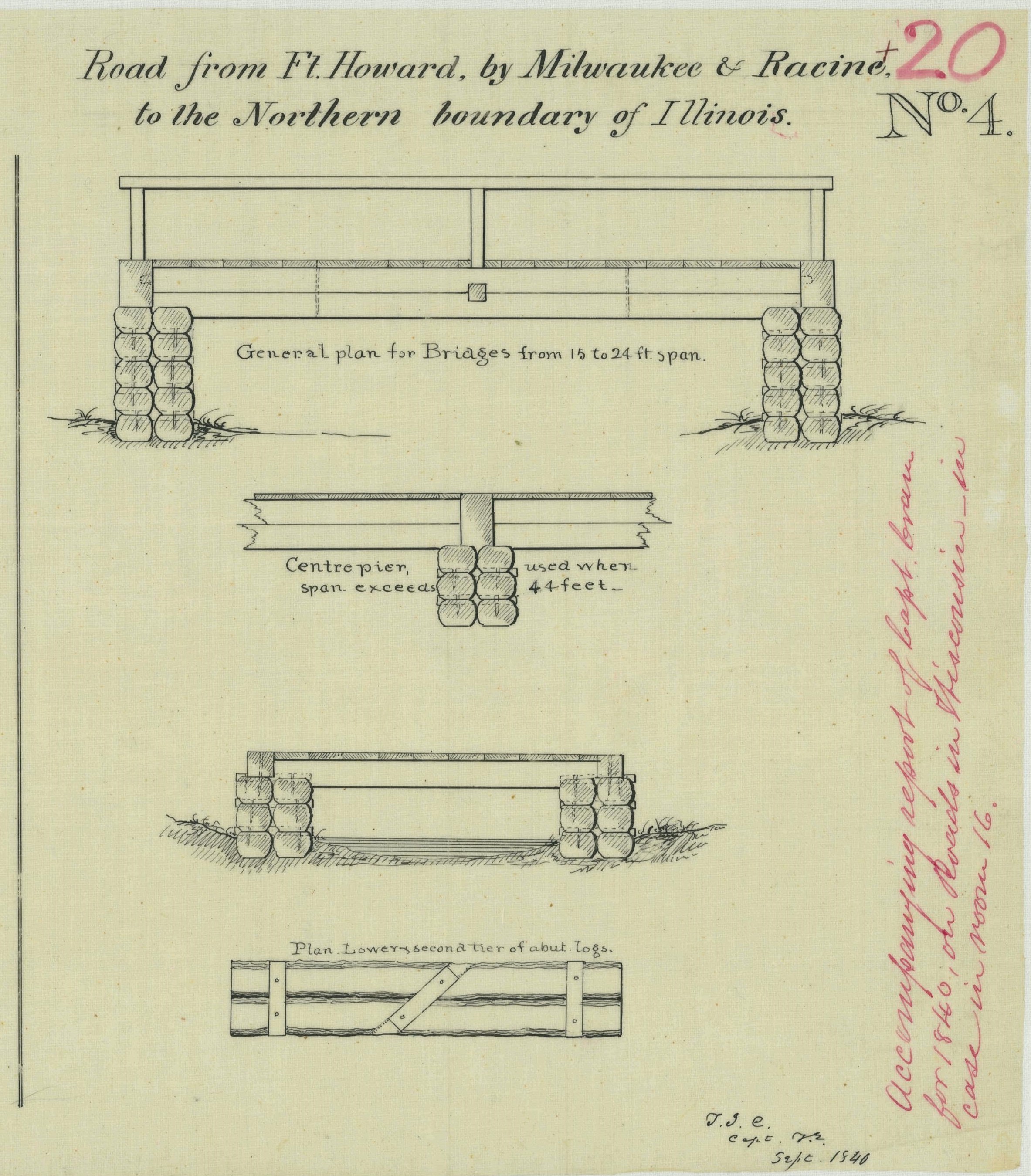
Jonathan M. Clark (1812-1857) enlisted as a Private in Company K, Fifth Regiment of the U. S. Army, and served at Ft. Howard, Michigan (later Wisconsin) Territory, from 1833 until mustering out, as Sargent Jonathan M. Clark, in 1836. In the 1830s, Fort Howard was on the nation’s northwestern frontier. Jonathan’s Co. K spent much of the summers of 1835 and 1836 cutting the military road across Wisconsin, from Ft. Howard toward Ft. Winnebago, near modern Portage, Wisconsin.

Fort Howard, Wisconsin Territory, circa 1855, from Marryat, Frederick, and State Historical Society Of Wisconsin. “An English officer’s description of Wisconsin in 1837.” Madison: Democrat Printing Company, State Printers, 1898. Library of Congress. Click to open larger image in new window.

Continue reading

Labor Day – a photo essay

Even thought it’s Labor Day, the holiday celebrating the working men and women of our nation, I’ll be at work, back at our local mercantile establishment. You know, a store kind of like this one, stocked with just about anything you need for modern living:

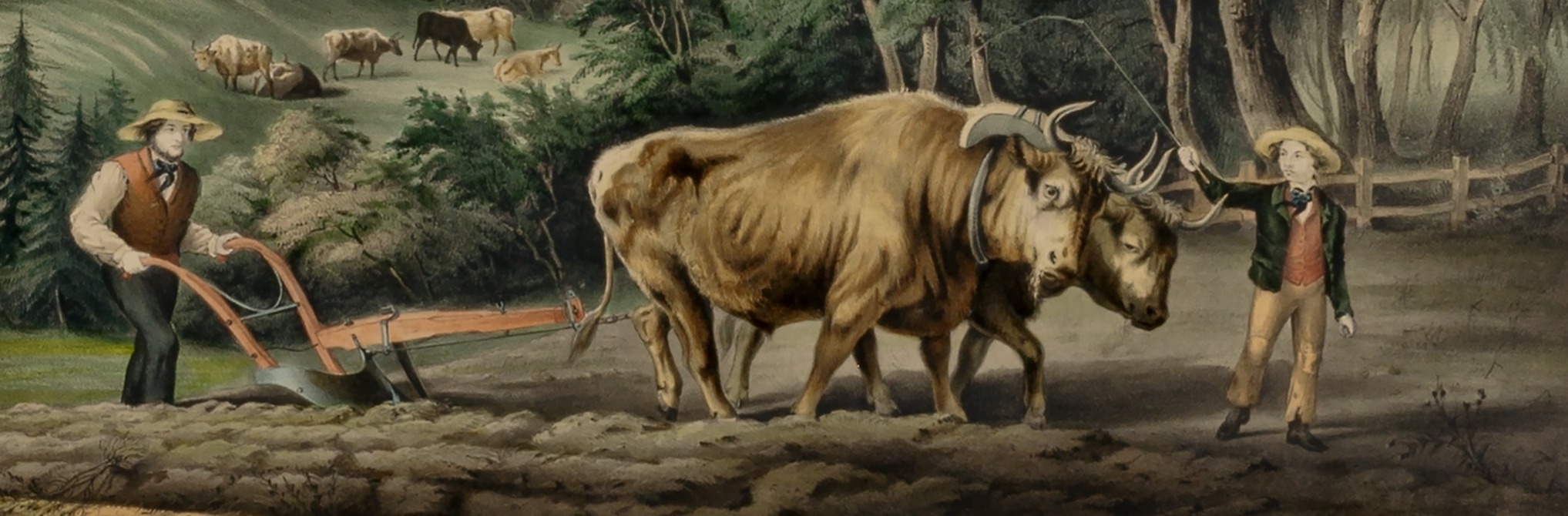
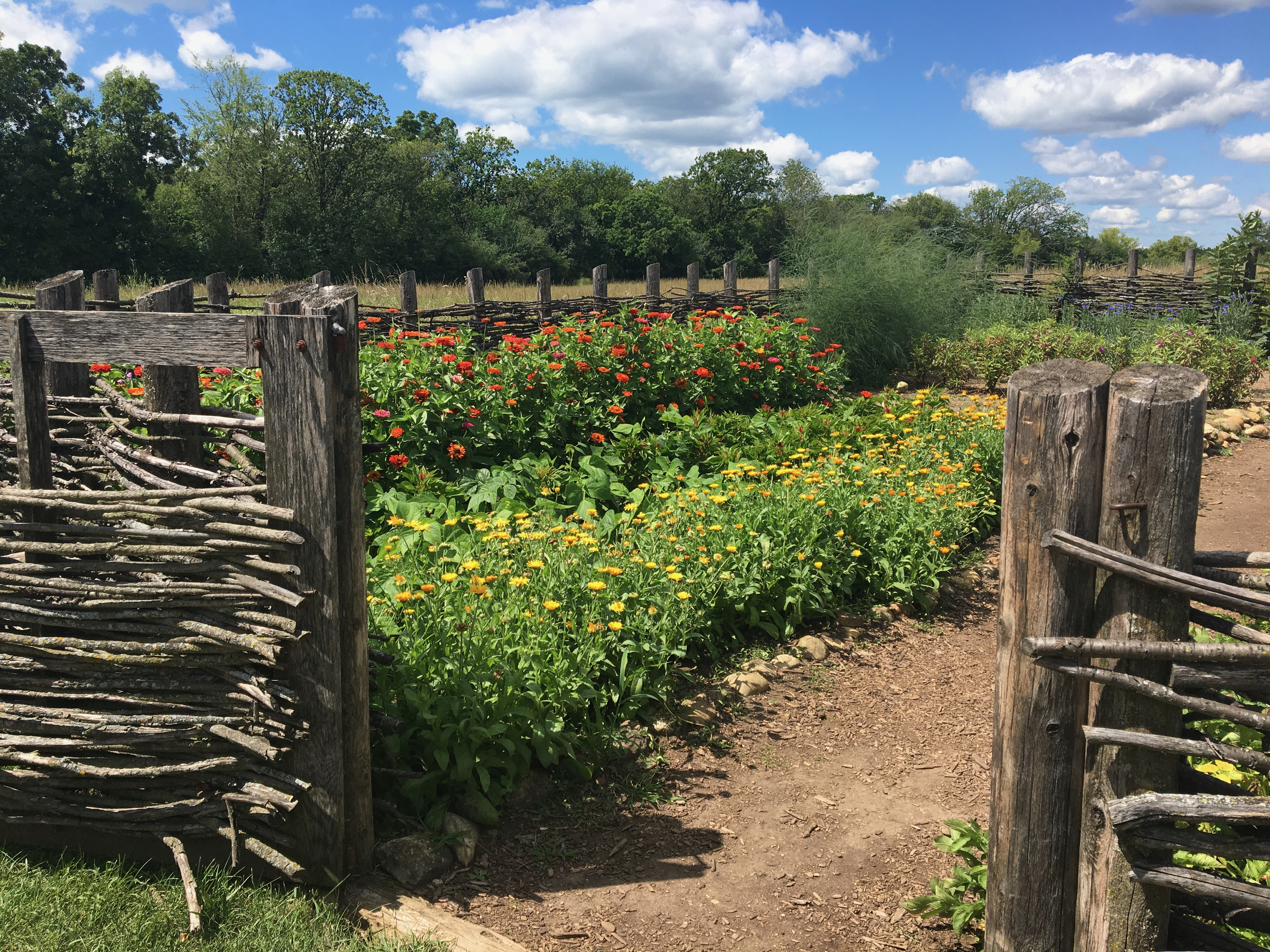
I don’t have the day off, and won’t be marching in a parade, but I’d still like to honor the holiday and salute the American worker, past and present. With that in mind, let’s revisit some of the nineteenth-century occupations we’ve talked about previously at Clark House Historian, highlighting a few of the many skills, trades, and occupations common during the Clark House era.

Since it is a holiday, I’m not going to add much commentary today. Enjoy the photos, and click the links to visit the original CHH posts with lots more information about the different skills and jobs, and for full image credits.

Continue reading

1836: Astounding Produce News!

While researching the life of one of Mequon’s first white settlers, Isham Day, I ran across the following breathless bit of regional puffery and promotion, penned by Milwaukee co-founder Byron Kilbourn. It’s from page 2 of the November 17, 1836, edition of the Milwaukee Advertiser:

Lawyer Pettibone has, indeed, grown some astounding turnips (“Ruta Baga”), ‘taters, and carrots in the fertile soil of Milwaukee. Likewise Mr. Douglass with his enormous radishes and “common English” turnips. Have others done anything comparable? Indeed they have, and Mr. Kilbourn has the details…

Continue reading

Isham Day: Civil War casualty

Isham Day was one of the very first white pioneers to settle in the future Town of Mequon, Wisconsin Territory. I first wrote about Isham Day, and his historic house—later Mequon’s first post office, and also known as the Yankee Settlers’ Cottage—in an earlier post, River Walk. You might want to read that before continuing with today’s essay.

Isham Day was not only one of the first settlers in this area, he was active member of the small but growing community in what would become Washington and, later, Ozaukee counties. There is a lot to say about his role in the early decades of pioneer life in the Clarks’ neighborhood, some of which is already known through early local histories and various federal and local primary sources. (And he appears in six different posts here at Clark House Historian.)

One thing that is less well known is what happened to Isham Day after those early days in Milwaukee and Mequon. I wanted to know and, after an extended search, I found out. In many ways, it’s a story of the stereotypical moving-ever-westward American pioneer experience. But it’s also a story of a man trying to live a peaceful life in the midst of violence and rebellion. In our recent post, Memorial Day, 2023, we remembered some of our local men that fought and died to preserve the Union and end the scourge of slavery in “the land of the free.” Today we examine one of the many civilian casualties of that conflict: Isham Day.

Isham Day house (“Yankee Settler’s Cottage”), built 1839, Mequon, Wisconsin. The oldest house in Ozaukee county still on its original foundation. Photo credit: Anna Perkins, 2021.

Please note: sensitive or younger readers may find some of the language and events documented below to be disturbing.

Continue reading