The Jonathan M. Clark House is located in Mequon, Ozaukee (formerly Washington) County, Wisconsin. In our previous post, Mequon – What’s in a name?, we looked into how Mequon became a political entity and how its goverment evolved from the county system to the town system.
From…which archives?
Where do you look when you’d like to read (and download) the handwritten minutes of the meetings of old Washington county’s commissioners, circa 1841-1846? How about…the Washington Co. Highway Department!
This actually makes more sense than you might think, since many of the county’s earliest decisions and expenditures involved proposing, surveying and cutting roads to connect new settlements to each other, to the rest of Wisconsin Territory, and beyond. So—in a fine example of professional organization and public service—the Washington county highway department has gathered together and put online many of their oldest records.
The County Highway Register was an attempt to search out, correlate, and record all known information concerning the laying out of all roads in the county. Some of these books have not been updated since the mid to late 1950’s. Read the forward in the index to understand how these books were created.
If you follow the link, you’ll find an long list of pdfs, organized by Washington County towns, that contain the collected official highway records and some of the earliest records of county government.
Mequon is the home of the Jonathan M. Clark House. Mequon is a unique name, and its source, pronunciation, spelling—and, occasionally, location—are the source of a fair amount of confusion and error. So I thought I would gather a few pertinent facts about the name that might help readers avoid some of the pitfalls in Mequon research.
As a reminder:
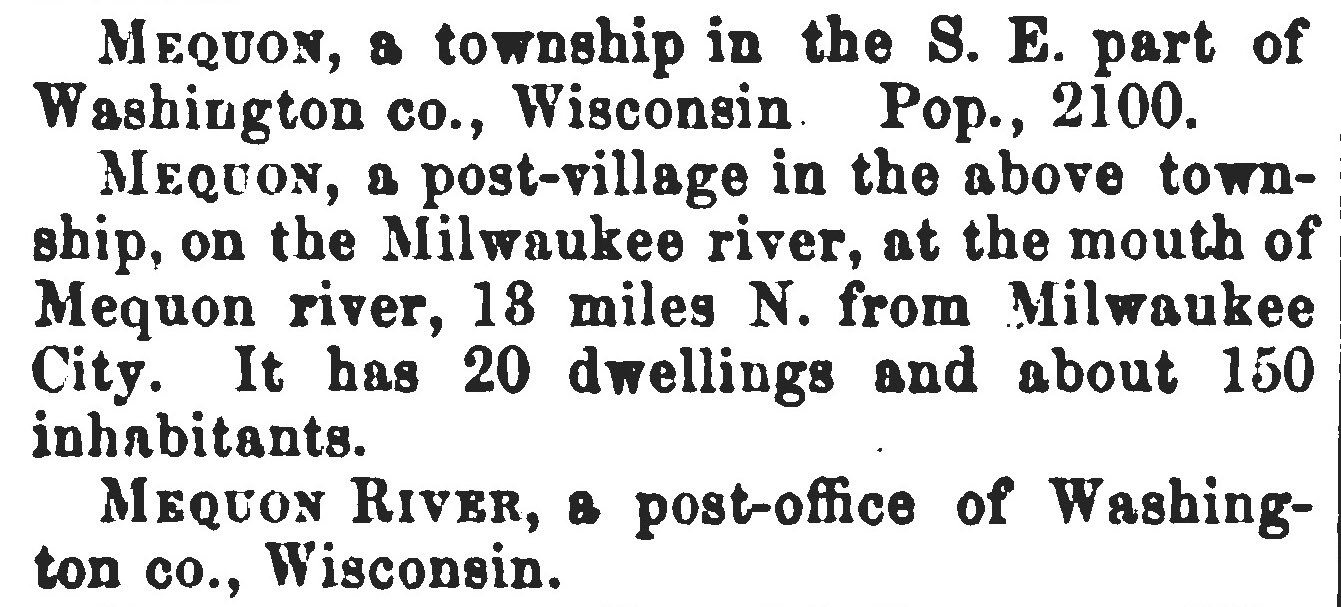
Baldwin, Thomas and J. Thomas, M.D., A New and Complete Gazetteer of the United States […], Philadelphia,1854, p. 687. Via GoogleBooks.
That’s a pretty accurate, “just the facts,” description of Mequon in 1854. (Although it looks like Gazetteer editors Baldwin and Thomas didn’t get the news that on March 7, 1853, the east part of Washington county—including the Town of Mequon—had split from its parent county to form the new Ozaukee county. And the town vs. township distinction could be more precise, too.)
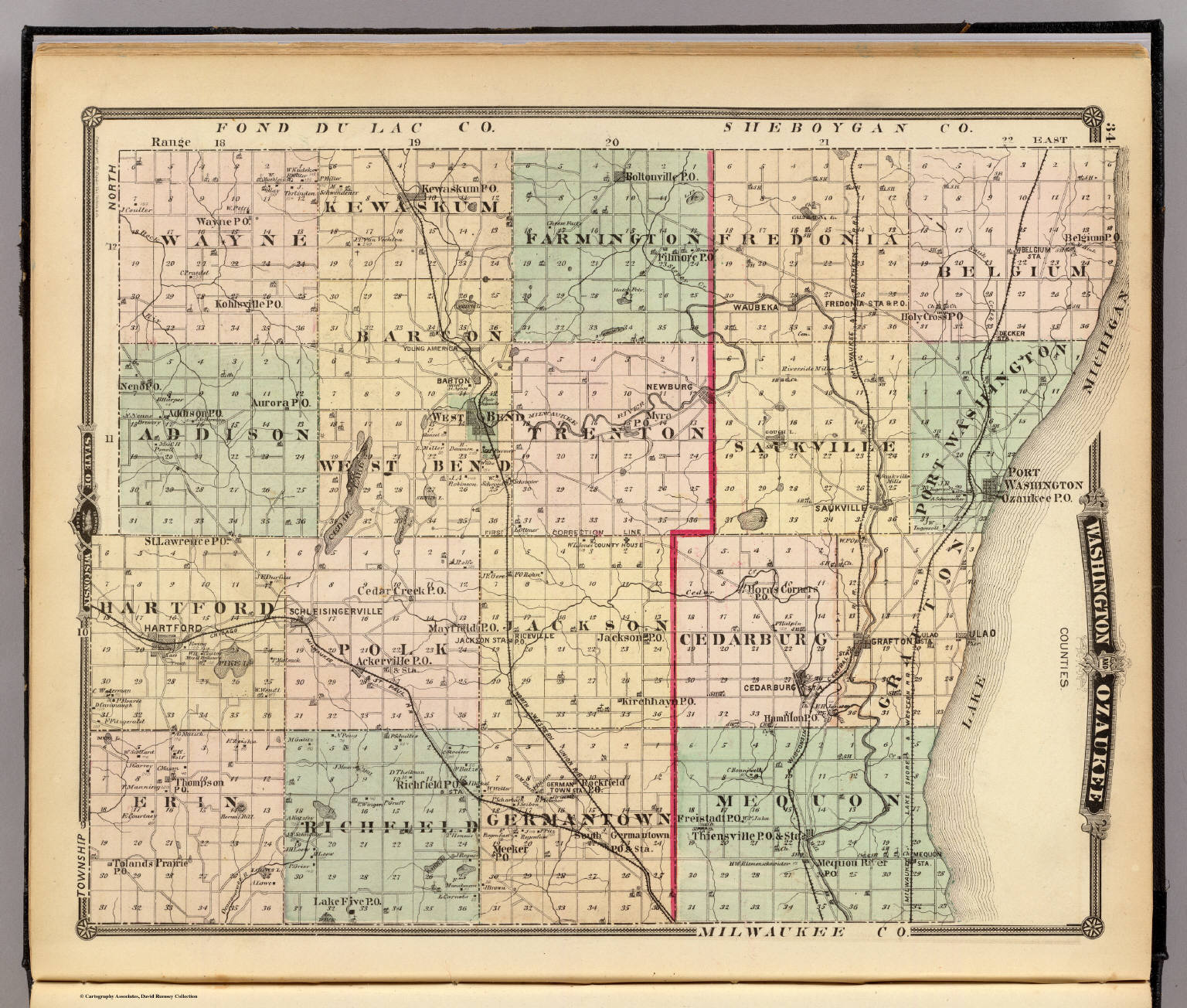
Today’s map is another unique and wonderful map from the University of Wisconsin–Milwaukee, American Geographical Society Digital Map Collection. It is map of Washington and Ozaukee Counties from 1874, and it is packed with information and unique details.
Map of Washington and Ozaukee Counties, Wisconsin 1873-4 / drawn, compiled and published by G.V. Nash & M.G. Tucker ; engraved & printed by J. Knauber & Co. ; colored and mounted by E.M. Harney. University of Wisconsin-Milwaukee, American Geographical Society Digital Map Collection. Full copyright notice here, presented in this post as a public domain item and/or under fair use provisions of U.S. copyright law. Click map to go to the UWM collection and open larger image in new window.
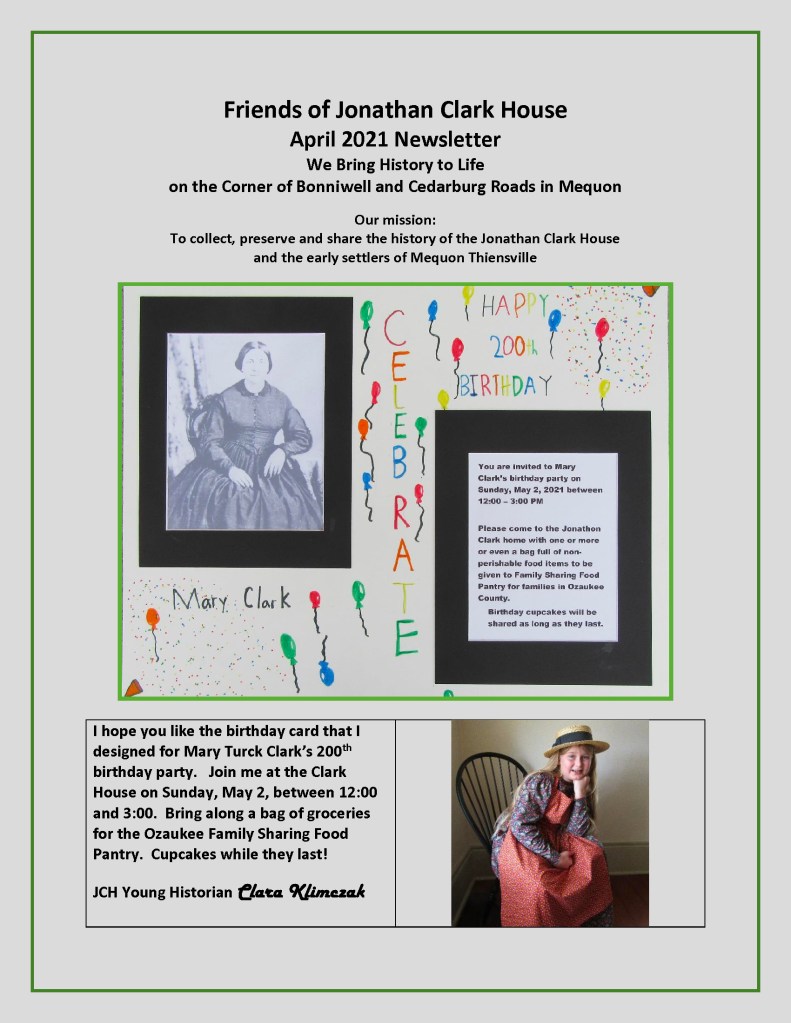
Spring is here and things are happening at the Jonathan Clark House Museum. All the info is in our latest newsletter. Click the image or this link to open (and save) your own copy of the full pdf:
It’s early April, and the growing season is not far off. For a farmer like Jonathan M. Clark, it’s a little early yet for plowing and sowing, but not too early to make plans and sharpen the tools. For a farmer’s wife, like Mary (Turck) Clark, it’s not too soon to think about the farm garden, its crops and layout.
I don’t know if Mary and Jonathan were regular readers of the popular and affordable farmers’ almanacs of their era; I wouldn’t be surprised if they were. There were many to chose from. Perhaps they had a copy of something like:
The Cultivator […], New Series, Vol. VII, Albany, 1850, title page. Click to open larger image in new window.
There were a lot of deadly, infectious diseases in 19th-century North America. When Jonathan M. Clark was young, the causes and cures for most of these illnesses were a mystery. Germ theory was unknown, and for many people hygiene was, at best, a hit-or-miss affair. But even in that era, we can be certain Jonathan M. Clark was inoculated against one of the worst recurring plagues of all time: smallpox.
General Regulations of the U.S. Army, 1821, Art. 73, no. 90
Today is St. Patrick’s Day, originally the religious observance of the feast day of the principal patron saint of Eire.1 In honor of the day, let’s take a look at a few aspects of Irish life in early southeast Wisconsin and the involvement of Mary (Turck) Clark’s father Peter Turck in a civic effort to relieve Irish suffering during the Great Famine.
Irish immigrants in early Wisconsin
The first white visitors to Wisconsin were seventeenth-century French-Canadian explorers, priests and fur trappers, at home along Wisconsin’s lakes and rivers. They were followed by a smattering of British and French settlers in the mid- and later-eighteenth century. Cornish lead miners arrived in the southwest corner of the territory around the turn of the nineteenth-century. And in the mid-1830s, when the federal government officially “opened” the southeast corner of Wisconsin for settlement, there was a large influx of New Englanders and New Yorkers.
There were also a substantial number immigrants from across the sea among the Wisconsin pioneers of the 1830s and ’40s, including settlers from Upper and Lower Canada, Nova Scotia, Great Britain, the Netherlands, the German-speaking lands, and Ireland. By the time of the 1850 federal decennial census, Irish men, women, and children comprised the second-largest group of foreign-born immigrants in the state, surpassed in number only by immigrants from the German-speaking lands.
Before Mequon: finding Mary Turck’s home in upstate New York
Tracing the lives of Americans in the first decades of the 19th-century can be challenging. Whether along the expanding frontier, or in long-established and settled areas such as New York’s Hudson River valley, there are often many unhelpful gaps in the paper trail. Even the federal census—which counted, every ten years, “all persons” living in America—only recorded the name of the “head” of each (white) family, and the sex and age ranges of other members of the household.
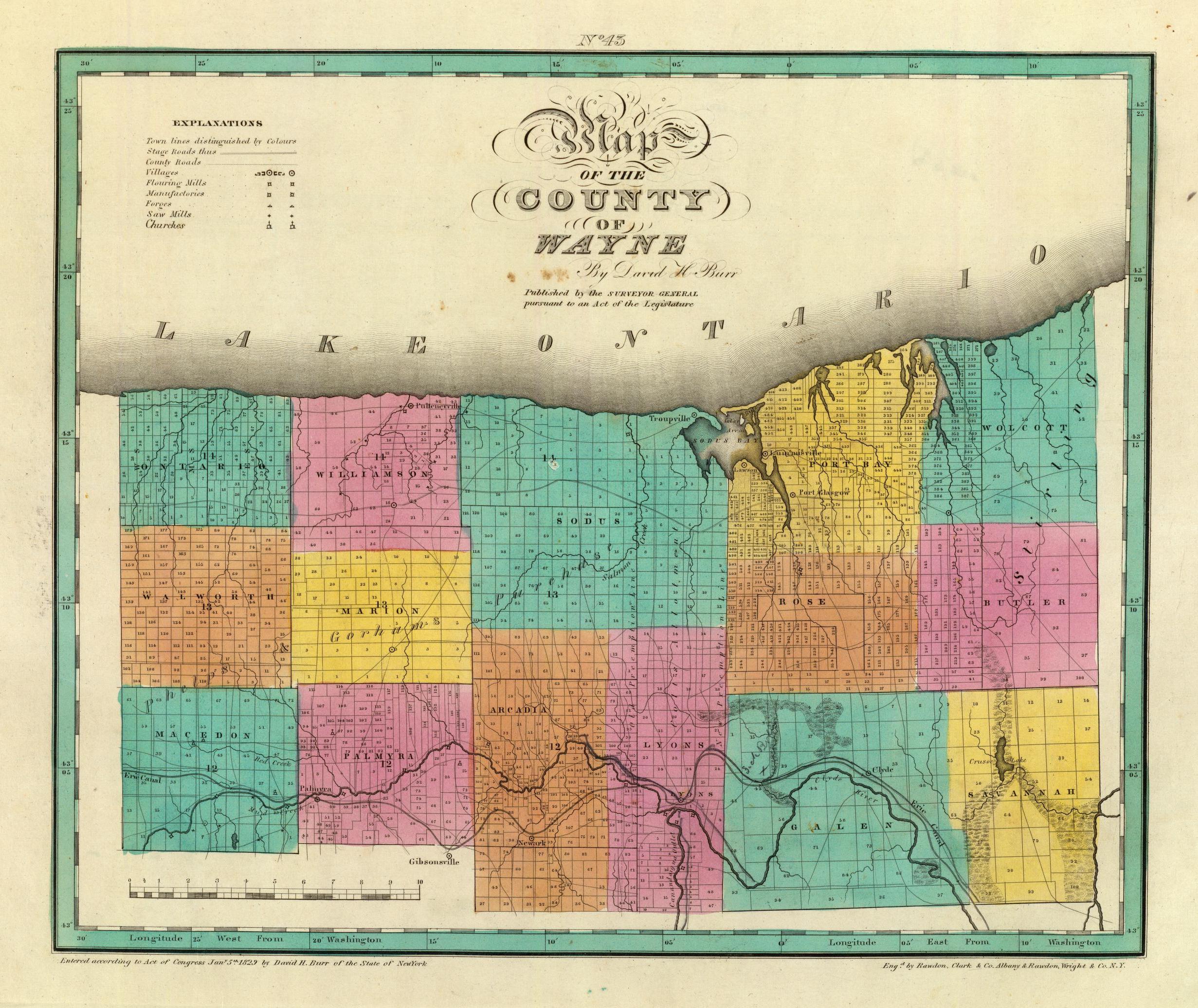
So what do we know about the Peter and Rachael (Gay) Turck family in the years before they arrived in Mequon? As we discussed previously, we know the family had deep roots in the traditionally Dutch-American communities of the Hudson River valley’s Ulster, Greene, Dutchess and Columbia counties. We know Mary Turck was born in Athens, Greene county, in 1821, the eldest child of Peter and Rachael (Gay) Turck. By tracing the baptismal registers (where they exist) and other biographical records of her younger siblings, we know that by 1833 the family was in Palmyra, Wayne County, New York.




 Clark House Historian