I’m in the thick of researching and writing several series of illustrated posts for the blog, as well as for some upcoming public talks that I’m giving this spring and summer, and it’s kept me from posting lately. And as is often the case with these big projects, I find I have so much fresh material, and so many interesting, interconnecting, events and stories, that the problem becomes sorting and organizing all that information, and all those images, into coherent and not-overwhelmingly-long posts and presentations. (Heh. We’ll see about that…)
Anyway, while I continue my writing and editing behind the scenes, I thought you might enjoy this random bit of Mequon history I found while looking for some other, entirely different, information. It’s an advertisement originally dated May 21, 1855; this copy was published on page 3 of the Milwaukee Banner und Volksfreund [Banner and People’s Friend] on February 6, 1856. The ad announces a new business venture by one of Mequon’s earliest and most influential German settlers, Wilhelm Ferdinand “William F.” Opitz (1813 or 1816 – 1882):
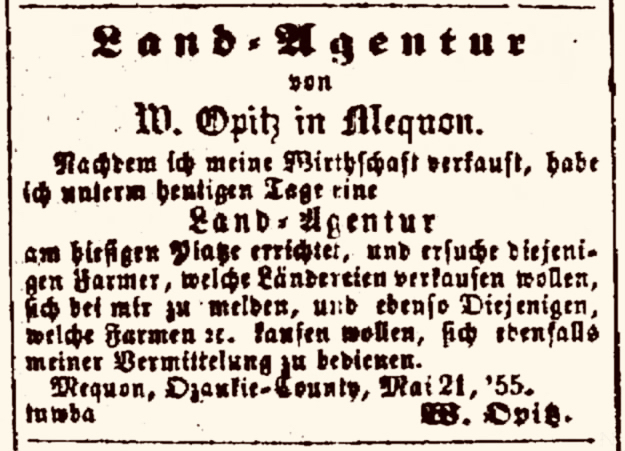
How’s that? Your German language and Fraktur-reading skills are a bit too rusty to enjoy this historical advert? Well, just click and read on for all the details!
Continue reading
 Clark House Historian