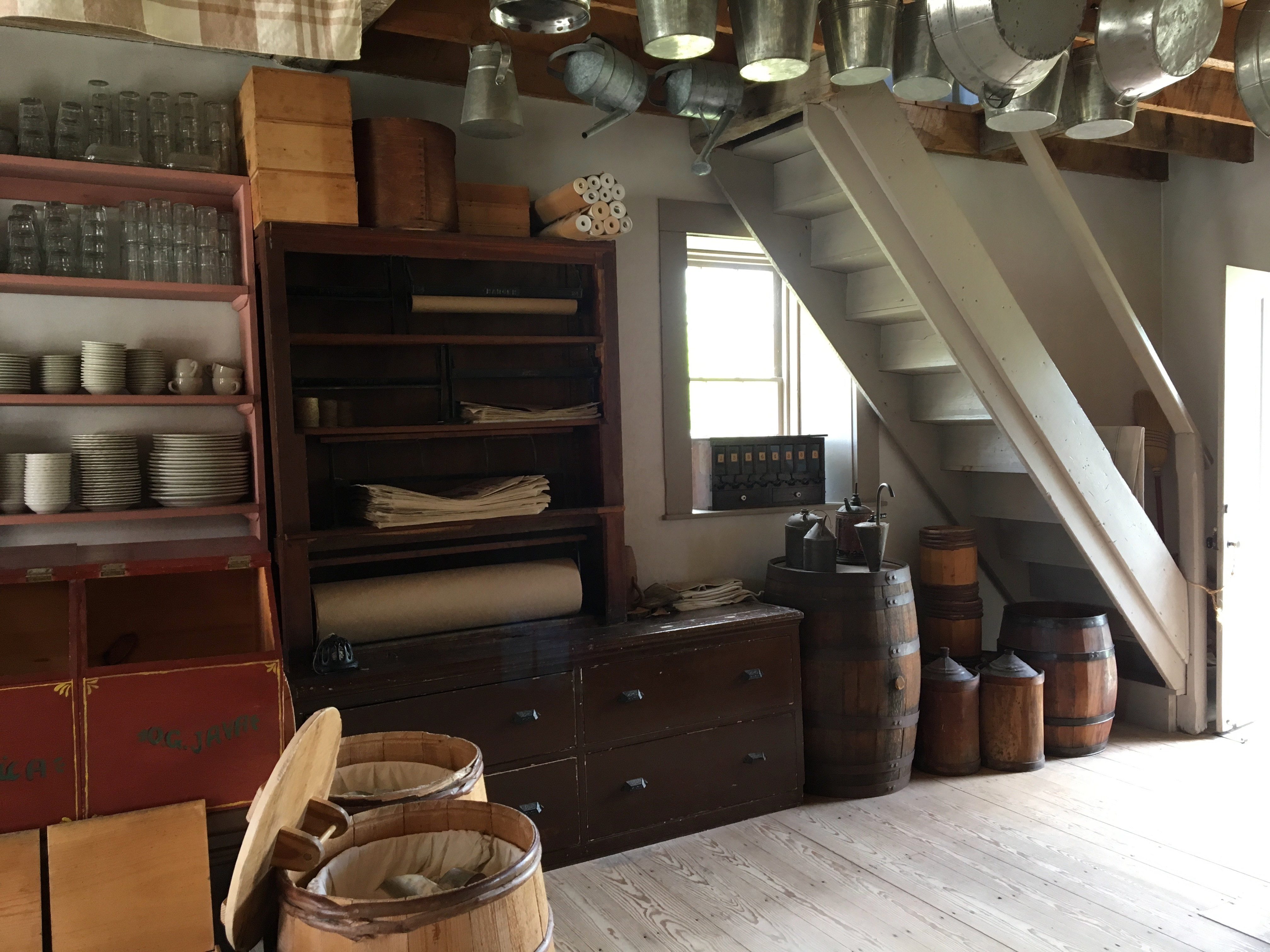
School supplies…and more, 1850

Labor Day has come and gone, and for many this marks the unofficial “end of summer.” With that in mind, I thought you might enjoy a lightly revised and enhanced re-post of this CHH piece from 2023.

Many students start classes today. Others began school a week or two ago. Many Wisconsin families have spent the past few weeks (or months) preparing for the new school year, shopping for “Back to School” deals on clothing and school supplies at local, chain, and online retailers.

Harrison’s Columbian inks, black, scarlet, red, blue. [United States, publisher not transcribed], c. 1846. Library of Congress

Shopping for school supplies at the start of the school year is nothing new. But the origin of the now ubiquitous use of “Back to School!” as a marketing phrase is obscure. From what I’ve observed, it seems very much a post-World War II phenomenon. Yet with our current focus on three-ring binders, zippered pencil cases, and boxes of 64 Crayolas (with the built-in sharpener!), have you ever wondered what kind of school or office supplies might have been necessary or useful for Jonathan and Mary Clark, their children, and their neighbors? For a fun comparison, let’s take a look at just two of the many relevant advertisements from the columns of the Clarks’ local papers, in this case the [Milwaukee] Daily Free Democrat, November 2, 1850, page 4…

Continue reading

Labor Day – a photo essay

UPDATE: This was supposed to go out on Monday. I hit “publish” before the piece was ready. Here’s the updated 2025 version for your reading enjoyment. Sorry for any confusion (and, for you CHH subscribers, the premature email in your inbox).

Monday, September 1st, is Labor Day, the holiday celebrating the working men and women of our nation, and I thought I’d commemorate the day with a lightly-revised re-post of this CHH piece from 2023. This Labor Day, as in 2023, I have to work a shift at our local mercantile establishment. You know, a store kind of like this one, only much bigger, stocked with just about anything you need for modern living:

Like many Americans, I don’t have the day “off” on Monday, and won’t be marching in a parade, but I’d still like to honor the holiday and salute the American worker, past and present. With that in mind, let’s revisit some of the nineteenth-century occupations we’ve talked about previously at Clark House Historian, highlighting a few of the many skills, trades, and occupations common during the Clark House era.

Since it is a holiday, I’m not going to add long commentaries to each photo. Enjoy the photo galleries, and be sure to click each gallery—and photo—to open and peruse larger versions of each image. And click the highlighted links to visit the original CHH posts, filled with lots more information about the different skills, tools, and jobs, and the full image credits.

Continue reading

Labor Day – a photo essay

Today is Labor Day, the holiday celebrating the working men and women of our nation, and I thought I’d commemorate the day with a lightly-revised re-post of this piece from 2023.

This Labor Day, I’ll be at home, working on my upcoming lectures for the state DAR and the Cedarburg History Museum. Last year, I had to work at our local mercantile establishment. You know, a store kind of like this one, only much bigger, stocked with just about anything you need for modern living:

I don’t really have the day “off” today—too much writing to do—and won’t be marching in a parade, but I’d still like to honor the holiday and salute the American worker, past and present. With that in mind, let’s revisit some of the nineteenth-century occupations we’ve talked about previously at Clark House Historian, highlighting a few of the many skills, trades, and occupations common during the Clark House era.

Since it is a holiday, I’m not going to add long commentaries to each photo. Enjoy the photo galleries, and click each gallery to open larger versions of each image. And click the highlighted links to visit the original CHH posts, filled with lots more information about the different skills, tools, and jobs, and the full image credits.

Continue reading

Clark House News – June, 2024

There’s a lot going on at the Jonathan Clark House this summer! Here’s a quick look at two upcoming June celebrations, as well as information about our other 2024 summer events. Be sure to click Continue reading (below) to see all the details.

Pie on the Patio 2024

As a reminder, Pie on the Patio, our annual salute to donors and Friends of the Jonathan Clark House will be held at the museum this Wednesday, June 12, from 5:00-7:00 p.m. There is limited space for the event and RSVPs were due June 5. But if you have questions or last-minute changes in plans, please contact executive director Nina Look via email at jchmuseum@gmail.com or call 262-618-2051.

And if you don’t want to miss next year’s Pie on the Patio, become a Clark House donor, today! Just click this link to our JCH donor page, or scan the QR code, below, and scroll down to the Donate Online info. And thank you for your support!

This Saturday! – Heritage Day 2024

Put away the electronics and experience life in Mequon-Thiensville as it was in the 1850s. On Saturday, June 15, from Noon to 3:00 p.m., the Jonathan Clark House Museum hosts its annual Heritage Day, where everyone steps back in time to learn more about early settler life. Each event features hands-on activities and fun for all ages. Admission is free and open to the public. Come see us at the corner of Cedarburg and Bonniwell Roads in Mequon!

Continue reading

Searching for JMC’s roots in Eastern Township sources: books (part 1)

If this were an academic thesis (don’t worry: it’s not, it’s still a blog), one of the first things we’d do at the start of a project like this is create a “literature review” and accompanying annotated bibliography. Now that we’re restarting our search for JMC’s roots in the border area of northern Vermont and the Eastern Townships of southern Québec, circa 1790-1840, I thought it would be smart to do something similar, but less formal. Over the next several posts we’re going to sort and prioritize the various sources that look useful, and find a way to organize those sources—with their proper bibliographical citations—in a way that will serve us over time.

The Clark House Historian, growing old as he searches for Jonathan M. Clark’s roots…1

Today’s post is Part 1 (of many) of our hybrid literature review and annotated bibliography that—we hope—will finally lead us to JMC’s as-yet-unknown parents, ancestors, possible siblings, and kin.2 We begin with some Lower Canada—Eastern Townships books that I have found more (or less) useful.

Continue reading

Labor Day – a photo essay

Even thought it’s Labor Day, the holiday celebrating the working men and women of our nation, I’ll be at work, back at our local mercantile establishment. You know, a store kind of like this one, stocked with just about anything you need for modern living:

I don’t have the day off, and won’t be marching in a parade, but I’d still like to honor the holiday and salute the American worker, past and present. With that in mind, let’s revisit some of the nineteenth-century occupations we’ve talked about previously at Clark House Historian, highlighting a few of the many skills, trades, and occupations common during the Clark House era.

Since it is a holiday, I’m not going to add much commentary today. Enjoy the photos, and click the links to visit the original CHH posts with lots more information about the different skills and jobs, and for full image credits.

Continue reading

School supplies…and more, 1850

Almost three weeks remain until Labor Day marks the unofficial end of summer, and already many Wisconsin families are preparing for the new school year. “Back to School” promotions and special merchandise can be found in many local, chain, and online retailers. The history of “Back to School” as a marketing theme in the U.S. is obscure, but from what I’ve observed, it seems very much a post-World War II phenomenon.

With our current the focus on three-ring binders, zippered pencil cases, and boxes of 64 Crayolas (with the built-in sharpener!), have you ever wondered what kind of school or office supplies might have been necessary or useful for Jonathan and Mary Clark, their children, and their neighbors? Just for fun, here are just two of the many informative advertisements from the columns of the local papers, in this case the [Milwaukee] Daily Free Democrat, November 2, 1850, page 4:

Your local book & stationery shop

Milwaukee book & stationery retailer Rood & Whittemore had a fine selection of supplies for the scholar, letter writer, or professional man or woman of 1850:

Something for everyone, including the “country traders” and teachers that often served as buyers and distributors of school textbooks for their rural areas. For their efforts, the traders and teachers received “liberal terms,” presumably some sort of discount (for cash accounts, of course), from Rood & Whittemore.

And as you might expect, even from its earliest days Milwaukee was not a one-store town. In the words of the immortal Ron Popiel

Continue reading

A familiar sight: St. Peter’s Church, 1839

I had a fine day last month walking through our state’s wonderful outdoor living history museum, Old World Wisconsin, where I enjoyed this familiar view:

Photo credit: Reed Perkins, 2022.

There among the trees stood Milwaukee’s old St. Peter’s Roman Catholic Church, a building that was certainly well-known—at least on the exterior—to our Clark and Turck families.

The church was built in 1839, two years after young Mary Turck arrived in Wisconsin Territory with her parents, Peter and Rachael (Gay) Turck and her six siblings, and the same year that Jonathan M. Clark and the Bonniwell family first appeared in the Milwaukee-Mequon area.

Continue reading

Back to School, 1831: JMC in Stanstead?

In an earlier post I wrote: I’m still on the hunt for the elusive parents and kin of Jonathan M. Clark. Based on what we know so far, we are looking in the area of Derby, Orleans County, Vermont and its northern neighbor Stanstead Township, Lower Canada, circa 1800-1830 or so.

Well, the hunt continues, and today I thought I’d share with you another Back to School tidbit, a “hot tip” that I’ve been meaning to write about for a while. The tip—and its source—comes from Clark-Turck family descendant and Clark House Museum supporter Liz Hickman1, who kindly gave me a copy of this fascinating book:

Kathleen H. Brown’s comprehensively researched and encyclopedic Schooling in the Clearings: Stanstead 1800-1850 is devoted to the early history of public and private education in Quebec’s Eastern Townships and, in particular, Stanstead Township. That might seem like a highly specialized corner of North American history on which to focus, and I suppose it is. But Ms. Brown’s heroic labors in the archives are now a readable and invaluable resource for those of us trying to learn more about the early settlers in the Eastern Townships and their children including, possibly, the earliest record of Jonathan M. Clark known to date.2

Continue reading

Back to School, 1842!

I hope you liked our recent re-post of Back to School, 1839! And since I’m still working on a number of new but not-yet-ready projects, I thought you might also enjoy a revised and expanded version of a related post that was first published September 2, 2020.

It’s “Back to School” time for many of us, so I thought you might be interested in this transcription of the earliest known school records of old Washington/Ozaukee county prior to 1845, published on page 328 of the History of Washington and Ozaukee Counties, Wisconsin […] Illustrated. Western Historical Co., Chicago, 1881:

Click to open a larger image in a new window, and see which of the early settler families had school age children, that is, children between the ages of 4 and 16, in 1842 and 1843. (Current Washington and Ozaukee county readers: do you have any kin listed in this summary of early school censuses? Let us hear from you via the Leave a Reply box, below.)

Continue reading