I’m still working on several larger Clark House Historian projects, but I still have time to share a few Random Bits O’ History with you…
More Fun with Fraktur
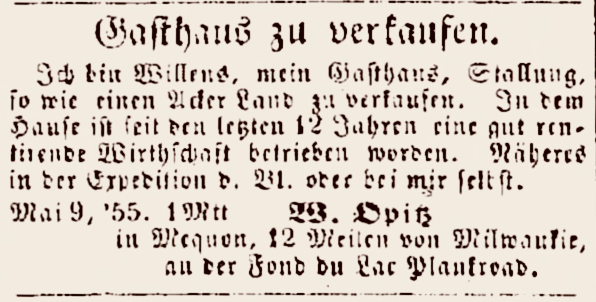
You may remember our recent post, William Opitz – real estate agent (1855), in which we noted the start of a new business venture—a “Land Agency”—by one of Mequon’s earliest and most influential German settlers, Wilhelm Ferdinand “William F.” Opitz (1813 or 1816 – 1882). Well, I found a companion advertisement from W. F. Opitz, published on page 2 of the Milwaukee Banner und Volksfreund on May 18, 1855:
In our previous post I made use of a paragraph from a recently rediscovered 1891 profile of Jonathan and Mary (Turck) Clark’s eldest child, Caroline M. Clark, later Mrs. C. M. Woodward. Caroline was the most publicly active, visible, and well-documented of all of the Clark siblings, and we have published a number of blog posts on her life and career, including this comprehensive piece: Caroline M. (Clark) Woodward: a closer look at that 1893 biography. I recommend reading that post and clicking all the links; they lead you to other, detailed CHH posts about specific moments and events in Caroline’s life.
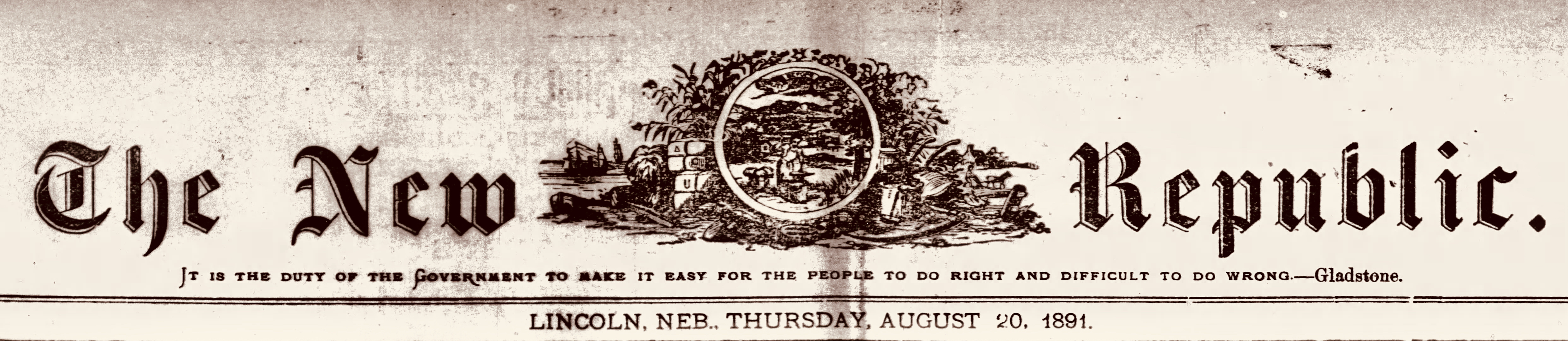
Today I’d like to share with you the complete 1891 profile that I quoted in our March 26, 2026, post. It originally appeared as one long column of text on page 1 of the Lincoln, Nebraska, “New Republic” newspaper, on August 20, 1891. Caroline (1840-1924) was fifty years old when this article appeared, and had another thirty years of active work in the temperance and women’s rights fields ahead of her.
Given the amount of accurate detail in the article, I suspect that the information came directly from Caroline herself. In fact, given how well-written and how accurate the whole profile is, I would not be surprised if Caroline wrote most, or all of it herself. For ease of reading, I have divided the article into several sections, created paragraph headers, and added a few notes on some of the facts mentioned in each section.
Clark House Historian is about to begin its tenth year of investigating, interpreting and sharing the stories of the Clarks, their relatives, neighbors, friends, and the world in which they lived. With that in mind, I’ve been looking through the blog, and thinking about making a few, useful updates to the site. Chief among these would be a decent, searchable index to all those posts.
(Still) “under construction“…
From our first post in late-March, 2016, through early March, 2026, I’ve researched, written and published almost 500 Clark House Historian posts comprising about a half-million words, and illustrated with hundreds of historic maps, photographs, lithographs and other images. That’s a lot of information to organize and search.
So even though the blog has a decent SEARCH BY KEYWORDS(s) function, and each post is kind-of, sort-of indexed with SEARCH BY CATEGORY labels and SEARCH BY TAGS (mostly tagged by date or decade), it has become more difficult to find specific information and archived CHH source materials than I’d prefer. So in 2021 I started indexing the blog. Unfortunately, in the five (!) years since 2021 there’s been a long pause in indexing because, frankly, I don’t much care for indexing.
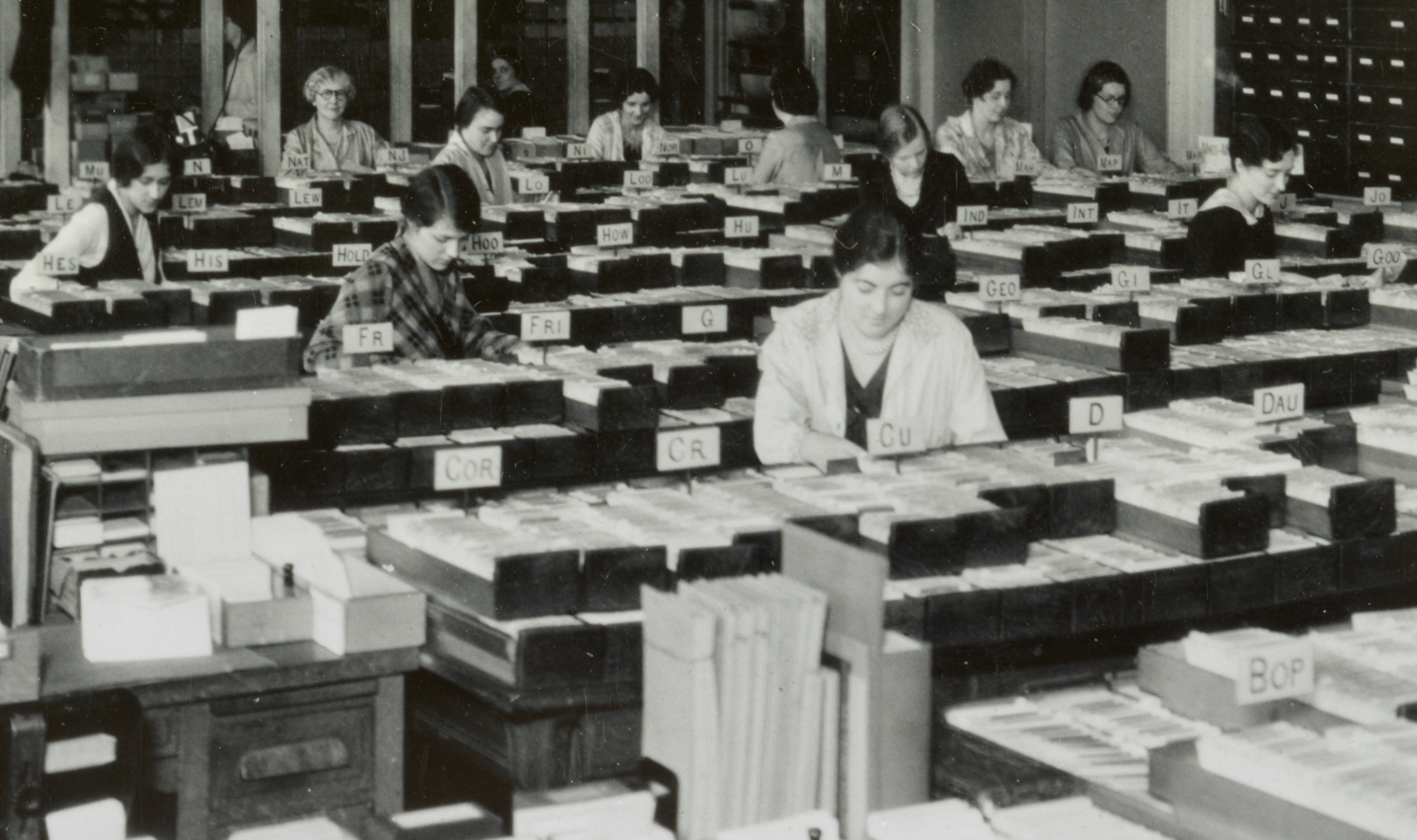
What I really need is an intelligent team of trained, experienced and eagle-eyed indexers, like these women at the catalog cards processing department of the Library of Congress in the late 1910s.
Harris & Ewing, photographer. Librarians working with catalog cards in the Processing Department of the Library of Congress, Washington, D.C. [detail]. [Between 1917 and 1920?]. Library of Congress.
Unfortunately, I can’t afford an intelligent team of trained, experienced, and detail-oriented indexers like those women at the Library of Congress in the late 1910s. So—alas!—it’s up to me to get the indexing project moving again, bit by bit. (But, as my astute, dear father used to say, “that’s a fine speech, son…” so we’ll see.)
Anyway, if you’ve looked through the blog’s INDEX, tried the SEARCH BY KEYWORD function, and you’ve sorted by CATEGORIES, and still can’t find the CHH post, image, or other information that you’re looking for, please let me know via the blog’s CONTACT form and I’ll do my best to help.
And if you’d like to look at the most recent additions to the CHH INDEX, click “Read More” or “Continue reading” for the details…
Our previous two posts (here and here) examined the 1888 recollections of a Mequon man that migrated from Germany to Mequon-Thiensville in 1848-1849, just after completing his schooling. His recollections were published in the form of two “letters” addressed to the Cedarburg News in May, 1888. Both letters were signed with just the initial “L.” Today I’d like to see what we know about our author — “L.” — and whether we can identify him.
But—before we start solving mysteries, there are errors to correct…
Updated dates!
I goofed! I fell into a record-keeping, citation-making trap. As I started this new post, I decided to take yet another look at my sources. And much to my chagrin, I noted that the date at the head of each of our “Mequon Correspondence” letters does not agree with the date that each letter was actually printed in the Cedarburg News. That’s not so strange; I would expect that a letter would be written, dated, and sent to the paper’s editor before the newspaper’s date of publication. But in our case, the letters are dated almost a full week after the newspaper date of publication. What’s that all about?
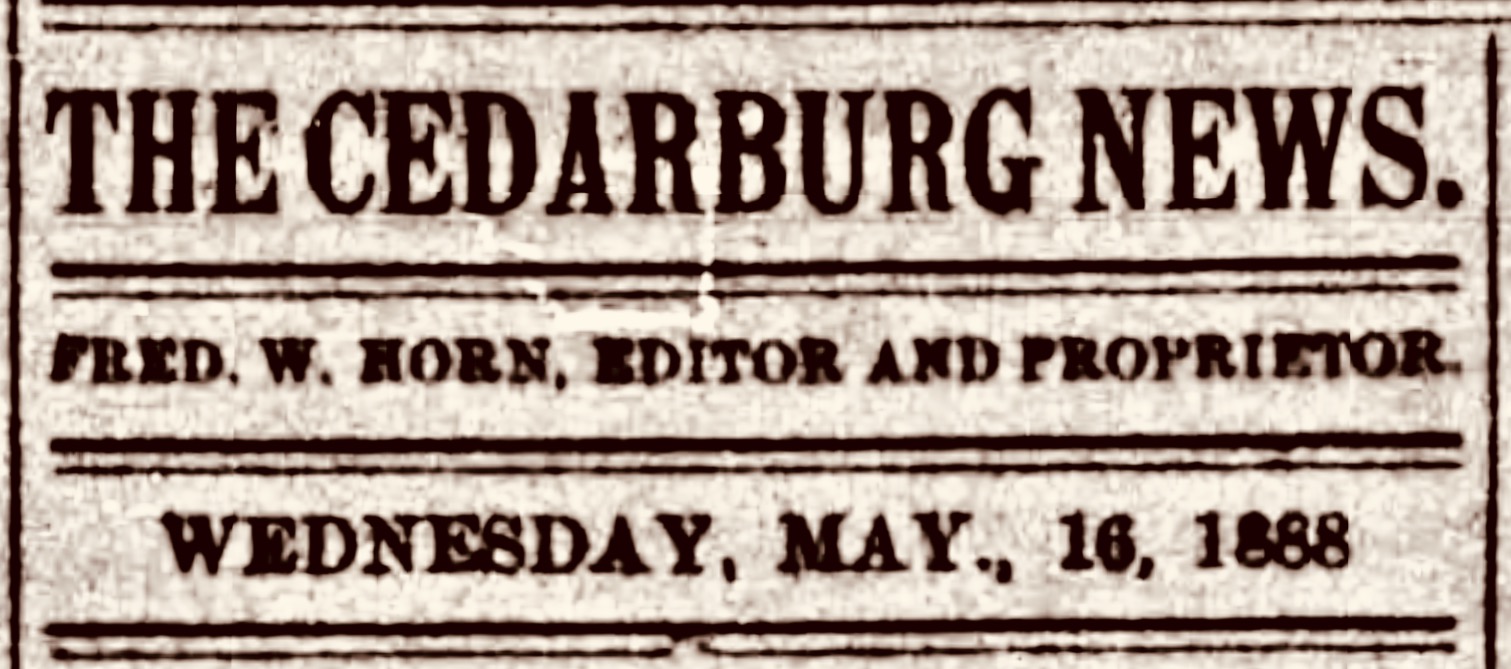
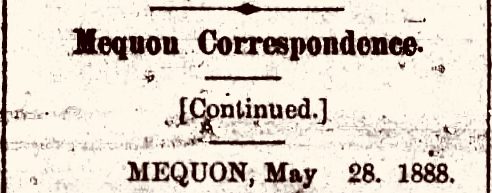
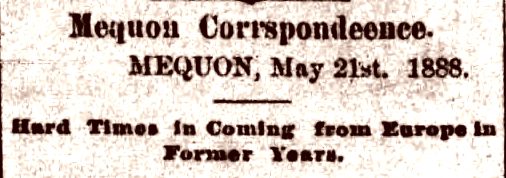
Anyway, here’s the correct info: • the first letter of two, titled “Mequon Corrspondeence” [sic], was published on page 2 of the Cedarburg News on May 16, 1888, but the “letter” was dated, in its headline, “May 21, 1888.” • the second letter, titled “Mequon Correspondence. [Continued.]” appeared the following week, May 23, 1888, also on page 2, but the “letter” was dated, in its headline, “May 28, 1888.”
For the record, earlier today (28 Feb. 2026) I added this corrected date information to thosse two previous CHH posts. And now that we’ve settled that, let’s see what we can do to solve today’s History Mystery!
UPDATED, Feb. 28, 2026, to correct erroneous dates of publication of the two Cedarburg News “letters.“
Migration memories, 1848, continued
In our previous post we presented the first part of a personal memoir of travel from Germany to New York City and, eventually, Mequon-Thiensville, circa 1848. Those recollections were published as the first of two “letters” to the Cedarburg News in May, 1888. Both letters were pseudonymous, signed only with the initial “L.”
The first letter of the pair, titled “Mequon Corrspondeence” [sic], was published on page 2 of the Cedarburg News on May 16, 1888, but note that the letter itself was dated, in its headline, “May 21, 1888.” If you missed it, I recommend you begin with that earlier post and then come back here for the conclusion. Today we complete the author’s reminiscences with excerpts from his second letter, titled “Mequon Correspondence. [Continued.]” appeared the following week, May 23, 1888, also on page 2, but the letter was dated, in its headline, “May 28, 1888.”
An 1840s “prank” in NYC
The May 28th, 1888, letter begins with two anecdotes from our immigrant’s first day in New York City. The first incident involves a schoolboy “prank” in which a bottomless peach basked is used to trap the arms of an unsuspecting “fat old bachelor, the universal fool of our ship [illegible] to the greatest merriment of the bystanders.”
UPDATED, Feb. 28, 2026, to correct erroneous dates of publication of the two Cedarburg News “letters.”
Hard Times in Coming from Europe
You may have wondered why I haven’t written much about the German immigrant history and heritage of our corner of southeast Wisconsin. After all, since the late-1830s, and especially following the “Revolutionary Year” of 1848 in Europe, waves of Europeans—including hundreds of thousands of emigrants from the German Lands— left their homes in the Old World and set out to make a fresh start in America. Many of these German-speaking emigrants would find their way to Wisconsin, where they and their descendants would leave a lasting imprint on the culture and development of the new state.
The story of the Jonathan Clark House, however, centers around the lives of the Clarks and their immediate neighbors and in-laws, especially the Bonniwell and Turck families. All were prominent players in the earliest days of white migration to and settlement of Mequon, old Washington/Ozaukee county, and the city of Milwaukee. The Clarks, Turcks and Bonniwells came to Wisconsin Territory from New York, New England, English-speaking Canada and the United Kingdom in the later 1830s. Their Wisconsin story was not so well known or documented, so I have spent much of my time over the past decade or so researching their families, lives, and the events of their day.
Having said that, we need to remember that these “Yankee-Yorkers” and other English-speaking pioneers were not the only early immigrants to our area. Irish and German families were, indeed, already present and establishing farms and businesses in old Washington/Ozaukee county by the late-1830s, including at the large German Freistadt Colony and the early Irish neighborhood centered between the Jonathan Clark House and the crossroads hamlet of Hamilton. All of these overseas immigrants were the Clarks’ neighbors, and their stories are intertwined throughout the early history of Mequon.
And one thing those 19th-century Irish and German and British immigrants all had in common was time spent on a ship, making the uncertain and difficult voyage from Europe to America. In the next few posts we will look at some first-person recollections of a school boy who came with his mother and brother from the German Lands to Mequon-Thiensville around 1848, as recollected and published in 1888.
Those of you that have been reading this blog for a while know that I really enjoy researching and writing about Clark House genealogy and history. I get excited chasing down obscure sources, finding unknown facts and images and then using them to craft a more detailed picture of Jonathan and Mary (Turck) Clark, their lives, family, neighbors, and to develop a clearer understanding of the era they lived in.
Regular readers also know that I’ve learned a few things along the way, one of which is that, in the words of—supposedly—Lawrence of Arabia, “All sources lie.” Which means, explains genealogist and bibliographer Elizabeth Shown Mills, “Sources err. Sources quibble. Sources exaggerate. Sources mis-remember. Sources are biased. Sources have egos and ideologies. Sources jostle for a toehold in the marketplace of ideas.
Here at CHH, I’ve blogged about and evaluated a number of local history sources over the years, most recently at JCH sources: a look at local history, part 1 and part 2. Now I’ve been asked by Jonathan Clark House museum director Nina J. Look to examine the detailed timeline of Clark House events that she has assembled over the past decade or more. This is painstaking and detailed work, and while don’t exactly enjoy proofreading and fact-checking, it’s an important thing to do. Thus, I’m in error-hunting mode these days, as I help my Clark House friends tell the most accurate and complete version of the Clark House story that we can.
ER-RA’ TUM, n.: pl. ERRATA.
Errata are errors or mistakes in writing or printing… on paper, the internet, or wherever, and I’m currently focused on finding and correcting some of them. This has inspired me to add another selection to the blog’s list of categories in the “Search CHH by Category” menu. This new category is called Errata, and I’m going to attach it to posts like this one, that are focused on particularly important, tedious, and/or persistent errors of fact. (For more on using Categories and navigating the blog in general, see our post Finding what you want: a few tips.)
Today, our inaugural “Errata”-filled example comes from an otherwise impeccable source, architectural historian Richard W. E. Perrin and his important, lavishly illustrated book Historic Wisconsin Buildings: A Survey in Pioneer Architecture 1835-1870, second edition (Milwaukee Public Museum, Milwaukee, 1981).
The lives of Mary Clark’s sister Elizabeth (Turck) Maxon, her husband Densmore W. Maxon, and the Maxon children are deeply intertwined with the history of Washington and Ozaukee counties, and with the lives of many of the early settlers, especially the Clark, Turck and Clow families.
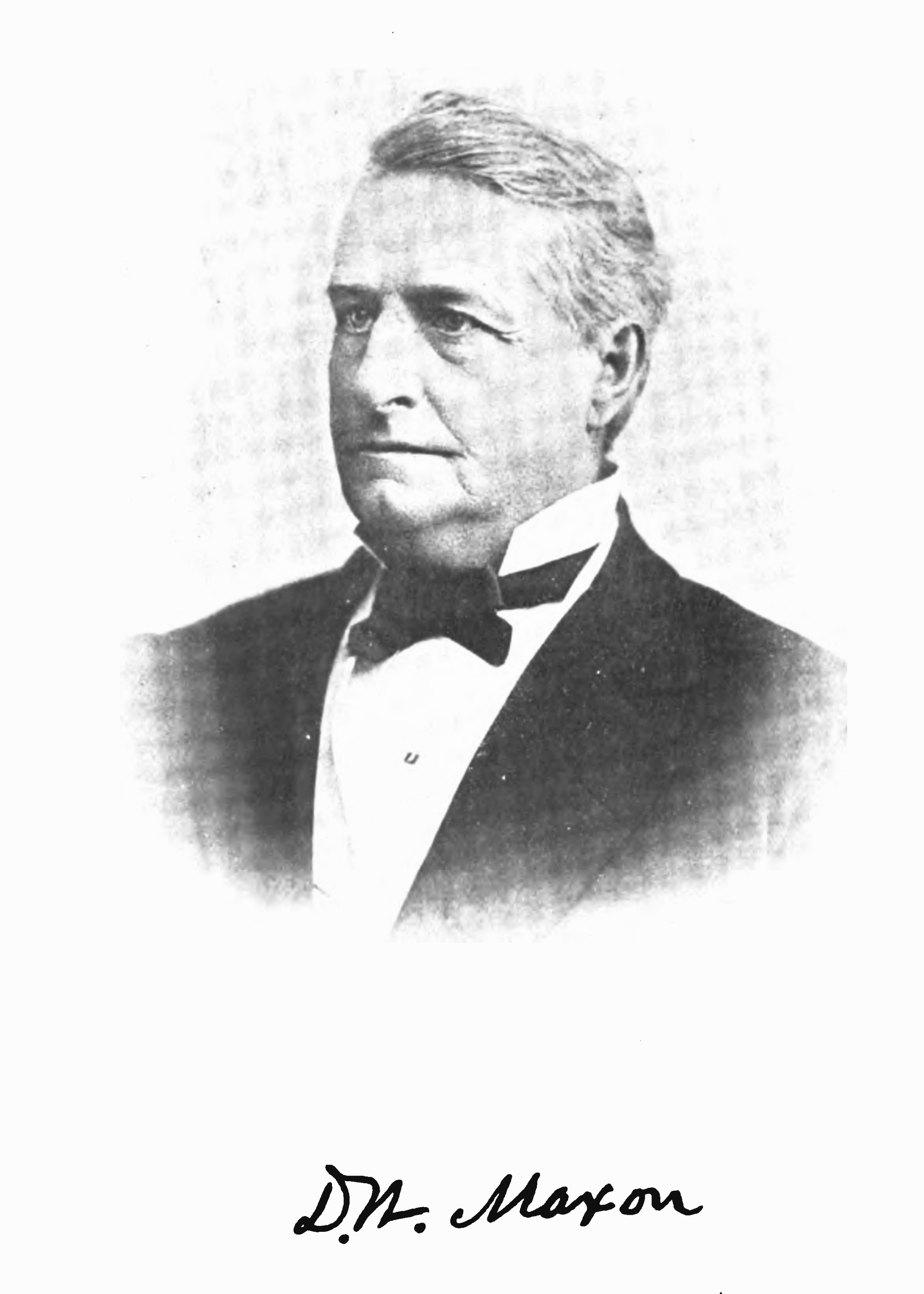
From the early 1840s until at least the 1880s, members of the Maxon family—and especially D. W. Maxon— played important, recurring roles in Clark and Turck family affairs. That being the case, I thought we might benefit from a reasonably detailed overview of D. W. Maxon’s life, and I found a good one in A. M. Thomson’s A Political History of Wisconsin, second edition (C. N. Caspar Company, Milwaukee, 1902).
D. W. Maxon
The biography spans pages 431-433. D. W. Maxon’s portrait, with signature (above), is found facing page 236. I have proofread the transcribed text and added some paragraph breaks and headers for ease of reading. Otherwise the text, displayed here in grey-background “quotation” paragraphs, is complete as published in 1902.
We’re coming up on the tenth (!) anniversary of Clark House Historian, and I realize that in those ten years I have not yet written about all of Mary (Turck) Clark’s immediate family. Regular readers will recall that the Vermont and/or Canadian ancestry of Mary’s husband Jonathan M. Clark remains, in spite of our best efforts, mysterious and—so far—mostly unknown. But we actually know a lot about Mary Clark’s people, the Peter Turck family, including her seven siblings. Over the years I’ve blogged a bit about Mary’s oldest sibling, Joseph R. Turck, and her youngest, brother Benjamin Turck. I think it’s about time I started to write about Mary Clark’s other brothers and sisters, beginning with younger sister Elizabeth Turck, later Mrs. Densmore Maxon.
Elizabeth Turck Maxon’s memoir
A memoir from the Turck family, even a short one, would be a substantial addition to what we know about the family and the events of their pioneer lives. In 1907, near the end of her long and productive life, Elizabeth Turck Maxon wrote down some of her recollections of early days in the area, in the form of a letter to the Old Settler’s Club of Washington County, Wisconsin.
When that 1907 letter was new, some—but not all—of its contents were published in various Wisconsin newspapers. In 1912, editor Carl Quickert included his selection of “the most interesting passages” from Elizabeth’s letter on pages 64-65 of his book Washington County Wisconsin Past and Present, Vol 1 (Chicago, S.J. Clarke Publishing Co., 1912).
In all the various 1907 newspaper editions, and in Quickert’s 1912 history, the omitted passages were usually noted with three asterisks, like this * * * This was typical editorial practice for the time. But, of course, those asterisks piqued my interest. What had been cut? What additional things might Elizabeth’s full text tell us about the early days in old Washington/Ozaukee county?
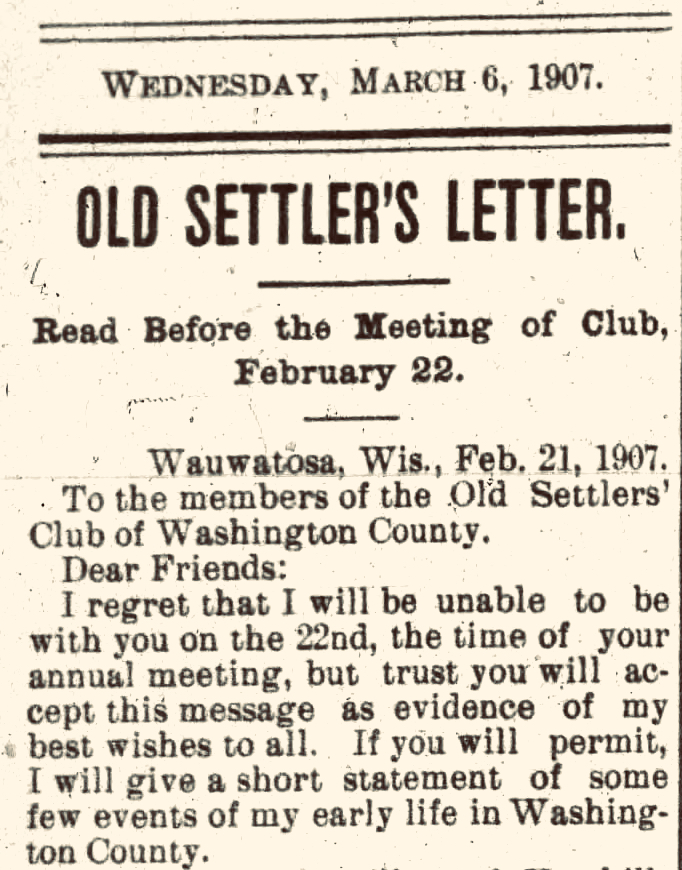
Old Settler’s Letter, 1907
I spent over a decade looking for Elizabeth’s unabridged, original, text and I think I finally found it. It was published on page 4 of the West Bend [WI] News of March 6, 1907. It’s a long letter, a full column of text, beginning with Elizabeth’s salutation to the members of the club, dated February 21, 1907.
The greetings are followed by the main text, beginning with her birth information and the story of the Peter Turck family’s migration from New York state to Wisconsin Territory in 1837. Below is the unabridged text (in the grey text boxes), interspersed with paragraph headers and my comments in plain type. FYI, I have blogged previously about a number of the events and characters in Elizabeth’s letter here on CHH, and have added links to some of those posts. Be sure to click the links for more information, and some interesting illustrations and maps.
In our previous post, we were introduced to the Desmond family, early Irish immigrants to old Washington/Ozaukee county and neighbors of Jonathan and Mary Clark. To our good fortune, one of the Desmond sons, Humphrey Desmond, wrote a memoir of his father Thomas that includes some unique family genealogy and tales of pioneer days in our area.
If you missed Part 1, I suggest you go ahead and read that post first. Then return here to continue with Part 2 of selections from A Memoir of Thomas Desmond, with a chapter on The Desmond Genealogy, by Humphrey J. Desmond, 77 pages, Milwaukee, 1905. And remember: you can read the complete memoir at this link, which is a part of the admirably organized and comprehensive online genealogy project The Desmond Archives.
Pioneer Days
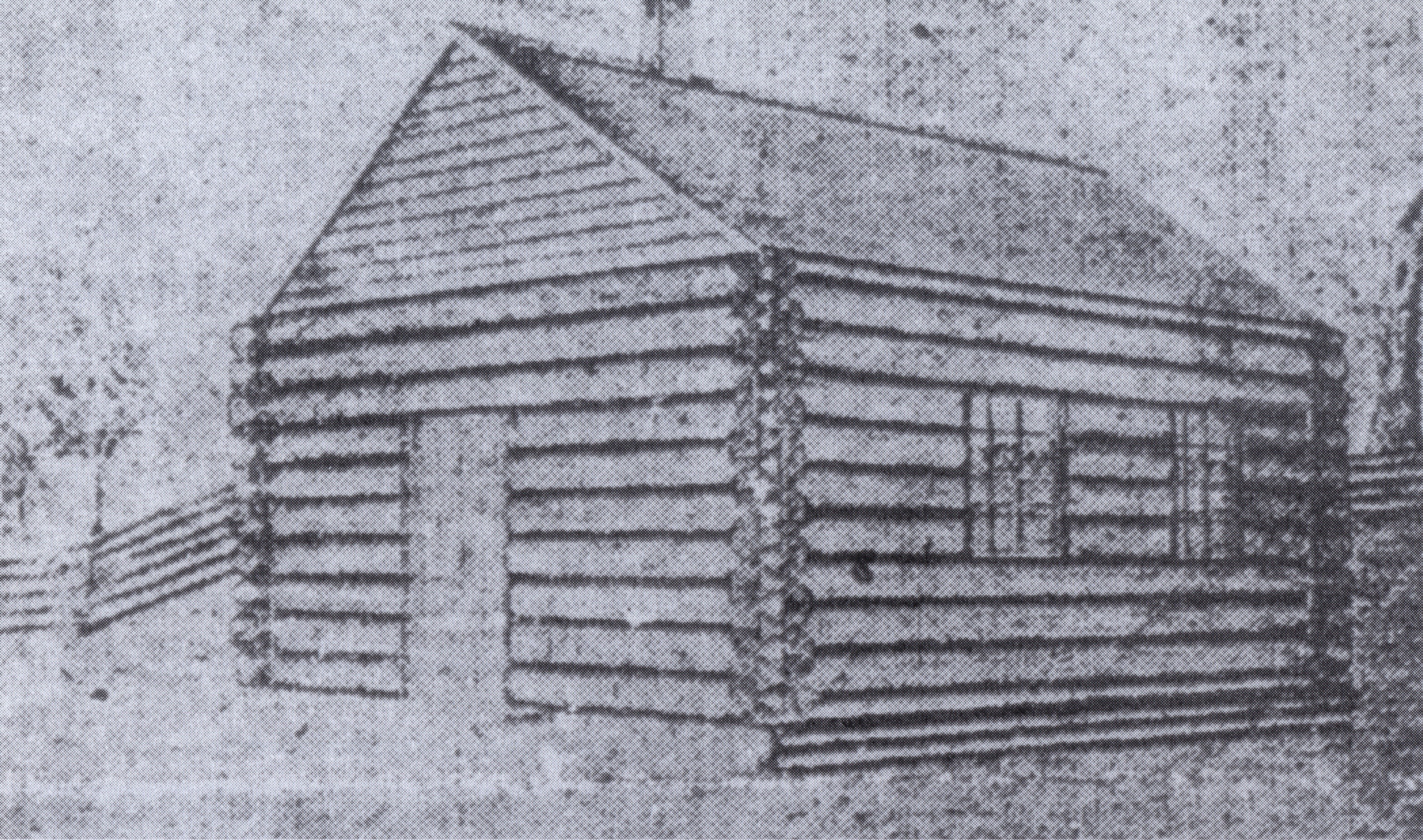
Chapter 3 of Desmond’s memoir will be of particular interest to CHH readers. It relates various early Mequon events, some involving the Desmond family’s Catholic faith, their Bonniwell neighbors, and the local school that the Bonniwells helped build in the early 1840s. That first “Bonniwell School,” located less than a mile west of the Jonathan Clark house on what is now the southeast corner of Bonniwell and Wauwatosa roads in Mequon, was sketched in 1864 by Evander Bonniwell. The sketch (above) is reproduced here from page 71 of George B. Bonniwell’s comprehensive family history, The Bonniwells: 1000 Years. (Used by permission.)
[31]        III.   PIONEER DAYS

THE "hazard of new fortunes" undertaken by the Desmond family involved the clearing away of woods with the ax of the pioneer and the building of a commodious log house.
    The pioneers of this neighborhood were the Bonniwell brothers, who had settled there about 1835 [sic, 1839], and it was known as the Bonniwell settlement.
    Indians still roamed the forests of southeastern Wisconsin in 1843. My [32] father, then ten years old, alone in the house one day, was visited by a brave to whom he gave a large loaf of bread. The Indian loosened his belt as he ate the loaf, and when it was all gone departed peaceably on his journey.
    There was a log school house to which my father went. Books were not plentiful in those days. He studied his spelling lesson during the noon hour from the book of a desk mate. He had to start at the foot of the class, but one day he got to the head and kept his place.

 Clark House Historian