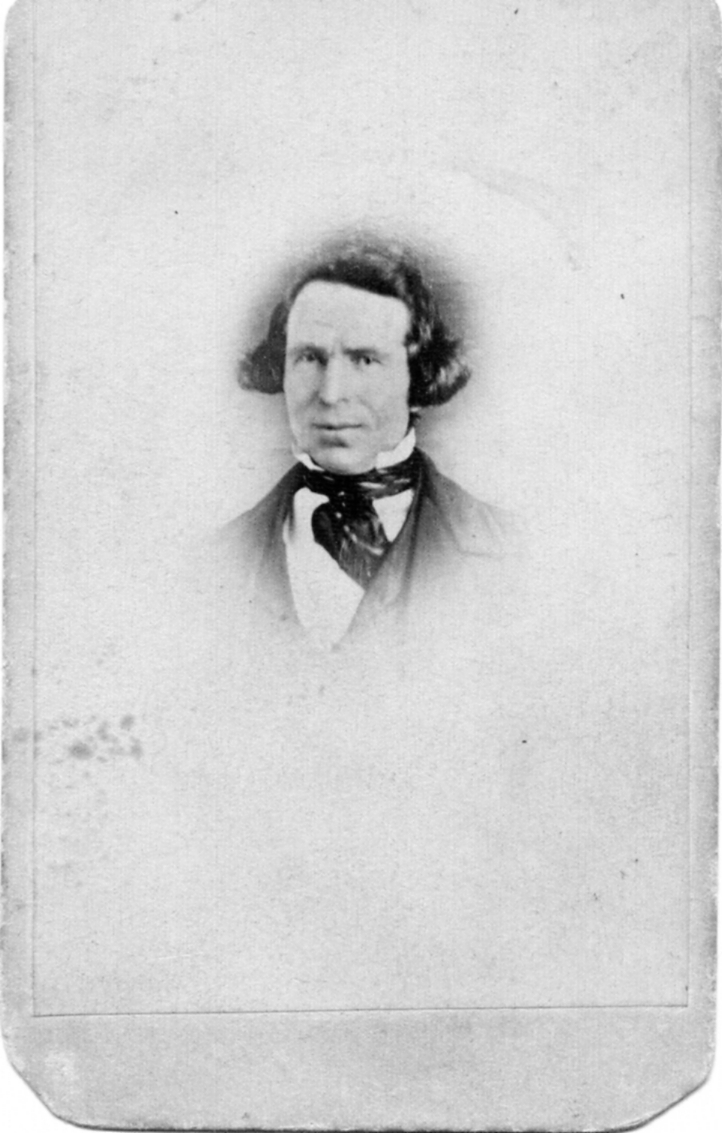
Fred Beckmann, Sr.

UPDATED February 9 & 11, 2025, to correct the year and date of Fred. Beckmann’s death and investigate the apparent errors on his gravestone (see updated images, text, and especially Note 4, below).

Farming the Clark place, 1868-1873

In our previous post we saw that sometime around 1861/62, Mary Clark and her children decided to move to Milwaukee. By the time the Milwaukee City Directory for 1862 was published, Mary—and, we presume, her children—were living together with Mary’s father Peter Turck, at 474 Jefferson in the city.

We also know that Mary and her daughters did not sell the Mequon farm—to Catherine Doyle—until April, 1872. So, for over a decade, someone besides the Clark family was living and working on the Clark property. Most likely, Mary made some kind of tenant-farmer arrangement where someone grew crops on the Clark land and paid rent to Mary from the proceeds. This could have been a very useful source of income for Widow Clark and her seven children during the 1860s. Unfortunately, we don’t have much documentation of who the tenants may have been and what sort of arrangement Mary may have made with them.

The Doyle Family

In the same post, I also erred in assuming that the John and Catherine Doyle family probably farmed the Clark land throughout the 1860s. Clark House museum director Nina Look recently called my attention to information about the Doyles and their neighbors in various maps and census schedules created around 1870 that shows that the Doyles were living and farming elsewhere in Mequon through most of the 1860-1870 decade. In future posts I will look at those maps and census schedules and try and make more sense of where the Doyles lived and what land they may have farmed prior to purchasing the Clark farm in April, 1872.

Nina also reminded me that I forgot one important person that we know did farm the Clark farm: Fred Beckmann

Continue reading

Monday Miscellany!

Clark House News and an Update

I hope you enjoyed your Independence Day weekend. Our “Monday: Map Day!” feature is taking the week off. In its place, here is a round-up of some recent Jonathan Clark House news and a blog update/correction or two.

Three Cheers for Liz!

I was glad to assist Clark House museum director Nina Look in putting together this “tip of the hat” to Clark family descendant and stalwart Jonathan Clark House Museum friend and supporter Liz Hickman. This went out to Clark House board members and volunteers in mid-June, and I’m happy to share it with you here:

Continue reading

Updates, Corrections and other Miscellany…

Recently, I’ve made a few corrections and comments on previous posts, and I’ve gathered some here for your convenience, followed by a few suggestions so that you may get more out of Clark House Historian.

Lesen Sie Kurrent?

I’m not sure how I forgot this, but if you are really interested in reading or writing Kurrent, I highly recommend the 28-page A Guide to Writing the old German “Kurrent” Script, by Margarete Mücke, available in English as a free download at her website Ms. Mücke’s explanations of the Hows and Whys of the letters and their use in Kurrent are clear and thorough. If you read German and are interested in the old writing styles, you may find the rest of her website fascinating.

Spelling in the 19th-century: surnames

Something worth remembering when reading 19th-century (and earlier) documents, is that early spelling varied widely, even (or especially) for family names. One example, from the post on a “new” Jonathan M. Clark document, is Barnet Clow’s surname. It is found on other Wisconsin documents variously as CLOW or CLOUGH, and back in his Dutch- speaking home of Greene Co., New York, as CLOW, CLOUGH, CLAW, KLAUW, and KLAW. But it’s all the same family and surname.

(And if you think that’s confusing, I also have ancestors who migrated to the southern states and territories in the late 18th- and early 19th-centuries. And holy cow!, no one on those southern censuses spells given names or surnames the same way twice. And some of the name spellings are amazingly…creative, to say the least.)

Spelling in the 19th-century: long-S

In the recent post on a historic German cursive style and its relevance for American researchers, we discussed the various 19th-century forms of the letter S, including the long-S, as also found the U.S. Constitution:

“and secure the Blessings of Liberty” from Preamble, U.S. Constitution
Continue reading

The “E” is silent – as in “Clarke”

A “New” Jonathan M. Clark Document, a New Line of Inquiry, and a Friendly Reminder…

Take a look at the following name as written by a professional U.S. land office clerk in three different places on land patent no. 19687, from 1848:

Patent No. 19687, Jonathan M. Clark(e)? #1
Patent No. 19687, Jonathan M. Clark(e)? #2
Patent No. 19687, Jonathan M. Clark(e)? #3

What to you think? Jonathan M. Clark or Clarke? Is that a silent “e” at the end of “Clark,” or just a looping flourish? Whoever indexed this document at the Bureau of Land Management’s General Land Office website1 thought it was Clarke. Is it a big deal? No. Given that the GLO has been digitizing and indexing hundreds of thousands of pages of maps, survey notes and patent documents for the last decade or two, we can’t expect that the indexers can cross-reference each name on each patent and check for consistent spelling. And besides, 19th-century spelling is notoriously capricious anyway.

On the other hand, maybe the indexer could have looked at the end of the document and compared the “K” in “Clark” to the “K” at the end of this signature, representing our eleventh President:

Continue reading

Correction: Laura M. Clark

“Constant vigilance!” — J. K. Rowling, Harry Potter and the Goblet of Fire

Mad Eye Moody’s advice to the Hogwarts students was essential for them and remains apt for anyone doing historical research. Whether working on a large history project or a modest family tree, constant vigilance is needed to avoid bad information. Fortunately, the historian or genealogist’s dementors are not deadly wraiths ready to suck the life force from us, but more mundane creatures such as typos, inaccessible or hard-to-read documents, and—most vexingly—mystery data.

For some reason, in my database I had recorded that Jonathan and Mary Clark’s sixth child, daughter Laura, had a middle name of “Mandlena.” This—unless I’ve overlooked some important but now lost evidence—was nonsense. It’s the sort of mistake that creeps into historical writing via random error; I don’t know how I managed to make this particular honker. So for the record, the Clark’s sixth child was Laura Marcelleau Clark.

Continue reading