Memorial Day, 2025

Lest We Forget

Our annual Memorial Day post, first published in 2020, more relevant with each passing year.

Graves of Unknown Union Soldiers, Memphis National Cemetery, photo by Clayton B. Fraser, (Library of Congress), public domain. Memphis National Cemetery is the final resting place of Mequon’s Watson Peter Woodworth, and almost 14,000 of his Union Army comrades.

Today is the day our nation officially observes Memorial Day. For many Americans, Memorial Day represents “the first day of summer,” and is traditionally celebrated with trips to the lake, picnics, parades, and sales on cars, appliances, and other consumer goods.

But for many of us, Memorial Day remains rooted in its origins as Decoration Day. The first national observance was in 1868, when retired general John A. Logan, commander and chief of the Grand Army of the Republic—the Union veterans’ organization—issued his General Order Number 11, designating May 30 as a memorial day “for the purpose of strewing with flowers or otherwise decorating the graves of comrades who died in defense of their country during the late rebellion, and whose bodies now lie in almost every city, village, and hamlet churchyard in the land.”

On this Memorial Day, let’s take a moment to remember what this day truly represents.

Continue reading

Fred Beckmann, Sr. – updates & clarifications

Today’s post is an updated, corrected and expanded version a post I wrote in July, 2020, outlining what we knew (at the time), about the life of Fred Beckmann, Sr., the man that occupied and farmed the Jonathan Clark farm between 1868 and 1872. Then, in early 2023, I was asked to talk about the Clark House and its Cedarburg connections at the Cedarburg History Museum. I chose to center my talk on Fred Beckmann and his extended German-American immigrant family, as I believe they exemplify a number of important themes in the transformation of Ozaukee county from the initial Anglo-American dominated first wave of local settlement in the 1830s and early ’40s, into the subsequent decades of primarily German-American settlement and development.

Anyway, I had a lot of fun, and learned a lot, in preparing that 2023 talk. And one of the things I learned is that there was some doubt about the year and date of Fred Beckmann’s death. So I recently investigated the issues and have updated images, text, and information for you about the life—and death—of Fred Beckmann, and I managed to solve at least one mystery in the process…

Continue reading

Memorial Day, 2024

Lest We Forget

Our annual Memorial Day post, first published in 2020. Updated for 2024 with new information about the Civil War service of Isham and Emily (Bigelow) Day’s eldest child, Cpl. James Lemon Day (1834-1863).

Graves of Unknown Union Soldiers, Memphis National Cemetery, photo by Clayton B. Fraser, (Library of Congress), public domain. Memphis National Cemetery is the final resting place of Mequon’s Watson Peter Woodworth, and almost 14,000 of his Union Army comrades.

Today is the day our nation officially observes Memorial Day. For many Americans, Memorial Day represents “the first day of summer,” and is traditionally celebrated with trips to the lake, picnics, parades, and sales on cars, appliances, and other consumer goods.

But for many of us, Memorial Day remains rooted in its origins as Decoration Day. The first national observance was in 1868, when retired general John A. Logan, commander and chief of the Grand Army of the Republic—the Union veterans’ organization—issued his General Order Number 11, designating May 30 as a memorial day “for the purpose of strewing with flowers or otherwise decorating the graves of comrades who died in defense of their country during the late rebellion, and whose bodies now lie in almost every city, village, and hamlet churchyard in the land.”

On this Memorial Day, let’s take a moment to remember what this day truly represents.

Continue reading

The farm garden

It’s already the second week of May, 2024, and summertime will soon be here. At our southeastern Wisconsin home the first spring flowers are done, and the next round of blossoms have been blooming for a week or two. The peas will soon be in the ground, and we already harvested enough rhubarb to make two and a half small jars of jam. The tomato and pepper seedlings and the squashes will go in soon, and I need to put up a trellis or two so we can start the big patch of green beans. So even though it’s “early” by the standards of previous years, we’ve got gardening on the mind here at the Historian’s house, and I thought you might enjoy a slightly-belated repost of this annual favorite, which first appeared here in April, 2021. Cheers!

Planning the garden

It’s early April, and the growing season is not far off. For a farmer like Jonathan M. Clark, it’s a little early yet for plowing and sowing, but not too early to make plans and sharpen the tools. For a farmer’s wife, like Mary (Turck) Clark, it’s not too soon to think about the farm garden, its crops and layout.

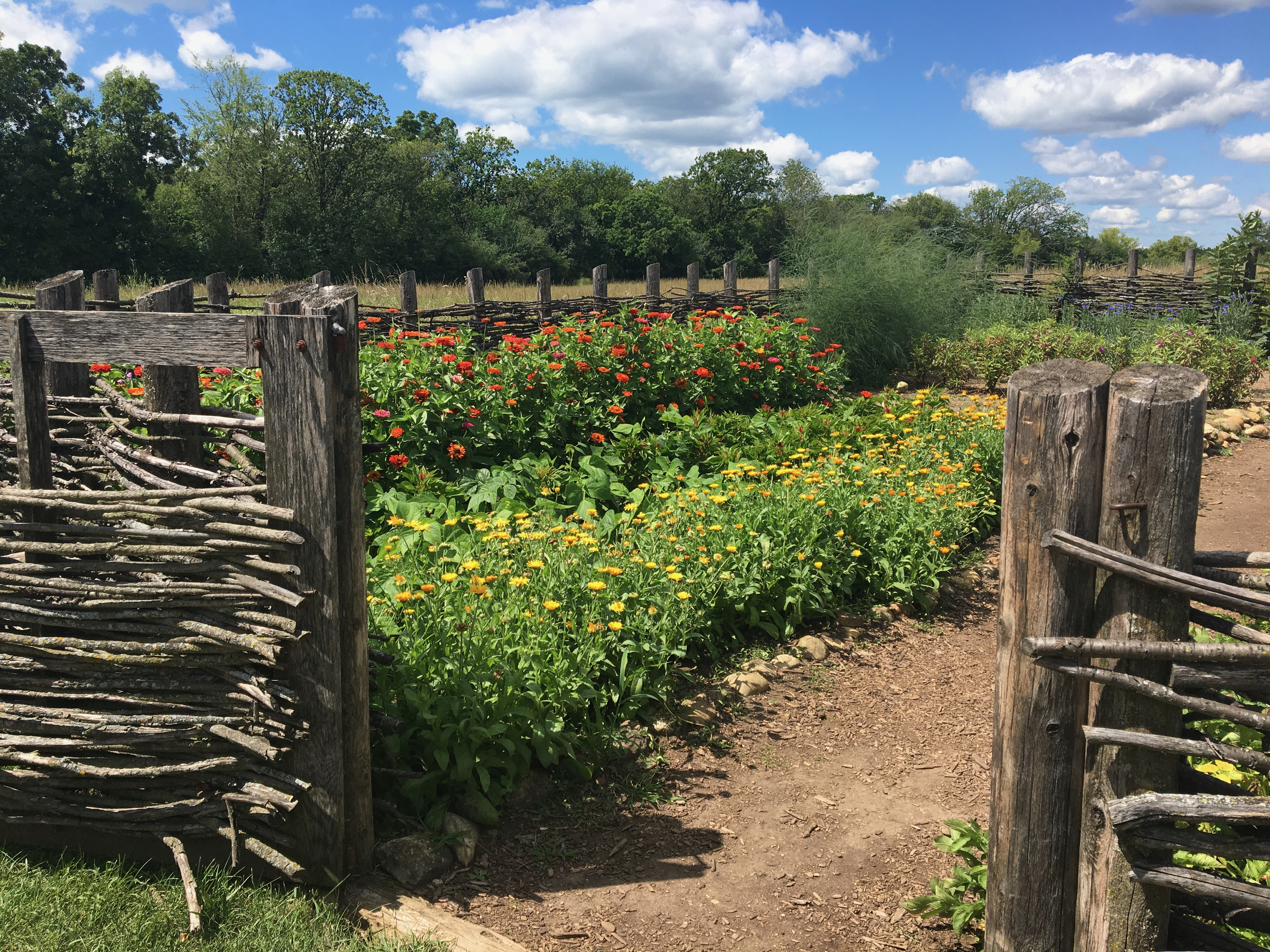
Garden at the Turck-Schottler House, 1870s Hessian Immigrant Farm, Old World Wisconsin. Photo credit Reed Perkins, 2022.1

I don’t know if Mary and Jonathan were regular readers of the popular and affordable farmers’ almanacs of their era; I wouldn’t be surprised if they were. There were many to chose from. Perhaps they had a copy of something like:

Continue reading

Monday: Map Day! – One more (updated) look at Ouisconsin Territory, 1836

Today’s Monday: Map Day! revisits and makes a correction to an interesting map that we first discussed here on October 29, 2017, and then re-visited on July 11, 2020. And for unknown reasons, that original 2017 post—according to my monthly WordPress statistics report—was the most-viewed post on this site for the month of January, 2024, with 341 views (!).

Burr, David H. Map of the Northern Parts of Ohio, Indiana and Illinois and Michigan and that part of the Ouisconsin Territory lying East of the Mississippi River, 1836, detail of title & author. Library of Congress.

The 2020 re-post was originally conceived as a kind of addendum to our June-July, 2020, multi-part discussion of the earliest Wisconsin territorial, state, and federal censuses. It also served to locate Jonathan M. Clark in Wisconsin Territory during his U.S. Army service from September, 1833, to September 19, 1836.

Today’s post includes one particular correction that I’ve been meaning to make for a while. When I added my original annotations to a detail of this map (in red), in 2017, I made an error. I mislabeled Sgt. Jonathan M. Clark’s location at the time he mustered out of service, a temporary army camp along the under-construction military road from Fort Howard (Green Bay) to Fort Winnebag0 (Portage). JMC’s muster-out location was always referred to in the records of the Fifth Regiment of Infantry as “Camp Hamilton.” For some reason, when I made my annotated detail map, I incorrectly labeled this place “Ft. Hamilton.” A minor error, but worth correcting , especially now that this map is receiving fresh attention.1

It’s 1836. Where’s…Wisconsin?

In September, 1836, Sgt. Jonathan M. Clark was discharged from the U.S. Army at “Camp Hamilton,” Wisconsin Territory, after serving his three-year term of service with Co. K, Fifth Regiment of Infantry.2  One year later, in the autumn of 1837, Jonathan’s future wife Mary Turck would make the long trip from Palmyra, New York, to Milwaukee and finally Mequon, Washington County, Wisconsin, with her parents Peter and Rachael Turck and six younger siblings. By the end of 1840 Jonathan and Mary would be married and starting their family in Mequon.

That seems simple enough, until you take a moment to wonder how much Jonathan—or especially Mary and her family—knew about this new Wisconsin Territory.  Jonathan had been in the territory since October, 1833, mostly on post at Ft. Howard. In the last year or so of his service he was busy cutting trees and building bridges for the military road along the Fox River waterway from Ft. Howard (Green Bay) towards Ft. Winnebago (near modern Portage). As a road-building soldier, Jonathan might have done some surveying and seen—or helped draw—a variety of maps of the military road and its vicinity. But for a better overview of this new territory, Jonathan or Mary might have sought out a map such as this:

Continue reading

RBOH: Weston & Western, Loomis & Loomer, and how do you pronounce Isham?

Time for a few Random Bits of History: Early Mequon Settlers’ Disambiguation Edition.

John Weston & John Western

Mequon’s first postmaster, John Weston, is mentioned many times in the essential local history book, the History of Washington and Ozaukee Counties, Wisconsin … Illustrated. Western Historical Publishing Co., Chicago, 1881. Using the “Find” function on my PDF copy of the book,1 I found results for “John Weston” on pages 475, 476, 523, 524 and 545.

There is also an entry for “T. Weston” among the names on the “First Poll-List of Washington County” on page 316. I am confident that this is a typographical error and that “T. Weston” is actually John Weston.

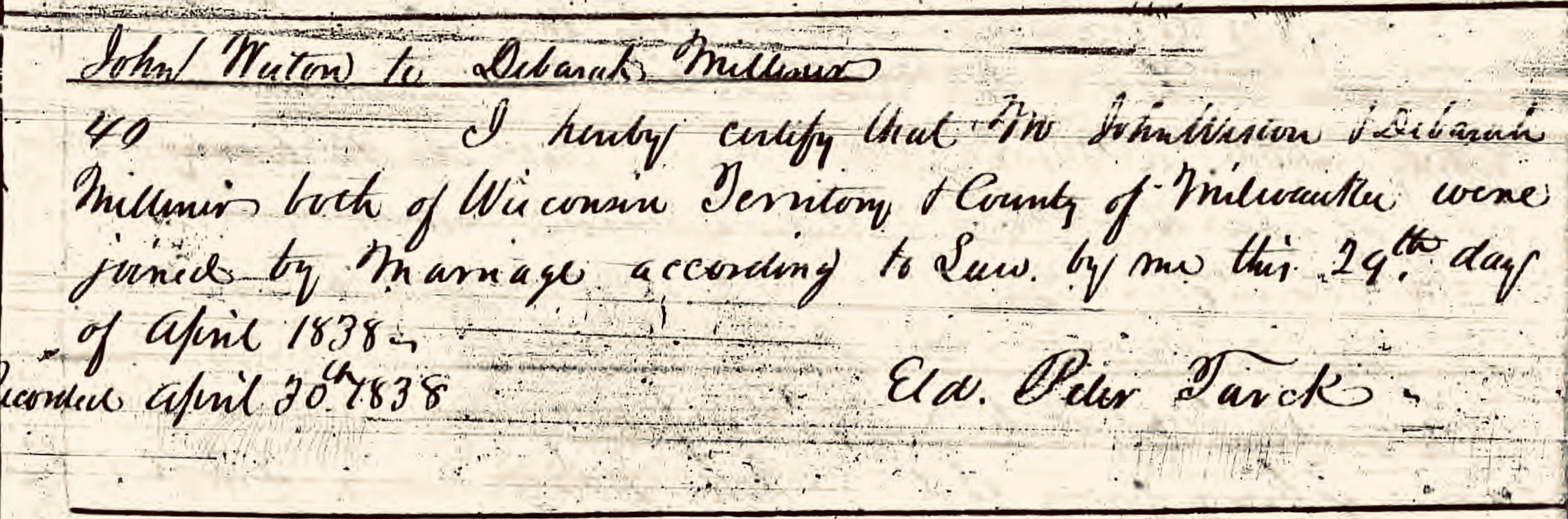
The same source also records, among the early area settlers, one “John Western,” on pages 316, 477 and 478. Is this the same man as John Weston? I have carefully compared a number of sources, including the early minutes of the county road supervisors and deeds in the Washington/Ozaukee county deed books, and I am convinced that during the early years of settlement in the Mequon-Milwaukee area, “John Weston” and “John Western” are the same person, namely John Weston, born in New York about 1800, and married to Deborah Milliner in Milwaukee County in April, 1838. I’ll have examples from the documents that explain my reasoning in a future post.

Fun fact: Mary (Turck) Clark’s father, (Baptist) “Elder” Peter Turck, was the officiant at the Weston-Milliner wedding in 1838. It was the fortieth marriage recorded in the first volume of marriage records for Milwaukee county (and its still-attached for judicial purposes neighbor counties, including old Washington/Ozaukee county).2

With the Weston & Western mystery solved—for the moment—let’s see what other bits of error and confusion we can clear up…

Continue reading

Bad Handwriting: not just a problem from the past

I hope you enjoyed Monday’s post Help the Historian — what’s Nellie’s last name? and that you’re now working on your best guess for Nellie’s almost-illegible surname.

A historical handwriting puzzle like this is fun when the stakes are low and you don’t have any pressure to get the job done quickly. But did you know that there are several hundred federal employees in Salt Lake City who decipher thousands and thousands of bad or damaged printed and handwritten addresses every day? Let’s let YouTube’s excellent experience-it-yourself man, Tom Scott, show us how it’s done:

How the U.S. Postal Service reads terrible handwriting

It’s an amazing system, when you think of it. To begin with, the speed and accuracy of optical character recognition (OCR) technology has improved dramatically over the years. But when the writing is really bad, or smudged? Then the mail is viewed by the men and women of the USPS Remote Encoding Center in Salt Lake City process, and they read and key in 1.2 billion (that’s billion with a B) images of mail every year. My hat’s off to the USPS employees that can do this fast-paced detective work so efficiently, day after day. Meanwhile, how about you and your deciphering skills?

Continue reading

Help the Historian — what’s Nellie’s last name?

Today was supposed to be a lavishly illustrated “Monday: Map Day!” post, to accompany our recent posts on the Bonniwell family’s roots in Chatham, Kent, England. But, of course, I ran into some interesting—although pretty much off-topic and confusing—Bonniwell documents. These records added a previously unknown1 second marriage to the story of early Mequon pioneer, Jonathan Clark House neighbor, and Washington/Ozaukee county mover-and-shaker William T. Bonniwell.

It’s a complicated story. A second marriage for him, a second marriage for her, and there is a seven-year-old child named Nellie (of somewhat obscure parentage) living with them. So, of course, I dropped what I was doing and dug in to try and solve these new mysteries. I’m now close to understanding what happened with W. T. Bonniwell’s short-lived second marriage, but I have a problem.

Cn u rd ths?

Can you read this?

As always, click the images to open higher-resolution versions of each.

I read a lot of handwritten documents, mostly from about 1600 to the present day. I’m pretty good at deciphering most English and German writing styles from those years, but every now and then I’m stumped.

This is an 1870 document in the hand of young Nellie’s trustee, one Jedd P. C. Cottrill (sp?), acknowledging the receipt of her share of the estate of her deceased foster father, Nelson Webster. Nellie’s name is inside the red rectangle: Nellie J. [hmm?]. What do you think Nellie’s surname is supposed to be? Is the first letter an F or a T or something else? And after that? Is it ?urck, ?urch, ?inck, ?inch? I’m leaning toward Finch or, maybe, Finck. But I’m not sure. Perhaps if we compared other examples of Nellie’s surname from the same probate file…

Continue reading

Memorial Day, 2023

Lest We Forget

Our annual Memorial Day post, first published in 2020. Updated for 2023 with new information about Evander B. Bonniwell’s service.

Graves of Unknown Union Soldiers, Memphis National Cemetery, photo by Clayton B. Fraser, (Library of Congress), public domain. Memphis National Cemetery is the final resting place of Mequon’s Watson Peter Woodworth, and almost 14,000 of his Union Army comrades.

Today is the day our nation officially observes Memorial Day. For many Americans, Memorial Day represents “the first day of summer,” and is traditionally celebrated with trips to the lake, picnics, parades, and sales on cars, appliances, and other consumer goods.

But for many of us, Memorial Day remains rooted in its origins as Decoration Day. The first national observance was in 1868, when retired general John A. Logan, commander and chief of the Grand Army of the Republic—the Union veterans’ organization—issued his General Order Number 11, designating May 30 as a memorial day “for the purpose of strewing with flowers or otherwise decorating the graves of comrades who died in defense of their country during the late rebellion, and whose bodies now lie in almost every city, village, and hamlet churchyard in the land.”

On this Memorial Day, let’s take a moment to remember what this day truly represents.

Continue reading

Memorial Day, 2022

Lest We Forget

Our annual Memorial Day post, first published in 2020. This revised edition, originaly published in 2022, was inadvertently updated for the further-revised 2023 edition, making a few minor edits and adding new information about Evander B. Bonniwell’s service. So the original 2022 post is “gone” and I’m going to leave this revised-revised version of that post here for reference, in case it is bookmarked elsewhere on the blog or in a readers’ notes.

Graves of Unknown Union Soldiers, Memphis National Cemetery, photo by Clayton B. Fraser, (Library of Congress), public domain. Memphis National Cemetery is the final resting place of Mequon’s Watson Peter Woodworth, and almost 14,000 of his Union Army comrades.

Today is the day our nation officially observes Memorial Day. For many Americans, Memorial Day represents “the first day of summer,” and is traditionally celebrated with trips to the lake, picnics, parades, and sales on cars, appliances, and other consumer goods.

But for many of us, Memorial Day remains rooted in its origins as Decoration Day. The first national observance was in 1868, when retired general John A. Logan, commander and chief of the Grand Army of the Republic—the Union veterans’ organization—issued his General Order Number 11, designating May 30 as a memorial day “for the purpose of strewing with flowers or otherwise decorating the graves of comrades who died in defense of their country during the late rebellion, and whose bodies now lie in almost every city, village, and hamlet churchyard in the land.”

On this Memorial Day, let’s take a moment to remember what this day truly represents.

Continue reading