Rabbits!

Audubon, John James, artist, and John T. Bowen, printer, Lepus Sylvaticus, Bachman, circa 1845-1848, Smithsonian Institution, Peters Prints Collection, Creative Commons CC0 license.1

There they are: Mr. & Mrs. Cottontail and one of their many offspring. The Eastern Cottontail and its relatives were a common sight in Jonathan and Mary Clark’s world, just as they are today.

We seem to have a bumper crop of rabbits in our suburban Wisconsin yard this year and, no doubt about it, the bunnies are cute and entertaining. But for the gardener, rabbits mean trouble. If you are trying to raise vegetables and fruits to feed your pioneer family, these amusing little fur balls are the enemy. They can consume huge amounts of seedlings and sprouts in just a day or two. What’s a gardener to do?

Last year—after they ate through the plastic fence around our vegetable garden and then devoured our entire crop of green been sprouts—I went to the local big box store and got a roll of metal wire rabbit fencing and some steel posts to hold it up. That worked great for us, but it made me wonder: what did Jonathan and Mary Clark use to keep the ravenous rabbits at bay? Well, I don’t have any documentation from the Clarks’ farm, but during my researches, I have noticed some popular 19th-century methods of rabbit control.

Continue reading

The farm garden

It’s already the third week of May, 2023, and summertime will soon be here. At our southeastern Wisconsin home the first spring flowers are done, and the next round of blossoms have been blooming for a week or two. The peas are in the ground and already about 8 inches high, the rhubarb is big enough to cut and make one or two pies, and we harvested the first half-dozen radishes today. We still have to put in the tomato and pepper seedlings and start the big patch of green beans. So with gardening on my mind, I thought you might enjoy a slightly-belated repost of this annual favorite, which first appeared here in April, 2021. Cheers!

Planning the garden

It’s early April, and the growing season is not far off. For a farmer like Jonathan M. Clark, it’s a little early yet for plowing and sowing, but not too early to make plans and sharpen the tools. For a farmer’s wife, like Mary (Turck) Clark, it’s not too soon to think about the farm garden, its crops and layout.

I don’t know if Mary and Jonathan were regular readers of the popular and affordable farmers’ almanacs of their era; I wouldn’t be surprised if they were. There were many to chose from. Perhaps they had a copy of something like:

The Cultivator […], New Series, Vol. VII, Albany, 1850, title page. Click to open larger image in new window.

Continue reading

Time flies!

[Editor], daguerreotype with added color highlights c.1855 (slightly cropped, and color adjusted), Smithsonian American Art Museum, Gift of Charles Isaacs, (link), Creative Commons CC0 license. Click to open larger image in new window.

Hey! It’s almost been a month since my last post. Sorry about that. I haven’t gone this long between posts in several years, I think, and now I’ve got (the digital equivalent of) a towering pile of half-written posts to finish and topics to discuss. That said, I have been busy…

Continue reading

JMC & the neighbors petition Congress, 1849

Today we have a surprise addition to our survey of Alfred T. Bonniwell documents. It’s a recent discovery, a very cool 1849 petition to Congress asking for a new postal road from Grafton to Waukesha, via Mequon. It’s signed by many of old Washington county’s most civic-minded men, including Grafton postmaster P.M. Johnson, Jonathan M. Clark, Peter Turck, and almost all of the Bonniwell men. It’s of interest to us, in part as an example of the citizen petition process in the early days of Wisconsin statehood, and more specifically as a record of “who was here?” in Washington county in a non-census year.

A growing county needs a new mail route

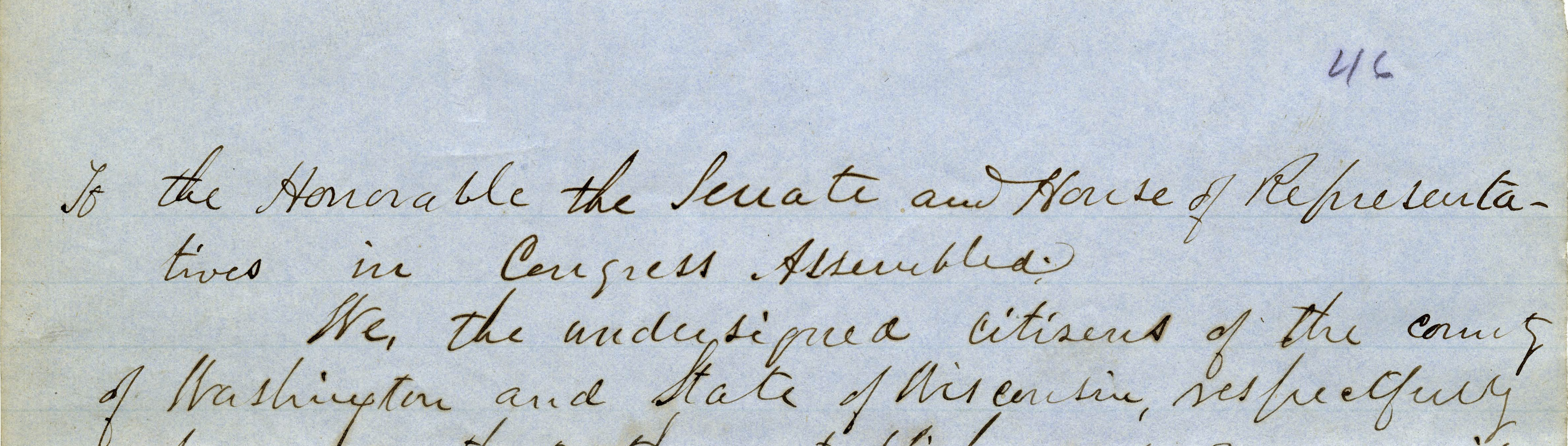
Petition of Phineas M. Johnson and others to U.S. Congress. [1849-02-06]. /documents/D275080, page 1, detail, salutation, The Papers of Abraham Lincoln Digital Library. Public domain.1, 5

Citizen petitions have been a part of American governance since early days. Check out our 2021 RBOH: Wisconsin Citizen Petitions for more information on a newly digitized collection of early Wisconsin territorial and state petitions, including a searchable database of petition images. Citizens could also petition the federal government for assistance; our petition is addressed To the Honorable the Senate and House of Representatives in Congress Assembled, and looks like this:

Continue reading

Snow!

The Holidays are upon us, and I’m taking time to celebrate and enjoy some time with family, That means I won’t have much new for you for the next week or so. (Don’t worry, we will wrap up the Alfred T. Bonniwell story in the very near future. I promise!) But in case you need a little Clark House history for fireside reading this week, I’m going to re-post several seasonal CHH favorites from past years. And since much of the Midwest is currently under a blizzard warning, I thought we should begin with this essay, which originally appeared in early 2021, was revised last February, and has been updated with an additional Currier & Ives lithograph for today’s post.

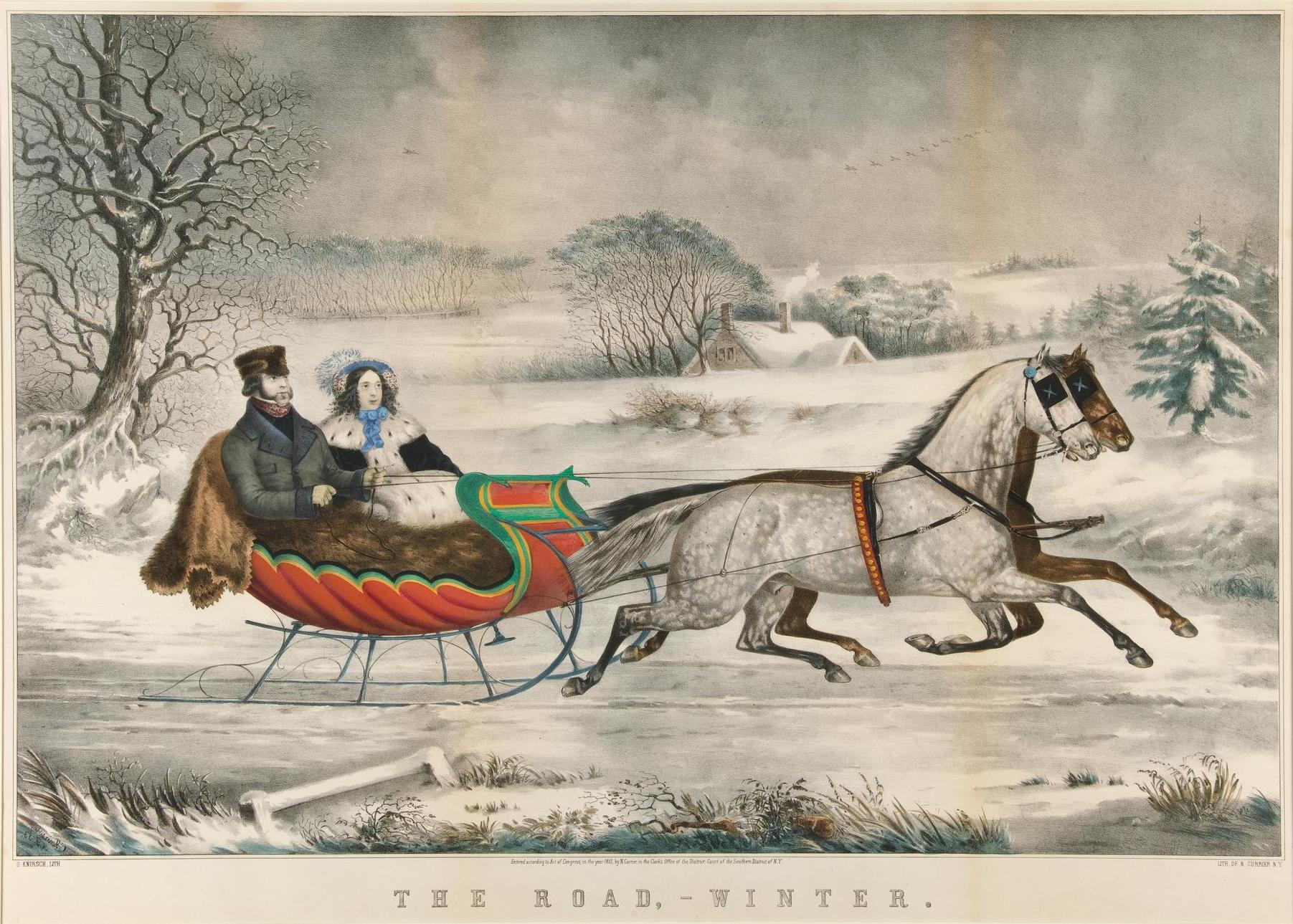
Snow, and often lots of it, was a feature of Jonathan and Mary Clark’s life in Wisconsin. And if you wanted to go to town or church or visit your neighbors during the snowy Wisconsin winter—or just enjoy a pleasant winter ride in the country—you’d need a sleigh.

Currier, Nathaniel (1813-1888), The road, winter / O. Knirsch, lith., 1853. New York: Published by Currier & Ives. Yale University Art Museum, Whitney Collections of Sporting Art, given in memory of Harry Payne Whitney (B.A. 1894) and Payne Whitney (B.A. 1898) by Francis P. Garvan (B.A. 1897) June 2, 1932. Public domain. Click to open larger image in new window.1

We don’t know if the Clarks owned a sleigh while they lived in Mequon. I suspect they did, though their sleigh—and their clothing—may not have been quite as posh as those in this Currier & Ives lithograph from 1853.

Continue reading

Home to Thanksgiving

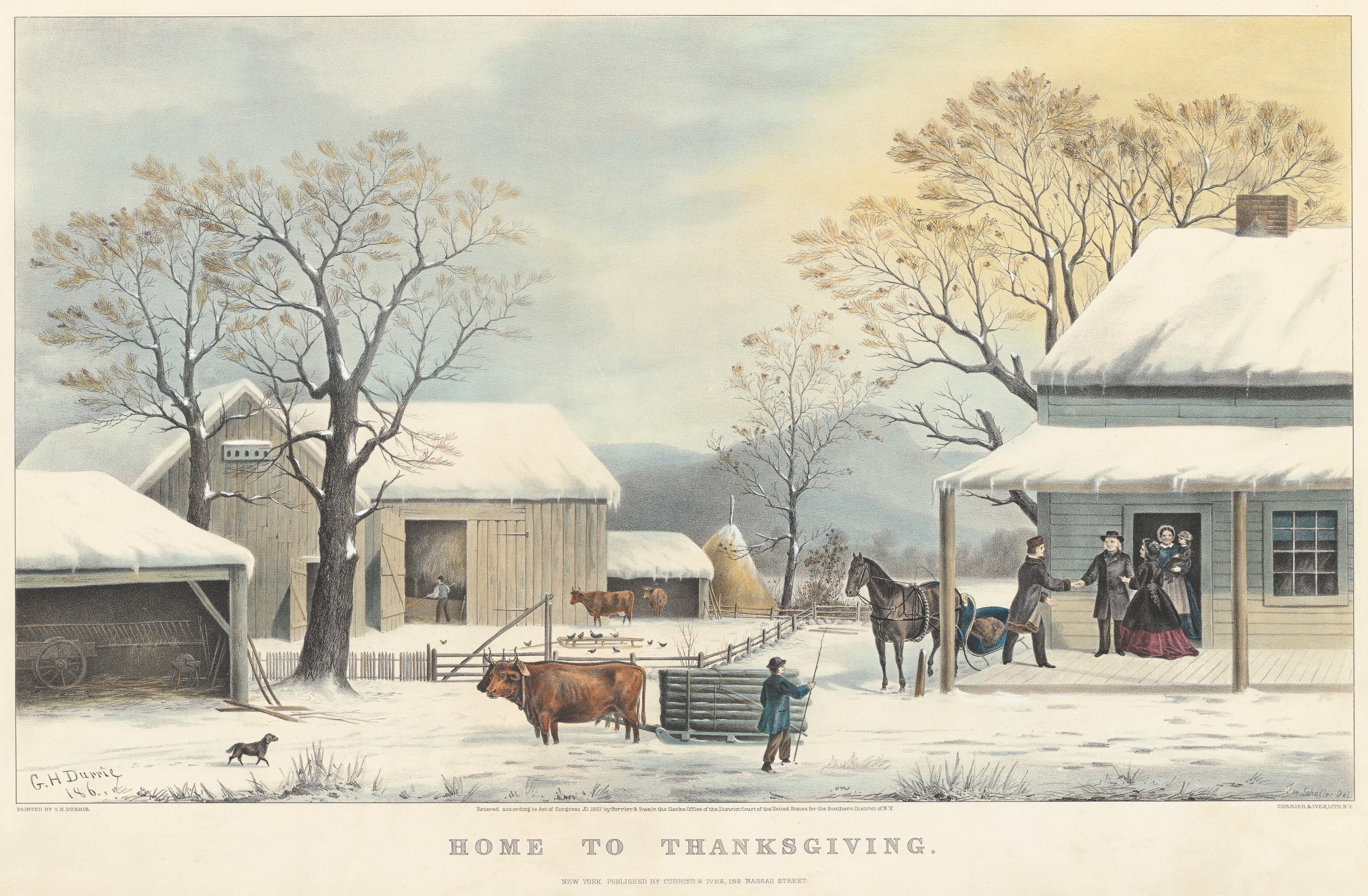
It’s Thanksgiving today, and I’m taking the day off to spend time with family. But in the spirit of the holiday, I thought I’d reprint a lightly revised version of last year’s Thanksgiving post, to share with you a few vintage recipes and a nice Currier & Ives lithograph from the period.1

Thanksgiving, 1867

Durrie, George H. and John Schutler, Home to Thanksgiving, ca. 1867, New York, Currier & Ives. National Gallery of Art, Collection of Mr. and Mrs. Paul Mellon. Public Domain. Click to to open larger image in a new window.

Continue reading

Veterans Day, 2022

Veterans Day is today. For a perspective on the day—and our early Mequon veterans—here’s a post originally published at Clark House Historian on November 11, 2016, and revised, expanded and republished several times since.

Armistice Day

One hundred and three years ago, on the eleventh day, of the eleventh month, at the eleventh hour—Paris time—the Armistice of Compiègne took effect, officially ending the fighting on the Western Front and marking the end of World War I, the optimistically named “War to End All Wars.”

In the United States, the commemoration of the war dead and the Allied victory began in 1919 as Armistice Day, by proclamation of President Woodrow Wilson. Congress created Armistice Day as a legal holiday in 1938. Starting in 1945, a World War II veteran named Raymond Weeks proposed that the commemorations of November 11 be expanded to celebrate all veterans, living and dead. In 1954 Congress and President Eisenhower made that idea official, and this is what we commemorate today. There are many veterans with a connection to the Jonathan Clark house. We honor a few of them in this post.

Jonathan Clark, Henry Clark, and the U.S. Army

Jonathan M. Clark (1812-1857) enlisted as a Private in Company K, Fifth Regiment of the U. S. Army, and served at Ft. Howard, Michigan (later Wisconsin) Territory, from 1833 until mustering out, as Sargent Jonathan M. Clark, in 1836. In the 1830s, Fort Howard was on the nation’s northwestern frontier. Jonathan’s Co. K spent much of the summers of 1835 and 1836 cutting the military road across Wisconsin, from Ft. Howard toward Ft. Winnebago, near modern Portage, Wisconsin.

Fort Howard, Wisconsin Territory, circa 1855, from Marryat, Frederick, and State Historical Society Of Wisconsin. “An English officer’s description of Wisconsin in 1837.” Madison: Democrat Printing Company, State Printers, 1898. Library of Congress. Click to open larger image in new window.

Continue reading

I must have drifted off…

Inman, Henry. Rip Van Winkle Awakening from his Long Sleep, 1823. National Gallery of Art, gift of William and Abigail Gerdts. Public Domain.

A long “nap”

Unlike Rip van Winkle, I haven’t been asleep the whole time since our previous post. But we are well overdue for new blog material. I’ve got a big backlog of documents and images to share with you; all I need to do is get writing. But first…

Be sure to vote today!

It’s election day today, and your vote counts. If you haven’t already done so, get out of the house, over to your polling place, and vote. Voting is your right and responsibility as a citizen, and an indispensable element of our nation since the earliest days of the Republic.

Not surprisingly, voting and public service were an important part of life in the Clark House era. From 1840 onward, Jonathan M. Clark, Peter Turck, William T. Bonniwell and many other relatives and neighbors sought, and won, appointment or election to a wide variety of local, territorial and state offices. Voting—then limited to white males only—was a priority for Mequon’s early settlers, and they never failed to turn out in large numbers for each election. Their passion for civic engagement and electoral politics was, in turn, passed to the next generation.

Continue reading