The Clark Family in 1850, part 3

Where y’all from? 

If you missed them, you might want to begin with Part 1 and Part 2 of our look at Jonathan and Mary Clark and their growing family on the 1850 federal decennial census. Those earlier posts focused in some detail on the names and ages of the various family members and how that information correlates with the manuscript Clark Family Record. In this post we’ll try and answer the question of where Jonathan, Mary, and the children were born, a simple question, right? Let’s start by taking another look at the census page: Continue reading

The Clark Family in 1850, part 2

A Closer Look at the 1850 Census: Ages and Dates

How well does the information on the 1850 census schedule agree with the Clark Family Record and other Clark family documents and known facts?

First, examine the census page header. It was enumerated by J. I. Loomis (a resident of Polk township, Washington county) and covered the “Free Inhabitants in Mequon Dist. No 15 in the County of Washington State of Wisconsin enumerated by me, on the 7th day of Oct. 1850.” Continue reading

The Clark Family in 1850, part 1

Looking at the 1850 Census: A Growing Family

Continuing our look at important sources for Clark family history, let’s return to the decennial U.S. federal census. If you missed it, be sure to read our earlier post on Jonathan, Mary, and ? on the 1840 Census. The 1850 census was the seventh United States federal —and first “all name”— decennial census; every free person—man, woman or child—living on June 1, 1850, was to be counted and named on a separate line on the census form. It was also the first federal census to ask for certain additional information, such as each individual’s place of birth and occupation. (Enslaved African-Americans were enumerated on a separate form and not by name, but by sex, age, and owner. Click here for more information on the 1850 and 1860 so-called Slave Schedules.)

Based on what we know from the Clark Family Record and other sources, as of the official enumeration day, June 1, 1850, if the census enumerator and his Clark family “informant” were both accurate in providing and recording the data, we should expect to find the following living family members listed on the 1850 census: parents Jonathan and Mary Clark and their children Caroline, Henry, Elizabeth, Persis, and new baby Teresa. Let’s look at the census page and see what the enumerator recorded: Continue reading

History Mystery! No. 2

The Clark Family Record: What is it? Who created it?

Welcome to our second installment of the Clark House Historian’s History Mystery! in which you, the reader, are invited to Help the Historian and solve one of the many persistent mysteries surrounding Jonathan M. Clark, his family, and related unknowns of local history. In a previous post, we got to Meet the Children of the Clark family. One of the sources for that post is an image that I received from Clark descendant Liz Hickman (thanks, Liz!) of what looks like a single page removed from an old family bible. The page lists birth dates for Jonathan M. Clark, Mary Turck Clark, and their children, and death dates for Jonathan and his only son, Henry. It’s a key document for Clark family research and yet there is much we don’t know about it.  History Mystery! No. 2 seeks to answer: What is the Clark “Family Record,” who created it, and how accurate is it?

Here’s a copy of the image from our files: Continue reading

Rev. Woodworth’s Autobiography

James W. Woodworth (1813-1893) and his brother Ephraim were among the earliest settlers in Mequon. They came from Nova Scotia, as did several other early Mequon settlers and families, including Isaac Bigelow, Daniel Strickland and Stephen Loomer. On March 1, 1838, J. W. Woodworth married fellow Nova Scotia emigrant and Mequon neighbor Mary Cerena Loomer. The marriage was believed to be the first Christian marriage in old Washington county and was performed by Mary Turck Clark’s father, Peter Turck, “an anabaptist preacher.”

J. W. Woodworth, like so many Protestant Christians of his era, was a man in search of a powerful and authentic connection to God. He found his answer in the 1830s and ’40s through Methodism. And, after many years of intense self-instruction, camp meetings, private prayer and preaching at local worship services, Woodworth was certified as a Methodist minister.

For much of his life Rev. Woodworth kept a diary of both the spiritual and mundane events of his life. He published the diary in Milwaukee in 1878 as My Path and the Way the Lord Led Me.  Continue reading

Map of Ouisconsin Territory, 1836

UPDATED, February 11, 2024, to include a revised annotated map. But for the full update—with additional notes and corrections—please see the most recent version of this, posted on February 12, 2024.

In September, 1836, Sgt. Jonathan M. Clark was discharged from the U.S. Army at “Ft. Hamilton,” Wisconsin Territory, after serving his three-year term of service with Co. K, Fifth Regiment of Infantry.  One year later, in the autumn of 1837, Jonathan’s future wife Mary Turck would make the long trip from Palmyra, New York, to Milwaukee and finally Mequon, Washington County, Wisconsin, with her parents Peter and Rachael Turck and six younger siblings. By the end of 1840 Jonathan and Mary would be married and starting their family in Mequon.

That seems simple enough, until you take a moment to wonder how much Jonathan—or especially Mary and her family—knew about this new Wisconsin Territory.  Jonathan had been in the territory since October, 1833, building portions of the military road along the Fox River waterway from Ft. Howard (Green Bay) towards Ft. Winnebago (near modern Portage). As a road building soldier, Jonathan probably had seen—or helped draw—a variety of maps of the military road and its vicinity. But for a better overview of the larger territory, Jonathan or Mary might have sought out a map such as this:

Continue reading

History Mystery! No. 1 (of many)

Jonathan & Mary & ? on the 1840 Census

Introducing a new feature on the blog: History Mystery! In which you, the reader, are invited to Help the Historian solve one of the many persistent mysteries surrounding Jonathan M. Clark, his family, and related bits of local history.  History Mystery! No. 1 seeks to answer the question: Who was that older guy living with newlyweds Jonathan and Mary Clark in June, 1840? Here are the clues: Continue reading

Jonathan and Mary, together.

This document is probably the earliest record we have of Jonathan M. Clark in old Washington County, Wisconsin. It is the handwritten marriage license that Jonathan obtained in early 1840. Transcribed, it reads:

    To whom it may concern Marriage Being intended Between Jonathan M Clark and Mary Turck and application being made to me for a Marriage license by the above named Clark I therefore being satisfied by the oath of the party applying of the legality of said the aforesaid marriage union do hereby license and authorise the same

     Granvlle March 13 1840

                                         Andrew Smith Justice peace

Continue reading

Where are we?

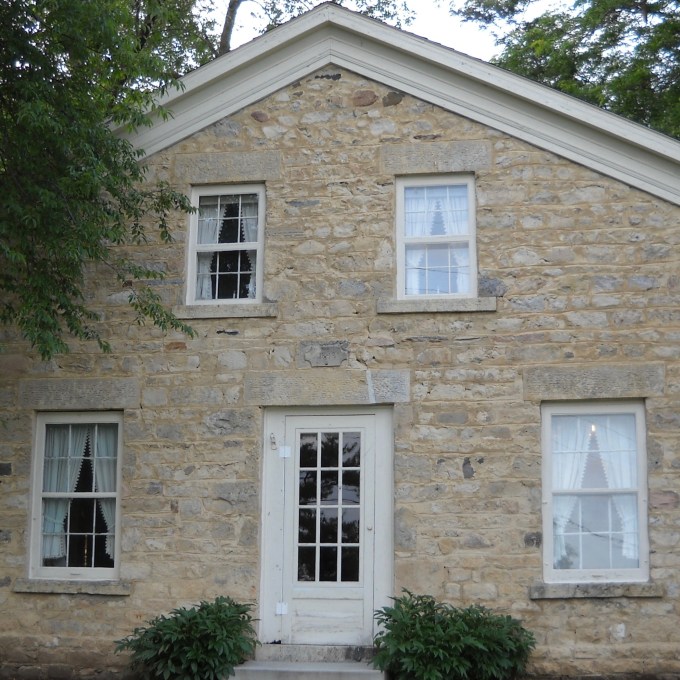
CLARK, Jonathan house square crop  July,  2015

Jonathan Clark House, Mequon, Wisconsin, July, 2015. Photograph by Reed Perkins

Where are we? Well, if you’re looking at this handsome stone house in real life, you’re standing by the front door of the Jonathan Clark House Museum, looking northward. On a modern map you can find it at 13615 N. Cedarburg Road—on the intersection with Bonniwell Road—Mequon, Wisconsin. If you’d like to visit the museum, click here for more info.

But “Where are we?” is never a simple question when it comes to historic places, because the answer often changes over time. Along with “Where are we?” we need to ask “When are we?” The answer to “Where are we?” is surprisingly varied—and useful for further research—throughout the lives of Jonathan and Mary Clark.

Continue reading