Home Sweet Home., ca. 1876. [New York: publisher not transcribed]. Library of Congress.
One of the first and most important tasks for any settlers arriving in the recently “opened-for-settlement” Wisconsin Territory was to create some sort of dwelling to shelter themselves as they carved out new farmsteads amid the dense hardwood forests. But what sort of quickly-built structures did our immigrants first construct and take shelter in?
Obviously, the big, stone, full-basement, two-story, Greek Revival style Jonathan Clark House, with its “1848” inscription carved over the front door, and its many double-hung sash windows, was not a hastily-made “first shelter” for newlyweds Jonathan and Mary (Turck) Clark. They must have had another, smaller, first home. What was that first home like? Until now we have assumed that the Clarks’ first home was probably a log cabin, and not some kind of “shanty,” but we didn’t really know. In today’s post, we share with you a recently discovered document that—I believe—solves this mystery once and for all…
We’re coming up on the tenth (!) anniversary of Clark House Historian, and I realize that in those ten years I have not yet written about all of Mary (Turck) Clark’s immediate family. Regular readers will recall that the Vermont and/or Canadian ancestry of Mary’s husband Jonathan M. Clark remains, in spite of our best efforts, mysterious and—so far—mostly unknown. But we actually know a lot about Mary Clark’s people, the Peter Turck family, including her seven siblings. Over the years I’ve blogged a bit about Mary’s oldest sibling, Joseph R. Turck, and her youngest, brother Benjamin Turck. I think it’s about time I started to write about Mary Clark’s other brothers and sisters, beginning with younger sister Elizabeth Turck, later Mrs. Densmore Maxon.
Elizabeth Turck Maxon’s memoir
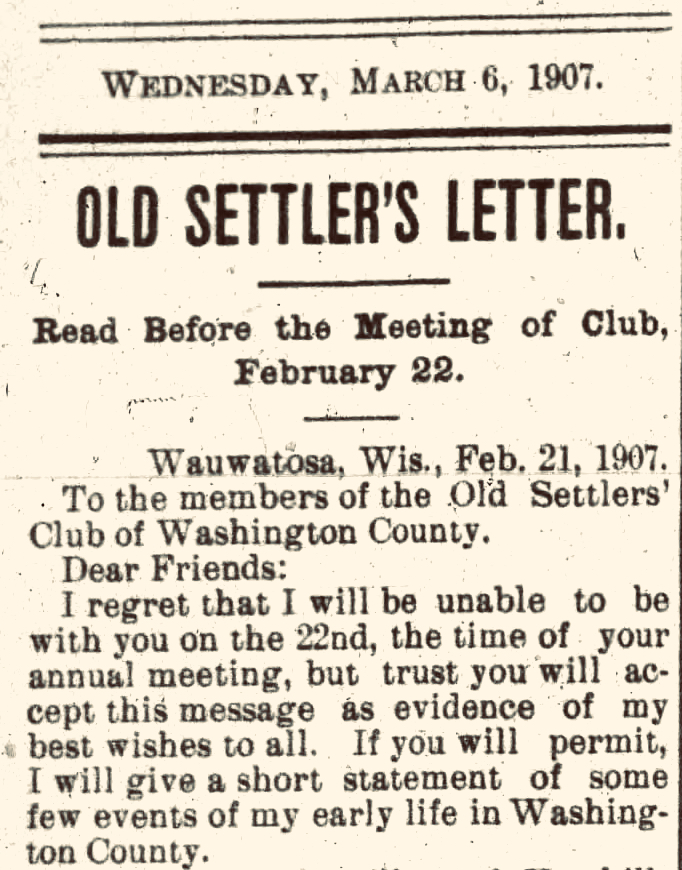
A memoir from the Turck family, even a short one, would be a substantial addition to what we know about the family and the events of their pioneer lives. In 1907, near the end of her long and productive life, Elizabeth Turck Maxon wrote down some of her recollections of early days in the area, in the form of a letter to the Old Settler’s Club of Washington County, Wisconsin.
When that 1907 letter was new, some—but not all—of its contents were published in various Wisconsin newspapers. In 1912, editor Carl Quickert included his selection of “the most interesting passages” from Elizabeth’s letter on pages 64-65 of his book Washington County Wisconsin Past and Present, Vol 1 (Chicago, S.J. Clarke Publishing Co., 1912).
In all the various 1907 newspaper editions, and in Quickert’s 1912 history, the omitted passages were usually noted with three asterisks, like this * * * This was typical editorial practice for the time. But, of course, those asterisks piqued my interest. What had been cut? What additional things might Elizabeth’s full text tell us about the early days in old Washington/Ozaukee county?
Old Settler’s Letter, 1907
I spent over a decade looking for Elizabeth’s unabridged, original, text and I think I finally found it. It was published on page 4 of the West Bend [WI] News of March 6, 1907. It’s a long letter, a full column of text, beginning with Elizabeth’s salutation to the members of the club, dated February 21, 1907.
The greetings are followed by the main text, beginning with her birth information and the story of the Peter Turck family’s migration from New York state to Wisconsin Territory in 1837. Below is the unabridged text (in the grey text boxes), interspersed with paragraph headers and my comments in plain type. FYI, I have blogged previously about a number of the events and characters in Elizabeth’s letter here on CHH, and have added links to some of those posts. Be sure to click the links for more information, and some interesting illustrations and maps.
We’re having some very cold weather this weekend, not unusual for Wisconsin in mid-winter. But it got me thinking, wondering what sort of winter weather did the Clarks and Turcks and Bonniwells experience, and what effect the did the cold have on their daily lives?
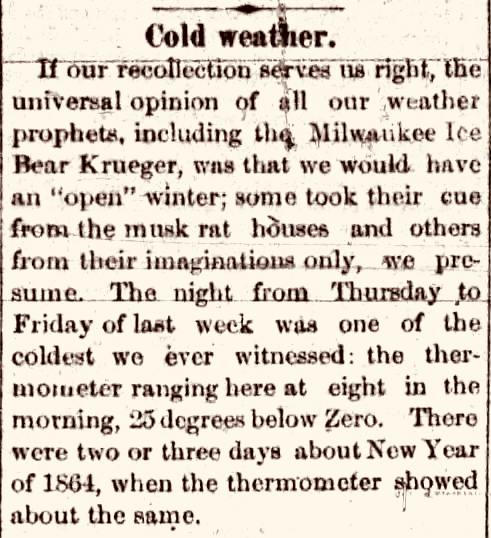
To find out, I started by searching digitized old newspapers, looking for the phrase “below zero,” in Wisconsin, between the years 1833-1899. Oh boy, did I get results! After narrowing my search to more local sources, I found this news item on page 2 of the Wednesday, January 2, 1884 issue of the Cedarburg News:
This article suggests that the winter of 1883-1884 was expected to be somewhat mild; an “open” winter was one with little or no snow cover on the ground. All the signs and predictions thought this would be the case. Apparently, the local muskrats had built their houses differently in 1883, as muskrats do when they expect a milder winter. The “universal opinion” of the “local weather prophets”—including Milwaukee’s famed “Ice Bear,” Henry Kroeger—thought so, too. But on the night of December 28-29, 1883, the thermometers in Cedarburg—just a few miles from the old Jonathan Clark farm—dropped to 25 degrees below zero (Farenheit). It was the coldest morning in decades.
But by the 1880s many of the older members of the Clark, Turck, and Bonniwell families had died, and many of the younger generation had left Ozaukee county and relocated to Milwaukee, Chicago, Minnesota, and elsewhere. Some or most of them may have missed this late-1883 cold snap. But this short article also mentions another, similar record cold spell, one that Mary Turck Clark and her children actually lived through, in Milwaukee, around the New Year of 1864.
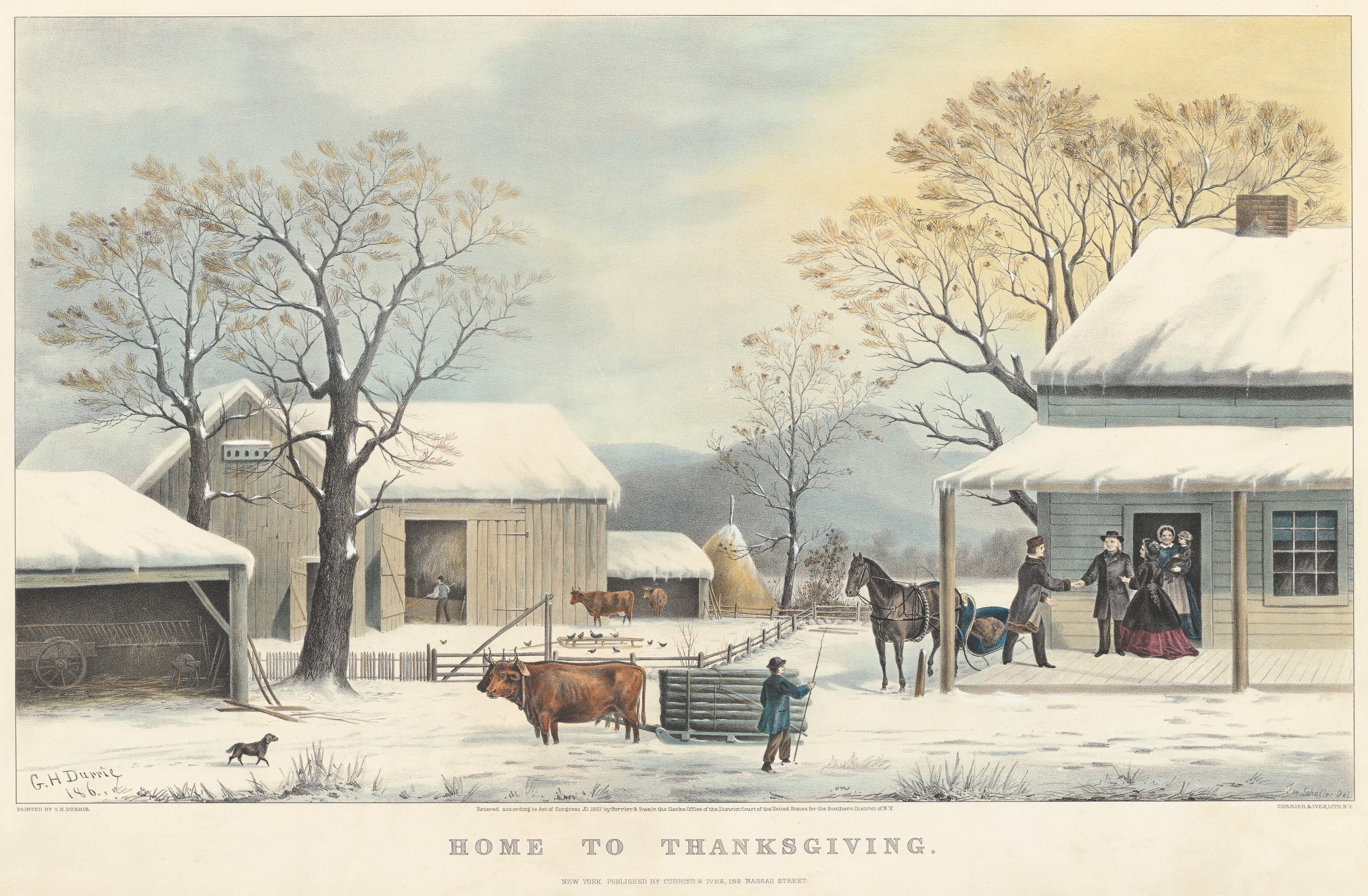
Tomorrow is Thanksgiving. To celebrate the holiday, I thought I’d reprint a lightly revised version of our now-annual CHH Thanksgiving post, to share with you a few vintage recipes and a nice Currier & Ives lithograph from the period.1
Thanksgiving, 1867
Durrie, George H. and John Schutler, Home to Thanksgiving, ca. 1867, New York, Currier & Ives. National Gallery of Art, Collection of Mr. and Mrs. Paul Mellon. Public Domain. Click to to open larger image in a new window.
By 1867, when this sentimental lithograph was first published, the Clark family had been living in the City of Milwaukee’s seventh ward for about six years. Family patriarch Jonathan M. Clark had died a decade earlier, and his only son, Henry M. Clark, had been gone for about a year and a half. Family matriarch Mary (Turck) Clark was living in a house in Milwaukee with her unmarried daughters, Libbie, Persie, Theresa, Laura, Josie and Jennie.
The American War of Independence began 250 years ago, more than half a century before the forced removal of Wisconsin’s original native peoples and the beginnings of large-scale, government-sponsored, white settlement in the Wisconsin Territory of the 1830s.
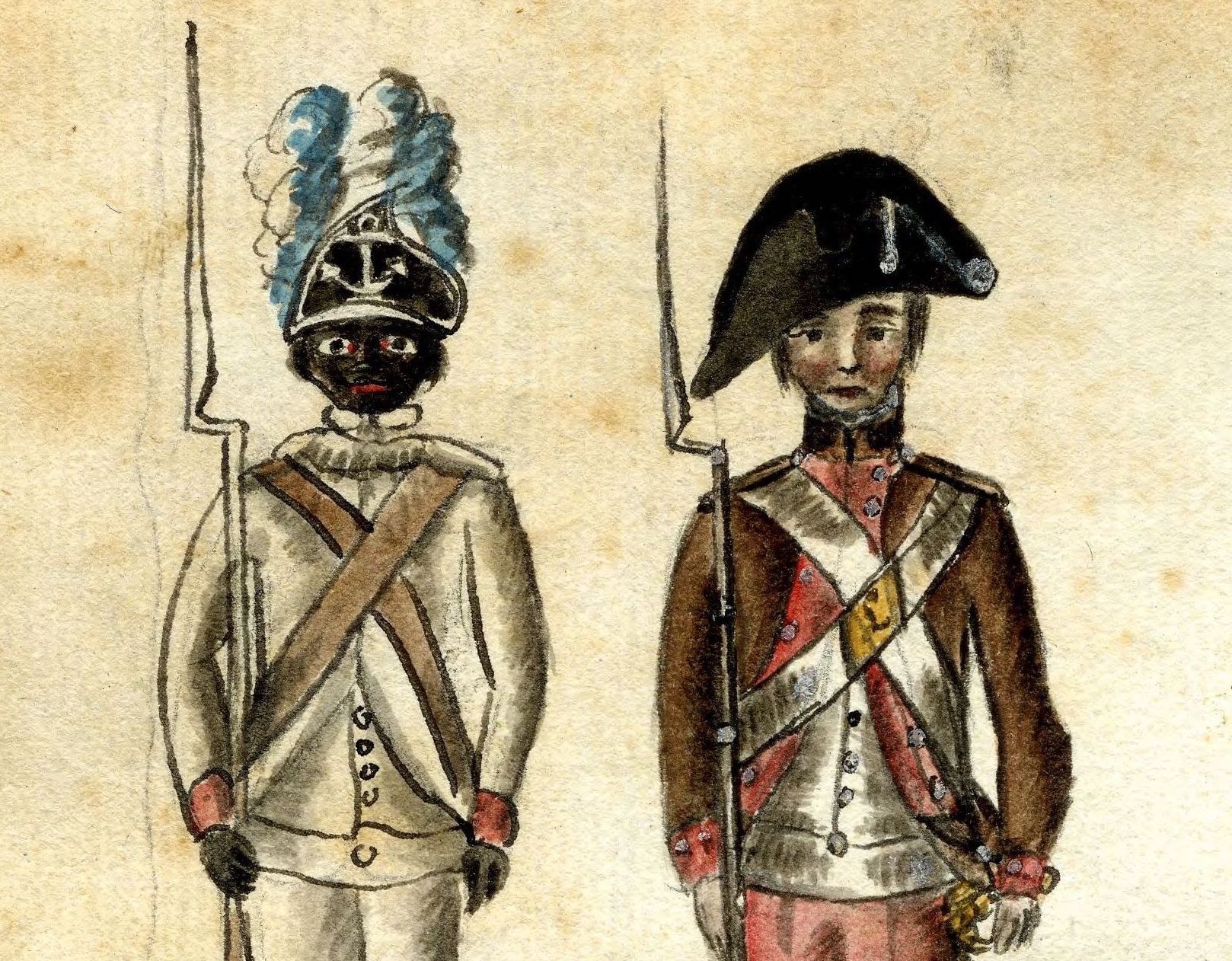
Verger, Jean Baptiste Antoine De, artist, [Soldiers in Uniform], 1781 (detail). The soldier on the right was a New England militiaman, one of many New Englanders (including, we believe, Jonathan Clark’s kin) that fought for the Patriot cause. More on this image, below.
PBS is commemorating the big anniversary by sponsoring and broadcasting “The American Revolution,” a six-part, 12-hour documentary film by Ken Burns and company, exploring the roots of the conflict, the military and diplomatic progress of the war, and the contributions to, and effects of, the war on its many military and civilian participants, including white, Black, and Native American men and women, both Loyalists & Patriots.
I’ve seen the first four episodes and found them lively, interesting, informative, and sometimes deeply moving. I’m no expert on the Revolutionary era, but I know quite a bit, and I find the series includes all the “important” events and persons that one would expect, along with all kinds of nuance and detail which are new to me.
It’s an excellent documentary, well worth your time, and is currently streaming—for free—on PBS.org. And in case you are wondering: yes, there are many topics in this Revolutionary War documentary that connect to, and later influence, the lives many of the early Mequon settler families, including the Clark and Turck families. In particular, be sure to watch the whole first episode, a clear and detailed explanation of the complex background and causes of the fight for American independence.
Veterans Day is today. For a perspective on the day—and our early Mequon veterans—here’s a post originally published at Clark House Historian on November 11, 2016, and revised, expanded and republished several times since.
Armistice Day — Veterans Day
One hundred and seven years ago today, at the eleventh hour, of the eleventh day, of the eleventh month—Paris time—the Armistice of Compiègne took effect, officially ending the fighting on the Western Front and marking the end of World War I, the optimistically named “War to End All Wars.”
In the United States, the commemoration of the war dead and the Allied victory began in 1919 as Armistice Day, by proclamation of President Woodrow Wilson. Congress created Armistice Day as a legal holiday in 1938. Starting in 1945, a World War II veteran named Raymond Weeks proposed that the commemorations of November 11 be expanded to celebrate all veterans, living and dead. In 1954 Congress and President Eisenhower made that idea official, and this is what we commemorate today. There are many veterans with a connection to the Jonathan Clark house. We honor a few of them in this post.
114th Regimental Reunion, May 30, 1897, Norwich, N. Y., Library of Congress [cropped and adjusted]. Many Clark neighbors served during the Civil War, and many remained active in the Grand Army of the Republic, the national organization for Union Army veterans, including these men from rural New York, gathered together in 1897.
I am saddened to report that my dear friend and fellow Clark & Turck family researcher and descendant Elizabeth “Liz” Alice (Wenger) Hickman has died, at home with her family, at the age of 81.
A life well lived.
Her family has posted a lovely obituary online and it’s worth reading. It not only reviews Liz’s personal and professional achievements—and they were many—it also manages to give the reader a good sense of her lively, intelligent, and fun personality. These two excerpts were particularly good at capturing Liz as I knew her:
Liz was a woman of determination and unmatched work ethic, whose approach to life was reflected in her annual back-to-school advice to her daughters to “sit in the front row and ask lots of questions.”
[…]With an unquenchable thirst for knowledge, Liz read widely, was a passionate follower of current events, a collector of recipes, and a world traveler. She was keenly interested in technology, and often one of the earliest adopters in her family of any new technology or gadget.
Cousin Liz
Her obituary also recalls that “in retirement, Liz enjoyed genealogy, especially as it allowed her to find ‘new’ cousins and expand the family.” In 2012 it was my good fortune to become one of Liz’s newly-discovered cousins. Liz had noticed some of my early online corrections and additions to Turck and Clark documents and sources, and then contacted me through a genealogy message board. We exchanged emails and began to collaborate, and in no time we formed a happy and productive relationship as researchers and as kin.
UPDATE: This was supposed to go out on Monday. I hit “publish” before the piece was ready. Here’s the updated 2025 version for your reading enjoyment. Sorry for any confusion (and, for you CHH subscribers, the premature email in your inbox).
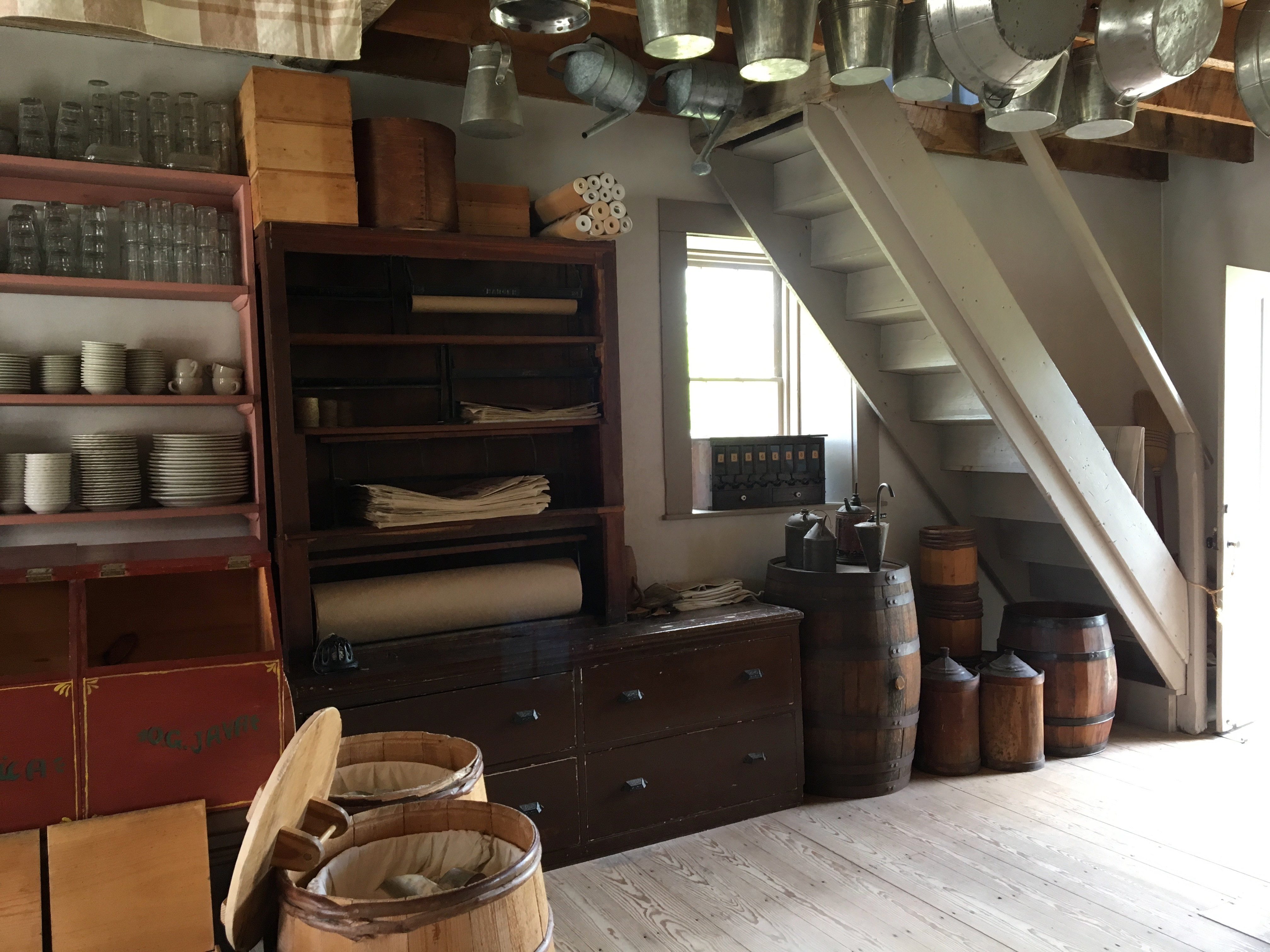
Monday, September 1st, is Labor Day, the holiday celebrating the working men and women of our nation, and I thought I’d commemorate the day with a lightly-revised re-post of this CHH piece from 2023. This Labor Day, as in 2023, I have to work a shift at our local mercantile establishment. You know, a store kind of like this one, only much bigger, stocked with just about anything you need for modern living:
Like many Americans, I don’t have the day “off” on Monday, and won’t be marching in a parade, but I’d still like to honor the holiday and salute the American worker, past and present. With that in mind, let’s revisit some of the nineteenth-century occupations we’ve talked about previously at Clark House Historian, highlighting a few of the many skills, trades, and occupations common during the Clark House era.
Since it is a holiday, I’m not going to add long commentaries to each photo. Enjoy the photo galleries, and be sure to click each gallery—and photo—to open and peruse larger versions of each image. And click the highlighted links to visit the original CHH posts, filled with lots more information about the different skills, tools, and jobs, and the full image credits.
Our annual Memorial Day post, first published in 2020, more relevant with each passing year.
Graves of Unknown Union Soldiers, Memphis National Cemetery, photo by Clayton B. Fraser, (Library of Congress), public domain. Memphis National Cemetery is the final resting place of Mequon’s Watson Peter Woodworth, and almost 14,000 of his Union Army comrades.
Today is the day our nation officially observes Memorial Day. For many Americans, Memorial Day represents “the first day of summer,” and is traditionally celebrated with trips to the lake, picnics, parades, and sales on cars, appliances, and other consumer goods.
But for many of us, Memorial Day remains rooted in its origins as Decoration Day. The first national observance was in 1868, when retired general John A. Logan, commander and chief of the Grand Army of the Republic—the Union veterans’ organization—issued his General Order Number 11, designating May 30 as a memorial day “for the purpose of strewing with flowers or otherwise decorating the graves of comrades who died in defense of their country during the late rebellion, and whose bodies now lie in almost every city, village, and hamlet churchyard in the land.”
On this Memorial Day, let’s take a moment to remember what this day truly represents.
Howdy! Sorry for the long blog silence. It’s not that I’m lacking for topics or material to share with you all, but I’ve been busy “behind the scenes” at the Clark House for the last month or so.
In particular, I’ve been working on two big projects. JCH executive director Nina Look and I have just published the Spring | May 2025 issue of the JCH Newsletter, and Nina and I have been collaborating with JCH intern Nicole Buerosse on a major, archival-quality upgrade for the preservation and display of the museum’s irreplaceable Bonniwell Family Bible.
Scaffolding at the Clark House? What’s up with that? Read on for more info…




 Clark House Historian