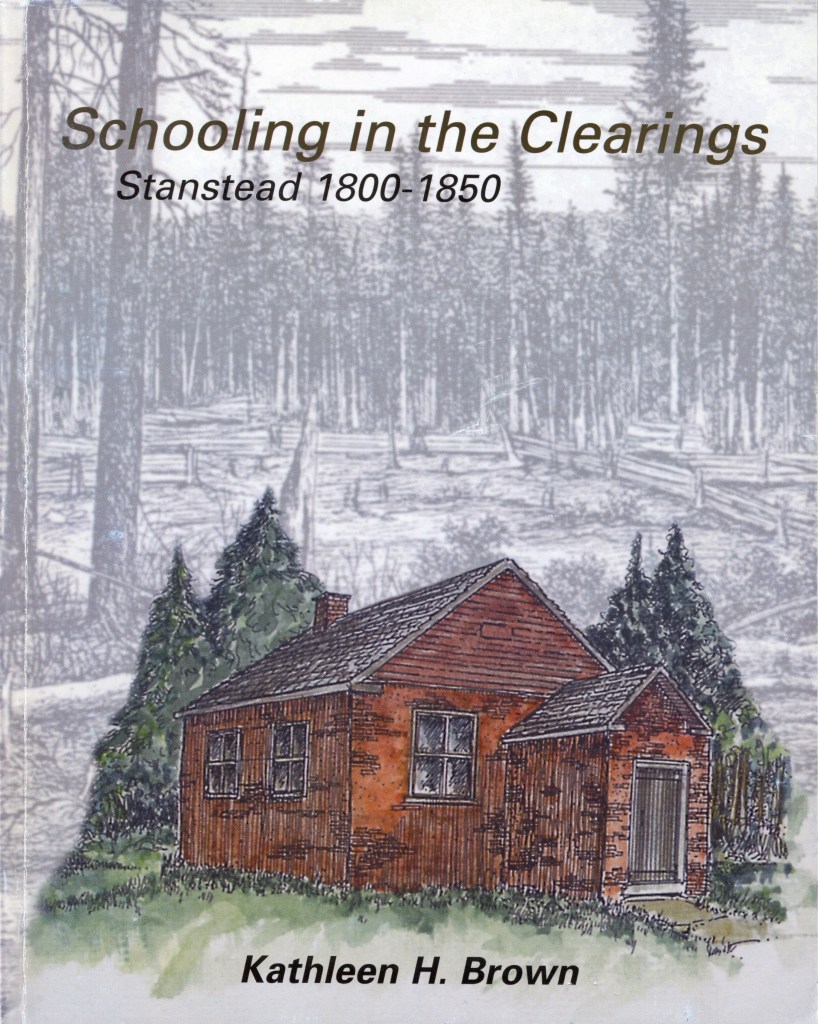
I hope you liked our recent re-post of Back to School, 1839! And since I’m still working on a number of new but not-yet-ready projects, I thought you might also enjoy a revised and expanded version of a related post that was first published September 2, 2020.
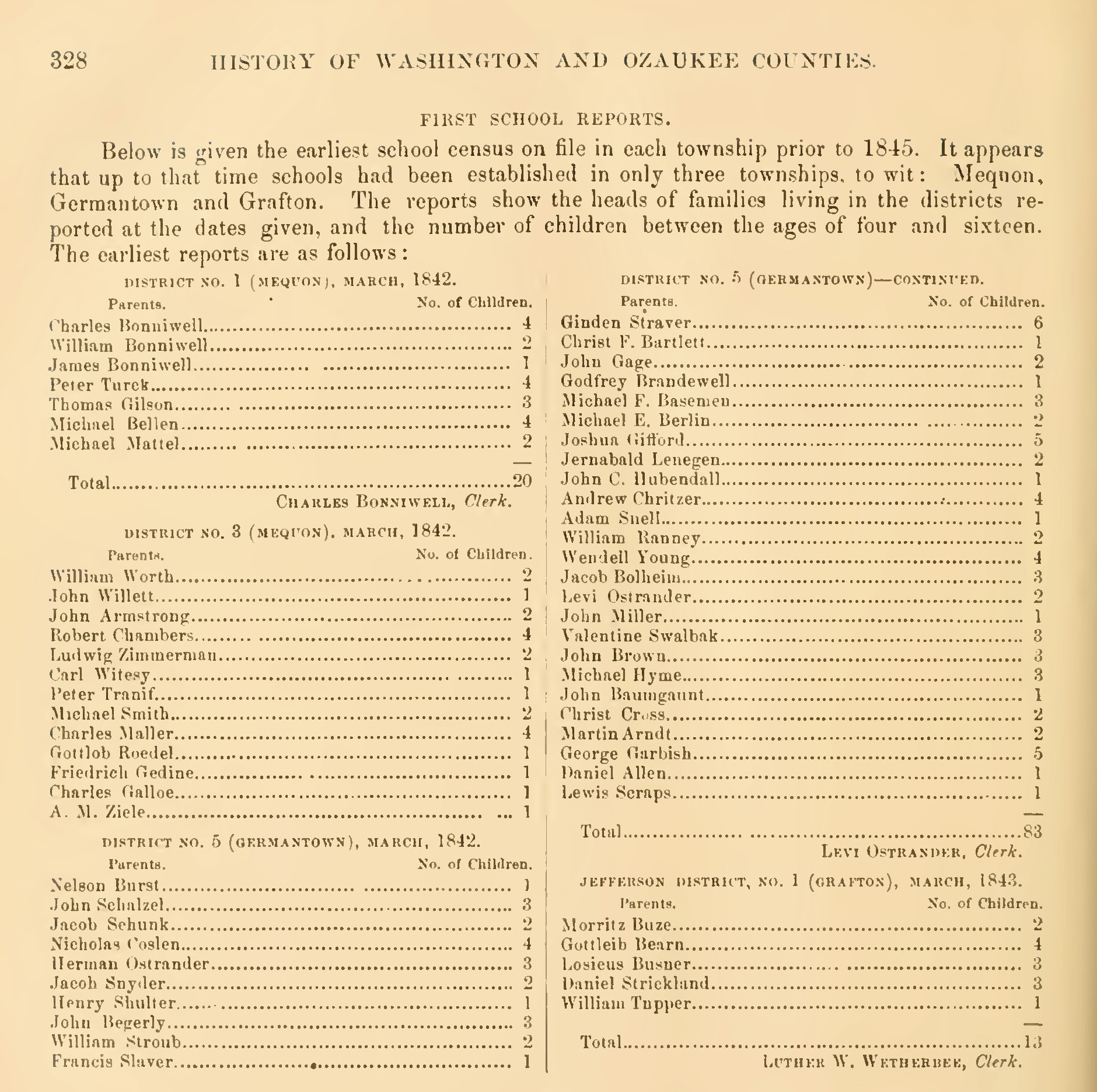
It’s “Back to School” time for many of us, so I thought you might be interested in this transcription of the earliest known school records of old Washington/Ozaukee county prior to 1845, published on page 328 of the History of Washington and Ozaukee Counties, Wisconsin […] Illustrated. Western Historical Co., Chicago, 1881:
Click to open a larger image in a new window, and see which of the early settler families had school age children, that is, children between the ages of 4 and 16, in 1842 and 1843. (Current Washington and Ozaukee county readers: do you have any kin listed in this summary of early school censuses? Let us hear from you via the Leave a Reply box, below.)
I’m still tied up with other projects, so I thought you might enjoy a repeat of this seasonal post from last May. I’ll be back soon with new Clark House history.
It’s mid-May in southeastern Wisconsin, and with luck the last frost is behind us. For the past weeks and months farmers and gardeners have been tending to the soil and preparing for planting. At this time of year in the 1840s and ’50s, Jonathan M. Clark would have done much the same, hitching up his team of oxen to a steel-bladed plow to cut and turn over the tough prairie grasses and break up the soil of his newly-cleared lands.
When the extended Bonniwell family arrived in Wisconsin Territory in May, 1839, youngest son Alfred T. Bonniwell was not quite two months past his 13th birthday, and his brother Walter was only two years older. Because of their youth, neither Alfred nor Walter were able join their mother and brothers as they purchased government land and established what became known as Mequon’s Bonniwell Settlement.1
That changed for Alfred on June 7, 1845, when his mother, Eleanor (Hills Bonniwell) Hyde, gave him the eastern 80 acres of her original federal land patent.
Hyde, Eleanor (grantor) to A. T. Bonniwell (grantee), deed for 80 acres, June 7, 1845. See note 2 for source and details. Click to open larger image in new window.
Alfred would buy and sell several other properties in the 1850s and ’60s, but he held on to this parcel until his death, fifty years later. Let’s see what he got…
Today’s post in our Bonniwell document series1 focuses on one important item, Alfred T. Bonniwell’s Petition for Naturalization as a United States citizen, completed in Milwaukee, at the U.S. District Court for the District of Wisconsin, November 6, 1849.
Bonniwell, Alfred, Petition for Naturalization 6 Nov 1849; for full citation see note 2, below. Click to open larger image in new window.
This petition was the final step in a relatively simple citizenship process whose basic outlines had not changed much since the early days of the republic. Alfred T. Bonniwell’s 1849 citizenship petition follows a form typical of such documents, but has a few extra bits of information that are particular to his immigration story. Let’s take a closer look.
Continuing our look at the life of Alfred Bonniwell, today’s post focuses on two documents, the Wisconsin territorial censuses of 1846 and 1847. We’ll take a close look at the Bonniwell families as enumerated on the Wisconsin territorial census of 1846, and discuss briefly the status of the 1847 census schedules for old Washington/Ozaukee county.1
The Wisconsin Territorial census of 1846:
The next Wisconsin territorial census after 1842 was officially enumerated on June 1, 1846. The record of Mequon’s various Bonniwell families begins on the third line of page 43 of the Washington county schedules:
For full citation, see note 2, below; image lightly tinted. Click to open larger image in new window.
For our purposes today, the key “heads of families” and their households begin on line 3. They are the households of:
We see that by mid-1846 there were seven Bonniwell family households in Mequon’s “Bonniwell Settlement.” Five were headed by Bonniwell sons: William T., Charles, James, George and Henry, and another by Bonniwell brother-in-law Philip Moss. And Matriarch Eleanor (Hills Bonniwell) Hyde still led her own substantial household.
Who’s who in 1846?
As we noted in our discussion of the 1842 territorial census, identifying “who’s who?” in each family takes some guesswork, and the identifications are never 100% certain. But let’s try and make some educated guesses about who is living with whom in each of the 1846 Bonniwell family households. Let’s start with the families of the Bonniwell sons:
Continuing on with our series of Alfred Bonniwell documents, today’s post looks at one of two censuses that (probably) record Alfred Bonniwell in Wisconsin Territory between the federal decennial censuses of 1840 and 1850. If you need to catch up, our previous installments are here, here, here, here and here. UPDATED May 22, 2022, to correct Charles Bonniwell, Sr.’s birth year to 1806
The Wisconsin territorial census of 1842
For background on the 1842 Wisconsin territorial census, its enumeration in old Washington/Ozaukee county, and its relation to the Clark, Turck and Bonniwell families and their neighbors, you’ll want to read Census Records for the In-Between Years: 1842.1
The official enumeration date for this census was June 1, 1842; the enumeration of old Washington county—still attached to Milwaukee County for legal purposes—was done by Levi Ostrander and officially completed on July 1, 1842. Here’s page 65 of that census. The extended Bonniwell family—and some of their notable neighbors—are circled in red.2
Full source details in note 2, below. Click to open larger image in new window.
Let’s take a closer look at each of these families and try and understand which Bonniwells were living where, in Mequon, in mid-summer, 1842…
Today’s post is another installment in our new series about the life of Alfred Bonniwell, youngest son of Mequon’s Bonniwell family, and brother-in-law of Jonathan and Mary (Turck) Clark. If you missed them, our first installments are here and here. Although I—and others—have written quite a bit about the Bonniwells in Mequon, Alfred and his family have remained something of a mystery. It’s time to try and fix that. So for the next few posts our focus will be on Alfred Bonniwell, his life and descendants, as described in contemporary documents.
Alfred Bonniwell’s earliest record
The earliest record of Alfred Bonniwell that I have seen is an index of his 1826 baptism.1 It includes this information:
Name: Alfred Febbett Bonniwell Christening Date: 7 May 1826 Christening Place: St. Mary’s, Chatham, Kent, England Father’s Name: William Bonniwell Mother’s Name Eleanor Bonniwell
Other, later, records indicate that Alfred was born on April 1, 1826. A baptism in the following month or so—such as on May 7th, 1826—would be pretty typical for Anglican parish baptisms of the period. So the date, as well as the names of the parents, are consistent with what we already knew about Mequon’s Alfred Bonniwell.
UPDATED 16 July 2022, to correct typo in Alfred’s death year. Correct year is 1895.
At last month’s annual meeting of the Friends of the Jonathan Clark House, assistant director Nina Look mentioned that she had some sort of research project coming later this year, involving the youngest Bonniwell brother, Alfred T. Bonniwell (1826-1895). I’m not quite sure what Nina’s project will focus on, but Alfred is, perhaps, the least-known Bonniwell, and deserves further study.
As a Bonniwell brother, Alfred plays his part in the establishment of one of Mequon’s first cleared and populated areas, the Bonniwell Settlement. The Clark house—and Clark family—played an important role in the early decades of this settlement, and the history of the Clark family is intimately tied up with their neighbors, the Bonniwells. How intimately?
We’ve mentioned Whitehall, New York, on several occasions. Located just east of the south end of Lake Champlain, the town of Whitehall has long claimed to be the “Birthplace of the U.S. Navy.” More importantly for our story, in 1823 Whitehall became the northern terminus of the Champlain Canal, connecting the Hudson River and the Erie Canal to Lake Champlain and points further north.1
Port of Entry
More importantly for our story, Whitehall served as an international port of entry for immigrants coming to New York and New England from Canada and overseas via the St. Lawrence River and Lake Champlain. In the early 1830s, these immigrants included Jonathan M. Clark, who came from Lower Canada in April, 1831,2 and the entire Bonniwell family, who arrived the following year.3
What did our immigrants of 1831 and ’32 see just before they stepped ashore in the United States? The hustle and bustle of a major harbor and center of commerce such as New York, Boston or Philadelphia? Er, no. Instead, this is what greeted our intrepid newcomers:
Whitehall, Lake Champlain
Milbert, Jacques Gerard, Amerique Septentrionale – Etat de New-York. N. 21, pl. 1…White Hall, Lake Champlain, Lithograph by Bichebois and Adam, Paris, 1828–1829. Yale Art Gallery, Mabel Brady Garvan Collection. Public Domain. Click to open larger image in new window.
Veterans Day is today. I’m preparing a new post on one of our Clark House veterans, Mary (Turck) Clark’s youngest sibling, Benjamin Turck (1839-1926), but it’s not quite ready yet. For a wider perspective on the day—and our early Mequon veterans—here’s a post originally published at Clark House Historian on November 11, 2016, and revised, expanded and republished on November 11, 2020. I’ve also incorporated a list of Mequon’s Civil War soldiers, originally published here on May 24, 2020.
Armistice Day
One hundred and three years ago, on the eleventh day, of the eleventh month, at the eleventh hour—Paris time—the Armistice of Compiègne took effect, officially ending the fighting on the Western Front and marking the end of World War I, the optimistically named “War to End All Wars.”
In the United States, the commemoration of the war dead and the Allied victory began in 1919 as Armistice Day, by proclamation of President Woodrow Wilson. Congress created Armistice Day as a legal holiday in 1938. Starting in 1945, a World War II veteran named Raymond Weeks proposed that the commemorations of November 11 be expanded to celebrate all veterans, living and dead. In 1954 Congress and President Eisenhower made that idea official, and this is what we commemorate today. There are many veterans with a connection to the Jonathan Clark house. We honor a few of them in this post.
Jonathan Clark, Henry Clark, and the U.S. Army
Jonathan M. Clark (1812-1857) enlisted as a Private in Company K, Fifth Regiment of the U. S. Army, and served at Ft. Howard, Michigan (later Wisconsin) Territory, from 1833 until mustering out, as Sargent Jonathan M. Clark, in 1836. In the 1830s, Fort Howard was on the nation’s northwestern frontier. JMC’s Co. K spent much of the summers of 1835 and 1836 cutting the military road across Wisconsin, from Ft. Howard toward Ft. Winnebago, near modern Portage, Wisconsin.
Fort Howard, Wisconsin Territory, circa 1855, from Marryat, Frederick, and State Historical Society Of Wisconsin. “An English officer’s description of Wisconsin in 1837.” Madison: Democrat Printing Company, State Printers, 1898. Library of Congress. Click to open larger image in new window.